Medical Disclaimer: This article is for informational purposes only and does not constitute medical advice. CoQ10 supplements may interact with blood thinners and other medications. If you have heart disease, take statins, or manage any chronic condition, consult your physician before starting CoQ10.
CoQ10 for Heart Health: The Complete 2026 Guide
Why Richard Started Asking Questions About His Energy
Richard, 67, had been on a statin medication for high cholesterol for about four years. His numbers were good — his cardiologist was pleased — but Richard wasn't pleased. He had been an active man, walking five miles a day and gardening on weekends, but over the past two years he'd developed persistent muscle aches and a fatigue that felt different from normal tiredness. Not sleepy-tired. Heavy-tired. Like his legs were working against resistance that wasn't there before.
He mentioned it to his doctor, who noted that muscle-related side effects are among the most common complaints with statin therapy and that CoQ10 depletion is a well-established mechanism — statins block the same metabolic pathway the body uses to make CoQ10 as well as cholesterol. His doctor was careful to say the evidence on CoQ10 supplementation for statin-related myopathy is mixed, but given how common CoQ10 deficiency is in statin users and how safe the supplement is at standard doses, supplementing was a reasonable trial. Richard started 200 mg of ubiquinol daily. Within six weeks, the heaviness in his legs had eased considerably, and he was back to his regular walking routine.
Richard's story is one of millions. CoQ10 is one of the most widely used supplements by adults over 50, and for good reason — its roles in heart function, energy metabolism, and antioxidant defense are among the best-documented of any supplement on the market. Explore CoQ10 supplements at AllCare Store's Vitamins & Supplements collection.
What Is CoQ10?
Coenzyme Q10 — also called CoQ10, ubiquinone, or ubiquinol (its active, reduced form) — is a fat-soluble compound synthesized naturally in the body. It is present in virtually every cell, with the highest concentrations in organs that have the greatest energy demands: the heart, liver, kidneys, and skeletal muscles. CoQ10's primary roles are:
- ATP production: CoQ10 is an essential component of the mitochondrial electron transport chain, the process by which cells convert nutrients into ATP (adenosine triphosphate), the body's primary energy currency. Without CoQ10, this process cannot function efficiently.
- Antioxidant defense: In its reduced form (ubiquinol), CoQ10 is one of the body's most potent fat-soluble antioxidants. It neutralizes free radicals in cell membranes and mitochondria, protecting tissues from oxidative damage.
- Cell membrane stability: CoQ10 helps maintain the structural integrity of cell membranes, supporting overall cellular function.
The body produces CoQ10 naturally, but production declines significantly with age — typically beginning in the mid-30s and decreasing steadily thereafter. By the time a person reaches their 60s or 70s, CoQ10 levels may be 50% lower than they were in early adulthood. Certain medications — most notably statins — further deplete CoQ10 by blocking the biosynthetic pathway that produces it.
CoQ10 and Heart Health: What the Research Shows
The heart is the organ most dependent on CoQ10. It beats over 100,000 times per day, never resting, and requires a continuous, enormous supply of ATP. Unsurprisingly, CoQ10 concentrations in heart muscle are among the highest in the body — and patients with heart failure and other forms of cardiovascular disease consistently show lower CoQ10 levels than healthy individuals of the same age.
Heart Failure (Congestive Heart Failure)
The most compelling clinical evidence for CoQ10 involves heart failure. The landmark Q-SYMBIO trial, a randomized, double-blind, placebo-controlled study published in JACC: Heart Failure, found that patients with chronic heart failure who received CoQ10 (300 mg/day) for two years had significantly lower rates of major adverse cardiovascular events, including cardiovascular deaths, compared to those receiving placebo. This was a meaningful clinical outcome, not just a surrogate marker. The researchers proposed that CoQ10 supplementation essentially replaces a deficiency that develops in failing heart muscle, allowing it to produce energy more efficiently.
Blood Pressure
Multiple meta-analyses of randomized controlled trials have found that CoQ10 supplementation produces modest but statistically significant reductions in systolic and diastolic blood pressure — on the order of 11 mmHg systolic and 7 mmHg diastolic in hypertensive patients. While CoQ10 alone is not a replacement for antihypertensive medication, it appears to complement treatment. The proposed mechanism involves CoQ10's role in vascular endothelial function and its antioxidant effects on nitric oxide pathways that regulate vascular tone.
Statin-Associated Muscle Symptoms
Statins (atorvastatin, rosuvastatin, simvastatin, etc.) reduce CoQ10 levels by inhibiting HMG-CoA reductase — the same enzyme used in CoQ10 synthesis. The resulting CoQ10 depletion in muscle tissue is believed to be one mechanism behind statin-associated myopathy (muscle pain, weakness, and tenderness). Clinical trials on CoQ10 for statin myopathy have shown mixed results, but several have shown significant improvement in muscle pain scores, and the safety profile is excellent. Many cardiologists and pharmacists now routinely recommend CoQ10 for patients on statins who experience muscle symptoms.
Exercise Tolerance and Fatigue
CoQ10 supplementation has been shown in several studies to improve exercise performance and reduce exercise-induced oxidative stress in both athletes and older adults with heart disease. Improvements in peak oxygen consumption and reduction in fatigue scores have been documented, particularly in patient populations with established CoQ10 deficiency.
Ubiquinone vs. Ubiquinol: Which Form Is Better?
CoQ10 exists in two forms in the body:
- Ubiquinone — the oxidized form. This is what most supplement labels read as simply "CoQ10." It is the form the body synthesizes and is widely available and generally less expensive.
- Ubiquinol — the reduced (active antioxidant) form. This is the form that actually performs CoQ10's antioxidant function in tissues. The body converts ubiquinone to ubiquinol as needed, but this conversion becomes less efficient with age.
Research suggests that ubiquinol is better absorbed — particularly in older adults — because the conversion step is already done. A 2014 study found that ubiquinol produced blood levels 3–4 times higher than an equivalent dose of ubiquinone in older subjects. For adults under 40 with healthy metabolic function, ubiquinone is likely sufficient and more cost-effective. For adults over 50, those with heart disease, or statin users, ubiquinol is generally the preferred form.
CoQ10 Dosage: How Much Do You Need?
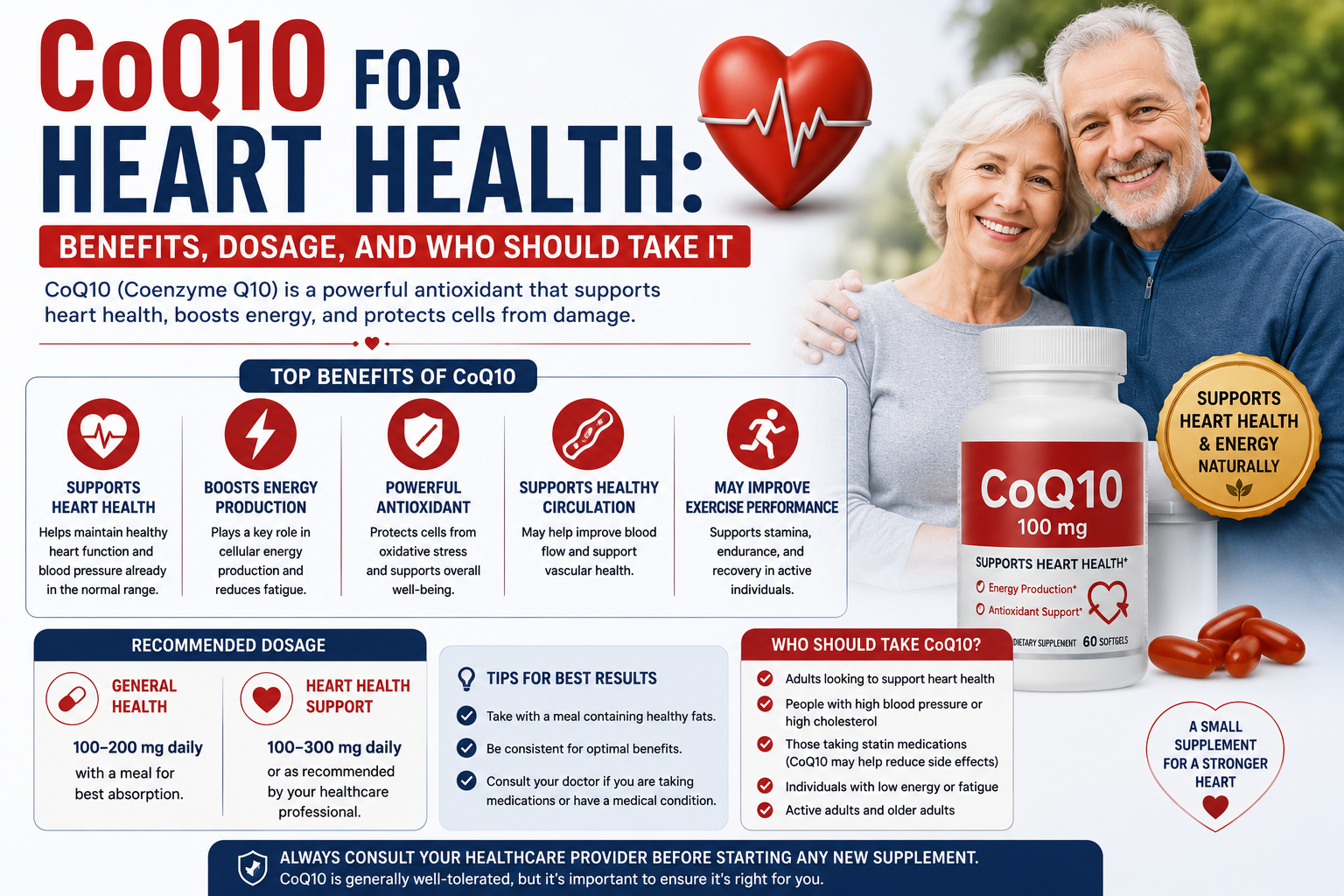
There is no established Recommended Dietary Allowance (RDA) for CoQ10. Dosing ranges used in clinical research vary by indication:
| Purpose | Typical Dose Range | Notes |
|---|---|---|
| General wellness / prevention | 100–200 mg/day | Ubiquinone is adequate for most healthy adults |
| Statin-associated muscle symptoms | 100–300 mg/day | Ubiquinol preferred; discuss with prescribing physician |
| Heart failure support | 200–400 mg/day | Used under medical supervision; Q-SYMBIO used 300 mg/day |
| Blood pressure support | 100–300 mg/day | Results typically seen after 4–12 weeks |
| Energy and exercise performance | 100–200 mg/day | Often split into two doses |
CoQ10 is fat-soluble, meaning it is best absorbed when taken with a meal containing fat (olive oil, avocado, eggs, fish, etc.). Taking it with a fatty meal can increase absorption by 3–5 times compared to taking it on an empty stomach.
Food Sources of CoQ10
CoQ10 is found in small amounts in many foods, particularly organ meats and fatty fish:
- Organ meats (heart, kidney, liver): Highest food sources — beef heart contains approximately 113 mg/kg
- Fatty fish (sardines, mackerel, herring, trout): 1–4 mg per 3 oz serving
- Beef and pork: 2–4 mg per 3 oz serving
- Chicken: 1–2 mg per 3 oz serving
- Soybeans and tofu: ~1 mg per half cup
- Nuts (peanuts, pistachios): 0.5–1 mg per ounce
- Broccoli, cauliflower, spinach: Trace amounts
The average dietary intake of CoQ10 is estimated at 3–6 mg per day — far below the 100–300 mg used in clinical trials showing benefits. Supplementation is the only practical way to achieve therapeutic levels.
Drug Interactions and Safety Considerations
CoQ10 is generally very well tolerated. The most common side effects at higher doses are mild gastrointestinal symptoms (nausea, stomach discomfort) that typically resolve with dose adjustment or taking the supplement with food. Important interactions include:
- Warfarin (Coumadin): CoQ10 has a chemical structure similar to vitamin K and may reduce the blood-thinning effect of warfarin. If you take warfarin, do not start CoQ10 without consulting your physician — your INR should be monitored closely.
- Statins: CoQ10 does not interfere with the cholesterol-lowering effect of statins; it is taken to address the CoQ10 depletion caused by statins.
- Blood pressure medications: CoQ10's modest blood pressure-lowering effects are generally additive rather than problematic, but people on antihypertensives should monitor blood pressure when starting CoQ10.
- Chemotherapy drugs: CoQ10's antioxidant activity may potentially interfere with certain chemotherapy agents. Cancer patients should consult their oncologist before supplementing.
Who Should Consider CoQ10?
CoQ10 is particularly relevant for:
- Adults over 50: Natural production declines significantly with age
- People taking statins: Cholesterol medications deplete CoQ10 through shared biosynthetic pathways
- People with heart disease or heart failure: Cardiac tissue CoQ10 levels are consistently low in these populations
- People with high blood pressure: Modest antihypertensive benefit in clinical trials
- People experiencing persistent fatigue or low energy: Especially if mitochondrial function may be compromised
- Migraine sufferers: CoQ10 has shown benefit in migraine prevention in several clinical trials (typically 300–400 mg/day over several months)
- People with type 2 diabetes: Oxidative stress is elevated in diabetes; CoQ10 may improve glycemic markers and endothelial function
Frequently Asked Questions
How long does it take for CoQ10 to work?
Blood CoQ10 levels begin to rise within a few weeks of consistent supplementation, but meaningful clinical effects — reduced muscle pain in statin users, improved energy, or changes in cardiovascular markers — typically require 4–12 weeks of daily use. Blood pressure effects in hypertensive individuals have been observed after 4–8 weeks in clinical trials. Consistency matters: CoQ10 must be taken daily with fat to maintain adequate blood levels.
Is CoQ10 safe to take long-term?
CoQ10 has an excellent long-term safety record. Clinical trials have used doses of 100–600 mg per day for periods of up to two years without significant adverse effects. It is not associated with toxicity or organ damage at standard supplemental doses. The most common side effects are mild GI symptoms (nausea, stomach upset) at higher doses, which usually resolve by taking CoQ10 with food or splitting the dose. As with any supplement, people with serious health conditions or on multiple medications should discuss long-term use with their physician.
Should I take ubiquinone or ubiquinol?
For adults under 40 without cardiovascular disease or statin use, standard ubiquinone is adequate and more affordable. For adults over 50, statin users, or those with established cardiovascular disease, ubiquinol is generally preferred because it is better absorbed and does not require the conversion step that becomes less efficient with age. Ubiquinol is typically 1.5–2x more expensive than ubiquinone, but the improved bioavailability often makes it the better value at equivalent doses.
Can CoQ10 replace my statin medication?
No. CoQ10 does not lower LDL cholesterol or reduce cardiovascular risk in the way that statins do. CoQ10 is taken alongside statins to address CoQ10 depletion caused by statin therapy — it does not replace the medication's primary function. Never stop or reduce your statin dose without first discussing it with your prescribing physician.
Why must CoQ10 be taken with fat?
CoQ10 is a fat-soluble compound, meaning it dissolves in fat rather than water. When taken without dietary fat, absorption is very limited. Taking CoQ10 with a fat-containing meal — even just a tablespoon of olive oil, a handful of nuts, or eggs — can increase absorption 3–5 times compared to taking it on an empty stomach. Some newer CoQ10 formulations use lipid-based delivery systems (softgels with oil carriers) to improve absorption even without a meal, making them a convenient option for people who take supplements in the morning before breakfast.
Richard's Checkup
Richard has now been on CoQ10 for two and a half years. His cardiologist knows he takes it, has no objection, and noted that Richard's reported quality of life and exercise tolerance have improved markedly since his last visit. His statin dose hasn't changed. His CoQ10 has become as automatic as his morning coffee — a daily ritual that, by his account, gave him his walks back.
For a compound the body makes naturally, loses with age, and depletes further with common medications, ensuring adequate CoQ10 status is one of the more evidence-grounded steps adults over 50 can take for cardiovascular and energy health.
Browse CoQ10 supplements — including both ubiquinone and ubiquinol options — at AllCare Store's Vitamins & Supplements collection. Free shipping on qualifying orders. Questions? Call us at 1-888-889-6260 or visit AllCareStore.com.
— The AllCare Store Team