
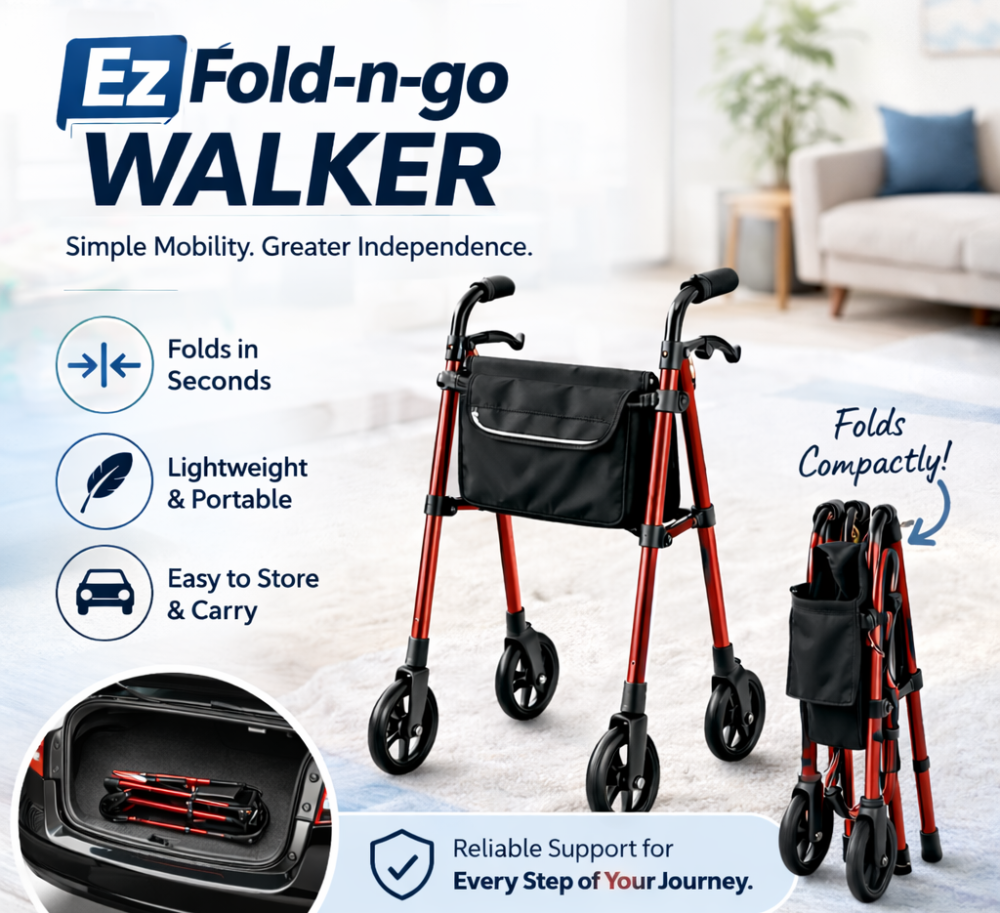
"Folds for easy storage" appears on almost every walker listing, which makes it close to useless as a way of telling models apart. Two walkers can both be described as foldable and behave completely differently in your hallway, your car boot and the back of your wardrobe. Before you pay extra for portability, it is worth knowing what folding actually gives you, what it costs, and whether you need it at all.
Three different things "foldable" can mean
Walker folding mechanisms fall into roughly three families, and they produce very different results.
- Side-to-side fold. The classic folding walker has a hinge in the cross-brace so the two side frames collapse toward each other. The walker becomes flat but stays full height and full length. It slides behind a door or between a bed and a wall, but it will not go in a suitcase.
- Compact or multi-directional fold. The frame collapses in more than one axis, so the walker becomes a short block rather than a tall flat panel. This is what makes a walker fit in a car footwell, under an aeroplane seat or in a cupboard alongside other things.
- Telescoping or removable legs. Some frames shorten as well as narrow, usually via the same push-pin holes used for height adjustment. This buys you length, which matters more than people expect when the storage space is a car boot with a high lip.
If a product page only says "foldable", look for the folded dimensions. If those are not published, ask before ordering. A walker that folds flat but stays 34 inches tall solves a different problem than one that folds into a block.
The questions that actually predict daily satisfaction
Folded size is only one of four things that decide whether a folding walker gets used or resented.
How small does it get?
Measure the space it has to live in before you shop: the depth of the hall cupboard, the height of the car boot opening, the gap beside the passenger seat. Compare those numbers to the published folded dimensions rather than to a photograph.
Can you fold it with one hand?
This is the question most buyers skip and most users care about. In real life you fold a walker while holding a car door open, holding a handbag, or steadying yourself on a door frame. A mechanism that needs two hands and a firm squeeze is fine on a shop floor and frustrating in a car park. If the user has arthritis or reduced grip strength, test the release before committing.
How heavy is it once folded?
Compact is not the same as light. You still have to lift the folded walker into a boot, over a kerb or up a step. A frame that is easy to push may still be awkward to lift, especially at shoulder height into a high-sided vehicle.
Does it stay folded and stay upright?
Some walkers stand on their own when folded; others fall over and take a lamp with them. Some spring partly open when you pick them up. If the walker will be parked beside a restaurant table or a waiting room chair, this matters more than the last inch of compactness.
Where folding genuinely pays off
- Cars. The single most common reason people upgrade. If a walker has to come out for every appointment, shop trip and family visit, a compact fold changes the whole errand.
- Small homes and flats. A rigid walker left in a narrow hallway becomes a trip hazard for everybody else. Being able to tuck it away restores the room.
- Restaurants, clinics and other people's houses. A walker that folds and leans neatly beside a chair is far less socially awkward than one that has to be parked in a walkway.
- Travel. Compact walkers are easier to gate-check or stow. Airline policies on mobility aids and cabin stowage vary, so confirm with the carrier rather than assuming a walker will fit an overhead locker.
- Shared use. If the walker moves between a home and a care setting, or between two households, folding makes the handover practical.
What folding costs you
Portability is a trade, not a free upgrade. Be honest about the other side of it.
- Fewer seats. If you need to sit down partway through a walk, you are usually looking at a rollator rather than a folding walker, and rollators that fold small tend to fold less small than a seatless frame.
- More moving parts. Hinges, catches and release buttons are things that can loosen, stiffen or wear. A rigid frame has fewer failure points.
- Cost. Compact-folding models generally sit above basic folding walkers in price for the same weight capacity.
- A daily habit. Folding and unfolding several times a day is a small physical task in itself. For someone with painful hands, that can outweigh the storage benefit.
Measure these five things before you order
- The narrowest doorway the walker must pass through, measured at the frame, not the door opening.
- The car boot opening height and the depth of the flat load area.
- The storage space at home: cupboard depth, or the clear gap where it will live.
- The user's height, so you can confirm the walker's handle-height range covers it. Standard and short or petite frames exist for a reason, and a walker that adjusts only within an adult standard range will never fit a shorter user properly.
- The user's weight against the frame's stated capacity, with a margin rather than at the limit.
Looking after a walker that folds every day
Frequent folding is the main thing that ages a walker, so a few minutes of maintenance protects both the mechanism and the user.
- Check that every leg pin or button clicks fully home after each unfold. A leg that is one hole out makes the frame rock.
- Keep hinges free of grit; wipe them after outdoor use in winter or on sand.
- Inspect glides, tips and wheels monthly. Worn tips lose grip long before they look obviously damaged.
- If a catch starts needing force, stop forcing it and have it looked at. Forcing is how hinges bend.
Do you actually need a folding walker?
If the walker never leaves the house, and there is somewhere sensible to park it, a rigid or basic folding frame is often the better value: fewer parts, lower price, and nothing to fiddle with. Folding is worth paying for when the walker regularly travels, when storage space is genuinely tight, or when the user is put off by having a large medical-looking frame permanently visible in the living room. That last reason is not vanity, and it is a legitimate factor in whether someone uses their walker at all.
All Care Store's walkers and rollators range includes both rigid and compact-folding frames, including the Stander EZ Fold-N-Go Walker, and if you find yourself wanting a seat rather than just support, the rollators range is the place to compare. For a lighter-duty option where a walker is more support than someone needs, see the canes range.
Next steps
Once you have chosen a frame, two things decide whether it works for you: setting it up correctly and getting comfortable using it. Read how to fit and adjust a walker correctly for the height, grip and walking technique details, and how to choose the right walker for you for a wider comparison of walker types. If the resistance you are meeting is emotional rather than practical, talking about a walker without a fight covers that conversation.



