Most people choosing a walker are really choosing between three things: a standard frame with four rubber tips, a frame with two front wheels, or a four-wheeled rollator with hand brakes and a seat. They look similar in a catalogue. They behave completely differently, and picking the wrong one is one of the more common mistakes in home mobility.
The distinction that matters is not price, colour or weight. It is the trade-off between stability and momentum. Every wheel you add makes the walker easier to move and harder to stop.
The One Idea That Explains All Three
A walker with no wheels does not move unless you move it. That is inconvenient, and it is also exactly why it is safe for someone who leans hard. When you put your weight on it, it stays put.
A walker with four wheels rolls freely. That is wonderful for someone who wants to cover distance without getting exhausted. It is dangerous for someone who bears real weight through their arms, because the frame can roll away from them at the worst possible moment.
Everything below follows from that single idea.
Standard Walkers: Maximum Stability, Slowest Pace
A standard walker has four legs with rubber tips and no wheels. You lift it slightly, set it down ahead of you, then step into it.
What it does well
- Holds firm when weight is placed on it, because nothing rolls
- Gives the most support of the three for someone with poor balance
- Works well on carpet, where wheels can be more trouble than help
- Costs the least and needs almost no maintenance beyond replacing worn tips
What it costs you
- The lift-and-step rhythm is tiring over any real distance
- It interrupts natural walking pattern, which some people find awkward
- It needs enough arm and shoulder strength to lift the frame repeatedly
- Carrying anything is impractical, since both hands are on the frame
Who it actually suits
Someone with significant balance impairment who needs the frame to hold still. Someone in the early weeks after surgery who is under instruction to keep weight off a leg. Someone whose walking is mostly short indoor trips: bedroom to bathroom, chair to kitchen.
Two-Wheel Walkers: The Sensible Middle Ground
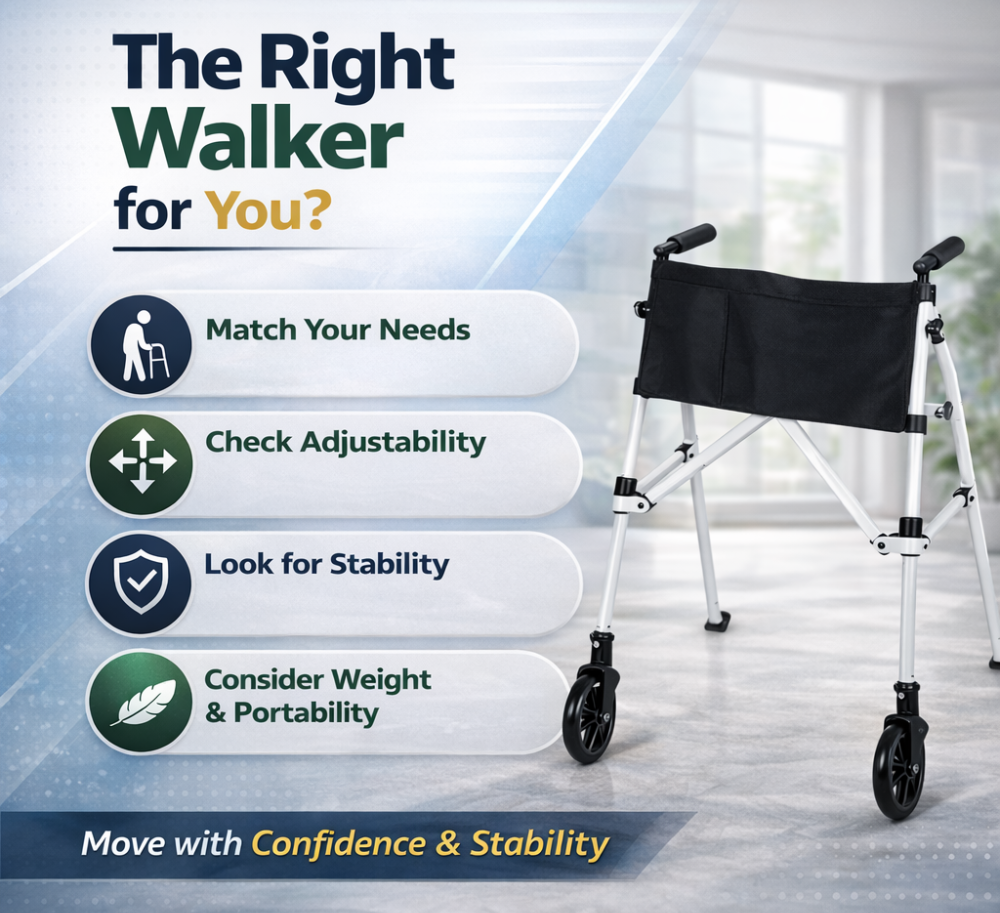
A two-wheel walker has wheels at the front and rubber tips or glides at the back. You push it forward and it slides, but the back tips grip when you press down.
What it does well
- No lifting required, so it is far less tiring than a standard frame
- The rear tips still bite when weight goes through the handles, so it does not run away
- Keeps a more natural, continuous walking rhythm
- Suits people with weak shoulders or arthritic hands who cannot lift a frame repeatedly
What it costs you
- Slightly less rock-solid than a fully static frame
- Front wheels can catch on thick carpet, door strips and uneven paving
- No seat, so there is nowhere to rest on a longer outing
Who it actually suits
This is the quiet workhorse of the category and it is under-recommended. It fits the large group of people who cannot manage the lifting of a standard frame but who still lean noticeably on their walker and should not have four free-rolling wheels underneath them.
Rollators: Maximum Momentum, Least Bracing
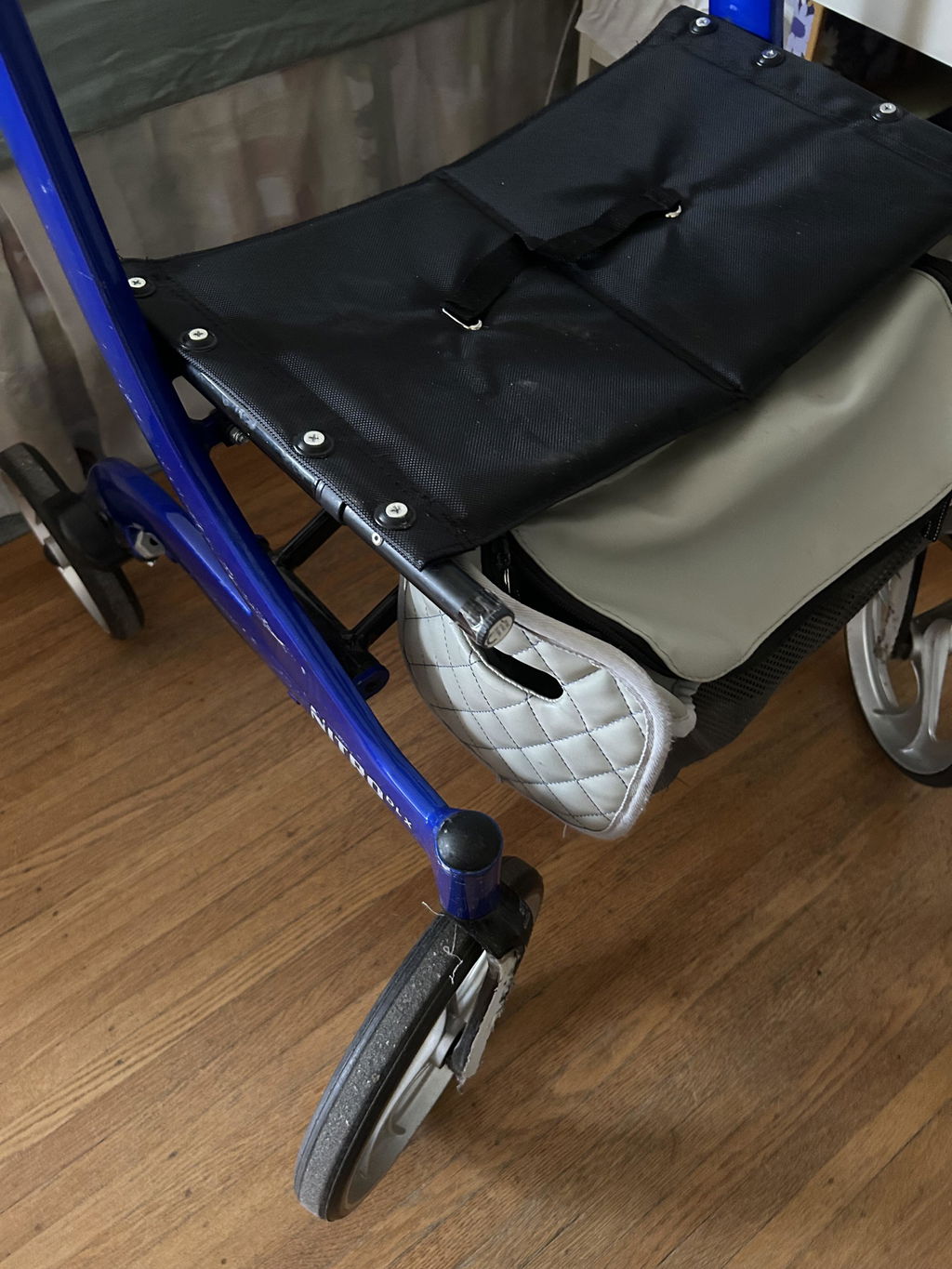
A rollator has four wheels, hand brakes and usually a padded seat and a basket or bag. It rolls continuously and you steer it rather than place it.
What it does well
- Covers distance with much less effort than any lifting frame
- The seat means you can rest partway through an outing, which extends how far someone can go
- Handles outdoor surfaces better, especially models with larger wheels
- Carries shopping, a bag or a coat, which restores a lot of ordinary independence
What it costs you
- It rolls. That is the whole point and also the whole risk
- It relies entirely on the user's hands to brake, and on their judgement about when to brake
- It is bulkier to store and heavier to load into a car
- Brakes need checking and adjusting, and they do go out of alignment over time
Why a Rollator Is the Wrong Choice for Someone Who Leans Heavily
This deserves its own section, because it is the mistake families make most often and usually with the best intentions.
Rollators look like the premium option. They have the seat, the brakes, the basket. So when a parent is struggling, the instinct is to buy the nicest one available. But if that parent puts real weight through their hands to stay upright, a rollator can slide forward as they load it, leaving them stretched out and falling forward with nothing underneath them.
Some warning signs that a rollator is not the right aid:
- The person pushes down hard on the handles rather than resting hands on them
- Their arms visibly take weight with every step
- They have grip weakness, arthritis or tremor that makes squeezing a brake lever unreliable
- They forget to apply the brakes before sitting on the seat
- They have memory or judgement changes that make consistent brake use unlikely
- They have had a fall while using wheeled equipment before
A rollator suits someone who is steady but tires easily. It does not suit someone who is unsteady and needs bracing. Those are different problems and they need different equipment.
Have Someone Qualified Watch the Person Walk
You cannot settle this question from a product page, and honestly you often cannot settle it from watching at home either. Ask a physiotherapist, occupational therapist or another clinician to assess the fit and observe the walking pattern before committing.
They are looking at things that are hard to judge yourself: how much weight actually goes through the arms, whether the handle height is right, whether the person can brake reliably, and whether their walking pattern improves or worsens with each type of frame. A walker set to the wrong height increases fall risk regardless of which of the three types you buy, so this is not a step to skip.
Once the type is settled, our guide to fitting and adjusting a walker correctly covers handle height, grip and safe walking technique in detail.
Might a Cane Be Enough?
Worth asking honestly. If someone is steady on their feet and only wants a little reassurance on stairs or uneven ground, a walker may be more equipment than the situation calls for, and it brings its own hassle around doorways and storage. A cane offers less support but far more freedom. Our comparison of folding canes and rigid canes covers where each one makes sense. You can also browse canes and walking sticks to see the range.
Practical Questions to Ask Before You Decide
- Does the person lean on the frame, or rest hands on it? This is the deciding question
- Can they squeeze and hold a brake lever reliably, every time, without thinking about it?
- Can they lift a frame repeatedly without their shoulders tiring?
- Is the walking mostly short indoor trips, or genuine outings?
- Do they need to rest partway through a walk?
- Will it have to fit through the narrowest doorway in the house?
- Is the flooring mostly carpet, mostly hard floor, or a mix?
It Does Not Have to Be One Forever
Needs change, sometimes quickly. Someone recovering from a hip replacement may need a standard frame for a few weeks, a two-wheel walker for a few months, and nothing at all by the following year. Someone with a progressive condition may move the other direction. Buying the aid that fits this month is not a failure of planning; it is usually the right call, and it is why many families end up owning more than one.
It is also common and entirely sensible to use different aids in different places, such as a firm frame indoors and a rollator for the pavement outside.
The Emotional Side Is Real Too
Choosing correctly is only half the job. Plenty of well-chosen walkers sit unused in hallways because the person is not ready to be seen with one. If that is where you are, the emotional side of starting to use a mobility aid may be more useful reading than any specification.
Summing Up
Wheels buy you ease and cost you bracing. Choose a standard frame when the walker has to hold still under real weight. Choose a two-wheel walker when lifting is too tiring but weight still goes through the arms. Choose a rollator when the person is steady but tires quickly and wants to get out and about with somewhere to sit.
When you are ready to compare, our mobility aids collection has all three types side by side. Just be sure the type is settled with a clinician before the colour is.