MEDICAL DISCLAIMER: This article provides general guidance on wheelchair selection. Always consult with your physician, physical therapist, or certified rehabilitation technology supplier (CRTS) for personalized recommendations based on your specific medical needs and physical condition.
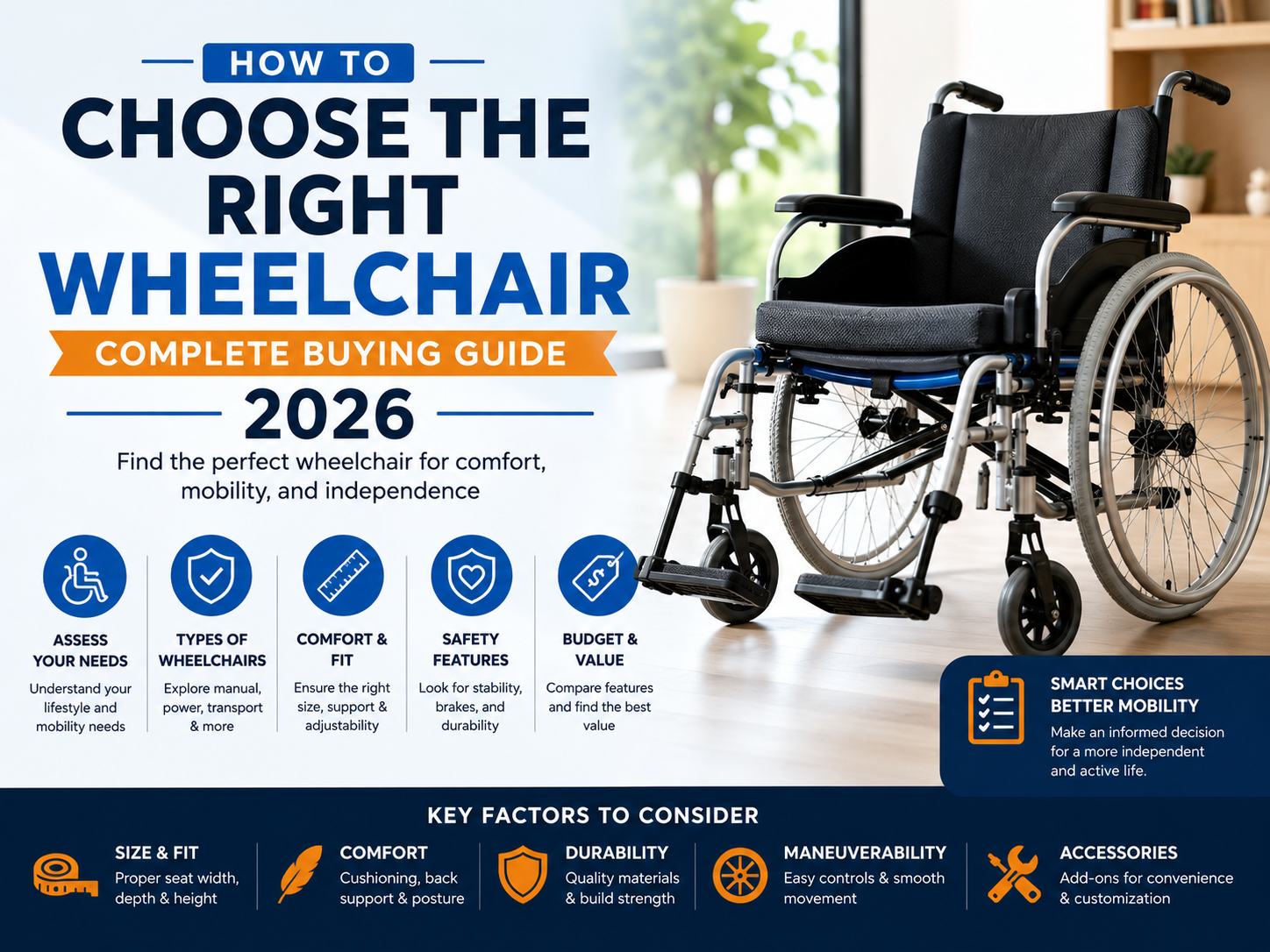
How to Choose the Right Wheelchair: Your Complete 2026 Buying Guide
Patricia's Choice: The Decision That Changed Everything
Patricia was 74 when she and her daughter Sandra drove to a medical supply store after Patricia's hip replacement. Patricia needed a wheelchair — at least temporarily, and possibly longer. Sandra had done some online research the night before, but standing in the store confronted with rows of chairs at different price points, different widths, different weight ratings, and different features, she felt completely lost. They bought what the salesperson pointed them toward. It wasn't the wrong choice, exactly. But three weeks later, sitting in her daughter's car trying to fold the chair into the trunk, Patricia realized the chair was just slightly too wide to fit comfortably. And the footrests were angled in a way that caused pain in her operated hip after an hour of sitting. And the armrests couldn't be removed, which made transfers from bed to chair — the maneuver her physical therapist had taught her — unnecessarily difficult.
The chair worked. But it didn't work well. And the difference between a wheelchair that works and a wheelchair that works well, for someone using it every day, is significant.
At AllCare Store, we want every person and every caregiver to feel confident when choosing a wheelchair — not lost. This guide will walk you through every major decision point, explain the terminology that often confuses buyers, and help you match the right chair to the right person and the right life.
Step 1: Understand the Two Main Wheelchair Categories
Before you consider any features, the most fundamental decision is whether you need a manual standard wheelchair or a transport (companion) wheelchair. These look similar but serve meaningfully different purposes.
Standard Manual Wheelchairs (Self-Propelled)
Standard wheelchairs have large rear wheels with hand rims that the user grips and pushes to move independently. This design is appropriate when:
- The user has sufficient upper body strength and coordination to self-propel
- Independence is a priority — the user wants to move without assistance
- The user will spend significant time in the chair (multiple hours per day)
- Transfers in and out of the chair are done by the user without full assistance
Standard wheelchairs are heavier (typically 35–50 lbs for standard frames; 15–30 lbs for lightweight/ultralight models) but give the user control over their own movement. Most have removable or swing-away armrests and footrests to facilitate safe transfers.
Transport / Companion Wheelchairs
Transport wheelchairs have four small wheels — no large rear wheels with hand rims. They cannot be self-propelled; they must be pushed by a caregiver. They're the right choice when:
- The user cannot self-propel due to weakness, coordination issues, or cognitive impairment
- The chair is used primarily for transport between locations (appointments, shopping, outings) rather than all-day independent use
- Portability and light weight are the top priorities
- Trunk space is limited and a compact, folding chair is essential
Transport chairs typically weigh 15–25 lbs — significantly lighter than standard chairs — and fold more compactly. They're easier for caregivers to lift into car trunks. The tradeoff is complete dependence on a pusher for movement.
Which Category Is Right?
| Factor | Choose Standard Manual | Choose Transport |
|---|---|---|
| Primary user | Person can self-propel | Caregiver pushes the chair |
| Hours per day in chair | Multiple hours of regular use | Occasional outings, appointments |
| Weight priority | Moderate (15–50 lbs) | Light (15–25 lbs) |
| Independence | Important | Not the priority |
| Budget | Wider range; lightweight models cost more | Generally lower cost |
Step 2: Get the Sizing Right
Wheelchair sizing is probably the most critical — and most overlooked — aspect of selection. A chair that doesn't fit correctly causes pressure sores, poor posture, shoulder pain (for self-propellers), difficulty with transfers, and reduced functional independence. This is what Patricia's experience illustrated.
Seat Width
Seat width is measured across the seat from left to right. The standard measurement is taken at the widest part of the user's hips or thighs while seated. Add approximately 1–2 inches for comfortable seating without pressure on the hips.
- Too narrow: Pressure on hips and thighs, difficulty with transfers, skin breakdown risk
- Too wide: User can't reach the hand rims efficiently, poor posture support, difficulty getting through doorways
Standard seat widths are 16", 18", and 20". Bariatric models go wider. Most adults need an 18" seat, but measure — don't assume.
Seat Depth
Seat depth runs from the backrest to the front edge of the seat. Measure from the back of the user's bent knee to the back of the buttocks when seated, then subtract approximately 2 inches to leave a finger-width gap between the front edge of the seat and the back of the knee.
- Too deep: User slumps forward or can't reach the backrest; pressure behind the knees
- Too shallow: Inadequate thigh support; increased pressure on the sitting bones (ischial tuberosities)
Seat Height
Seat-to-floor height determines footrest position and ease of floor clearance. Measure from the bottom of the user's heel to the back of the bent knee when seated upright. Footrests should allow the thighs to rest flat on the seat with a slight upward slope (heels slightly higher than knees). Standard seat heights are 17.5" to 19.5".
Back Height
Standard chair backs are approximately 16" high, which provides mid-back support. Taller backs (up to 20–24") provide better trunk support for users with limited core strength. Lower backs increase upper body mobility for active users who self-propel frequently.
Weight Capacity
Every wheelchair has a maximum weight capacity. Standard chairs are typically rated to 250 lbs. Heavy-duty chairs are rated to 300–400 lbs. Bariatric models handle 500+ lbs. Always choose a chair rated for at least the user's body weight — exceeding weight capacity compromises structural integrity and safety.
Step 3: Choose Frame Style — Folding vs. Rigid
Folding (Cross-Brace) Frames
Most standard and transport wheelchairs use a folding cross-brace frame that allows the chair to collapse sideways for storage and transport. Folding chairs are:
- More versatile — fold compactly for car travel, storage in small spaces
- More forgiving on uneven terrain — the frame flexes slightly over bumps
- Generally more affordable
- Standard for transport chairs and most home-use standard chairs
The tradeoff is that cross-brace frames are somewhat heavier and less energy-efficient for self-propulsion (the flex absorbs some of the user's pushing energy).
Rigid Frames
Rigid frames don't fold — instead, the rear wheels pop off for transport and the frame may tilt. Rigid chairs are:
- Lighter — rigid titanium or aluminum frames can be under 15 lbs
- More efficient to propel — no flex means more of the user's energy translates to movement
- More durable over time — fewer moving parts means fewer points of failure
- Preferred by active wheelchair users and those who self-propel extensively
Rigid chairs are typically more expensive and require more adjustment skill to fit properly. They're the right choice for an active user who will spend most of their waking hours in the chair.
Step 4: Evaluate Key Features
Armrests
For users who transfer in and out of the chair, removable or swing-away armrests are nearly essential — fixed armrests turn every transfer into an obstacle course. Desk-length armrests (shorter than full-length) allow the chair to slide under tables and desks. Full-length armrests provide more lateral support. Padded armrests improve comfort for extended sitting.
Footrests / Leg Rests
Swing-away footrests move to the side and can be removed entirely, making transfers much easier and allowing the user to stand directly in front of the chair. Elevating leg rests are important for users who need their legs raised due to edema, post-surgical recovery, or circulation issues. Standard footrests are fixed at a single angle; adjustable models allow tuning for individual anatomy.
Wheel and Tire Type
Hard (solid rubber) tires require no maintenance and never go flat — ideal for indoor use and smooth surfaces. Pneumatic (air-filled) tires provide a smoother ride on outdoor and uneven surfaces but require periodic inflation and can puncture. Many all-purpose chairs use solid rear tires with soft-ride foam front casters for a compromise.
Anti-Tippers
Anti-tipping devices are small rear extensions that prevent the chair from tipping backward — an important safety feature for new wheelchair users, older adults, and anyone who navigates ramps or inclines. Many chairs come with anti-tippers included; for others they're an add-on accessory available in our Wheelchairs collection.
Cushioning
The standard upholstered seat that comes with most wheelchairs is adequate for occasional use but inadequate for users sitting more than two hours per day. A proper wheelchair cushion is critical for pressure injury prevention in extended-use situations. See our Wheelchair Cushions for foam, gel, and air-cell options suited to different risk levels and sitting patterns.
Wheelchair Products at AllCare Store
Browse our complete Wheelchairs collection featuring standard manual chairs, transport chairs, lightweight folding models, and bariatric options. Key ranges include:
- Standard manual wheelchairs — 16", 18", and 20" seat widths with swing-away footrests and removable armrests; ideal for home use and rehabilitation
- Lightweight transport wheelchairs — under 20 lbs, compact fold, caregiver-push design; perfect for outings and travel
- Bariatric wheelchairs — reinforced frames with 300–500 lb capacity and wide seat options
- Wheelchair accessories — cushions, lap trays, bags, anti-tippers, and positioning aids
Medicare and Insurance Coverage for Wheelchairs
Medicare Part B may cover a "manual wheelchair" as durable medical equipment (DME) if your physician documents that you have a mobility limitation that significantly impairs your ability to participate in one or more mobility-related activities of daily living (MRADLs) within your home. Key points:
- A face-to-face examination by your physician is required
- The chair must be purchased through a Medicare-enrolled DME supplier
- Medicare typically covers 80% of the approved amount after the Part B deductible; your supplemental insurance may cover the remaining 20%
- Criteria focus on in-home mobility needs, not community mobility
Private insurance coverage varies by plan. Always call your insurer before purchasing to understand your benefits and prior authorization requirements. Our team at 1-888-889-6260 can help you navigate the documentation process.
Frequently Asked Questions About Choosing a Wheelchair
What is the most important measurement when choosing a wheelchair?
Seat width is typically the most critical measurement because it directly affects hip comfort, pressure distribution, and the ability to reach hand rims (for self-propulsion). A chair that's too narrow causes painful pressure on the hips; one that's too wide compromises posture and propulsion efficiency. Measure the user's widest hip/thigh width while seated, then add 1–2 inches for clearance.
How do I know if someone needs a transport chair or a standard wheelchair?
The key question is: can (and will) the user propel themselves? If yes, choose a standard wheelchair with large rear wheels and hand rims. If the user lacks the upper body strength, coordination, or endurance to self-propel — or if the chair will only be used for short-duration transport with a caregiver pushing — a transport chair is the more practical choice. Many families purchase both: a transport chair for outings and a standard chair for home use.
What's the lightest type of manual wheelchair?
Ultra-lightweight rigid-frame wheelchairs made from titanium can weigh under 12–14 lbs without the wheels. Lightweight folding chairs (K0003 classification for Medicare) typically weigh 19–34 lbs. Transport chairs usually fall in the 15–25 lb range. For caregivers who need to lift the chair into a car trunk frequently, the chair's total weight including footrests is an important practical consideration.
Can a wheelchair fit through standard doorways?
Standard interior doorways in homes built before the 1990s are often 28–30 inches wide. A wheelchair with an 18" seat width typically has an overall width of 24–26 inches, which fits most doorways. An older home with narrow doorways may require a narrower chair (16" seat) or bathroom modifications. ADA-compliant doorways are 32–36 inches, which accommodates all standard wheelchair sizes. Measure your home's narrowest doorways before purchasing.
Do I need a wheelchair cushion?
For occasional use (under 2 hours per day), the standard upholstered seat is usually adequate. For users who sit for longer periods, a proper wheelchair cushion is strongly recommended. Standard foam cushions reduce pressure compared to a flat seat. For higher-risk patients — those with reduced sensation, poor nutrition, skin fragility, or history of pressure injuries — a gel, air cell, or alternating pressure cushion is essential. Pressure injuries are among the most serious complications of wheelchair use and are largely preventable with proper cushioning.
What's the difference between "K0001" and "K0004" wheelchairs?
These are Medicare HCPCS codes classifying manual wheelchairs by weight and features: K0001 is a standard manual wheelchair (heaviest, least features); K0002 is a standard hemi-wheelchair with lower seat height; K0003 is a lightweight wheelchair (under 34 lbs with specific features); K0004 is a high-strength lightweight wheelchair; K0005 is an ultra-lightweight wheelchair (the highest-performance classification, covering rigid-frame active-user chairs). Higher K-codes generally require more extensive medical justification for Medicare coverage but provide significantly better performance and lighter weight.
Patricia's Chair, Revisited
When Patricia came back to AllCare Store three months later to buy a transport chair for travel — something lighter that Sandra could manage at the airport — she knew exactly what to ask for. She measured her hip width and her car trunk opening before she came in. She asked whether the footrests swing away. She tested the fold. She lifted it to see if Sandra could manage the trunk lift alone.
She left with a chair that fit. That's the whole goal.
Browse our full Wheelchairs collection at AllCare Store — manual, transport, lightweight, bariatric, and all the accessories that go with them. Also explore our related Walkers & Rollators and Canes & Crutches collections if a wheelchair is part of a broader mobility plan.
Questions about which wheelchair is right for your situation? Our team is ready to help — call us at 1-888-889-6260.