Most advice about canes, walkers and rollators is about the hardware: how many wheels, how much it weighs, whether it folds. But the reason a device ends up folded in a hallway closet is almost never mechanical. It is that the person it was bought for has not yet agreed, internally, to be someone who uses one.
This article is about that part — the emotional transition. It is general information for families and for people making the decision themselves, not medical advice. Decisions about which device is appropriate should involve a doctor, physical therapist or occupational therapist.
Where the resistance actually comes from
When someone says "I don't need that thing," they are usually answering a question nobody asked out loud. It helps to know which one.
"It makes me look old"
A mobility aid is a visible, public signal. Reading glasses and hearing aids can be put away; a rollator cannot. For many people the objection is not to the support but to being read differently by neighbours, grandchildren and strangers. This is a real social cost, not vanity, and dismissing it as vanity usually entrenches the refusal.
"If I start using it, I'll never stop"
There is a widespread belief that support causes weakness — that leaning on a walker will let the legs give up. In practice the opposite pattern is more common: people who avoid an aid walk less, and walking less is what erodes strength and confidence. A therapist can advise on whether an aid is intended to be temporary, situational or permanent, and that distinction alone often defuses the argument.
"It means I'm not getting better"
For someone recovering from surgery, a fracture or a stroke, accepting a device can feel like conceding the recovery. It helps to reframe the aid as equipment for the current stage rather than a verdict on the final one — the same way crutches are understood after a broken ankle.
"I don't want to be a burden"
This one is worth naming directly, because it often runs the other way in practice. People who refuse an aid tend to ask for more hands-on help — an arm to hold, a lift out of a chair, a ride somewhere they would otherwise have walked. The device usually reduces dependence on other people rather than increasing it.
What reduced mobility does to mood and social life
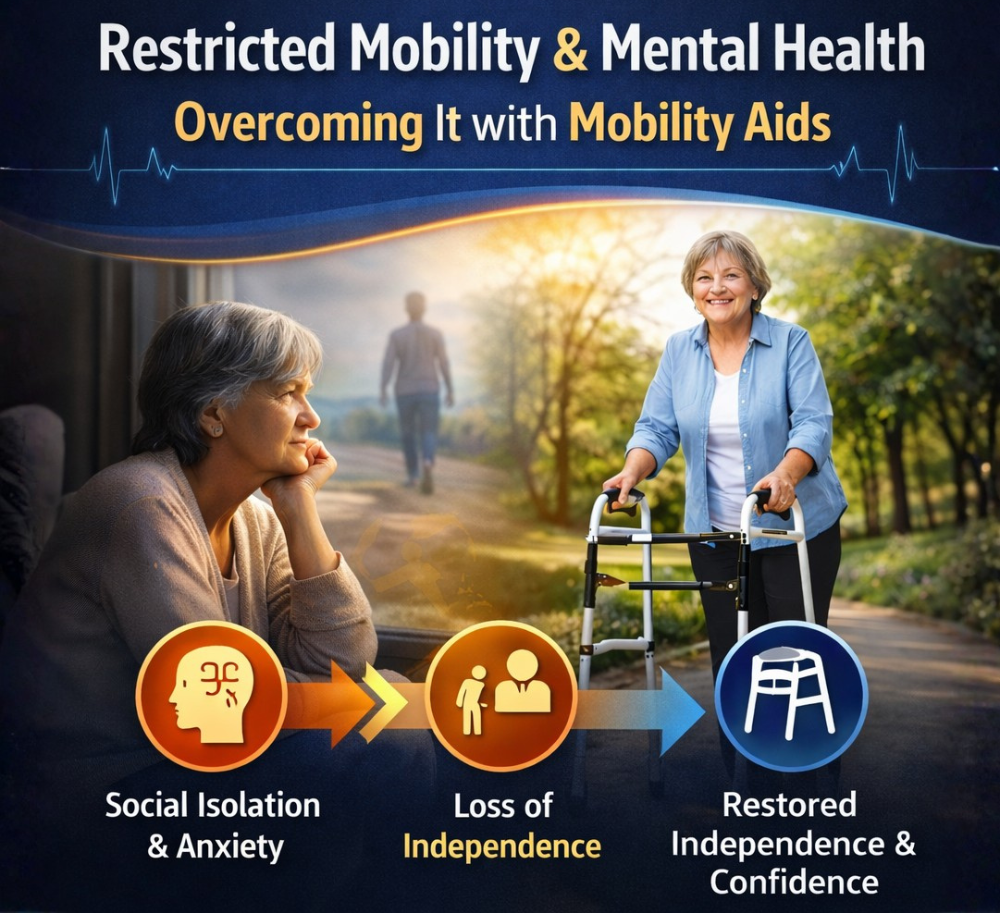
Restricted movement rarely stays a movement problem. The sequence families describe is fairly consistent:
- The world shrinks by distance. The corner shop, the second floor, the far end of the garden quietly drop off the map. Nobody announces this; the places simply stop coming up.
- Social contact becomes something that has to be arranged. Spontaneous visits and walks are replaced by scheduled ones, and scheduled contact is easier to cancel.
- Fear of falling becomes its own restriction. After a fall — or a near miss — people often limit themselves far more than their physical capacity requires.
- Activity drops, and mood follows. Less movement, less daylight and less company are each independently linked with low mood in older adults. Together they compound.
The point is that the emotional cost of avoiding an aid is usually higher than the emotional cost of using one. It is just spread out over months, so it is harder to see.
Signs the adjustment is going badly
Worth paying attention to, in the person or in yourself:
- Declining invitations with vague reasons, repeatedly
- Planning the day around avoiding stairs, kerbs or being seen
- The aid being used indoors but hidden before visitors arrive
- Withdrawing from a hobby or role that used to define them
- Persistent low mood, poor sleep, loss of appetite or expressions of hopelessness
The last one is not a mobility issue. Depression is common alongside reduced mobility and is treatable — it should be raised with a GP or doctor rather than waited out.
What actually helps the transition
Attach the device to a destination
"You need a walker" is a statement about decline. "With a rollator you could get to the Sunday market again" is a statement about a place. People adopt equipment far more readily when it is tied to something specific they have lost and want back.
Let them choose it
Colour, handle style, whether it has a seat, whether it folds small enough for the car — these seem trivial and are not. Choosing the device is the difference between something being done to a person and something being chosen by them. Browsing options together, whether among canes, walkers and rollators or rollators, restores some authorship over the decision.
Get the fit sorted before the first outing
A badly adjusted aid is uncomfortable and looks awkward, which confirms every fear the person had. Height adjustment, grip comfort and brake reach should be set — ideally by a therapist — before the device is used anywhere public.
Start somewhere low-stakes
A quiet park on a weekday morning is a better first outing than a family wedding. Early experiences shape whether the device gets associated with capability or with embarrassment.
Remove the practical friction too
Resistance often has a mundane component: the aid does not fit through the bathroom door, there is nowhere to park it, or it is a struggle to load into the car. Sorting the home out first removes the excuses that get dressed up as objections — see our guide to setting up a home so a mobility aid actually works.
For family members
A few things that tend to help more than persuasion:
- Stop arguing about the device and ask what they are worried about. The stated objection and the real one are often different.
- Let a clinician make the recommendation. Advice from a physical or occupational therapist lands differently than advice from an adult child.
- Don't narrate it. Constant checking, praising and commenting turns an ordinary object into an event.
- Give it time. Acceptance is frequently a matter of weeks. Pushing hard in week one can cost you month three.
Related reading
- Matching the aid to the limitation: canes, walkers, rollators, wheelchairs and scooters
- Setting up a home so a walker or wheelchair actually works
You can also browse mobility, transportation and transferring equipment and aids to daily living.
This article is general information and is not a substitute for advice from a qualified healthcare professional.