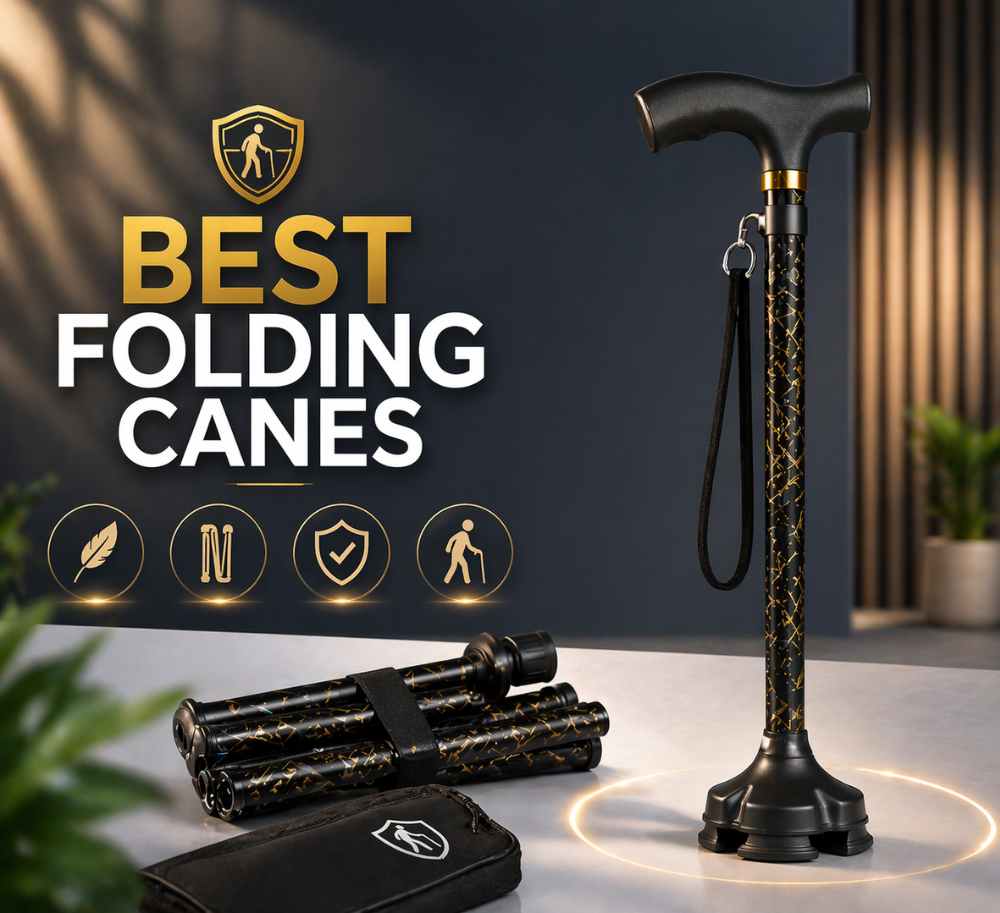
A folding cane collapses into three, four or five short sections held together by an internal elastic cord, then snaps back into a full-length cane in a couple of seconds. It fits in a handbag, a glovebox or an overhead locker.
That convenience is genuine. It is also the whole of the argument for a folding cane, and it comes with trade-offs that shop listings rarely spell out. Understanding them is the difference between buying a cane you use every day and buying one that lives in a drawer.
How folding canes actually work
The shaft is cut into sections. A shock cord runs through the middle under tension. When you release the sections, the cord pulls them into line and the tapered ends seat into one another; a button or collar then locks the length. To fold it, you pull the sections apart and let them concertina.
Most folding canes are aluminium, because the design needs a hollow shaft. That is why you rarely see a folding cane in solid hardwood.
Where a folding cane genuinely wins
- Sitting down anywhere. Restaurants, waiting rooms, theatres and buses are where rigid canes get knocked over, kicked, and left behind. A folded cane goes in a bag or under a seat.
- Air travel and long journeys. It fits in carry-on luggage and does not need to be surrendered or stowed separately.
- Intermittent need. If you only need support for longer walks, uneven ground or bad days, a cane you can carry unobtrusively is a cane you will actually have with you.
- As a second cane. Many people who use a rigid cane at home keep a folding one in the car or a bag as a backup.
- Recovery periods. After a temporary injury, the ability to stow it while sitting matters more than long-term durability.
The trade-offs
These are the things people notice after a few weeks, not in the shop.
- More joints, more play. Every folding point is a place where a little movement can develop. Over time some folding canes acquire a slight flex or a click under load. A single-piece shaft has none of this.
- Noise. Sections can rattle when the cane swings, which some users find irritating enough to stop carrying it.
- More parts to fail. The shock cord loses tension eventually, and the locking mechanism is a wear point. A solid wooden or one-piece aluminium cane has almost nothing to go wrong.
- Weight capacity. Folding models are not automatically weaker, but jointed designs often carry a lower stated limit than heavy-duty or bariatric one-piece canes. Always check the figure the manufacturer publishes rather than assuming.
- The unfolding step. It takes two hands and a moment. If you have significant hand weakness, arthritis or tremor, that moment can be genuinely awkward, and it happens every time you stand up.
- Fewer handle options. The range of handle shapes and materials on folding canes is narrower than on rigid ones, which matters if wrist or grip comfort is your main issue.
When a rigid cane is the better call
- You use a cane for most of your walking, every day. Fewer moving parts wins over years of use.
- You put significant weight through it rather than using it for light balance.
- You need a heavy-duty or bariatric rating.
- You want a specific handle shape for wrist or hand comfort, or a wooden cane for its feel and appearance.
- You need a wider base for stability, since quad and tripod bases are generally not foldable.
If material and handle choice is the deciding factor, the comparison of mahogany hardwood against aluminium covers weight, durability and feel, and choosing a handle for comfort rather than just support goes into grip shapes in detail.
It does not have to be either-or
Plenty of people own both, and it is often the cheapest way to solve the whole problem. A rigid cane sized correctly for daily use at home, plus a folding cane in the car or bag for outings, covers almost every situation without compromise. Given typical cane prices, owning two is a smaller decision than it sounds.
What to check before buying a folding cane
- Adjustment range against your measurement. Take your own height measurement first, then confirm the cane adjusts to it comfortably within its stated range rather than at the extreme end.
- Number of sections. More folds means a smaller bundle but more joints. Fewer folds is usually sturdier.
- The lock. Extend it in the shop if you can. The button should seat with an audible, definite click and should not need excessive force.
- Stated weight capacity. Check the published figure, and treat it as a limit rather than a target.
- Handle and grip. Hold it. Foam and gel grips reduce pressure on the palm; a wrist strap keeps the cane with you when you let go.
- A carrying case. A pouch keeps the folded cane from working loose in a bag.
- Tip diameter. Note it now so you can buy the right replacement later. Common shaft sizes include 5/8, 3/4, 7/8 and 1 inch.
Folding models, rigid canes and wide-base options are grouped in the canes collection, and replacement tips, pouches and grips in crutches and canes accessories.
Safety habits specific to folding canes
- Confirm the lock is engaged and every section is fully seated before you put weight on it. A partially seated joint can collapse.
- Check the shock cord tension every few months. If the sections no longer snap together crisply, the cord has stretched and should be replaced or the cane retired.
- Do not lean on a folding cane as a seat or use it to lever yourself up from a low chair.
- Store it extended rather than folded when you can. Leaving it compressed for long periods shortens cord life.
- Inspect the tip on the same schedule as any other cane. Guidance on spotting wear is in the article on checking and replacing cane tips.
Getting the height right matters more than the folding mechanism
A cane of any type set at the wrong height will cause more problems than it solves: shoulder hitching if it is too tall, stooping and wrist strain if it is too short. Setting it correctly, and the technique for using it on stairs, is covered alongside the practical side of helping someone start using a cane. If you are unsure which device suits your situation at all, matching the device to the condition is the place to start, and a physiotherapist can assess this properly in a single appointment.
A folding cane is a good answer to a specific problem: needing support without always wanting a cane in your hand. Buy it for that reason, check the lock and the height, and it will do the job well.