A cane is a simple device with one consumable part. The rubber tip at the bottom is the only thing between the shaft and the floor, and it is doing all the work: gripping, absorbing shock, and staying flat against the ground as your weight shifts forward.
It also wears out gradually enough that most people never notice until the cane skids. Unlike a worn shoe, there is no discomfort to prompt you. The failure is silent right up until the moment it matters.
What the tip is actually doing
- Traction. The tread pattern channels water and dust away so the rubber can make contact with the floor.
- Full-surface contact. A tip is designed so the whole flat face meets the ground when the cane is planted at its natural angle. Once it wears to a bevel, only an edge is touching.
- Shock absorption. The rubber takes some of the impact that would otherwise travel up the shaft into the wrist and shoulder.
- Keeping the shaft sealed. On hollow aluminium canes the tip also stops grit and water entering the tube.
The five-minute wear check
Turn the cane upside down under good light and look at the tip face.
- Tread depth. If the pattern has worn smooth in the centre or across one side, grip is already reduced.
- A bevel or flat spot. This is the most common and most dangerous wear pattern. The tip wears at an angle on the side you lead with, so the cane meets the floor on an edge instead of a flat face. Stand the cane on a table at its normal walking angle: the whole face should sit flush.
- Cracks and splits. Check around the sidewall and where the rubber meets the shaft. Rubber hardens and cracks with age even if the cane has barely been used.
- Hardness. Press a thumbnail into the rubber. A serviceable tip gives slightly. One that feels like hard plastic has perished.
- Fit. Grip the tip and try to twist it on the shaft. It should not rotate or slide. A loose tip can come off entirely.
- Debris. Gravel, chewing gum and grit lodged in the tread hold the rubber off the floor. Pick it out and rinse the tip.
The signs you will feel before you see
People often describe these before they think to look at the tip:
- The cane slips on wet tile, polished floors, or a supermarket entrance mat
- It skates forward slightly as you load it, so you find yourself planting it more carefully
- The tapping sound changes to a harder, sharper knock
- More vibration reaches the wrist
- Black scuff marks appear on light flooring
Any of these is reason enough to replace the tip. It is an inexpensive part and there is no benefit to waiting.
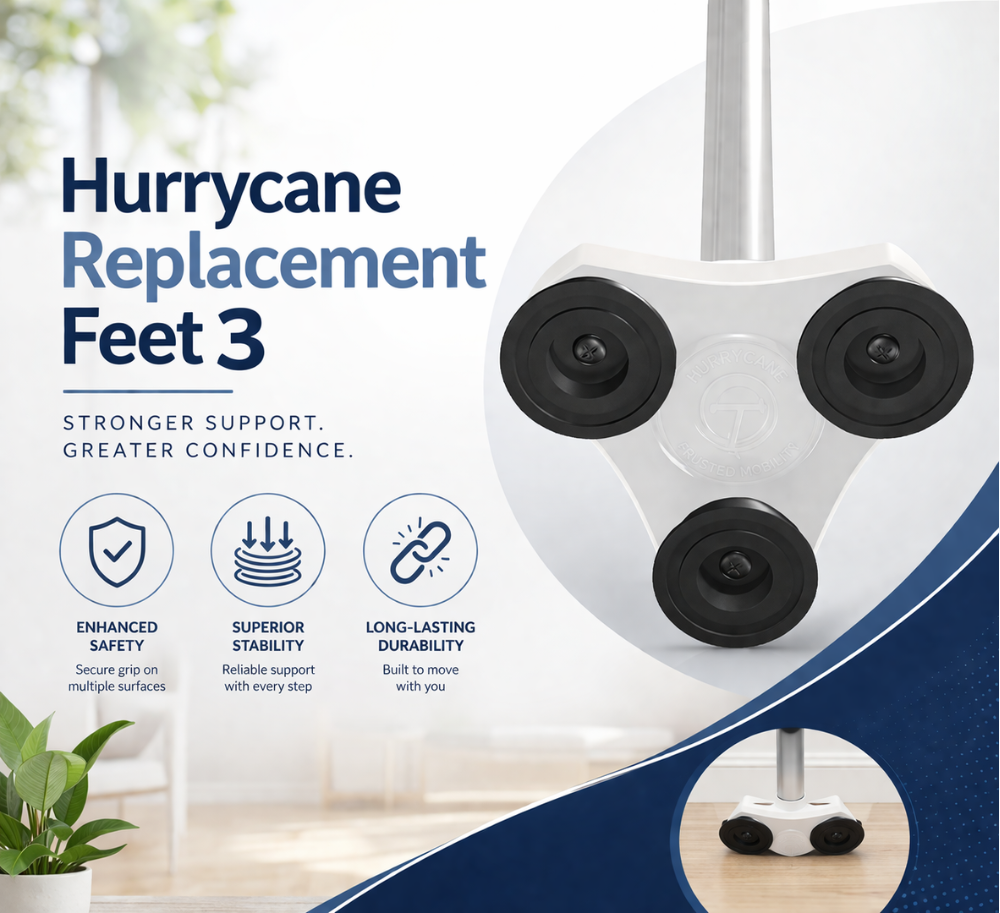
Tripod and quad bases need every foot checked
Canes with a three- or four-point base are chosen specifically for stability, and that stability depends on all the feet contacting the ground together. They fail differently from a single-point cane.
- Check each foot separately. Uneven wear is normal, because the base is loaded asymmetrically. One badly worn foot undermines the whole base.
- Test on a flat surface. Stand the cane on a hard, level floor and press down. If it rocks, either a foot is worn or the base is bent.
- Replace feet as a set. Mixing a new foot with worn ones reintroduces the rocking you were trying to eliminate.
- Inspect the base itself. A dropped or over-loaded multi-point base can bend so that no combination of new feet will sit flat. At that point the cane needs replacing, not repairing.
- Watch the leading edge. On offset multi-point bases the outermost foot usually wears fastest.
Measuring for the right replacement
Tips are sized by the outside diameter of the cane shaft, not by the size of the old tip.
- Remove the old tip and measure the shaft across its widest point with a ruler or calliper.
- Common sizes are 5/8 inch, 3/4 inch, 7/8 inch and 1 inch.
- If your measurement falls between two sizes, take the cane or the old tip with you rather than guessing. A tip that is slightly too large will work loose.
- Buying a multi-pack is usually more economical, and it means the spare is already in the house when you need it.
- Multi-point bases often use a proprietary foot shape. Check compatibility with the specific base before ordering.
Replacement tips in the common shaft sizes, along with grips and other spares, are in the crutches and canes accessories collection.
Fitting a new tip
- Twist and pull the old tip off. If it resists, twist rather than yank; the shaft can be damaged by levering.
- Wipe the end of the shaft clean and dry. Grit trapped under a new tip causes it to work loose.
- Check whether the old tip contains a metal washer at its base. Many do, and it needs to be present in the new tip too. It stops the shaft punching through the rubber.
- Warm the new tip in hot water for a minute if it is stiff. This makes it far easier to seat.
- Push and twist it on until the shaft bottoms out. There should be no gap between the rubber and the shaft.
- Test it: press the cane firmly against a hard floor at a walking angle and check that the face sits flat and the tip does not rotate.
How often is often enough
There is no fixed interval, and any specific figure would be misleading. Wear depends on how much weight goes through the cane, how many hours a day it is used, and whether the surfaces are carpet or concrete. Someone using a cane for a short indoor walk each day will get far longer from a tip than someone walking outdoors on pavement for an hour.
A workable habit is a quick look every month, a proper inspection at the change of season, and an immediate check after any slip. If the cane has been stored unused for a year or more, inspect before returning it to service, because rubber degrades on the shelf.
While you have the cane in your hands
- The grip. Foam that has compressed flat or split no longer cushions the palm, and a slick worn grip is its own hazard. Grips are replaceable on most canes.
- The height-adjustment button. It should spring fully into its hole. A button that sits proud or feels sticky can slip under load.
- Adjustment holes. Look for elongation or cracking around the hole in use, which indicates metal fatigue.
- Folding joints. On a collapsible cane, check the shock cord still pulls the sections together crisply.
- The wrist strap. Frayed webbing and worn stitching fail suddenly.
What a new tip will not fix
If the cane still feels unstable with a fresh tip fitted, the problem is elsewhere. The usual causes are a cane set at the wrong height, a single-point cane being used by someone who needs a wider base, or a device that was never the right choice for the underlying condition. Guidance on matching the device to your situation covers that decision, and there is separate advice on tips and accessories for ice and uneven ground if the issue is terrain rather than wear.
If you are considering a different cane altogether, the canes collection covers single-point, folding and wide-base options, and there is a comparison of folding against rigid designs if portability is part of the decision. For anyone who has outgrown a cane, walkers and rollators provide a wider base of support.
A cane tip costs very little and takes two minutes to change. Checking it regularly is the cheapest fall prevention available.