Medical Disclaimer: This article is for informational purposes only and does not constitute medical advice. In adults over 65, iron deficiency should always be evaluated by a healthcare provider before supplementing — it can be the first sign of internal bleeding or another treatable condition. Never start iron supplements without confirmed deficiency, and never ignore black or bloody stools.
Iron Deficiency After 65: Why Low Iron Is Never Just "Getting Older"
The Most Dangerous Words in Senior Health: "It's Probably Just Age"
Fatigue that creeps up over months. Breathlessness on the stairs that wasn't there last year. Less appetite, less energy, a little more brain fog. It is remarkably easy — for patients and sometimes even clinicians — to file all of this under "getting older." But anemia is not a normal part of aging. It affects roughly one in ten adults over 65 and becomes more common with each decade, yet in every single case it has a cause — and iron deficiency is one of the most frequent and most fixable of them.
Here's the part that makes this topic genuinely important rather than merely interesting: in an older adult, iron deficiency is treated by doctors as a finding that demands an explanation, not just a number to correct. Younger women lose iron predictably through menstruation; a 72-year-old does not. When an older adult's iron runs low, the iron went somewhere or stopped coming in — and the answer is often in the digestive tract. That's why the right response to low iron after 65 is a conversation with your doctor first, and a supplement second.
Where the Iron Goes: The Three Big Mechanisms
1. Slow, Silent Blood Loss (the One That Matters Most)
The leading concern is gradual bleeding in the GI tract — often invisible in the stool. Common sources include stomach or duodenal ulcers (frequently aggravated by daily aspirin or NSAID pain relievers like ibuprofen and naproxen), inflamed stomach lining, diverticular disease, colon polyps, abnormal blood vessels in the bowel, and — the reason doctors take this so seriously — colon or stomach cancers, which are most curable exactly when they're found at this quiet stage. This is why new iron deficiency in an older adult typically triggers a recommendation for endoscopy and/or colonoscopy. It's not overkill; it's the standard of care.
2. Reduced Absorption
Iron absorption depends on stomach acid, and stomach acid tends to decline with age (atrophic gastritis becomes more common). Layer on acid-suppressing medications — which many seniors take daily for years — and absorption drops further. Conditions like celiac disease, and prior stomach or bowel surgery, also impair absorption.
3. Reduced Intake
Smaller appetites, dental problems that make meat difficult, fixed food budgets, cooking for one, and "tea and toast" eating patterns all shrink iron intake precisely when absorption is also declining.
Red Flags of a GI Bleed: Know These Cold
- Black, tarry, sticky stools (digested blood — note that iron supplements also darken stool, but supplements should never be the assumed explanation until bleeding is ruled out)
- Visible blood in the stool or on the toilet paper — never attribute it to hemorrhoids without an exam
- Vomiting blood or material resembling coffee grounds — emergency care, immediately
- New persistent stomach pain, or pain that improves when you eat and returns hours later
- Unintentional weight loss or a change in bowel habits lasting more than a couple of weeks
- Dizziness, racing heart, or breathlessness that's new or worsening
The Medication Question: What's Blocking (or Being Blocked by) Your Iron
Adults over 65 average more daily medications than any other group, and several common ones tangle with iron in both directions — some block iron's absorption, and iron blocks some of theirs. Bring your full medication list to the conversation.
| Medication | The Interaction | Practical Strategy |
|---|---|---|
| PPIs (omeprazole, esomeprazole, etc.) | Long-term acid suppression reduces iron absorption — and can itself contribute to deficiency over years | Ask your doctor whether you still need the PPI, at what dose; don't stop on your own |
| Antacids & H2 blockers (calcium carbonate, famotidine) | Neutralized acid and calcium both cut iron absorption | Separate from iron by at least 2 hours |
| Levothyroxine (thyroid hormone) | Iron binds levothyroxine in the gut and can quietly undermine thyroid control | Take levothyroxine alone on waking; keep iron at least 4 hours away |
| Certain antibiotics (ciprofloxacin, doxycycline) | Iron binds these drugs and sharply reduces their effect | Follow pharmacist spacing instructions — usually iron 2 hours before or 4–6 hours after |
| Osteoporosis bisphosphonates (alendronate) | Absorption is destroyed by minerals taken nearby | Take the bisphosphonate fasting per its instructions; iron much later in the day |
| Levodopa (Parkinson's) | Iron chelates levodopa and reduces its benefit | Separate doses by at least 2 hours; discuss timing with your neurologist or pharmacist |
| Daily aspirin, NSAIDs, blood thinners | Don't block absorption — they promote the GI blood loss that causes deficiency | Flag them to your doctor when low iron is found; never stop heart medications on your own |
The Testing Conversation: What to Ask Your Doctor
Two numbers do most of the work, and it's worth knowing them by name:
- Ferritin — your iron storage gauge. A clearly low ferritin essentially confirms iron deficiency. The catch for seniors: ferritin rises with inflammation, infection, liver disease, and several chronic conditions common after 65, so a "normal" ferritin doesn't always mean normal iron stores.
- Transferrin saturation (TSAT) — the fraction of your iron-transport protein actually carrying iron. When ferritin is muddied by inflammation, a low TSAT (commonly below about 20%) helps unmask true deficiency.
Useful questions to bring: "Is my ferritin low, or just low-normal?" — "Could inflammation be hiding a deficiency?" — "Do I need a repeat panel after treatment to confirm my stores refilled?" — and the big one: "Do we know why my iron is low, and do I need a GI evaluation?" A doctor who hears that last question knows you understand the stakes.
Safe Dosing for Older Adults: Less Is Often More
The old-school regimen — high-dose iron three times daily — is particularly rough on older adults: constipation, nausea, and cramping lead many to quietly quit. Modern practice has moved toward gentler, smarter dosing:
- Lower doses absorb surprisingly well. After a dose of iron, the body releases hepcidin — a hormone that temporarily blocks further iron absorption for the next day or so. Piling on more pills mostly feeds the toilet, not the bloodstream.
- Alternate-day dosing — one modest dose every other morning — works with this biology, improving the fraction absorbed while roughly halving GI side effects. Ask your doctor whether it suits your case; it has become a favored approach for seniors.
- A single standard tablet (for example, 325 mg ferrous sulfate, which contains 65 mg of elemental iron) taken every other day is a commonly used senior-friendly regimen — but let your clinician set your dose based on your labs.
- Expect a marathon, not a sprint: blood counts improve over weeks, but refilling ferritin stores takes 3–6 months. A follow-up blood test is how you'll know you're done — don't stop early, and don't continue indefinitely without retesting either.
- If pills fail or absorption is the problem, IV iron given at an infusion center is a safe, effective option your doctor may suggest.
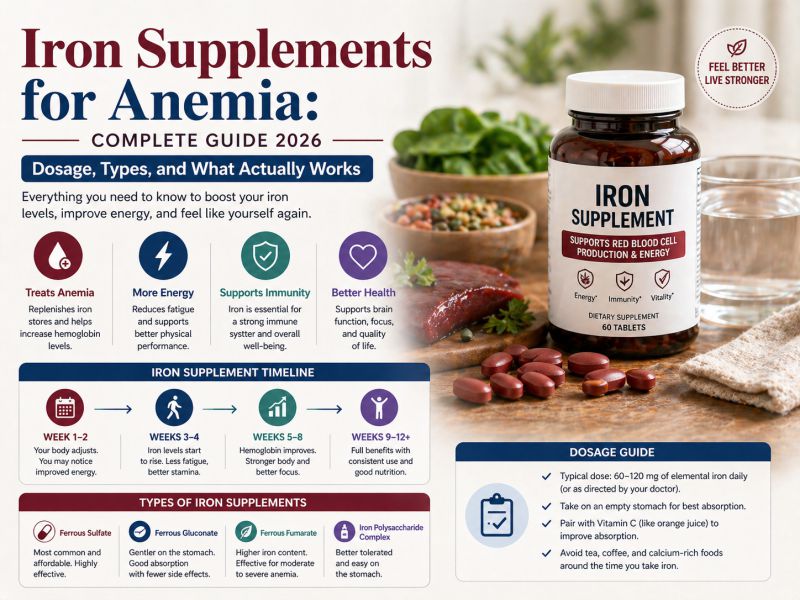
For a full comparison of iron types — ferrous sulfate vs. gluconate vs. bisglycinate — plus vitamin C pairing and absorption blockers, see our companion guide: Iron Supplements for Anemia: Complete Guide.
Food Strategies for Smaller Appetites
When appetite shrinks, every bite has to work harder. The goal isn't eating more — it's making iron-dense choices and removing the blockers:
- Prioritize heme iron, the well-absorbed form in animal foods: lean beef, dark-meat poultry, and canned sardines or tuna — small portions count, and canned fish requires no cooking energy on tired days.
- Lean on fortified staples: many breakfast cereals and oatmeals carry substantial added iron — an easy win for small appetites.
- Add plant iron with helpers: lentil soup, baked beans, eggs, and spinach absorb better when paired with vitamin C — tomatoes, citrus, bell peppers, or a small glass of orange juice with the meal.
- Move tea and coffee between meals. Their tannins are potent iron blockers; enjoy them an hour or more away from iron-rich food.
- Watch the calcium timing: dairy and calcium supplements are important for bones but compete with iron — take calcium supplements at a different meal than your iron-focused one.
- Soft-food options for dental issues: slow-cooked stews, meatloaf, bean purees, hummus, and iron-fortified hot cereal deliver iron without a fight.
Shop Nutrition Support at AllCare Store
Browse our Vitamins & Supplements collection for iron and vitamin C options, and our Nutrition and Feeding Essentials collection for nutritional support products suited to smaller appetites. Free shipping on every order, 30-day returns.
Visit AllCare Store — your trusted partner in home health and wellness. 1-888-889-6260.
Frequently Asked Questions: Iron Deficiency in Older Adults
Is anemia a normal part of aging?
No. Anemia becomes more common with age, but it always has a cause — iron deficiency, vitamin B12 or folate deficiency, chronic kidney disease, inflammation, or blood loss among them. In adults over 65, new iron deficiency specifically raises the question of slow gastrointestinal blood loss, which is why doctors often recommend endoscopy or colonoscopy rather than simply prescribing iron pills. Accepting fatigue as "just aging" risks missing a very treatable — and occasionally serious — underlying condition.
Can my acid reflux medicine cause low iron?
Long-term use of proton pump inhibitors (PPIs) such as omeprazole reduces stomach acid, which the body needs to absorb iron from food — and over years this can contribute to iron deficiency. Antacids and calcium supplements taken alongside iron have a similar blocking effect. Don't stop a prescribed PPI on your own; instead, ask your doctor whether you still need it at the current dose, and separate any iron supplement from antacids and calcium by at least two hours.
Why does my doctor suggest iron every other day instead of daily?
After each iron dose, the body releases hepcidin, a hormone that blocks further iron absorption for roughly a day. Taking iron every other morning works around this block — research shows a larger fraction of each dose is absorbed — while producing fewer GI side effects like constipation and nausea. For older adults, who are more sensitive to those side effects, alternate-day dosing of a single modest tablet is often both gentler and effective. Your doctor will confirm the right dose and schedule based on your lab results.