Vision Health Note: This article is for educational and product guidance purposes. If you are experiencing new or worsening vision changes, please consult an ophthalmologist or optometrist before relying solely on magnification aids. Some vision changes require medical evaluation.
When Small Print Becomes a Problem
Harold, a 74-year-old retired engineer, loved reading technical magazines and doing crossword puzzles. When presbyopia — the natural age-related stiffening of the eye's lens — made small print increasingly difficult, he bought the first reading glasses he found. They helped for books but did nothing for the tiny print on his medication bottles. His daughter found him a 3x handheld magnifier, and it changed his daily life. Medication labels, restaurant menus, train schedules, appliance settings — the small print world became accessible again.
Magnifying glasses are among the most practical and underappreciated daily-living aids for older adults. They require no prescription, no fitting appointment, and no special training. Yet many people struggle for months or years with small print before realizing a simple magnifier would solve the problem.
This guide helps you choose the right type, size, and magnification for your specific needs.
Understanding Magnification Levels (The "X" Number)
Magnification is expressed as a multiple — 2x, 3x, 5x, 10x — indicating how many times larger the image appears compared to the naked eye. Here's what the numbers mean in practical terms:
| Magnification | Best For | Notes |
|---|---|---|
| 2x–3x | Books, newspapers, general reading | Wide field of view, easier to use for extended reading |
| 4x–5x | Medicine labels, maps, fine print | Narrower field of view; ideal for short reading tasks |
| 6x–10x | Very fine print, needlework, stamps | Small field of view; best for spot reading, not extended |
| 10x–20x | Jewel inspection, electronics work, extreme fine detail | Very small field of view; specialized use |
A common mistake is assuming more magnification is always better. Higher magnification reduces the field of view and requires holding the magnifier closer to the object, which can be tiring for extended reading. Most people who need a magnifier for general reading find 2x–4x ideal; higher powers are better reserved for specific tasks like reading medication labels or examining small objects.
Types of Reading Magnifiers
Handheld Magnifiers
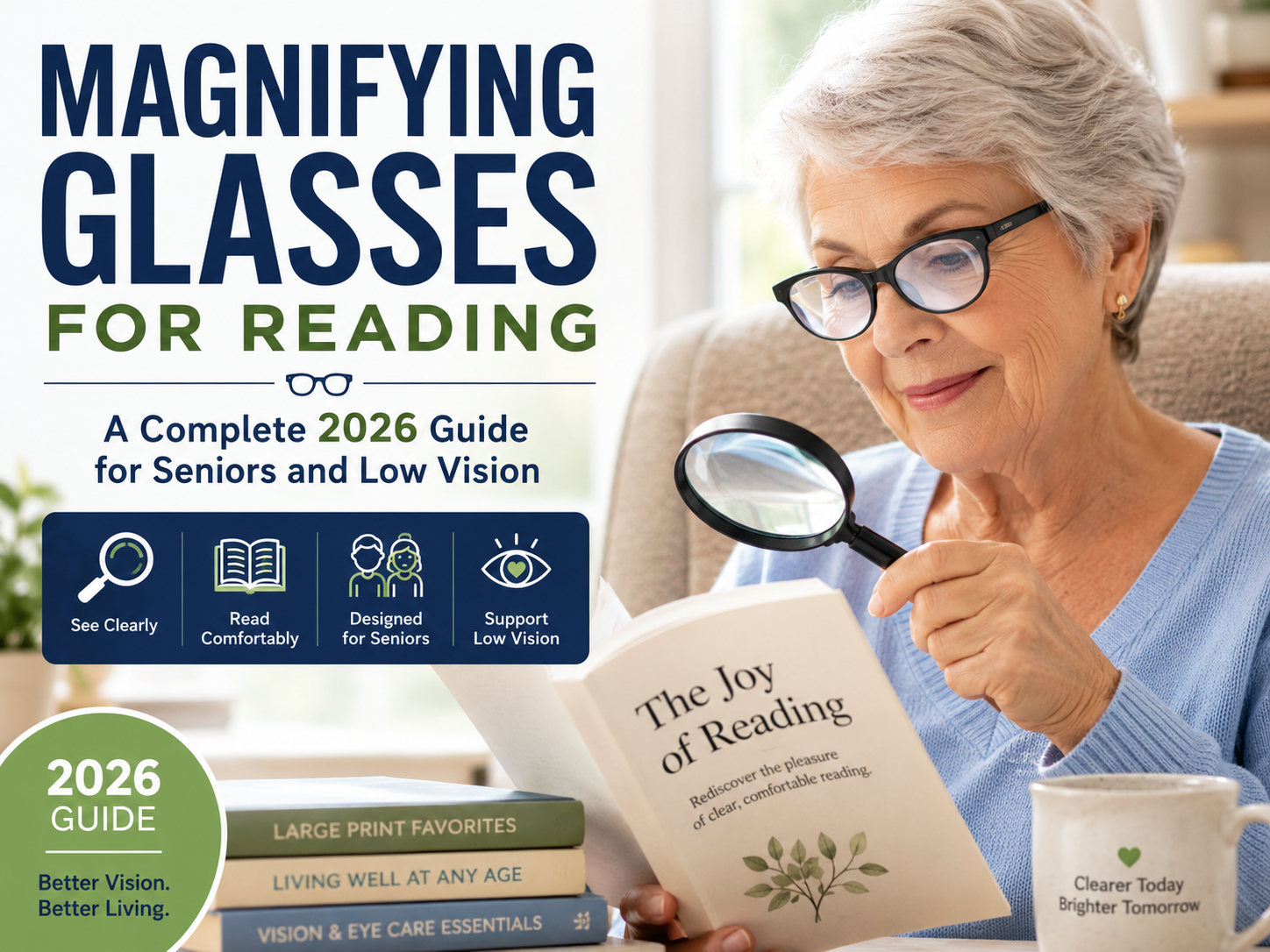
The classic handheld magnifier — a lens mounted in a frame with a handle — is the most versatile type. It's portable, works for any task, and requires no setup. Most come in 2x–5x magnification. The main drawback is that you need one hand to hold it, which can be inconvenient for tasks requiring both hands. For people with arthritis or hand tremor, holding a magnifier steady can be fatiguing.
Handheld magnifiers are a good starting point for anyone new to magnification aids. They're inexpensive, widely available, and easy to use.
Lighted Magnifiers
Lighted magnifiers include built-in LED illumination — either in the handle or around the lens rim. This is a major practical advantage: reading fine print in dim restaurants, checking labels in a dimly lit pharmacy aisle, or reading in bed without disturbing a partner becomes much easier. For seniors with reduced light sensitivity (a normal consequence of aging), lighted magnifiers often feel dramatically better than unlit versions of the same power.
LED lighted magnifiers are available in both handheld and hands-free configurations. Battery life varies; rechargeable models are more economical for frequent users.
Stand Magnifiers
Stand magnifiers sit on the page, freeing both hands. They maintain a fixed focal distance (matching the lens's focal length), which means you don't need to hold the magnifier at exactly the right distance — it's built in. This makes stand magnifiers particularly useful for tasks like reading books, doing needlework, or examining documents when you need both hands available.
Some stand magnifiers include lighting built into the base. They're less portable than handheld versions but excellent for desk use.
Hands-Free / Wearable Magnifiers
Hands-free magnifiers are worn on the head or clip to existing glasses, leaving both hands completely free. They're particularly useful for extended close work like needlepoint, model building, or jewelry repair. Full-head wearable magnifiers (sometimes called "head loupes" or "magnifying visors") are practical for tasks lasting more than a few minutes where holding anything is impractical.
These are not ideal for walking around or general reading, but for specific crafts or hobbies they can be transformative.
Pocket / Wallet Magnifiers
Thin, credit-card-sized or small folding magnifiers that slip into a wallet or purse. They're not as optically refined as dedicated magnifiers, but they are genuinely convenient for occasional use — checking restaurant menus, reading a price tag, scanning a map. For everyday carry, a pocket magnifier addresses the common frustration of forgetting your reading glasses.
Electronic / Digital Magnifiers
Electronic handheld magnifiers use a camera and small screen to show a magnified image — often with adjustable magnification (4x to 20x or more), contrast control, and color filter options. They're significantly more expensive than optical magnifiers but offer capabilities optical lenses cannot: very high magnification without the field-of-view limitations, the ability to freeze an image on screen, and contrast settings that help people with specific vision conditions like macular degeneration. For people with significant low vision, electronic magnifiers (also called video magnifiers or CCTVs) may be a better fit than optical magnifiers alone.
Key Features to Look For
Optical Quality
Lens quality varies significantly across price points. Glass lenses are optically superior to acrylic but heavier. Aspheric lenses (a specific lens design) provide sharper, more consistent magnification across the entire lens surface with less edge distortion. For extended reading, a higher-quality aspheric lens is noticeably more comfortable than a cheap plano-convex lens.
Lens Size
Larger lenses provide a larger field of view at the same magnification, making extended reading more comfortable. A 3x magnifier with a 4-inch lens is easier to use for reading books than a 3x magnifier with a 2-inch lens. For general reading, prioritize larger lens diameter. For portability and spot reading, a smaller lens is fine.
Lighting
Built-in LED lighting is highly recommended for anyone who reads in varied lighting conditions. Aging eyes require more light than younger eyes — significantly more. A lighted magnifier compensates for this naturally declining light sensitivity and makes reading more comfortable in most real-world environments (living rooms, restaurants, cars).
Weight and Grip
For people with arthritis, reduced hand strength, or essential tremor, a lightweight magnifier with a comfortable, textured grip is essential. Some handles are rubberized or ergonomically contoured — worth looking for if you'll use the magnifier for extended periods.
Battery Type
For lighted models, USB rechargeable batteries are more economical and convenient long-term than disposable batteries, especially for daily users. Check battery life ratings — a magnifier used for an hour a day should last several days on a charge.
Who Benefits Most from Reading Magnifiers
Seniors with Presbyopia
Presbyopia (the natural age-related loss of near-focus flexibility) affects virtually everyone by their mid-40s and continues progressing into the 60s and beyond. Even people with strong reading glasses sometimes need magnification for very small print. A reading magnifier complements — rather than replaces — reading glasses, and is particularly useful for tasks where glasses alone are not enough.
People with Macular Degeneration
Age-related macular degeneration (AMD) affects central vision, making fine print reading progressively more difficult. Reading magnifiers — especially high-power or electronic magnifiers — help compensate for central vision loss. Low-vision specialists often recommend starting with a 4x–6x magnifier and adjusting based on current visual acuity. Lighted magnifiers are especially valuable for AMD, as increased illumination can improve contrast and visual clarity.
People with Cataracts
Cataracts cloud the eye lens, reduce contrast sensitivity, and increase glare sensitivity. While cataract surgery is the definitive treatment, a lighted magnifier can significantly improve daily function in the interim and complement vision even post-surgery.
Anyone Who Reads Fine Print Regularly
Medication packaging, food nutrition labels, appliance settings, legal documents, maps — modern life is full of fine print. Even people with generally good vision find a small pocket magnifier genuinely useful to have available.
How to Choose the Right Magnification
A practical approach to choosing magnification power:
- Start lower than you think you need — most people benefit from 2x–3x for general reading and overestimate how much power they need
- Test before committing to high power — higher magnification significantly narrows field of view and can be frustrating to use for extended reading
- Match power to task — 2x–3x for books and newspapers; 4x–5x for labels and fine print; 6x+ for very fine detail tasks
- Consider an eye exam first — if your vision has changed recently, an updated prescription may reduce how much magnification you actually need
AllCare Store: Vision Aids and Daily Living Essentials
At AllCare Store, we carry a thoughtfully selected range of vision aids, personal care products, and mobility essentials to support comfort and independence at every age.
- Free Shipping on every order — no minimum required
- Discreet Packaging — plain, unmarked packaging on all orders
- 30-Day Returns — shop with full confidence
- Expert Help — reach our team at 1-888-889-6260
Explore our Personal Care collection and Home Safety collection for daily-living aids designed with seniors in mind. Visit AllCare Store — your trusted partner in senior health and wellness.
Frequently Asked Questions: Magnifying Glasses for Reading
What magnification is best for reading books and newspapers?
For general reading of books and newspapers, 2x–3x magnification is typically ideal. It provides a comfortable field of view, doesn't require holding the magnifier extremely close to the page, and is far less tiring for extended reading sessions than higher-power magnifiers. Higher power (4x–5x) is more useful for specific tasks like reading very small print on medication labels or maps.
Do I need a lighted magnifier?
For most seniors, a lighted magnifier is worth the modest extra cost. Aging eyes need significantly more light than younger eyes to see the same level of detail, and built-in LED lighting makes magnifiers dramatically more useful in real-world lighting conditions — dimly lit restaurants, pharmacy aisles, bedside reading. If you read in varied lighting environments or have low vision, a lighted model is highly recommended.
What's the difference between a handheld and a stand magnifier?
A handheld magnifier requires one hand to hold it, which is flexible but limits tasks requiring both hands. A stand magnifier rests on the page and maintains the correct focal distance automatically, leaving both hands free. Stand magnifiers are better for extended desk reading or any task requiring two hands, like needlework. Handheld magnifiers are more portable and versatile for casual use.
Are magnifying glasses the same as reading glasses?
No. Reading glasses are low-power corrective lenses worn on the face that correct for presbyopia (loss of near focus), typically in the +1.00 to +3.50 diopter range. Magnifying glasses are optical instruments held in the hand or over text that enlarges the image. They serve different (though sometimes complementary) purposes. Many people use reading glasses for general near work and a magnifying glass for very fine print tasks.
Can magnifying glasses help with macular degeneration?
Yes, reading magnifiers are a mainstay of low-vision management for macular degeneration. They help compensate for reduced central visual acuity by making text large enough to be detected by the surrounding (peripheral) retina. For mild to moderate AMD, a 4x–8x lighted magnifier is often recommended as a starting point. For more advanced AMD, an electronic/digital magnifier or consultation with a low-vision specialist may provide better outcomes. Magnifiers don't treat AMD but they help maintain reading independence as vision changes.