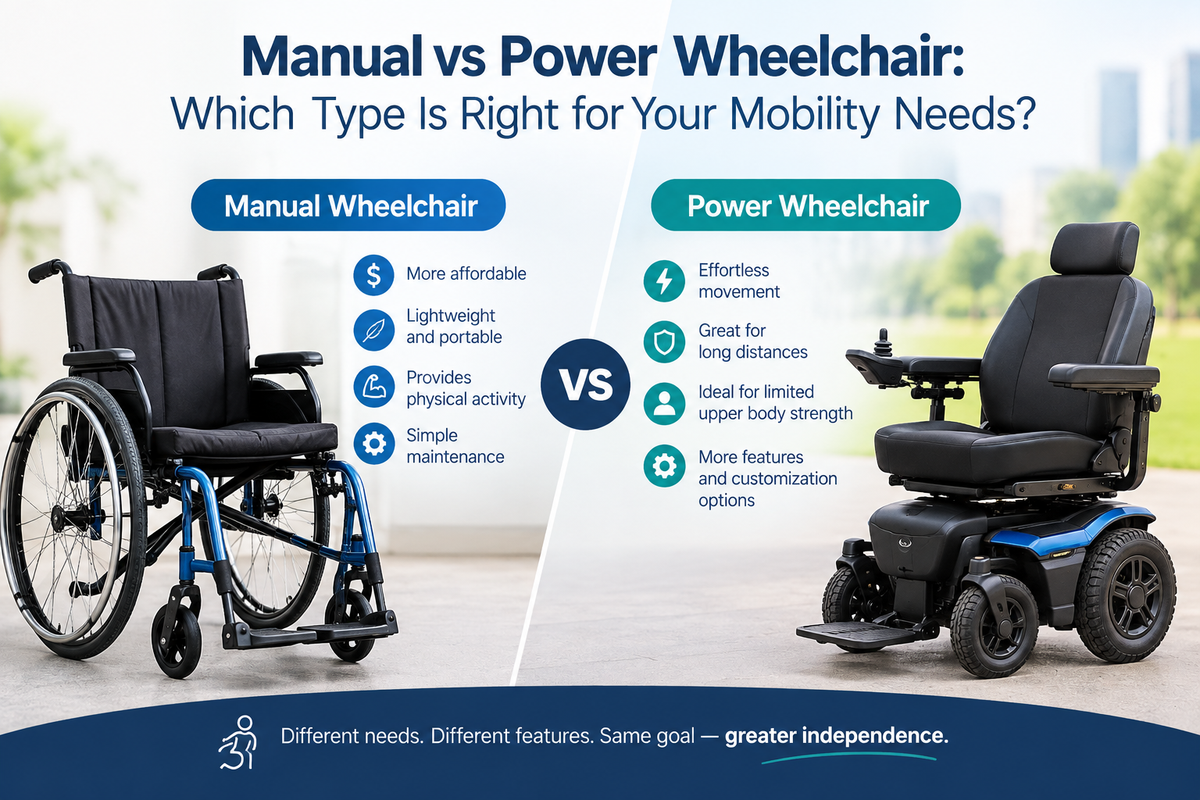
A manual wheelchair is generally suited to users who can propel themselves or have a caregiver available, while a power wheelchair uses a motor and battery to provide powered mobility with a joystick or other control system. The right choice depends on factors such as upper-body strength, daily mobility needs, environment, transportation, and how independently the user needs to operate the wheelchair.
Choosing between a manual vs power wheelchair is an important mobility decision. Both types are available in different sizes, configurations, weight capacities, and feature levels, so understanding their differences can help users and caregivers narrow down the options.
Manual vs Power Wheelchair: At-a-Glance Comparison
| Feature | Manual Wheelchair | Power Wheelchair |
|---|---|---|
| Propulsion | User or caregiver | Electric motor |
| Primary control | Hand rims or caregiver handles | Joystick or alternative controls |
| Battery required | No | Yes |
| Transportation | Often easier to fold and transport | Generally heavier and more complex to transport |
| Maintenance | Usually simpler | Battery, motor, electronics, and mechanical maintenance |
| Independence | Depends on user's ability to propel | Can provide powered mobility for suitable users |
| Indoor maneuverability | Depends on model and user | Many models offer tight turning capability |
| Outdoor use | Depends on tires and design | Varies by model and terrain capability |
| Weight | Often lighter | Usually heavier |
| Storage | Many folding options | Depends on design |
| Cost | Wide range | Generally varies based on technology and configuration |
What Is a Manual Wheelchair?
A manual wheelchair is a wheelchair that moves through physical propulsion rather than an electric motor. The user may propel it using the hand rims, or a caregiver may push it using the handles.
Manual wheelchairs are available in several configurations, including:
- Standard manual wheelchairs
- Lightweight wheelchairs
- Transport wheelchairs
- Folding wheelchairs
- Heavy-duty or bariatric wheelchairs
- Reclining wheelchairs
- Tilt-in-space wheelchairs
- Pediatric wheelchairs
For people who need occasional or regular mobility assistance and can safely use a manual chair, this category provides many options.
Who May Consider a Manual Wheelchair?
A manual wheelchair may be worth considering when:
- The user can safely self-propel.
- A caregiver regularly assists with mobility.
- The wheelchair needs to be transported frequently.
- A folding design is important.
- Battery charging is inconvenient.
- The user primarily needs mobility assistance for specific situations.
- A relatively lightweight wheelchair is preferred.
A user's ability to propel a manual wheelchair can depend on strength, endurance, coordination, wheelchair configuration, and the surfaces where it will be used.
What Is a Power Wheelchair?
A power wheelchair, also called an electric wheelchair, uses a rechargeable battery and electric motors to move the chair.
Instead of pushing the hand rims, the user typically operates a joystick or another control interface.
Power wheelchairs can include features such as:
- Joystick controls
- Adjustable seating
- Power tilt
- Power recline
- Elevating leg rests
- Adjustable armrests
- Multiple drive-wheel configurations
- Suspension systems
- Specialized seating systems
The available features vary considerably between models.
Who May Consider a Power Wheelchair?
A power wheelchair may be considered by users who need powered mobility and cannot comfortably or effectively propel a manual wheelchair for their intended activities.
Factors to consider include:
- Ability to operate a joystick or alternative control
- Daily distance traveled
- Indoor and outdoor environments
- Turning space
- Transportation requirements
- Battery charging access
- Seating and positioning needs
- Terrain
A qualified healthcare or rehabilitation professional can help determine whether powered mobility is appropriate for an individual's functional needs.
Manual vs Power Wheelchair: Propulsion and Independence
One of the biggest differences between a manual and power wheelchair is how the chair moves.
With a manual wheelchair, the user may propel the chair using the hand rims. This requires sufficient upper-body function and endurance for the intended environment.
A caregiver can also push a manual wheelchair.
With a power wheelchair, the motor provides propulsion. A joystick or another control mechanism allows the user to direct the chair.
For users who cannot effectively self-propel a manual wheelchair, powered mobility may provide another way to navigate independently, provided they can safely operate the controls.
Manual Wheelchair vs Power Wheelchair for Daily Use
Your everyday environment should be one of the first things you consider.
Indoor Mobility
For indoor use, consider:
- Doorway width
- Hallway space
- Turning radius
- Furniture placement
- Floor surfaces
- Bathroom accessibility
- Kitchen access
Some power wheelchairs offer excellent maneuverability in confined areas, but the actual turning radius varies by model.
A manual wheelchair can also work well indoors when the user or caregiver has adequate space to maneuver.
Outdoor Mobility
Outdoor requirements can be very different.
If you frequently travel over:
- Sidewalks
- Ramps
- Uneven pavement
- Grass
- Gravel
- Sloped surfaces
consider the wheelchair's tire configuration, ground clearance, stability, and overall design.
Not every manual or power wheelchair is designed for rough outdoor terrain.
Lightweight Manual Wheelchair vs Power Wheelchair for Transportation
Transportation can be a major deciding factor.
A lightweight manual wheelchair can often be folded or disassembled depending on its design. This may make it easier to place in a vehicle.
Some transport wheelchairs are even more compact and are designed primarily for caregiver-assisted mobility.
Power wheelchairs typically contain batteries, motors, electronics, and larger frames. Some models can be disassembled into multiple components, while others require specialized vehicle transportation equipment.
If you frequently travel by car, measure the vehicle's available storage area before purchasing.
For air travel, contact the airline before your trip and confirm its current wheelchair and battery procedures.
Manual Wheelchair vs Power Wheelchair: Weight and Portability
If portability is a priority, wheelchair weight deserves careful consideration.
A lightweight manual wheelchair may be easier for a caregiver to lift, fold, and place into a vehicle.
Power wheelchairs generally have additional components that increase their overall weight.
However, weight should not be considered by itself.
Also compare:
- Weight capacity
- Seat width
- Seat depth
- Folded dimensions
- Battery requirements
- Wheel configuration
- Frame construction
- Accessories
A wheelchair that is lighter but does not meet the user's functional or sizing requirements may not be the appropriate option.
Manual vs Power Wheelchair: Battery and Maintenance
Another important difference is maintenance.
Manual Wheelchair Maintenance
Manual wheelchairs generally have fewer electrical components.
Regular checks may include:
- Tire condition
- Wheel alignment
- Brakes
- Casters
- Footrests
- Armrests
- Fasteners
- Upholstery
The exact maintenance requirements depend on the wheelchair.
Power Wheelchair Maintenance
Power wheelchairs require attention to both mechanical and electrical components.
Users may need to monitor:
- Battery condition
- Charging
- Tires
- Motors
- Joystick controls
- Wiring
- Electronics
- Seating components
Following the manufacturer's charging and maintenance instructions is important for safe operation and reliable performance.
Manual Wheelchair vs Power Wheelchair Cost Considerations
Prices vary significantly within both categories.
A basic manual wheelchair may cost considerably less than a highly configured power wheelchair, but pricing depends on the specific model and features.
Power wheelchairs can include sophisticated electronics, motors, batteries, seating systems, and other components that affect the overall price.
When comparing costs, consider the complete setup rather than the wheelchair alone.
For example, transportation equipment, cushions, batteries, chargers, seating accessories, and maintenance can affect the overall cost of ownership.
How to Choose Between a Manual and Power Wheelchair
Instead of asking which type is universally better, consider your specific mobility requirements.
Choose a Manual Wheelchair When:
A manual model may fit your needs when you:
- Can safely self-propel.
- Have a caregiver who can assist.
- Need a wheelchair for occasional mobility.
- Frequently transport the wheelchair.
- Prefer a simpler mechanical design.
- Need a folding or lightweight option.
Consider a Power Wheelchair When:
A power model may be worth evaluating when you:
- Need powered mobility for daily activities.
- Cannot effectively self-propel a manual wheelchair.
- Need to travel longer distances without manual propulsion.
- Can safely operate the controls.
- Need specific powered seating functions.
- Have appropriate storage and charging arrangements.
These are general considerations rather than a substitute for an individual mobility assessment.
What Size Wheelchair Do You Need?
Proper sizing is essential regardless of whether you choose a manual or power wheelchair.
Important measurements include:
Seat Width
The seat should provide adequate room without creating excessive side-to-side movement.
Seat Depth
The seat depth should accommodate the user's body dimensions while allowing appropriate leg positioning.
Seat Height
Seat height affects transfers, foot positioning, and overall usability.
Back Height
Back support requirements vary according to the user's posture and seating needs.
Weight Capacity
Always check the manufacturer's stated weight capacity and select a wheelchair designed for the intended user.
Manual vs Power Wheelchair for Caregivers
Caregiver requirements can significantly influence the decision.
A manual wheelchair may be convenient when a caregiver frequently pushes the user and needs a relatively lightweight chair that can be transported.
A power wheelchair can reduce the physical effort required from a caregiver when the user can safely operate the controls.
However, caregivers should also consider:
- Charging requirements
- Transportation
- Storage
- Maintenance
- Home accessibility
- Battery management
Wheelchair Accessibility at Home
Whichever wheelchair type you choose, your home environment should be compatible with the chair.
Consider:
- Doorway clearance
- Hallway width
- Ramp access
- Bathroom entry
- Shower access
- Thresholds
- Flooring
- Turning areas
- Bed and furniture placement
For power wheelchairs, additional turning and charging considerations may be necessary depending on the model.
A properly planned accessible environment can make everyday wheelchair use easier and safer.
Common Mistakes When Choosing a Wheelchair
Choosing Based Only on Price
The least expensive option may not provide the required size, capacity, features, or durability.
Ignoring Seat Measurements
A wheelchair that does not fit properly can be uncomfortable and difficult to use.
Forgetting Transportation
A wheelchair may work well at home but be difficult to transport if its weight and dimensions are unsuitable for your vehicle.
Overlooking the User's Propulsion Ability
A manual wheelchair requires the user or caregiver to provide propulsion. Make sure the intended method is practical for everyday use.
Not Considering the Home Environment
Doorways, bathrooms, ramps, thresholds, and turning areas can affect wheelchair usability.
Find the Right Wheelchair for Your Mobility Needs
Understanding the differences between a manual vs power wheelchair can make the purchasing process easier. Manual wheelchairs can offer lightweight and transport-friendly options, while power wheelchairs provide motorized propulsion for users who need powered mobility.
The most important factors are the user's functional abilities, intended environment, transportation needs, wheelchair dimensions, weight capacity, and required features.
Explore manual wheelchairs, transport wheelchairs, lightweight wheelchairs, and power mobility products to compare options based on your specific requirements. For users and caregivers who are unsure about the appropriate configuration, consulting a qualified healthcare or rehabilitation professional can provide individualized guidance.