DISCLAIMER: This article is for general informational purposes only and does not constitute medical or occupational therapy advice. Raised toilet seats and toilet safety equipment should be selected in consultation with a healthcare provider or occupational therapist when possible, particularly following surgery, for users with significant mobility limitations, or for bariatric applications. Improper installation or selection of toilet safety equipment can increase fall risk. Always follow manufacturer installation instructions and weight capacity guidelines.
For many people with hip or knee pain, arthritis, balance issues, or recovering from joint replacement surgery, getting on and off the toilet is one of the most challenging — and highest-risk — daily activities. The standard toilet height of 15 to 17 inches requires significant quadriceps and hip flexor strength, deep knee flexion, and balance on a narrow seat without armrests. A raised toilet seat adds 2 to 6 inches to the seat height, dramatically reducing the range of motion required and the muscular effort needed to rise from seated. Combined with handles or a safety frame, a raised toilet seat can transform a dangerous transfer into a safe, independent activity. This 2026 guide helps you choose the right model for your needs, your toilet, and your bathroom.
Who Benefits from a Raised Toilet Seat?
Raised toilet seats are appropriate for a wide range of situations and user profiles. Understanding which scenarios apply helps clarify which features matter most.
Post-Joint Replacement Surgery (Hip and Knee)
After total hip replacement, surgeons typically restrict hip flexion to 90 degrees or less during the recovery period (often 6–12 weeks, sometimes longer) to prevent dislocation of the new joint. A standard toilet seat requires hip flexion well beyond 90 degrees for most people — making a raised toilet seat (often combined with a toilet safety frame or bedside commode) not just recommended but medically necessary in the post-operative period. Most hospitals discharge joint replacement patients with a raised toilet seat as part of a standard equipment package. Knee replacement recovery similarly benefits from reduced knee flexion demands when rising.
Arthritis (Hip, Knee, and Spine)
Osteoarthritis and rheumatoid arthritis make deep joint flexion painful and mechanically difficult. Raising the toilet seat reduces the range of motion required at the hip and knee, decreasing pain during transfer and reducing the risk of falls from losing balance or rushing due to pain. Handles on a raised toilet seat also offload joint stress by allowing upper extremity assistance with the sit-to-stand movement.
Lower Extremity Weakness
Conditions causing lower extremity weakness — including Parkinson's disease, multiple sclerosis, stroke, peripheral neuropathy, or general age-related sarcopenia — make rising from low surfaces mechanically harder and more fall-prone. A raised seat combined with handles provides both a higher starting position and a stable push point, significantly reducing fall risk.
Balance Disorders
Vestibular disorders, inner ear conditions, and central causes of balance dysfunction make any transfer activity higher risk. Raised seats with secure handles provide a stable structure for maintaining balance during the transition between sitting and standing.
Tall Users
Standard toilet height (15–17 inches) can be genuinely uncomfortable for tall adults (6'2" and above), who must flex their knees more acutely and find rising more difficult regardless of health status. A 2–4 inch riser improves comfort and ease of use for tall individuals even without a medical condition.
Short-Term Recovery
Ankle or foot surgery, knee surgery, lower extremity fractures, or pelvic injuries often make standard toilet use difficult for a period of weeks to months. A raised toilet seat provides a cost-effective, temporary solution during recovery without permanent bathroom modification.
Types of Raised Toilet Seats
Raised toilet seats are available in several distinct configurations, each with different installation methods, features, and ideal use cases.
Raised Seat Without Handles (Basic Risers)
The simplest type — a molded plastic or padded seat that adds height to the toilet. No handles; relies entirely on surrounding grab bars or the user's own strength for safe transfers. Best suited for users who need height elevation only and have adequate strength and balance, or who have independently installed wall-mounted grab bars nearby. Lower cost. Less bulky and easier to remove for other household members. Not recommended as a standalone solution for users with significant weakness or balance issues without separate grab bar support.
Raised Seat With Handles (Integrated Armrests)
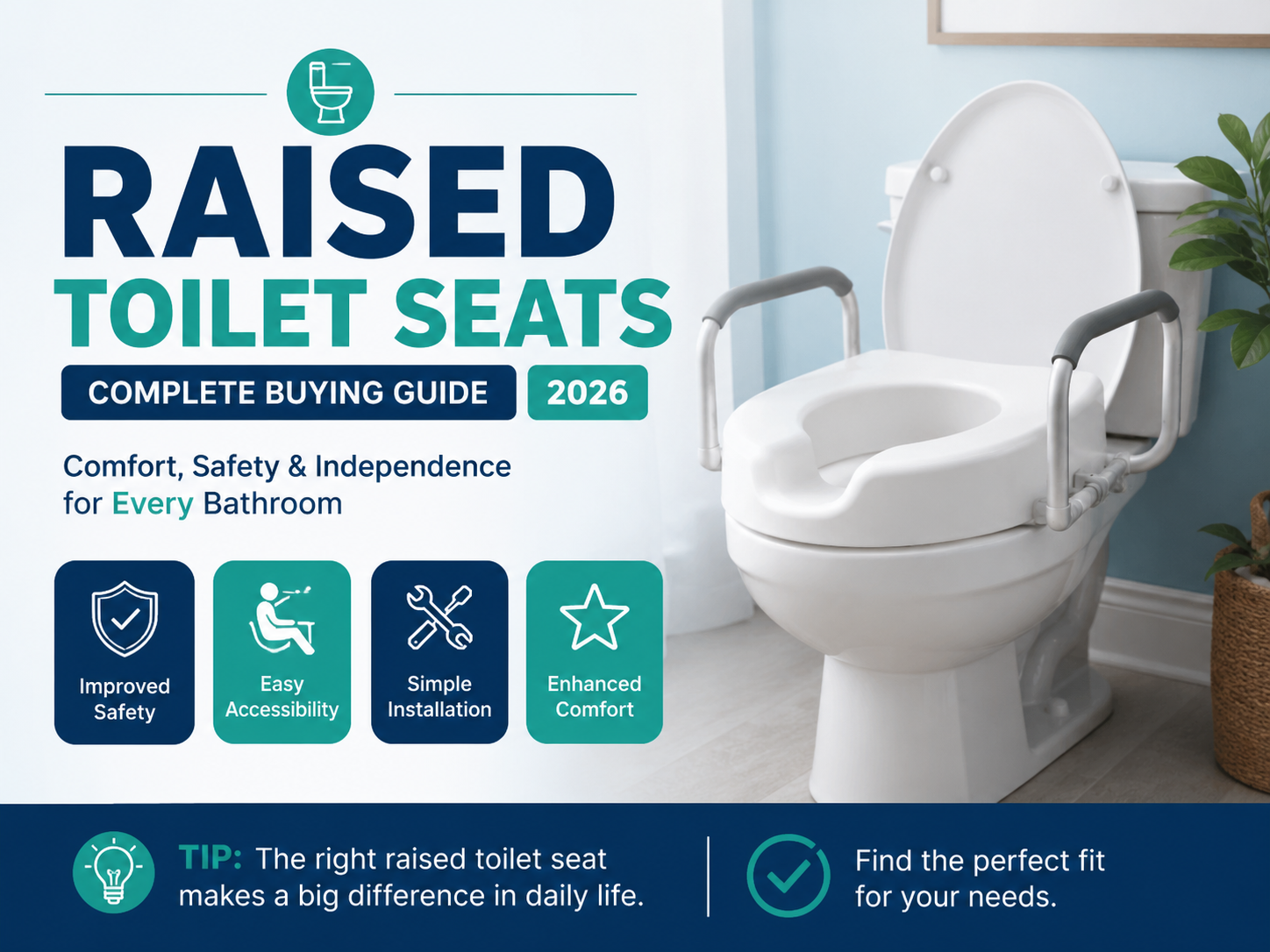
A raised toilet seat with fixed or folding armrests integrated into the seat frame. Handles typically extend 6–10 inches above the seat surface and provide a stable push point for the sit-to-stand movement. The most commonly recommended configuration for users who need both height and upper extremity support. Look for handles with a non-slip grip surface and a comfortable diameter. Folding handles (that swing up out of the way) are useful in shared bathrooms where one user needs the handles and another does not.
Toilet Safety Frames (Freestanding)
A freestanding metal frame that fits around the toilet and provides sturdy armrests at adjustable heights, independent of the toilet seat itself. Does not necessarily raise the toilet seat height — often used with a separate riser or on a comfort-height toilet. Advantage: highly stable (legs brace against the floor), adjustable arm height, easy to reposition or remove. Disadvantage: the frame legs occupy floor space and some users find them visually intrusive. A good choice when maximum stability is the priority and toilet height is already adequate.
Clamp-On Raised Seats
Attach to the toilet bowl using a clamping mechanism that grips under the rim of the existing seat. No tools required; simple to install and remove. More secure than rest-on-top styles during transfers. Available with and without handles. Best for users who need to add and remove the seat regularly or who have a toilet with an unusual shape.
Locking Raised Seats
Feature a locking mechanism that secures the raised seat to the toilet bowl, preventing movement during transfers. The most secure design for users with significant transfer challenges or where safety is the primary concern. Some designs lock by tightening bolts that press against the toilet rim; others use a positive-lock lever. Strongly recommended for heavier users or those with significant lower extremity weakness.
Padded Raised Seats
Feature a padded seat surface (typically vinyl-covered foam) rather than hard plastic. More comfortable for extended or prolonged use; important for users who sit for longer periods due to constipation, urinary retention, or simply preference. Padding also provides some insulation in cold bathroom environments. Tradeoff: harder to clean thoroughly; padding degrades over time with moisture exposure.
Bariatric Raised Seats
Heavy-duty models engineered for higher weight capacities — typically 500, 650, or 850 lbs — compared to the 250–350 lb capacity of standard models. Use heavier-gauge materials, wider seat surfaces, and reinforced handle supports. If a user's weight approaches or exceeds the stated capacity of a standard model, a bariatric model is essential — never exceed the rated weight capacity of any toilet safety product.
Height: How Much Elevation Do You Need?
The correct raised seat height depends on the user's own seated height and the existing toilet height. The goal is to achieve a toilet seat surface that allows the user's hips to be at or slightly above knee level when seated, and that minimizes the effort to rise to standing.
Standard raised seats add 2 to 4 inches to seat height. This is sufficient for most users and most post-surgical protocols.
Taller raised seats add 4 to 6 inches. Appropriate for taller users, users with very limited hip or knee flexion (including strict hip precaution protocols post-surgery), or users with very significant leg weakness.
To determine the right height: with the user seated in a regular chair or on the current toilet, check whether the hips are at or slightly above knee level. If the hips are significantly below the knees, more elevation is needed. Many occupational therapists measure the user's sitting height (floor to popliteal crease — the back of the knee) and recommend a toilet surface at that height. For most adults, this is 17 to 21 inches from floor to seat surface.
Note that comfort-height (ADA-compliant) toilets — increasingly standard in new construction — already sit at 17 to 19 inches, which is 2 to 4 inches higher than standard toilets. If your toilet is already comfort height, you may need less added elevation than you would with a standard toilet.
Fitting: Ensuring Compatibility with Your Toilet
Not all raised toilet seats fit all toilets. Before purchasing, you need to know the shape and dimensions of your toilet bowl.
Round vs. Elongated Bowls
The two standard toilet bowl shapes in North America are round (approximately 16.5 inches front-to-back) and elongated (approximately 18.5 inches front-to-back). Most raised toilet seats are designed for one shape or the other, or are adjustable to fit both. Measure your toilet bowl from the front edge to the back bolt holes — this gives you the bowl length. An elongated seat on a round bowl will overhang the front; a round seat on an elongated bowl will be too short and may rock.
Toilet Bowl Width
Check that the raised seat opening is at least as wide as your toilet bowl, particularly if using a bariatric model where the seat width matters for user comfort.
Toilet Rim Style
Some modern toilets have a skirted or concealed trapway (smooth sides with no under-rim ledge) that makes clamp-on models incompatible. Check whether your toilet has a rim ledge or if the sides are smooth. Some newer models use a different attachment method for this type of toilet.
Bidet Toilet Seats
If a bidet toilet seat is already installed, standard raised toilet seats may not fit over it. There are compatibility issues in both directions — check with the manufacturer of both products.
Installation and Safety
Installation procedures vary by model but most follow the same basic principles. Always read and follow the manufacturer's installation instructions for the specific product.
Remove the existing toilet seat. Most raised toilet seat models are designed to sit directly on the toilet bowl, replacing (or going over) the existing seat. Some models fit over the existing seat; check the product instructions.
Position correctly. Center the raised seat on the bowl with the front edge flush or slightly overhanging the front of the bowl. Side-to-side centering ensures even weight distribution.
Secure the clamp or locking mechanism. Whether using under-rim clamps, locking levers, or bolt-down hardware, ensure the seat is firmly secured with no movement before use. Test by pressing down firmly and attempting to shift the seat side-to-side — there should be no give.
Test weight capacity before first use. Apply body weight carefully while holding a nearby grab bar or having an assistant present. Verify stability before relying on the product for an unsupported transfer.
Clean regularly. Raised toilet seats should be wiped down with a disinfectant cleaner at least daily. Remove and clean under the seat weekly. Check the underside clamps and frame for any signs of cracking, loosening, or corrosion.
Pairing with Other Bathroom Safety Products
A raised toilet seat is most effective as part of a broader bathroom safety setup. Key companion products include:
Grab bars mounted to the wall adjacent to the toilet provide the most stable and reliable hand support for toilet transfers. Wall-mounted grab bars are more secure than any freestanding product and are the gold standard for permanent bathroom safety modifications. They should be installed into wall studs or with appropriate anchors by a qualified handyman or contractor, per ADA guidelines. A horizontal bar 33–36 inches above the floor on the side wall provides the most useful push/pull position for toilet transfers.
Non-slip bath mats in front of the toilet prevent slipping on bare or tile floors during the transfer. Look for mats with suction cups on the underside and a high-traction surface.
Toilet paper holder position is worth reviewing — reaching far to the side or behind for toilet paper is a common cause of balance loss during transfers. A toilet paper holder positioned within easy reach without twisting reduces this risk.
Bedside commodes — portable toilet chairs that can be positioned at any location — are worth considering for users who cannot safely navigate to the bathroom at night, or for post-surgical recovery before full mobility is restored. Many bedside commodes can also be positioned over the toilet and used as a toilet safety frame with a drop bucket removed.
Raised Toilet Seats and Bathroom Safety at AllCare Store
AllCare Store carries raised toilet seats, toilet safety frames, grab bars, commodes, and a full range of bathroom safety products for seniors and those recovering from surgery. Browse our daily living aids collection and our fall prevention products to find the right combination of safety equipment for your home bathroom setup.
Our team is available at 1-888-889-6260, Monday–Friday 7:00 AM–4:00 PM CST. Free shipping on qualifying orders at AllCare Store.
Frequently Asked Questions: Raised Toilet Seats
How much height does a raised toilet seat add?
Most raised toilet seats add between 2 and 6 inches to the existing toilet seat height, with the majority of standard models adding 2, 3.5, or 4 inches. The right amount of elevation depends on the user's height, the existing toilet height, and the degree of hip or knee flexion restriction. Standard raised seats (2–4 inches) are appropriate for most users. Taller raised seats (4–6 inches) are used for very tall users, users with strict hip precaution protocols after joint replacement, or users with very limited lower extremity strength who benefit from a higher starting position to reduce the effort of rising. If you are unsure how much elevation you need, an occupational therapist can assess your specific transfer requirements and recommend the right height.
Do I need a raised toilet seat after hip replacement surgery?
Yes — a raised toilet seat is almost universally recommended after total hip replacement surgery, particularly for the first 6–12 weeks of recovery. After hip replacement, surgeons prescribe hip precautions that restrict hip flexion typically to 90 degrees or less to prevent dislocation of the new joint while the surrounding tissues heal. A standard toilet (15–17 inches) requires hip flexion beyond 90 degrees for most adults, making standard toilet use a dislocation risk. A raised toilet seat (typically 4 inches is recommended, bringing total height to approximately 19–21 inches) keeps hip flexion within safe limits. Most hospitals and surgical centers include a raised toilet seat as part of their standard discharge equipment recommendation, and many insurance plans cover it as durable medical equipment for this indication. Always follow your surgeon's specific recommendations.
Are raised toilet seats covered by Medicare?
Coverage of raised toilet seats under Medicare is limited and conditional. Original Medicare (Parts A and B) generally classifies raised toilet seats as a convenience item rather than durable medical equipment (DME), and does not cover them for home use in most circumstances. However, if a raised toilet seat is prescribed as medically necessary by a physician and meets Medicare's DME criteria in specific clinical situations, partial coverage may be possible — check with your Medicare plan or a DME supplier. Medicare Advantage (Part C) plans vary significantly; some include home safety equipment benefits that cover raised toilet seats and other bathroom safety items. FSA (Flexible Spending Account) and HSA (Health Savings Account) funds can generally be used to purchase raised toilet seats and other bathroom safety equipment when medically necessary, sometimes with a Letter of Medical Necessity from your physician. Contact your insurance plan directly to determine your specific coverage.
How do I keep a raised toilet seat from slipping?
Preventing movement is critical for toilet safety. First, choose a model with a secure attachment mechanism — under-rim clamps (preferred over rest-on-top models), locking levers, or bolt-down hardware provide the most secure attachment. Tighten all clamps or hardware firmly per the manufacturer's instructions and re-check periodically as they can loosen with use. Ensure the toilet itself is securely mounted to the floor and does not rock — a wobbly toilet base will make any raised seat less stable. Avoid models that simply rest on the toilet rim without clamping or locking, as these shift under lateral force during transfers. If using a freestanding toilet safety frame instead, ensure the frame legs are positioned flat and flush with the floor. Check the entire installation weekly for any loosening.
What is the weight limit for raised toilet seats?
Standard raised toilet seats typically have weight capacities of 250 to 350 lbs. Bariatric models are available with capacities of 500, 650, or 850 lbs and are required for users whose weight approaches or exceeds standard capacity limits. Never purchase or use a raised toilet seat rated below the user's weight — this is a serious safety risk that can cause product failure and falls. Always verify the weight capacity before purchase and cross-reference the user's weight including any personal items (heavy clothing, braces, etc.) they typically wear. Bariatric raised toilet seats are wider, have heavier-gauge construction, and wider, more robust handle designs. They are available in handles-included and handles-optional configurations just like standard models.
For raised toilet seats, bathroom safety equipment, grab bars, and daily living aids, visit AllCare Store. Browse our daily living aids and fall prevention collection. Free shipping on qualifying orders. Call 1-888-889-6260, Monday–Friday 7 AM–4 PM CST.