Medical Disclaimer: This article is for informational purposes only and does not constitute medical advice. Bathing safety equipment should be selected and installed in consultation with your physician, occupational therapist, or physical therapist, particularly after surgery, stroke, or other medical events affecting mobility. Individual needs vary significantly.
Transfer Benches for Safe Bathing: Complete Guide (2026)
The bathtub is one of the most dangerous places in the home for older adults and people with mobility limitations. Stepping over a tub wall — especially when wet — requires a combination of balance, hip flexion, and lower body strength that many people simply cannot safely perform. Falls in the bathroom are a leading cause of injury-related emergency room visits for adults over 65, and a significant number occur during bathing.
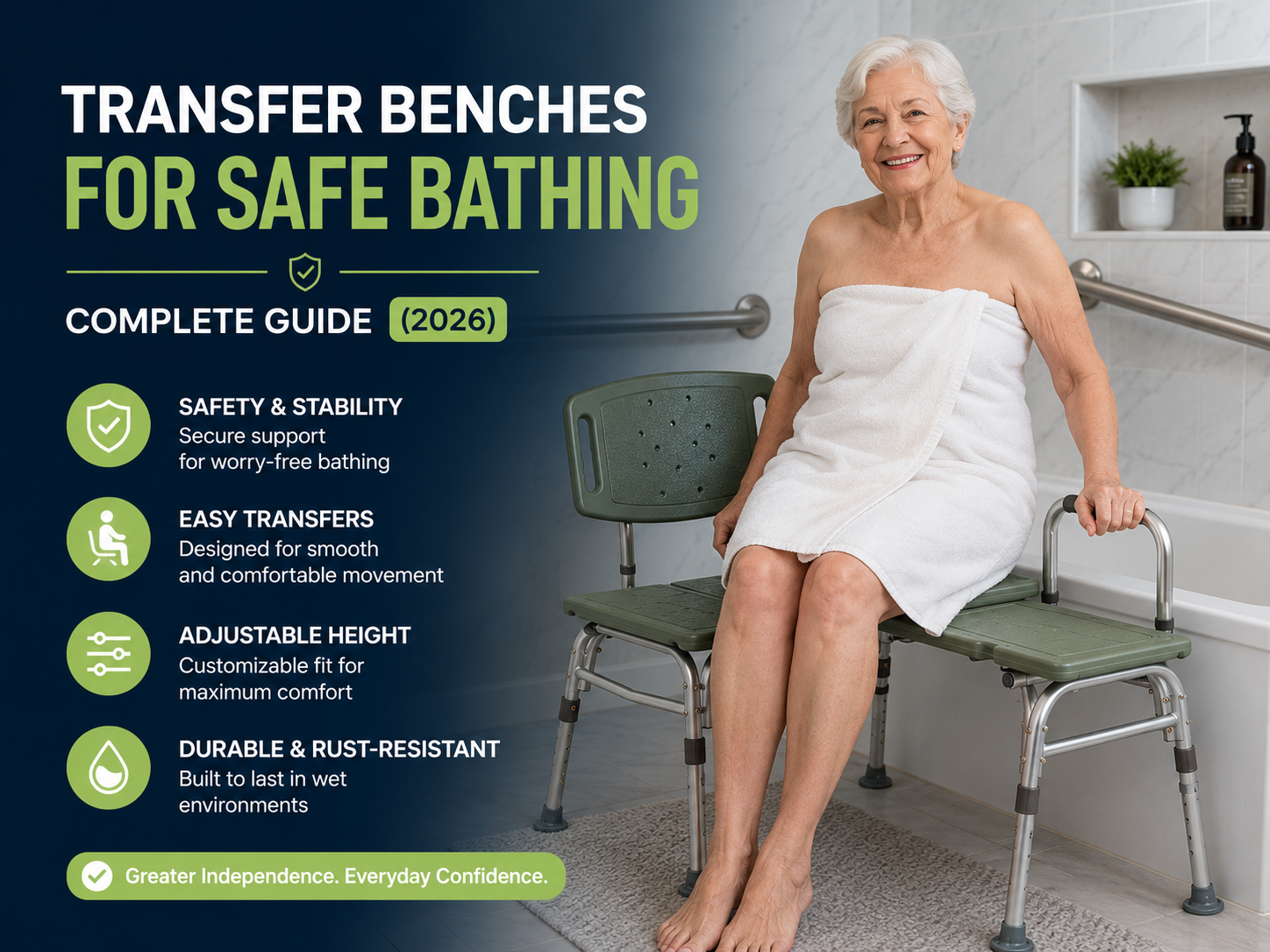
A transfer bench solves this problem elegantly. It spans the tub wall so you can sit down on the outside, slide across the bench seat into the tub, and bathe while seated — without ever needing to step over the tub edge. At AllCare Store, we carry a complete selection of bathroom safety products including transfer benches, shower chairs, grab bars, and accessories. This guide covers everything you need to know about choosing and using a transfer bench safely.
What Is a Transfer Bench?
A transfer bench is a bath safety device that bridges the bathtub wall. Its four legs are height-adjustable — two legs rest outside the tub on the bathroom floor, two legs rest inside the tub. The seat spans the tub rim, allowing the user to sit on the outside portion, then slide laterally across the seat to the inside, rather than stepping over the tub wall. Most transfer benches include a backrest for support and a cutout seat opening for handheld showerhead access for perineal hygiene.
Transfer benches are distinct from bath benches or shower chairs, which sit entirely inside the tub. A bath bench inside the tub still requires stepping over the tub wall to reach it — eliminating the greatest point of fall risk. The transfer bench design eliminates the step-over entirely.
Who Benefits Most from a Transfer Bench?
Transfer benches are recommended by occupational therapists and physical therapists for a wide range of situations. People recovering from hip replacement surgery are among the most common users, as hip precautions typically prohibit bending the hip past 90 degrees — making it impossible to step safely over a tub wall. People who have had knee replacement surgery, hip fractures, or lower extremity joint surgeries also benefit significantly.
Older adults with balance impairments, generalized weakness, or fear of falling in the bathroom find transfer benches restore safe independent bathing. People with stroke affecting one side (hemiplegia or hemiparesis), Parkinson's disease, multiple sclerosis, or other neurological conditions that affect balance and coordination also use them routinely. Individuals with arthritis causing hip or knee pain that makes the step-over movement difficult or painful round out the primary user population.
Key Features to Look for in a Transfer Bench
Seat width and length: the seat must be wide enough to slide across comfortably. Most standard transfer benches have a seat width of 15"–17". Bariatric models offer wider seats (up to 22") and higher weight capacities (up to 550 lbs vs 300 lbs for standard models). Measure your tub width and confirm the bench will bridge it properly — most transfer benches are designed for standard tubs (approximately 14"–17" wide at the top), but some tubs are wider or have curved walls that require specific bench designs.
Leg height adjustability: adjustable legs are essential for proper fit. Look for a wide adjustment range — typically 14"–21" for inside legs and slightly higher for outside legs. All four legs should adjust independently to accommodate a tub rim at the correct level.
Backrest: a backrest provides important support during the sliding transfer and throughout bathing. Some benches have reversible backrests (moving to the other side when the bench is configured for right- or left-handed transfers). Look for a backrest tall enough to support the mid-back, not just the lower back.
Seat cutout: a U-shaped or oval cutout in the seat allows a handheld showerhead to reach for perineal hygiene without the user needing to stand. This is an important hygiene feature most users want.
Non-slip rubber tips: all four legs should have non-slip rubber tips to prevent the bench from sliding on the wet tub surface and bathroom floor. Check that these are securely attached and replace them when worn — they are a critical safety feature.
Drainage holes in the seat: small holes in the seat surface allow water to drain through rather than pooling, reducing the slipping risk on the seat itself.
Right-hand vs left-hand configuration: most transfer benches are configurable for either a right-hand or left-hand transfer (meaning you approach the tub from the right or left side, based on tub placement and physical limitations). Check that your chosen bench is reversible or is designed for your specific tub orientation.
Standard vs Bariatric Transfer Benches
| Feature | Standard Transfer Bench | Bariatric Transfer Bench |
|---|---|---|
| Weight capacity | 250–300 lbs | 400–550 lbs |
| Seat width | 15"–17" | 18"–22" |
| Frame construction | Aluminum | Heavy-duty steel or reinforced aluminum |
| Price range | $35–$80 | $80–$180 |
| Best for | Most adults | Larger body size, higher support need |
Popular Transfer Bench Models (2026)
Drive Medical Tub Transfer Bench
The Drive Medical transfer bench is one of the most widely used and recommended by occupational therapists. It features tool-free assembly, independent height adjustment on all four legs, a backrest with lumbar support, a contoured seat with drainage holes, and non-slip rubber leg tips. Supports up to 300 lbs. Reversible for right- or left-hand transfers. Available in standard and bariatric versions. Its combination of durability, adjustability, and reasonable price makes it the benchmark model in this category.
Medline Premium Transfer Bench
The Medline Premium adds padded seat and backrest comfort upgrades over the standard model — useful for users who spend more time bathing in a seated position. Features the same four-leg adjustment design and 300-lb capacity with a tool-free setup. The padded seat is particularly helpful for users with limited tissue padding due to low body weight.
Carex Transfer Bench
The Carex model is a budget-friendly option that maintains the essential safety features — adjustable legs, reversible backrest, drainage holes — at a lower price point. It's a solid choice for users who need a functional transfer bench for temporary recovery from surgery and don't require the additional features of premium models.
Drive Medical Bariatric Transfer Bench
For users requiring higher weight capacity, the Drive Medical Bariatric Transfer Bench supports up to 400 lbs with a wider 19" seat and reinforced frame. Same reversible, height-adjustable design with all four legs adjustable independently.
How to Use a Transfer Bench Correctly
Setting up and using a transfer bench correctly is critical for safety. Here is the standard technique recommended by occupational therapists.
Setup: Position the bench so the inside legs are inside the tub and the outside legs are on the bathroom floor, with the seat spanning the tub rim. Adjust all four legs so the seat is level (or very slightly tilted toward the inside of the tub) at a comfortable seat height — typically the same height as your other seating, around 17"–19" for most adults. Verify that all four rubber tips are firmly in contact with the floor and tub surface. Do not use the bench if any leg tip appears to be off the surface.
Entering the tub: approach the bench from the outside. Back up to the bench seat and lower yourself to sitting — use a grab bar mounted to the wall for support if available (this is strongly recommended). Once seated on the outside portion of the bench, use your hands on the seat surface (and grab bar if present) to slide your buttocks across the bench toward the inside of the tub. Bring your legs over the tub rim one at a time, using your hands or a leg-lifter if needed. You are now seated inside the tub on the bench.
Bathing: use a handheld showerhead for bathing — this is essential with a transfer bench, as you cannot stand under a fixed showerhead. A suction-cup mounted showerhead holder at seated height makes this more convenient. Use the seat cutout and a long-handled sponge or bath brush to reach difficult areas.
Exiting the tub: slide back across the bench to the outside portion, bring your legs back over the tub rim one at a time, then use the grab bar and bench to stand. Do not stand up while still inside the tub portion of the bench.
Pairing a Transfer Bench with Grab Bars
A transfer bench is significantly safer when used with properly installed grab bars. A horizontal grab bar mounted on the wall at seat height — alongside the bench on the outside of the tub — provides a solid handhold for sitting down, sliding, and standing. A vertical or angled grab bar at the entrance of the tub helps with balance during leg transfers. Grab bars must be installed into wall studs or with appropriate toggle anchors rated for the load — suction-cup grab bars are not sufficient for bathing transfers and should be avoided for this use. Visit our bathroom safety collection for grab bars, non-slip mats, and other transfer bench accessories.
Shop Transfer Benches at AllCare Store
AllCare Store carries a complete selection of transfer benches, shower chairs, grab bars, and bathroom safety products with free shipping on all orders. Visit AllCare Store or call 1-888-889-6260 for help choosing the right product for your bathroom and mobility needs.
Frequently Asked Questions: Transfer Benches
What is the difference between a transfer bench and a shower chair?
A shower chair or bath bench sits entirely inside the bathtub and is used for seated bathing. It still requires stepping over the tub wall to reach it. A transfer bench spans the tub wall — with legs both inside and outside the tub — so the user can sit on the outside of the tub and slide across into the tub without stepping over the wall. The transfer bench is specifically designed for people who cannot safely step over the tub rim, making it the safer choice for people with hip replacements, severe balance issues, or lower extremity weakness. A shower chair is appropriate for people who can safely step into the tub but cannot safely stand throughout bathing.
Does Medicare cover a transfer bench?
Standard transfer benches and bath benches are generally not covered by Medicare Part B under the Durable Medical Equipment benefit, because Medicare classifies them as personal comfort items rather than medical equipment. However, some Medicare Advantage plans may provide coverage or an allowance for home safety equipment — check with your specific plan. Some state Medicaid programs cover bathroom safety equipment with a physician's prescription and documentation of medical necessity. Veterans through the VA may have coverage for home safety equipment through the VA prosthetics benefit. Contact your insurer to confirm your specific coverage.
Can a transfer bench be used in a walk-in shower?
No — a transfer bench is specifically designed to bridge a bathtub wall and requires the tub rim structure. In a walk-in shower without a tub, a shower chair or fold-down wall-mounted shower seat is the appropriate seating solution. Walk-in showers with roll-in access (no threshold or a very low threshold) can accommodate a shower wheelchair or a standard shower chair. If you have a traditional tub-shower combination, the transfer bench is designed for that configuration.
After hip replacement surgery, when can I switch from a transfer bench to a regular shower?
This depends entirely on your surgeon's hip precautions, your recovery progress, and your hip strength and range of motion. Most patients with hip precautions use a transfer bench for 6–12 weeks post-surgery, until their surgeon clears them for movements that require bending the hip past 90 degrees. Your occupational therapist will typically perform a home evaluation before discharge from the hospital or rehab facility and will provide specific guidance on when it is safe to transition back to standard bathing. Never transition earlier than your surgeon or therapist has cleared you — a fall during recovery can cause serious complications including dislocation of the new joint.