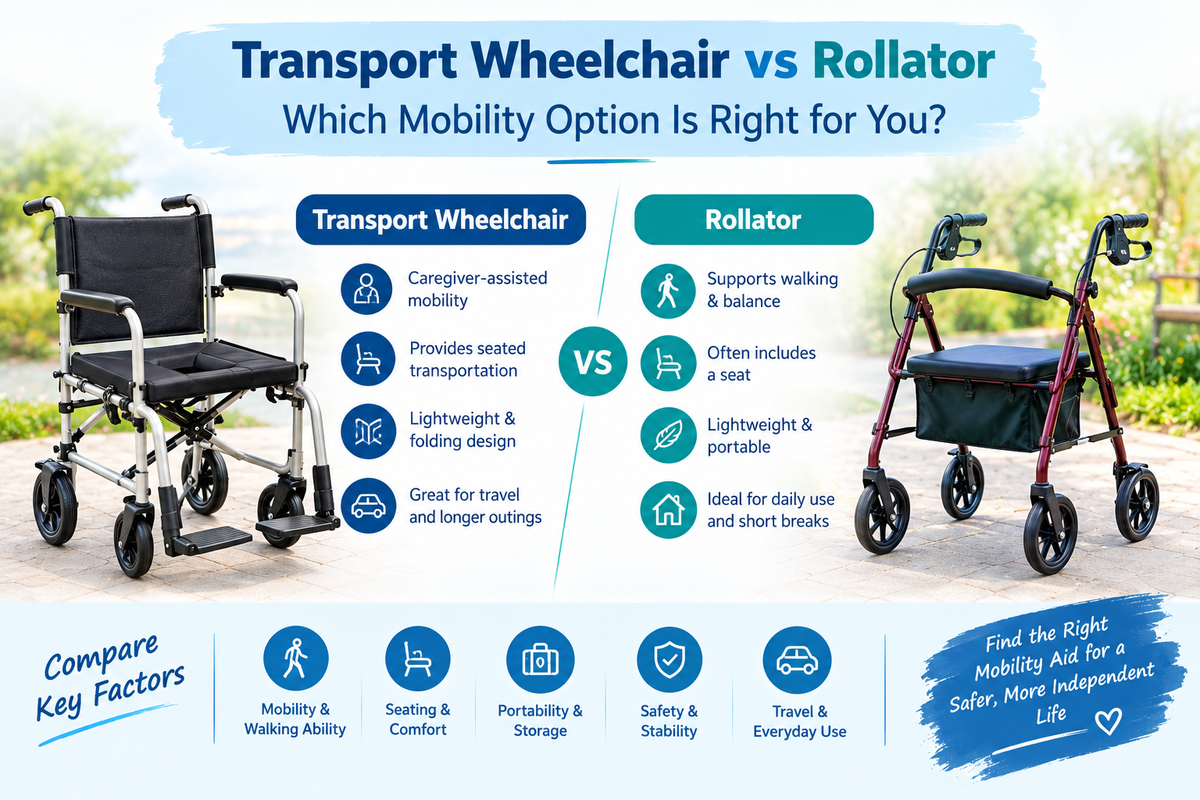
Choosing between a transport wheelchair and a rollator depends on how much walking the user can comfortably manage, whether they need seated mobility, and whether assistance from a caregiver is available. A transport wheelchair is primarily designed for caregiver-assisted seated transportation, while a rollator walker is designed to support walking while providing stability and, in many models, a built-in seat for resting.
Understanding the differences between a transport wheelchair vs rollator can help you compare mobility, seating, portability, maneuverability, weight capacity, and everyday use before choosing a mobility aid.
Transport Wheelchair vs Rollator: At a Glance
| Feature | Transport Wheelchair | Rollator |
|---|---|---|
| Primary purpose | Seated transportation | Walking support |
| Propulsion | Usually caregiver-assisted | User walks and pushes the rollator |
| Built-in seat | Usually | Many models |
| Self-propulsion | Generally not designed for it | Yes, by walking |
| Walking required | No | Yes |
| Caregiver assistance | Usually needed | May not be required |
| Portability | Often folds | Many models fold |
| Weight | Varies by model | Usually lightweight to moderate |
| Best for | Users who need seated mobility | Users who can walk with support |
| Outdoor use | Suitable surfaces depending on model | Suitable surfaces depending on model |
| Storage | Folded models can be compact | Folding models can be compact |
The most important distinction is simple: a rollator supports walking, while a transport wheelchair provides seated mobility and is generally pushed by a caregiver.
What Is a Transport Wheelchair?
A transport wheelchair is a lightweight mobility chair designed primarily for caregiver-assisted transportation. Unlike many standard manual wheelchairs, transport wheelchairs typically have smaller wheels and are not designed for the user to independently propel themselves.
A folding transport wheelchair can also be convenient for storage and vehicle transportation.
Common features include:
- Lightweight frame
- Folding design
- Caregiver push handles
- Smaller wheels or casters
- Locking brakes
- Padded seat and backrest
- Footrests
- Armrests
- Safety belt on some models
- Different seat widths and weight capacities
A portable transport wheelchair can be useful for medical appointments, shopping, travel, family outings, and situations where walking long distances is difficult.
Who May Use a Transport Wheelchair?
A transport wheelchair may be appropriate for someone who:
- Has difficulty walking longer distances
- Needs seated mobility
- Requires caregiver assistance
- Wants a wheelchair for travel or outings
- Cannot comfortably walk throughout a large facility
- Needs a compact mobility option for vehicle transportation
Because the chair is generally pushed by another person, consider who will operate the wheelchair before purchasing.
What Is a Rollator?
A rollator walker is a wheeled walking aid designed to provide support while the user remains on their feet. Most rollators have three or four wheels, handlebars, hand brakes, and a frame that the user pushes while walking.
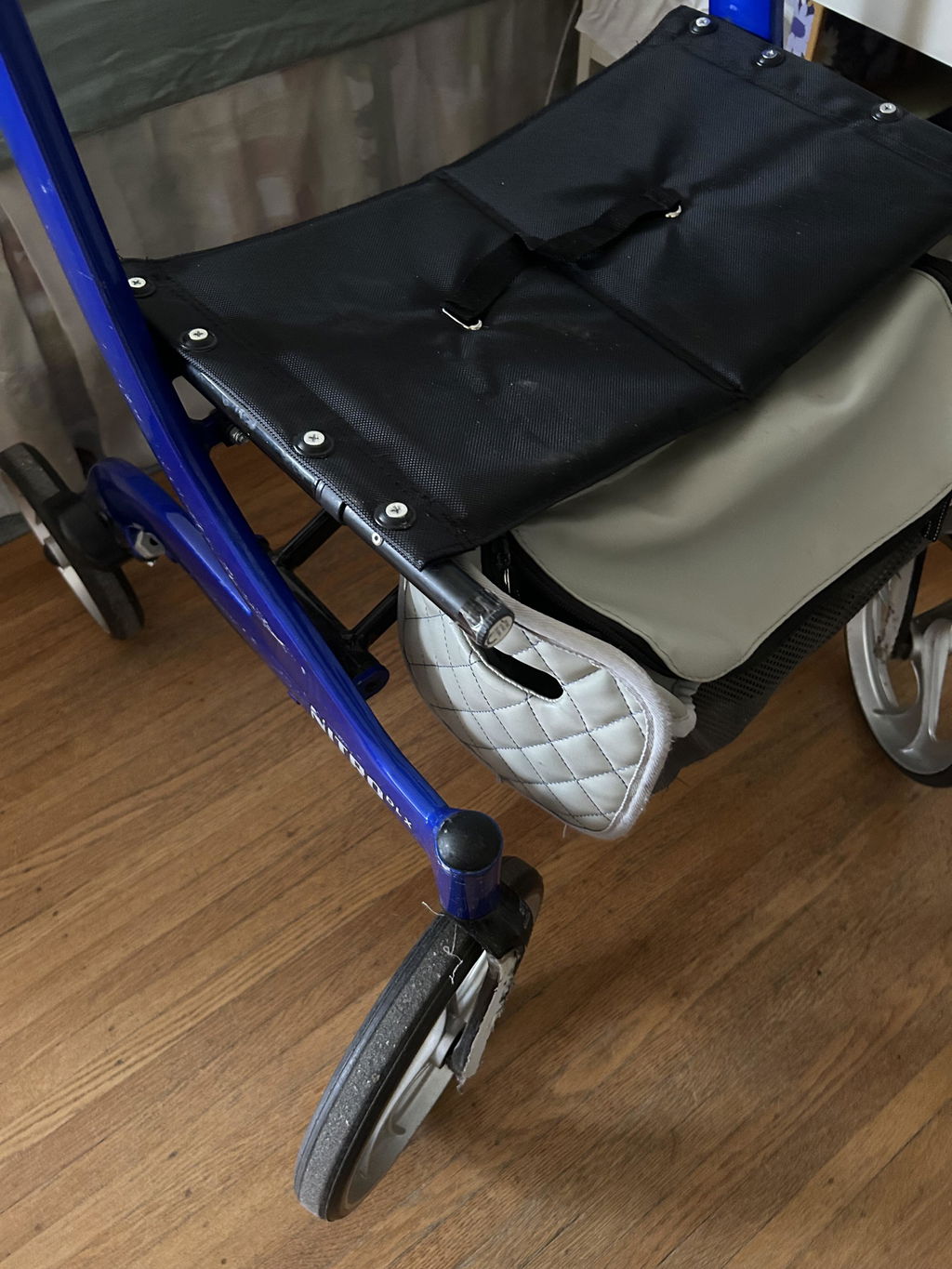
Many rollators with seats also provide a built-in seat that allows the user to take a break when needed.
Common rollator features include:
- Three- or four-wheel design
- Hand brakes
- Locking brakes
- Padded seat on many models
- Backrest on some models
- Storage basket or bag
- Adjustable handle height
- Folding frame
- Lightweight aluminum construction on many models
A walker with seat or rollator with seat can be useful for people who can walk but benefit from additional support and occasional seated rest.
Who May Use a Rollator?
A rollator walker may be suitable for someone who:
- Can walk independently or with some support
- Wants additional stability while walking
- Needs a mobility aid for longer distances
- Wants to sit and rest periodically
- Needs storage for personal belongings
- Wants a folding mobility aid for transportation
The user needs to be able to safely control the rollator, including steering, braking, and maintaining appropriate posture while walking.
Transport Wheelchair vs Rollator: Key Differences
1. Walking Ability
This is one of the most important differences.
A rollator is intended for people who can walk while using the device for support. The user remains standing and moves the rollator forward while walking.
A transport wheelchair does not require the user to walk. The user remains seated while a caregiver pushes the chair.
Simple rule: If the primary need is walking support, consider a rollator. If the primary need is seated transportation, consider a transport wheelchair.
2. Propulsion
A rollator is propelled by the user. The person walks while holding the handles and moving the rollator.
A transport wheelchair is generally propelled by a caregiver using the push handles.
This distinction can be especially important when comparing mobility aids for someone with limited walking endurance.
3. Seated Mobility
Both products can provide a seat, but they serve different purposes.
A rollator with seat is primarily a walking aid. Its seat is generally intended for resting when the rollator is stationary and properly secured.
A transport wheelchair is primarily a seated mobility device.
Therefore, if the user needs to remain seated while traveling between locations, a transport wheelchair may be more appropriate than a rollator.
4. Caregiver Assistance
A transport wheelchair generally requires another person to push it.
A rollator can often be used without continuous caregiver assistance when the user can safely walk and operate the device.
However, individual abilities vary, and users who have difficulty controlling a rollator may still require assistance.
5. Portability
Both options can be portable.
Many folding transport wheelchairs collapse for storage in a vehicle.
Many folding rollators also feature compact frames that make them easier to transport.
When comparing portability, check:
- Product weight
- Folded dimensions
- Carrying handles
- Wheel size
- Vehicle storage capacity
The lightest option is not necessarily the best fit; weight capacity, stability, comfort, and intended use should also be considered.
Transport Wheelchair vs Rollator for Travel
For travel, the choice depends on the user's mobility needs.
A travel rollator may be convenient when the user can walk but needs support and occasional rest. A portable transport wheelchair can be more useful when the user needs to remain seated for longer distances.
For vehicle travel, compare:
- Folded dimensions
- Product weight
- Ease of folding
- Storage space
- Wheel configuration
- Accessories
For air travel, check the current mobility-equipment procedures of the airline before departure.
Transport Wheelchair vs Rollator for Seniors
Both transport wheelchairs and rollators for seniors can provide useful mobility support, but they serve different purposes.
A rollator can support walking and provide a place to sit for short rest periods.
A transport wheelchair can provide seated transportation when walking is difficult or when longer distances need to be covered without walking.
When selecting mobility equipment for an older adult, consider:
- Walking ability
- Balance and stability
- Strength
- Endurance
- Ability to operate brakes
- Need for caregiver assistance
- Transportation needs
- Home environment
- Seat requirements
The user should be able to safely operate the selected mobility aid or have appropriate assistance available.
Transport Wheelchair vs Rollator for Everyday Use
For everyday mobility, consider where and how the device will be used.
A Rollator May Be Useful For:
- Walking around the home
- Shopping
- Short outdoor trips
- Appointments
- Walking through large stores
- Taking rest breaks
- Carrying personal items
A Transport Wheelchair May Be Useful For:
- Longer outings
- Medical appointments
- Shopping trips
- Airport transportation
- Events
- Large facilities
- Situations requiring seated mobility
- Caregiver-assisted transportation
Weight Capacity: Transport Wheelchair vs Rollator
Weight capacity is an important consideration for both products.
Transport wheelchairs are available in different weight capacities, including heavy-duty transport wheelchairs designed for higher user weights.
Rollators also come in different capacities, including bariatric rollators designed for users who require higher weight limits.
Always check the manufacturer's specifications and select a model with an appropriate weight capacity. Never exceed the manufacturer's stated capacity.
Seat Comfort and Support
If sitting comfort is important, compare the seat design carefully.
A rollator with a seat typically has a compact seat intended for resting during walking activities.
A transport wheelchair has a dedicated wheelchair seat designed for seated transportation.
Compare:
- Seat width
- Seat depth
- Padding
- Back support
- Armrests
- Footrests
- Seat height
For extended periods of sitting, proper sizing and support become especially important.
Maneuverability
Maneuverability differs between a rollator and transport wheelchair.
A rollator is designed to move with the user while walking. Swiveling front wheels on many models make it easier to change direction.
A transport wheelchair is controlled by the caregiver, who pushes and steers the chair.
When selecting either option, consider:
- Doorway width
- Hallway space
- Turning areas
- Flooring
- Outdoor surfaces
- Ramps and thresholds
Storage and Accessories
Both mobility aids can offer useful storage options.
Many rollators include:
- Storage bags
- Baskets
- Under-seat storage
- Pouches
Transport wheelchairs may include:
- Storage pockets
- Carry bags
- Under-seat bags
- Accessory pouches
When traveling, storage features can be useful for carrying personal items without placing excessive weight on the mobility aid.
Transport Wheelchair vs Rollator: Safety Considerations
Safety should be a priority when choosing and using either mobility aid.
Transport Wheelchair Safety
- Engage brakes before transfers.
- Make sure the chair is fully opened and secured before use.
- Stay within the manufacturer's weight capacity.
- Use footrests appropriately.
- Inspect wheels and brakes regularly.
- Use a safety belt if supplied and recommended by the manufacturer.
- Avoid surfaces or slopes outside the chair's intended use.
Rollator Safety
- Adjust the handles to an appropriate height.
- Make sure the user can comfortably operate the hand brakes.
- Engage the parking brakes before sitting on the seat.
- Do not use the seat while the rollator is moving.
- Keep the user's weight within the manufacturer's capacity.
- Inspect wheels, brakes, frame, and folding mechanism regularly.
Which Is Easier to Transport in a Car?
Both folding transport wheelchairs and folding rollators can be convenient for car travel.
A transport wheelchair may require more cargo space depending on its frame and seat dimensions, while many rollators fold into relatively compact shapes.
Before buying, compare the product's:
- Folded height
- Folded width
- Folded depth
- Weight
Then compare those measurements with your vehicle's available storage area.
Can a Rollator Replace a Transport Wheelchair?
A rollator cannot always replace a transport wheelchair because the two devices address different mobility needs.
A rollator requires the user to remain capable of walking while using the device.
A transport wheelchair allows the user to remain seated while a caregiver provides mobility assistance.
If a person can no longer safely or comfortably walk the required distance, a rollator may not provide the same functionality as a transport wheelchair.
Can You Use a Transport Wheelchair Without a Caregiver?
Most traditional transport wheelchairs are designed for caregiver propulsion and are not intended for independent self-propulsion.
If independent wheelchair mobility is important, consider a manual wheelchair designed with larger rear wheels and hand rims for self-propulsion.
How to Choose Between a Transport Wheelchair and Rollator
Use the following questions to narrow down your options:
1. Can the user walk safely?
If yes, a rollator may provide useful walking support.
If walking is difficult or not practical for the intended distance, consider a transport wheelchair.
2. Does the user need to sit while traveling?
If the user needs continuous seated mobility, a transport wheelchair may be more suitable.
If the user only needs occasional rest, a rollator with seat may be worth considering.
3. Is a caregiver available?
Transport wheelchairs generally require caregiver assistance for propulsion.
A rollator is designed for user-assisted mobility, although assistance may still be appropriate depending on the individual's abilities.
4. Is portability important?
Compare the weight and folded dimensions of both options.
5. Where will the device be used?
Consider the home, shopping areas, medical facilities, sidewalks, travel destinations, and other environments where the mobility aid will be used.
Common Mistakes When Choosing a Mobility Aid
Choosing a Rollator When Seated Mobility Is Needed
A rollator provides walking support but does not function like a wheelchair.
Choosing a Transport Wheelchair When Independent Walking Is the Goal
A transport wheelchair is generally designed for caregiver-assisted transportation rather than walking support.
Ignoring Weight Capacity
Always compare the user's weight with the manufacturer's stated capacity.
Forgetting Vehicle Storage
Measure your vehicle before purchasing a folding mobility aid.
Focusing Only on Price
Consider comfort, dimensions, weight, capacity, safety features, portability, and intended use in addition to price.