Note: This article is for informational and educational purposes only. It does not constitute medical advice. If your baby shows signs of severe colic, feeding difficulties, poor weight gain, blood in stool, or significant distress during or after feedings, consult your pediatrician. True colic has multiple potential causes; a bottle change addresses only one of them.
Best Baby Bottles 2026: Anti-Colic Options That Actually Work
When Every Feeding Ends in Tears
Maya was three weeks postpartum and running on almost no sleep. Her daughter, Isla, was eating well — she latched during breastfeeding, took a bottle willingly — but every feeding, whether breast or bottle, ended the same way: twenty minutes of desperate crying, legs pulled up, face flushed. Their pediatrician confirmed what Maya had already suspected: gas and colic. The doctor suggested starting with a bottle change since Isla was taking about half her feedings from a bottle while Maya returned to work.
The first bottle they tried — the one from the hospital — had a simple straight nipple and no venting. The second, with an internal vent system that reduced air intake, made a visible difference within three days. Not a miracle — Isla still had fussy evenings — but the post-feeding screaming shrunk from twenty minutes to five, and she slept for longer stretches. The bottle didn't fix everything. It fixed one fixable thing. That alone was worth it.
For parents navigating colic, gas, and feeding fussiness, understanding what bottles actually do (and don't do) is the first step toward making a choice that genuinely helps.
What Is Colic, and What Role Can Bottles Play?
Colic is defined clinically as crying for more than three hours a day, more than three days a week, for more than three weeks in an otherwise healthy infant. It affects an estimated 10–25% of newborns and typically peaks around 6 weeks of age, resolving on its own by 3–4 months in most cases.
The causes of colic are not fully understood and are likely multiple — gut immaturity, sensory sensitivity, feeding-related gas, and parental stress responses may all play roles. Bottle-related air swallowing (aerophagia) is one confirmed contributor to gas discomfort and feeding-related fussiness. Anti-colic bottles specifically address this one mechanism — they cannot resolve colic caused by other factors, but they can meaningfully reduce air intake during bottle feeding.
For formula-fed or mixed-fed babies who show signs of gas discomfort (pulling up legs, arched back, strained facial expression, burping frequently, or gassiness after bottle feeds in particular), an anti-colic bottle is a reasonable first intervention before changing formula or adding gas drops.
How Anti-Colic Bottles Work
All bottles work by creating a flow of milk when the baby sucks. The problem with standard bottles is that as milk flows out, air must flow in to replace it — and unless the bottle has a system to route that air, it gets mixed into the milk and swallowed by the baby.
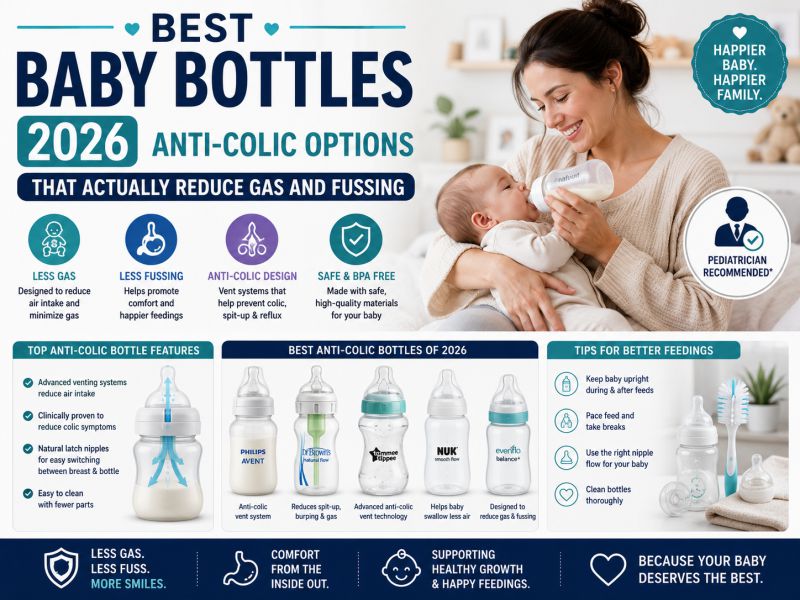
Anti-colic designs address this through several different mechanisms:
Internal Vent Systems
A tube or vent runs through the interior of the bottle, directing air intake separately from milk flow. As the baby drinks, air enters the bottom of the bottle through the vent rather than bubbling up through the milk. This keeps milk and air largely separated, reducing how much air the baby ingests. This is the most common and most proven anti-colic approach.
Angled or Bent Bottle Design
Some bottles are shaped at an angle (often 30–45 degrees) so that when held at a comfortable feeding position, the nipple remains full of milk rather than partially filled with air. This reduces the air-at-nipple problem without requiring a complex vent system, but it does require the parent to hold the bottle at a specific angle.
Vacuum-Free / Collapsible Liner Systems
Liner-based systems use a disposable or collapsible bag inside a rigid holder. As the baby drinks, the liner collapses — eliminating the vacuum that causes air bubbles in rigid bottles. These are highly effective at reducing air intake but involve ongoing liner costs and more complex assembly.
Slow-Flow Nipples
Not technically an anti-colic mechanism on their own, but slow-flow nipples reduce how fast milk flows, giving babies time to pace themselves and swallow with less air intake. Many pediatricians and lactation consultants recommend slow-flow nipples as a first line approach for gassy or fussy bottle-fed babies.
Key Features to Look For in 2026
Nipple Shape and Flow Rate
The nipple is the most important component for feeding comfort, and the wrong shape or flow rate causes more feeding problems than any other single factor.
Flow rate is determined by the number of holes in the nipple tip and their size. Most brands label flow rates numerically (Level 1 slowest, increasing from there) or descriptively (slow, medium, fast). For newborns, start with the slowest flow available. A flow rate that's too fast causes babies to gulp and swallow air; a flow rate that's too slow causes sucking exhaustion and frustration. Signs of the wrong flow rate:
- Too fast: Choking, sputtering, milk running down the chin, pulling off the nipple frequently
- Too slow: Intense sucking effort, clicking sounds, falling asleep before finishing, frustration and crying mid-feed
Nipple shape matters especially for babies who also breastfeed. Breastfed babies use a different oral motor pattern than bottle-fed babies — breastfeeding involves deep latching, jaw movement, and tongue peristalsis rather than simple suction. Wide-base nipples (sometimes called "breast-shaped" nipples) are designed to encourage a wider latch angle that more closely mimics breastfeeding. Whether this truly reduces nipple confusion is debated among lactation consultants, but many find that breastfed babies take wide-based nipples more readily.
Bottle Size
Most bottles come in two sizes: small (4 oz / 120 mL) and large (8–9 oz / 240–270 mL). Newborns typically take 2–3 oz per feeding and do well with smaller bottles. By 3–4 months, most babies consume 4–6 oz per feeding and transition to larger bottles. Starting with smaller bottles reduces the risk of overfeeding by visual cue (finishing the bottle rather than stopping when full).
Ease of Cleaning
Anti-colic bottles typically have more components than standard bottles — vents, internal tubes, or collapsible liners — and these must be disassembled and cleaned after every feeding. A bottle that requires five pieces to disassemble for every wash is a meaningful time investment when feeding 8–12 times per day. Consider how many parts the system has, whether they are dishwasher-safe (top rack), and whether small parts can be cleaned with a standard bottle brush or require a specialized tool.
Material Safety
All reputable baby bottles sold in the US and EU are now BPA-free. Beyond BPA, look for:
- Borosilicate glass: The most chemically inert option; heavier than plastic, can break if dropped, but no chemical leaching concern at any temperature. Some parents prefer glass for peace of mind.
- Polypropylene (PP): The most common plastic used in BPA-free bottles; BPA-free and considered food-safe. Avoid scratching (use soft brushes only) as scratches can harbor bacteria and potentially leach micro-particles.
- Silicone body: Soft, flexible, durable, and completely inert. Some anti-colic bottles use silicone bodies that are soft to hold. More expensive than standard plastic.
Dishwasher and Sterilizer Compatibility
Most plastic bottles are labeled dishwasher-safe on the top rack (lower heat exposure). Glass bottles are generally fully dishwasher-safe. Check that all components — including vent tubes and valves — are dishwasher and sterilizer compatible, as some silicone valves degrade in certain sterilization methods (particularly UV sterilizers vs. steam).
Anti-Colic Bottle Types Compared
| Bottle Type | How It Reduces Air | Best For | Considerations |
|---|---|---|---|
| Internal vent tube | Routes air intake through center tube, away from milk | Gas, colic, general use | More parts to clean; very effective |
| Angled / curved body | Keeps nipple full of milk, reduces air at tip | Simpler cleaning, moderate gas issues | Requires specific holding angle; fewer parts |
| Collapsible liner | Liner collapses as baby drinks; no vacuum or air mixing | Severe colic, heavy air swallowers | Ongoing liner cost; more assembly |
| Wide-neck + slow flow only | Slower intake = less gulping and air swallowing | Breastfed babies, mild gas | Fewer components, easiest to clean; less effective for severe gas |
| Glass bottle | Varies by design; glass body is inert and durable | Parents preferring no plastic; durability | Heavier; can break if dropped; silicone sleeve helps |
Matching the Bottle to Your Baby's Needs
Exclusively Bottle-Fed Babies
For babies who are exclusively formula-fed or receiving expressed breast milk exclusively by bottle, the feeding consistency and volume are fully under the parent's control. These babies often adapt readily to a range of bottle types. Focus on an internal vent anti-colic design with age-appropriate flow rate nipples, and step up nipple flow rate as the baby grows and feeding pace increases (typically around 3 months and again at 6 months).
Breastfed Babies Taking Some Bottle Feeds
The most challenging scenario is maintaining successful breastfeeding alongside bottle use. The risk — whether or not it's fully supported by evidence — is that a bottle's faster, easier flow causes the baby to prefer the bottle, leading to breast refusal. To minimize this:
- Use the slowest flow nipple available, even if your baby seems frustrated initially
- Practice paced bottle feeding: hold the bottle horizontally (not tilted steeply), allow the baby to actively suck for the milk rather than having it pour in, and take breaks every few sucks
- Consider wide-base nipples designed to encourage a wider latch angle
- Introduce bottles early (ideally around 3–4 weeks) once breastfeeding is established, but before 6–8 weeks when nipple preferences tend to solidify
Premature Babies
Premature infants often have less developed suck-swallow-breathe coordination and may fatigue during feeding. Specialized preemie-flow nipples (even slower than standard Level 1) are available and recommended. Gas and colic risk is also elevated in premature infants due to gut immaturity. Consult your NICU team or neonatologist before purchasing a bottle system for a premature infant — their recommendations may differ from general newborn guidance.
Babies with Cleft Palate or Oral Motor Issues
Standard bottles (including anti-colic designs) may not be appropriate for infants with cleft palate or significant oral motor difficulty. Specialized squeeze-assist bottles that allow the parent to gently compress the bottle to control milk flow are available and often recommended in this population. Work with a feeding therapist or craniofacial team for individualized guidance.
Anti-Colic Tips Beyond the Bottle
The bottle is one variable in a multi-factor equation. Complementary strategies that reduce gas and colic symptoms include:
- Pace feeding: Slow down the feed by tilting the bottle nearly horizontally and allowing breaks every 20–30 sucks. This reduces gulping and air swallowing regardless of which bottle you use.
- Frequent burping: Burp every 1–2 oz during feeding, not just at the end. More frequent burping gives trapped air exits before it accumulates.
- Feeding position: Keep baby at a 45-degree angle or higher during feeding, not flat on the back. Gravity helps milk flow toward the stomach and air toward the top.
- Bicycle legs and tummy massage: Gentle leg cycling and clockwise abdominal massage can help move gas through the digestive tract after feedings.
- Warm baths: The warmth and buoyancy can help relax a gassy, tense infant.
- Proper formula preparation: If using powder formula, let it rest for 5 minutes after mixing before feeding — this allows most of the air bubbles introduced by shaking to dissipate. Using a formula pitcher and stirring rather than shaking also reduces air incorporation.
When to Talk to Your Pediatrician
A bottle change is an appropriate first step for routine gas and fussiness. But some symptoms warrant medical evaluation:
- Poor weight gain or weight loss
- Blood in stool or vomit
- Projectile vomiting after most feedings (may indicate pyloric stenosis)
- Arching the back and screaming during feedings (may indicate reflux or GERD)
- Refusing to eat entirely for more than one feeding
- Fever accompanying fussiness
- Crying that cannot be soothed at all, or that seems like it is causing the baby significant pain
These symptoms go beyond what bottle design can address and need a professional evaluation.
Bottle Nipple Replacement: Don't Forget
Even the best anti-colic bottle loses effectiveness if the nipple is worn out. Nipples should be replaced when:
- They show any cracks, tears, or discoloration
- The silicone becomes tacky or thin
- Flow rate seems to change without an obvious cause
- The baby starts refusing a bottle they previously accepted (often caused by a worn nipple with altered feel)
As a general rule, replace nipples every 2–3 months with normal use, or sooner if you notice physical changes. Keeping an extra set of nipples on hand prevents feeding disruptions when one shows signs of wear.
Shop Baby Feeding Products at AllCare Store
AllCare Store carries a selection of baby feeding and mom & baby care products to support healthy feeding from day one. Browse our Mom & Baby Care collection for bottles, feeding accessories, and related products, or explore our full catalog at allcarestore.com.
- Free Shipping on every order — no minimum required
- Discreet Packaging — all orders arrive in plain, unmarked packaging
- 30-Day Returns — shop with confidence
- Expert Help — reach our team at 1-888-889-6260, Monday–Friday 7 AM–4 PM CST
Frequently Asked Questions: Baby Bottles and Anti-Colic
Do anti-colic bottles actually work?
Anti-colic bottles genuinely reduce air intake during bottle feeding, which is one contributor to gas and feeding-related fussiness. Research and widespread clinical experience support that vent-based and liner-based anti-colic bottles meaningfully reduce air swallowing compared to standard bottles. However, colic has multiple potential causes — gut immaturity, sensory sensitivity, and feeding technique all play roles — and an anti-colic bottle addresses only one mechanism. Many parents report significant improvement in gas and post-feeding fussiness; others see minimal change. They are a low-risk, low-cost first intervention worth trying before formula changes or medications.
What nipple flow rate should I use for my newborn?
Newborns should start with the slowest flow nipple available from your chosen bottle brand — typically labeled Level 1, Size 1, or "Newborn/Slow." A flow rate that's too fast causes gulping, air swallowing, choking, and overfeeding. Signs you need to move to the next flow level (usually around 3 months) include: intense sucking effort with visible fatigue, clicking sounds, the baby falling asleep mid-feed before finishing, and feeding frustration. Don't rush to faster nipples — slower is usually better for gas and air swallowing.
What is the best baby bottle for a breastfed baby?
For breastfed babies who also take bottles, the most important features are a slow flow nipple (to require active sucking effort similar to breastfeeding) and a wide-base nipple shape (to encourage a wider latch angle closer to breastfeeding). Paced bottle feeding technique — holding the bottle nearly horizontal and allowing feeding breaks — is as important as bottle selection for reducing nipple preference development. Bottles with internal vent anti-colic systems work well for breastfed babies who show signs of gas, as long as the flow rate is appropriately slow.
Are glass baby bottles safer than plastic?
All reputable baby bottles sold in the US and EU are now BPA-free, so the primary plastic safety concern from earlier decades no longer applies. Glass bottles are chemically inert (no leaching at any temperature or after any amount of use) and are a reasonable choice for parents who prefer to eliminate plastic entirely. The practical drawbacks are weight (glass is heavier, which matters as babies begin self-feeding) and breakage risk if dropped. Borosilicate glass is significantly more break-resistant than standard glass and is used in most quality glass baby bottles. Silicone sleeves around glass bottles reduce (but don't eliminate) shattering risk.
How do I know if my baby is swallowing too much air?
Signs that a baby is swallowing excess air during bottle feeding include: frequent burping during or after feeds, visible gas bubbles in the bottle during feeding, audible gulping or clicking sounds, abdominal distension (a visibly bloated or hard belly) after feedings, pulling up the legs and drawing in the abdomen (a sign of gas pain), prolonged fussiness or crying in the 30–60 minutes after feeding, and frequent spitting up that seems to bring air up with it. If you observe these consistently, trying an anti-colic bottle combined with paced feeding technique is a reasonable first step before consulting your pediatrician.
Medical Disclaimer: This article is for informational purposes only and does not constitute medical advice. Individuals at high risk for pressure injuries should consult a physician, occupational therapist, or certified rehabilitation engineer before selecting a wheelchair cushion.