MEDICAL DISCLAIMER: This article is for informational purposes only and does not constitute medical advice. Consult your physician or physical therapist before using a mobility scooter, particularly if you have balance, cognitive, or cardiovascular conditions. A healthcare provider can assess whether a scooter is appropriate for your specific needs and mobility level.
Margaret's Turning Point: Reclaiming Independence with a Mobility Scooter
Margaret had always been fiercely independent. At 78, she walked with her granddaughter to the farmers market every Saturday morning. But after her hip replacement and the nerve pain that followed, those walks became shorter and shorter — and then stopped altogether. She wasn't confined to bed. She wasn't "that sick." She was just limited. The distance from the car to the grocery store felt like a marathon. The neighborhood walk she'd done for decades felt impossible. And that limitation — so mundane to describe, so devastating to live — quietly took pieces of her life one by one.
Her doctor mentioned a mobility scooter. Margaret had pictured something clinical, institutional — a device for people who had "really" lost their mobility. But her daughter found a compact travel scooter that folded into the car trunk, looked more like a sleek modern product than a medical device, and opened up the world again. The first Saturday they took it to the farmers market, Margaret cried on the way home. Not from pain. From relief.
Mobility scooters are life-changing for millions of seniors and people with mobility challenges — but choosing the right one matters enormously. The wrong scooter for your needs can be frustrating, unsafe, or simply unused. This guide from AllCare Store walks you through everything you need to know to make the right choice.
What Is a Mobility Scooter?
A mobility scooter is a battery-powered, steerable personal vehicle designed to help people with mobility limitations travel distances that walking makes difficult or impossible. Unlike power wheelchairs — which are steered by a joystick and controlled with minimal upper body effort — mobility scooters use a tiller handlebar system and typically require some upper body strength and hand control to operate.
Scooters are not replacements for wheelchairs for people who need full-time seated support. They're best suited for people who can walk short distances but tire quickly, experience pain with extended walking, or need a reliable, long-range personal transport option for outings, errands, and community access.
3-Wheel vs. 4-Wheel Mobility Scooters: Which Is Right for You?
The first major decision in choosing a scooter is wheel configuration, and it has real implications for how the scooter handles and where you can use it.
3-Wheel Scooters
Best for: Indoor use, tight spaces, urban environments with narrow aisles
Three-wheel scooters have a single front wheel and two rear wheels. The single front wheel allows a tighter turning radius — typically 36–44 inches — making them excellent for navigating through store aisles, hallways, and furniture. They're generally lighter, more maneuverable, and easier to transport than four-wheel models.
Trade-offs: Three-wheel scooters are less stable on uneven terrain and slopes. They're not the best choice for outdoor use on grass, gravel, or rough pavement, and some users find them slightly less confidence-inspiring at speed.
4-Wheel Scooters
Best for: Outdoor use, uneven terrain, users who prioritize stability
Four-wheel scooters add a second front wheel, giving them a wider stance and significantly improved stability. They handle outdoor terrain, curb transitions, and slopes much more confidently. Most heavy-duty and long-range scooters use four-wheel configurations.
Trade-offs: The wider turning radius (typically 50–60 inches) makes four-wheel scooters harder to maneuver in tight indoor spaces. They're also heavier and generally more difficult to transport.
Types of Mobility Scooters
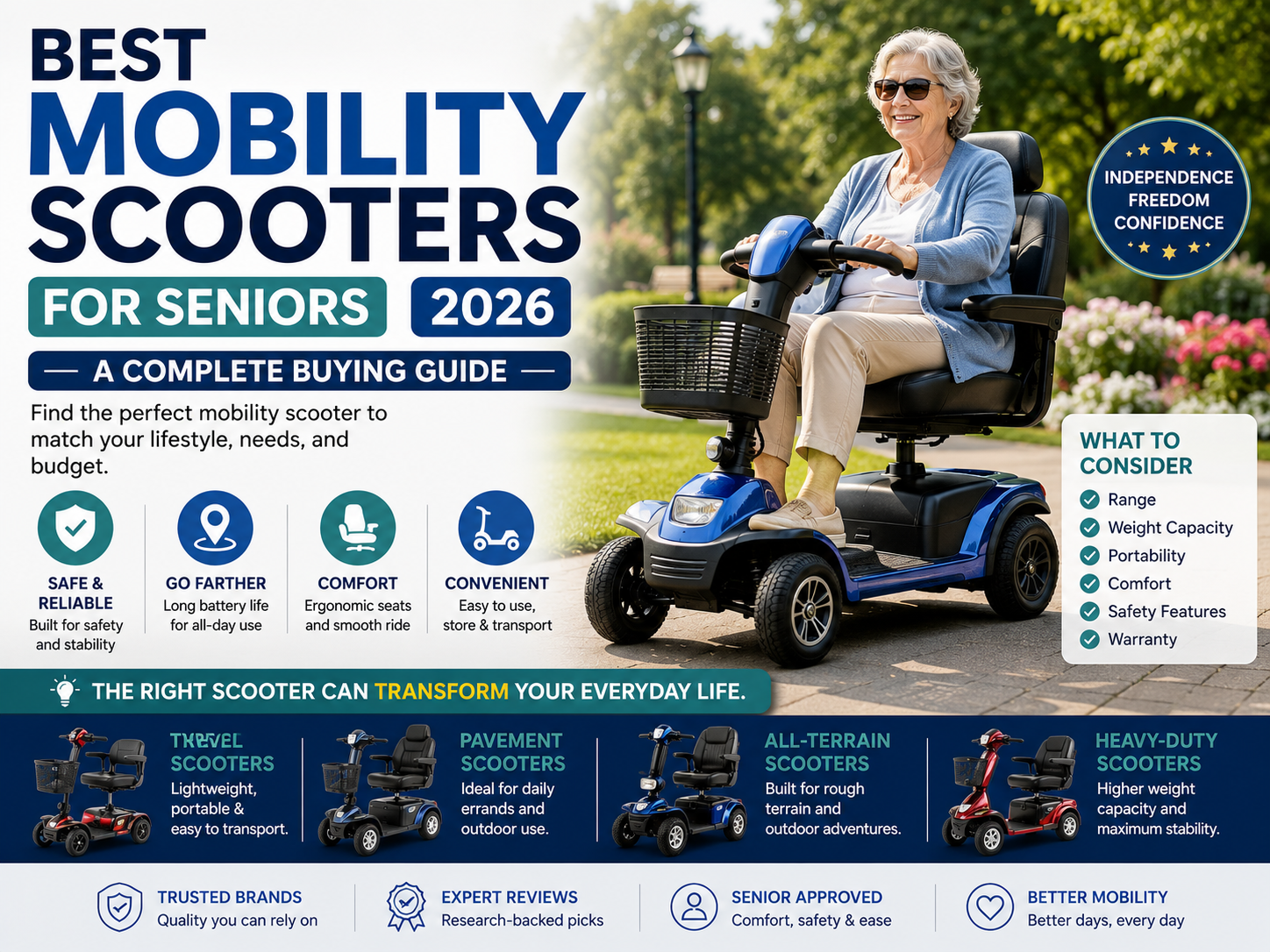
Travel / Portable Scooters
Travel scooters are designed to disassemble quickly — usually into 3–5 pieces — or fold automatically with a remote, making them light enough to fit in a car trunk. Most weigh between 40–80 lbs when assembled, with individual components typically under 30 lbs for easy lifting.
Ideal for: Active seniors who travel frequently, use their scooter for outings and errands, and need to transport it in a personal vehicle. Travel scooters generally have shorter battery ranges (up to 8–12 miles per charge) and lower weight capacities (up to 250–300 lbs).
Limitations: Not designed for all-day, heavy-duty use. Less comfortable for extended sessions, and typically less robust outdoors.
Mid-Size Scooters
Mid-size scooters balance portability and capability. They often disassemble but are heavier than travel models, with greater weight capacity (up to 300–350 lbs), better seating comfort, longer battery life, and improved outdoor capability. They represent the sweet spot for many users who need a scooter for daily use both indoors and outdoors.
Full-Size / Heavy-Duty Scooters
Full-size scooters are built for durability, comfort, and capability. They feature reinforced frames, large pneumatic tires, extended range batteries (up to 25–35 miles per charge), and weight capacities up to 500 lbs or more. They're ideal for heavier users, those who use their scooter as a primary mobility device, and people who spend significant time outdoors or on rough terrain.
Trade-off: Full-size scooters are heavy (100–200+ lbs) and typically cannot be transported in a regular car without a specialized scooter lift or trailer.
Key Features to Evaluate When Buying a Mobility Scooter
Weight Capacity
This is the single most important safety specification. Always choose a scooter rated for at least 20–25% more than your body weight. Consistently operating at or near maximum weight capacity stresses the motor, battery, and frame, shortens the scooter's lifespan, and may affect performance and safety.
- Standard capacity: 250–300 lbs
- Mid-range capacity: 300–400 lbs
- Heavy-duty capacity: 400–500+ lbs
Battery Range
Manufacturer range claims are typically measured under ideal conditions — flat surface, moderate temperature, lighter rider. Real-world range is often 20–30% lower. Consider your typical usage pattern: how far do you actually need to travel on a single charge?
- Travel scooters: 8–12 miles per charge
- Mid-size scooters: 12–20 miles per charge
- Full-size scooters: 20–35 miles per charge
Lithium-ion batteries are becoming increasingly common in newer models. They charge faster (2–3 hours vs. 6–10 hours for lead-acid), weigh significantly less, and maintain capacity better over time — but they cost more. For most daily users, the investment in lithium-ion is worth it.
Speed
Most mobility scooters have a top speed of 4–6 mph — roughly the pace of a brisk walk. Some heavy-duty models reach 8–9 mph. Higher speed sounds appealing but increases stopping distance and demands greater attention to surroundings. For indoor and mall use, lower top speeds are actually safer and easier to control.
Turning Radius
As noted above: 3-wheel scooters offer tighter turning (36–44 inches), 4-wheel models are wider (50–60 inches). Measure the tightest turns you'll regularly need to make — especially bathroom doorways, elevator openings, and kitchen or living room navigation if you'll use the scooter at home.
Seat Comfort and Adjustability
Seat quality matters enormously if you'll spend extended time on your scooter. Look for:
- Padded, contoured seats (avoid hard plastic seats for any prolonged use)
- Adjustable armrests (height and width)
- Swivel seat base for easy on/off transfer
- Adjustable seat height
- Seat back height and tilt adjustability
If you use a specialized pressure-relief cushion, verify that the seat pan dimensions are compatible before purchasing. Our Wheelchair & Scooter Cushions collection includes seat cushions specifically designed for scooter users who need added pressure relief or positioning support.
Tiller Adjustability
The tiller — the steering column with handlebar controls — should be adjustable for your arm length and seated position. A tiller that's too far away strains the shoulders; too close creates cramped steering. Delta-style tillers (a single large loop) are generally more comfortable for users with limited hand strength or arthritis than standard T-bar tillers.
Tires: Solid vs. Pneumatic
- Solid (flat-free) tires: Zero maintenance, never get flats, but transfer more vibration from the surface. Better for smooth indoor/outdoor surfaces.
- Pneumatic (air-filled) tires: Better shock absorption on rough terrain, but require occasional air pressure checks and can go flat. Better for serious outdoor use.
Portability and Transport
If you plan to transport the scooter in a vehicle, test the disassembly process before purchasing. Key questions:
- How many pieces does it break into?
- What is the heaviest single piece?
- Can the person doing the lifting safely manage that weight?
- Does the assembled scooter fit in your vehicle's trunk or cargo area?
Scooter lifts — vehicle-mounted platforms that raise and lower the entire assembled scooter — are an excellent solution for people who want a more capable scooter but can't manage heavy components. We can advise on compatibility.
Mobility Scooter Safety: What Every User Should Know
Before You Ride
- Read the owner's manual completely before first use
- Charge the battery fully before initial use and whenever the battery indicator drops into the lower third
- Check the tires (pneumatic models), brakes, and tiller controls before each use
- Adjust the seat and tiller to your body before moving
Operating Safety
- Always approach ramps, curbs, and inclines at a slow, controlled speed — and straight on (never at an angle)
- Do not attempt ramps steeper than the manufacturer's rated maximum grade (typically 6–8°)
- Avoid sharp turns at speed — they can tip three-wheel models
- Be especially cautious on wet surfaces; stopping distances increase significantly
- Use horn and mirrors in crowded environments
- Stay on designated pedestrian areas; do not use scooters on roads or bike lanes unless local rules specifically permit
Indoor Safety
- Reduce speed significantly in crowded or confined spaces
- Be aware of door thresholds, carpet edges, and transitions between floor surfaces
- Know your scooter's turning radius before entering narrow spaces — test it before committing
- Be alert to small children and pets who may move unpredictably
Who Should NOT Use a Mobility Scooter
Scooters require adequate upper body strength, reasonable hand coordination, and good enough cognitive function to respond to surroundings safely. People with significant upper extremity weakness, poor reaction time, or moderate-to-severe cognitive impairment are generally better served by a power wheelchair with joystick control — or by another mobility solution supervised by a healthcare provider. If you're unsure, ask your doctor or physical therapist for a mobility equipment evaluation.
Medicare and Insurance Coverage for Mobility Scooters
Medicare Part B may cover a mobility scooter (classified as a power-operated vehicle or POV) if your doctor documents that you have a mobility limitation that significantly impairs your ability to perform activities of daily living and that you cannot use a cane, walker, or manual wheelchair to meet your mobility needs in your home.
Key coverage requirements:
- A face-to-face evaluation with your physician documenting your need
- A written prescription/order for the equipment
- Purchase from a Medicare-enrolled durable medical equipment (DME) supplier
- The equipment must be used in your home
Medicare typically covers 80% of the approved cost after your Part B deductible; supplemental insurance may cover the remaining 20%. Coverage is determined on a case-by-case basis. Contact your Medicare plan or a DME supplier for guidance on the prior authorization process.
Private insurance and Medicaid coverage varies significantly by plan and state. VA benefits may also cover mobility scooters for eligible veterans. Always verify coverage before purchasing.
Accessories to Enhance Your Scooter
The right accessories make your scooter significantly more practical and safe:
- Basket or bag: Essential for carrying groceries, medications, or personal items. Most scooters have a front basket; under-seat bags and rear carriers add capacity.
- Cup holder: Stays hydrated on longer outings
- Weather canopy: For outdoor users in variable climates
- Phone mount: Keeps navigation accessible
- Seat cushion: Added comfort and pressure relief for extended rides. See our Cushion & Accessories collection
- Rear-view mirror: Important safety addition for any scooter used in shared spaces
- Flag: Increases visibility in parking lots and crowded areas
Frequently Asked Questions About Mobility Scooters
Can I take a mobility scooter on an airplane?
Most airlines accept mobility scooters as mobility aids at no charge, but there are important requirements. The scooter must have a battery that meets airline regulations — airlines generally accept lithium-ion batteries up to 300 Wh (or two batteries up to 160 Wh each) and require that sealed lead-acid batteries be non-spillable. You'll need to check in the scooter at the gate or ticket counter; it will be loaded as checked baggage. Contact your airline well in advance — at least 48–72 hours before departure — to confirm their specific requirements, battery policies, and any documentation needed.
How long does a mobility scooter battery last before needing replacement?
Battery lifespan depends on the battery type and usage habits. Lead-acid batteries (the most common in standard scooters) typically last 12–24 months with regular use and proper care. Lithium-ion batteries generally last 3–5 years or 500–700 charge cycles. To maximize battery life: charge after every use (don't let it fully deplete), avoid leaving the battery on the charger for extended periods after reaching full charge, store the scooter in a temperature-stable environment (avoid extreme cold or heat), and follow manufacturer charging instructions exactly.
What is the difference between a mobility scooter and a power wheelchair?
Mobility scooters use a tiller (handlebar steering) and are designed for people who can walk short distances but need help with longer distances. They require some upper body strength and hand control. Power wheelchairs use a joystick controller and are typically prescribed for people who need a full-time seated mobility solution and cannot reliably control a scooter's tiller system. Power wheelchairs are also more maneuverable in tight indoor spaces (most can turn in place) and are appropriate for users with more significant mobility limitations. A physical therapist or physiatrist can perform a mobility assessment to determine which option is most appropriate for your needs.
Can I use a mobility scooter indoors?
Yes — many people use mobility scooters in their homes, particularly in larger spaces. For indoor use, prioritize a model with the tightest possible turning radius (typically 3-wheel models) and the ability to reduce to very low speeds (under 2 mph) for safe maneuvering around furniture and through doorways. Standard interior doorways are 32–36 inches wide; measure your doorways and compare to the scooter's width before purchasing. Many scooter users find that their home works well for a scooter with minor furniture rearrangement to create clear pathways.
How do I charge a mobility scooter?
Most mobility scooters include a charger that plugs into a standard household outlet (120V in the US). The charger connects either directly to the battery pack or to an off-board charging port on the scooter — no need to remove the battery. Charge times vary: lead-acid batteries typically take 6–10 hours for a full charge; lithium-ion batteries charge in 2–4 hours. Most modern scooters have an automatic shutoff that prevents overcharging, but it's still best practice not to leave it charging indefinitely. Charge at the end of each day of use, even if the battery isn't fully depleted — partial charging extends battery lifespan.
Complementary Products for Scooter Users
Mobility scooter users often benefit from additional products that extend independence and safety at home and in the community:
- Bathroom safety grab bars: Scooter users who still walk short distances within the home need secure bathroom safety. See our Bathroom Safety collection.
- Ramps: Portable threshold ramps and modular ramp systems help scooters navigate curbs, steps, and vehicle transitions
- Seat cushions: Gel and memory foam cushions for pressure relief on longer rides. Browse our Cushions & Accessories
- Compression socks: Prolonged seated time can affect circulation in the legs. Our Compression Stockings & Socks collection includes graduated compression options
- Pill organizers: For active seniors who carry medications during outings
Finding Your Independence Again
For Margaret, the mobility scooter didn't represent giving up. It represented getting back. The Saturday morning farmers market returned. So did the neighborhood walks — just on wheels now. So did the visits to her grandchildren's school events. So did the ordinary, unremarkable freedom of being able to go where she wanted to go, when she wanted to go there.
The right mobility scooter, matched to your actual needs and lifestyle, can do the same for you or someone you love. At AllCare Store, we're committed to helping you find the right mobility solution — not just any solution, but the one that genuinely fits your life.
Explore our Mobility Scooters collection and our full Mobility Aids range, or call our team at 1-888-889-6260 for personalized guidance. We're here to help you move forward — confidently, safely, and on your terms.
Medical Disclaimer: This article is for informational purposes only and does not constitute medical advice. Individuals at high risk for pressure injuries should consult a physician, occupational therapist, or certified rehabilitation engineer before selecting a wheelchair cushion.