DISCLAIMER: This article is for informational purposes only. Every baby is different — consult your pediatrician if you have concerns about diaper rash, skin sensitivity, or your newborn's health.
The first weeks with a newborn move fast. In that blur of feeding schedules and sleepless nights, one thing you'll need in constant supply is diapers — and getting the right kind from the start matters more than most parents expect.
Newborn skin is extraordinarily sensitive. It reacts to friction, moisture, fragrances, and even slight fit issues in ways that older babies' skin does not. A diaper that works fine for a 3-month-old can cause persistent rash or leaks on a 1-week-old. Choosing diapers designed specifically for the newborn stage isn't just a marketing distinction — it's genuinely important for comfort and skin health.
This guide breaks down everything you need to know: what makes a good newborn diaper, how many to buy (without over-stocking a size your baby will outgrow in weeks), and when to make the switch to Size 1.
What Makes Newborn Diapers Different
Newborn diapers aren't just smaller versions of regular diapers. They have several design features specific to the newborn stage:
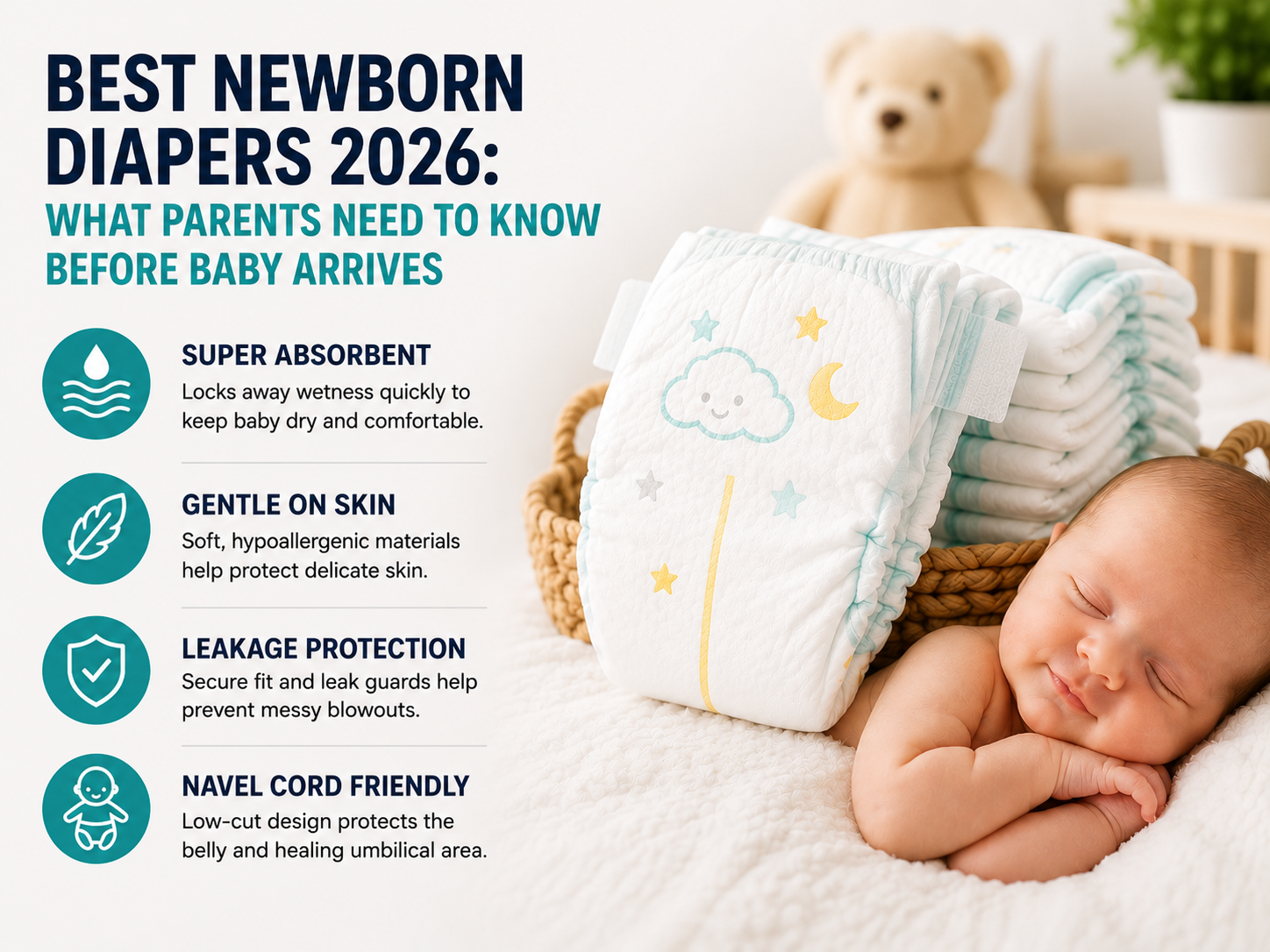
Umbilical cord notch: Most quality newborn diapers have a U-shaped or curved cutout at the front waistband. This keeps the diaper from rubbing against the umbilical cord stump, which typically falls off within 1-3 weeks. This feature alone is worth choosing a dedicated newborn diaper over a "Preemie" or generic small size in the early days.
Extra-soft materials: Newborn skin has a thinner, more permeable outer layer than older infants. Premium newborn diapers use ultra-soft inner layers — often cotton-like or cloth-like top sheets — to minimize friction against delicate skin.
Wetness indicator: Nearly all newborn diapers include a yellow stripe that turns blue or green when wet. This sounds like a small feature, but for exhausted new parents who are trying to track feeding and output, it's genuinely useful for knowing when to change without unnecessary undressing.
Gentle elastic: The leg cuffs and waistband on newborn diapers are designed to be snug enough to prevent leaks without leaving deep red marks on tender skin. If you consistently see red marks after removal, it's a sign the diaper is too small or the brand doesn't suit your baby's body shape.
How Many Newborn Diapers Do You Actually Need?
This is one of the most common — and most expensive — mistakes new parents make: buying too many newborn diapers. Here's the reality:
Newborns typically need 10-12 diaper changes per day in the first weeks. They also grow extremely fast. Most babies outgrow the newborn size (up to ~10 lbs) within 2-6 weeks, sometimes sooner. Some larger babies skip the newborn size entirely — if your baby was born above 9 lbs, buy very few newborn diapers and plan to move to Size 1 quickly.
A practical approach: buy 1-2 packs of newborn diapers before the birth (roughly 100-140 diapers total). Don't open all of them — if your baby is larger than expected, you can return unopened packages. Stock up on Size 1 diapers instead, which fit babies from about 8-14 lbs and last considerably longer.
Newborn Diaper Sizing Guide
| Size | Weight Range | Typical Age | Notes |
|---|---|---|---|
| Preemie | Under 6 lbs | Premature or very small newborns | Only if needed — most babies skip this size |
| Newborn (NB) | Up to 10 lbs | Birth to ~4-6 weeks | Has umbilical cord notch; buy limited supply |
| Size 1 | 8-14 lbs | 2 weeks to ~4 months | Stock up on this size — widest usage window |
| Size 2 | 12-18 lbs | 3-8 months | Begin transitioning when leaks increase |
Signs It's Time to Move Up a Size
Don't go purely by weight — watch for these practical signals that your baby has outgrown the current size. If you're seeing frequent blowouts despite a snug fit, the diaper is likely too small for your baby's body. Red marks on the thighs or waist after removal indicate the elastic is too tight. If the tabs barely reach the landing strip when fastened, the diaper is too small. And if the diaper looks crinkled or bunched rather than smooth and fitted, your baby needs the next size up.
Key Features to Look For
Absorbency and Leak Protection
In the newborn stage, you're dealing with frequent small voids rather than large ones. Good newborn diapers use absorbent gel cores that distribute moisture quickly and lock it away from skin. Look for diapers with inner leg cuffs (small gathered elastics near the leg openings) — these are a primary defense against side leaks and blowouts.
Fragrance-Free and Hypoallergenic
Fragrances and harsh chemicals in diapers are a leading cause of contact dermatitis in newborns. For the first weeks especially, choose fragrance-free, dye-free options. If your baby develops a persistent rash that doesn't respond to diaper cream and frequent changes, switching to a different diaper brand is worth trying.
Fit for Body Shape
This is underappreciated: different diaper brands fit differently shaped babies better or worse. Babies with chunkier thighs may do better with a brand that has stretchier leg cuffs. Longer, leaner babies may need a brand with a longer rise (distance from front to back). Don't assume the most popular brand is the best for your specific baby — you may need to try 2-3 brands in the newborn stage.
Cloth vs. Disposable Newborn Diapers
Many parents consider cloth diapers for environmental or cost reasons. For the newborn stage specifically, it's worth knowing that cloth diapers have a steeper learning curve, require more frequent washing, and don't have the umbilical cord notch of disposables. Many parents who plan to use cloth long-term still use disposables for the first 4-6 weeks, then transition once the cord stump falls off and the initial chaos of newborn care settles.
If you're committed to cloth from birth, look for newborn-specific cloth diaper covers that are sized for smaller babies (many one-size cloth diapers start fitting well only around 10-12 lbs).
Diaper Rash Prevention in the Newborn Stage
Newborn skin is particularly prone to diaper rash because the skin barrier isn't fully mature and babies are changed so frequently with such soft stools. To minimize rash risk: change diapers every 2-3 hours and promptly after bowel movements; use fragrance-free wipes and pat dry rather than rubbing; apply a thin layer of zinc oxide barrier cream (like Desitin or A+D) at each diaper change for the first few weeks as a preventive measure; and let the skin air-dry for a minute before putting on a fresh diaper.
If a rash develops that doesn't improve within 2-3 days of increased diaper changes and barrier cream, or if the rash has satellite spots (possible yeast infection) or open sores, consult your pediatrician.
How to Properly Put On a Newborn Diaper
It sounds basic, but proper technique prevents many leaks and rashes. Lay the diaper flat with the tab side under the baby's back at waist level. Pull the front up and over the belly, making sure the umbilical stump is above the waistband or in the notch — not covered by it. Fasten tabs snugly but with two-finger clearance at the waistband. Then run your finger around the leg cuffs to make sure they're pulled out and unfolded — the cuff should be facing outward, not tucked in, for leak protection. Check that the diaper sits evenly on both sides.
Budget vs. Premium: Is There a Real Difference?
In the newborn stage, there is a meaningful quality difference between budget and premium diapers that matters more than it will later. Premium diapers tend to have better-fitting elastic, softer interior materials, and more reliable absorbent cores — all of which matter more for tender newborn skin. This doesn't mean you need to spend the maximum; mid-range options from established brands generally perform well. Store brands from major retailers have improved considerably in recent years and are worth considering.
That said, for the newborn stage (which lasts only a few weeks), spending slightly more for a softer, better-fitting diaper is a reasonable choice if your budget allows. You'll go through far fewer newborn diapers in total than you will for later sizes.
Shop NewBorn and Baby Care Supplies at AllCare Store
AllCare Store carries a full selection of baby care products to help you prepare for your new arrival. Browse our Mom & Baby Care collection for newborn diapers, wipes, diaper rash creams, and more — everything you need for comfortable, rash-free diaper changes.
Need other essentials? Our First Aid collection includes baby-safe antiseptics and wound care products, and our vitamins and supplements section has postnatal vitamins for nursing mothers. Shop at AllCare Store with free shipping on qualifying orders. Call us at 1-888-889-6260, Monday through Friday, 7:00 AM – 4:00 PM CST, for personalized product recommendations.
Frequently Asked Questions: Newborn Diapers
How many newborn diapers should I buy before baby arrives?
Buy 1-2 packs of newborn diapers (roughly 100-140 total) before birth, and leave some packs unopened in case your baby is larger than average and outgrows them quickly. Focus most of your pre-birth diaper stocking on Size 1 (8-14 lbs), which has a longer use window. If your baby is born larger than 9 lbs, you may skip the newborn size entirely.
When should I move from newborn to Size 1 diapers?
Move to Size 1 when your baby reaches around 10 lbs, or sooner if you see red marks from elastic, frequent leaks despite good fit, or the tabs barely reach the landing strip. Many babies transition to Size 1 between 2-6 weeks of age. Watch your baby's fit rather than sticking rigidly to weight charts — fit varies by brand and baby body shape.
Why do newborn diapers have a notch at the front?
The U-shaped notch at the front of newborn diapers is designed to keep the diaper away from the umbilical cord stump, which typically falls off within 1-3 weeks after birth. Rubbing against the stump can slow healing or cause irritation. This notch is one of the key features that makes dedicated newborn diapers worth using in the first weeks rather than jumping straight to Size 1.
Are expensive newborn diapers worth it?
In the newborn stage, premium diapers do offer meaningful quality differences — softer materials, better-fitting elastic, and more reliable absorbency — that matter more for delicate newborn skin. However, you'll use newborn diapers for only a few weeks, so you won't spend as much in total as you will on later sizes. Mid-range options from established brands are a good balance of quality and value. Avoid very cheap, unknown-brand diapers in the newborn stage specifically.
What causes diaper rash in newborns and how can I prevent it?
Newborn diaper rash is usually caused by prolonged skin contact with moisture and stool, friction from diapers, or skin sensitivity to fragrances and materials. Prevent it by changing diapers every 2-3 hours and promptly after bowel movements, using fragrance-free wipes, applying a zinc oxide barrier cream at each change preventively, and allowing brief air-dry time before the fresh diaper. If rash persists beyond 2-3 days or looks unusual, consult your pediatrician.
For newborn diapers, baby wipes, and complete infant care supplies, visit AllCare Store. Browse our Mom & Baby Care collection for everything you need in the newborn stage. Free shipping on qualifying orders. Call 1-888-889-6260, Monday–Friday 7 AM–4 PM CST.