DISCLAIMER: This article is for general informational purposes only and does not constitute medical advice. People with diabetes, peripheral neuropathy, peripheral arterial disease, or compromised immune function should never attempt to self-treat calluses or corns. Salicylic acid corn removal products and mechanical callus removers can cause serious skin damage in these populations. Always consult a podiatrist or physician before treating any foot condition if you have underlying health conditions.
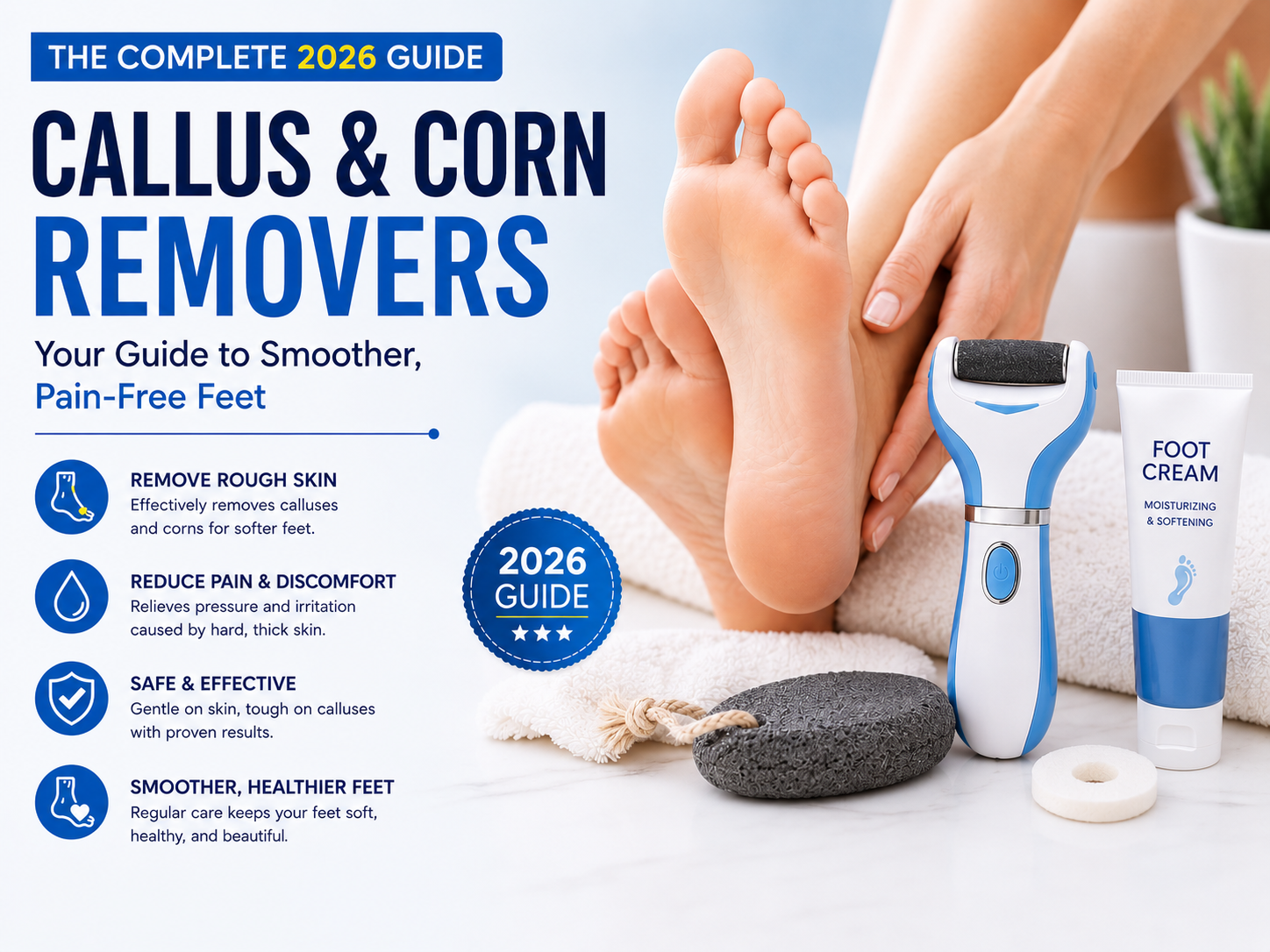
Calluses and corns are two of the most common foot complaints — uncomfortable, sometimes painful, and often persistent. Whether you're dealing with a rough patch on your heel, a painful corn between your toes, or a hardened ball-of-foot callus that makes walking uncomfortable, the right remover and technique can resolve the issue safely at home in most cases. This guide covers every category of callus and corn remover available in 2026, explains how each works, and helps you choose the right approach for your specific situation.
Calluses vs. Corns: Understanding the Difference
Calluses and corns are both areas of thickened, hardened skin caused by repeated friction or pressure — but they differ in appearance, location, and the way they feel.
A callus (also spelled callous) is a broad, relatively flat area of thickened skin that develops on weight-bearing surfaces — most commonly the heel, the ball of the foot, and the underside of the big toe. Calluses are the skin's protective response to repeated friction or pressure: the outer skin layer (stratum corneum) hyperproliferates, building up a pad of dead cells that shields the underlying tissue. Calluses are usually not sharply defined, may cover a wide area, and are often yellow or gray in color. They are commonly painless unless they become very thick.
A corn (heloma) is a smaller, more defined area of thickened skin with a central core — like a plug — that points inward toward deeper tissue. This inward-pointing core is what makes corns painful: when pressure is applied (as when standing or walking), the core presses against underlying nerves, causing a sharp, stabbing, or burning pain. Corns occur most commonly on the tops and sides of toes, between toes, and on pressure points over bony prominences. There are two main types:
Hard corns (heloma durum) are firm, well-defined lesions that typically form on the tops or outer surfaces of toes — especially the little toe — where shoe pressure creates focal friction over a bony prominence.
Soft corns (heloma molle) form between the toes, where moisture from sweat keeps them soft and macerated. They are whitish, rubbery in texture, and can be particularly painful because the tight spaces between toes concentrate pressure.
Types of Callus and Corn Removers
1. Salicylic Acid Products (Medicated Pads, Gels, and Liquids)
Salicylic acid is a keratolytic agent — it breaks down the protein bonds in keratin, the structural protein that makes up the outer skin layer. By softening and dissolving the thickened keratin of a callus or corn, it allows the dead skin to be gently peeled or abraded away. Salicylic acid products come in several forms:
Medicated corn pads (such as Dr. Scholl's Corn Removers) are adhesive pads containing a disc of salicylic acid-impregnated material. You apply them directly over the corn, leave them in place for up to 48 hours, and the acid penetrates and softens the lesion. They're convenient and provide some cushioning relief while treating.
Salicylic acid gels and liquids are applied with a small applicator directly to the callus or corn. They tend to be faster-penetrating than pads and are better for irregularly shaped or larger calluses. Concentrations typically range from 17% (over-the-counter standard) to 40% (higher-strength, for stubborn calluses — some formulations require more careful application).
Salicylic acid callus discs or plasters are similar to corn pads but larger, designed for the broad surface area of plantar calluses (heel and ball of foot).
When to use: For defined corns on toes and for moderate plantar calluses. Most effective when the skin is pre-softened by soaking.
When NOT to use: Diabetes, poor circulation, or neuropathy; on healthy surrounding skin; on irritated, broken, or infected skin; on soft corns between toes (the acid can cause chemical burns in tight moist spaces).
2. Callus Shavers and Razors
Callus shavers (sometimes called callus planes or callus razors) use a replaceable blade in a handle to mechanically shave away layers of thickened dead skin. They are highly effective for large, thick plantar calluses — especially heel calluses — and can remove significant buildup quickly. Professional pedicurists and podiatrists use similar devices.
For home use, look for ergonomic handles with replaceable blades, blade guards to prevent cutting too deeply, and a comfortable grip. Some include a blade angle guide to promote safe, consistent technique. Wet-use shavers can be used on soaked, softened skin for easier removal.
When to use: For thick heel calluses and large plantar calluses. Very effective for rapid reduction of buildup.
Caution: Requires careful technique — cutting too deeply can break the skin. Not recommended for people with diabetes, neuropathy, or poor circulation (risk of injury without sensation of pain). Always soak skin first to soften it.
3. Electric Callus Removers (Battery-Powered Foot Files)
Electric callus removers use a rotating micro-mineral or abrasive roller head to file down thickened skin quickly and with relatively even results. They are among the most popular home tools for callus management because they combine speed with ease of use — the rotation does the work while you control pressure and position. Most use a spinning roller coated with abrasive micro-crystals.
Key features to look for: multiple speed settings for coarse-to-fine work; wet/dry capability (waterproof models can be used in the shower on pre-softened skin); easy-clean or washable roller heads; LED light for visibility; and cordless operation. Some models include both a coarse roller (for initial heavy callus removal) and a fine roller (for smoothing and polishing).
When to use: For regular maintenance of heel and ball-of-foot calluses. Excellent for people who want a faster, less labor-intensive alternative to pumice stones. Use on dry or slightly damp skin — heavily wet skin can clog the roller.
Caution: Avoid using on sensitive skin, between toes, or on active corns with a central core — the rotating head can irritate already-painful tissue. Not for diabetics or those with neuropathy.
4. Pumice Stones and Foot Files
Pumice is a naturally porous volcanic rock with a fine abrasive surface ideal for gentle mechanical exfoliation of callused skin. It is one of the oldest and most widely used callus management tools. Pumice stones work best on softened skin — use them at the end of a warm soak (10–15 minutes) or in the shower/bath when skin is saturated and pliable. Rub in circular motions with moderate pressure.
Foot files — metal, glass, or synthetic abrasive surfaces in a paddle or block format — work on the same principle. Glass foot files (crystalline nano-glass surface) are increasingly popular because they are gentler than metal graters, effective on moist skin, non-porous (hygienic and easy to sterilize), and durable. Metal foot files (cheese-grater style) are the most aggressive option and remove the most material fastest, but require care to avoid removing too much skin.
When to use: For ongoing maintenance of mild to moderate calluses. A pumice stone or foot file used 2–3 times per week after bathing, followed by moisturizer, can prevent calluses from building up significantly.
Tip: Never use a pumice stone on dry skin — it will not work and can cause abrasions. Always soak first.
5. Foot Peels (Exfoliating Foot Masks)
Foot peels are gel-soaked plastic booties worn on the feet for 60–90 minutes. The gel typically contains a blend of alpha-hydroxy acids (glycolic acid, lactic acid) and/or beta-hydroxy acids (salicylic acid), sometimes combined with fruit enzymes, urea, and hydrating agents. These acids penetrate and break down the bonds between dead skin cells in the callus layer. Over the following 5–14 days, the outer skin progressively peels away in sheets, revealing smoother skin underneath.
Foot peels are popular as a periodic deep-treatment rather than a daily tool. They are not designed for immediate relief — if your calluses are actively painful, a foot peel will not provide the quick reduction that a shaver or electric file will. But as a monthly or bimonthly treatment, they can dramatically reduce overall callus thickness and keep skin softer long-term.
When to use: As a periodic deep exfoliation treatment rather than a daily tool. Best for people with widespread, multi-area thickening rather than a single defined callus.
Caution: Avoid during pregnancy; avoid broken or irritated skin; wear socks or loose shoes during the peeling phase as exposed peeling skin can stick to surfaces uncomfortably. Patch test on a small area first if you have sensitive skin.
6. Urea Creams (Chemical Softening)
Urea is a naturally occurring compound and one of the most effective ingredients for softening and gradually breaking down thickened callus skin. At concentrations of 20–40%, urea acts as both a humectant (drawing moisture into the skin) and a keratolytic (breaking down keratin protein). Applied daily, high-urea creams gradually thin and soften calluses over days to weeks without the abrasion of mechanical tools.
Urea creams are particularly valuable for heel calluses and cracked heels — they can break down even very thick, leathery skin with consistent use. They are gentler than salicylic acid and safer for sensitive skin. Many podiatrists recommend urea-based creams as first-line maintenance therapy for people who are prone to calluses.
When to use: For daily maintenance and gradual softening of calluses, especially heels. Can be combined with mechanical removal: apply urea cream daily to keep skin soft, and use a pumice stone or electric file periodically to remove the softened buildup.
Note: At 40%+ concentration, urea creams can irritate broken skin — do not apply to fissures or cracked heels that have broken through to raw skin.
Choosing the Right Remover: A Quick Reference
| Condition | Best Option(s) | Avoid |
|---|---|---|
| Hard corn on toe | Salicylic acid corn pad; medicated gel | Callus shaver; electric file on the corn itself |
| Soft corn between toes | See a podiatrist; toe separators to reduce friction | Salicylic acid (can cause chemical burn in moist spaces) |
| Thick heel callus | Callus shaver; electric callus remover; urea cream (daily) | None if healthy — choose based on preference |
| Ball-of-foot callus | Salicylic acid plaster; electric file; pumice stone | Over-aggressive shaving on active weight-bearing areas |
| Widespread mild thickening | Foot peel (monthly); urea cream (daily) | N/A |
| Diabetic feet | See a podiatrist — do not self-treat | All mechanical and chemical home removers without medical guidance |
How to Use Callus and Corn Removers Safely
Step 1 — Soak. Soak your feet in warm water for 10–15 minutes to soften the skin. This dramatically improves the effectiveness of mechanical removal and allows salicylic acid products to penetrate more deeply. Add Epsom salt if desired — it will not dissolve calluses but may provide comfort.
Step 2 — Apply or use your chosen remover. Follow product instructions carefully. For mechanical tools, use light-to-moderate pressure with even strokes. Never try to remove a callus in a single session — gradual removal over multiple sessions is safer and less likely to cause irritation.
Step 3 — Rinse and dry thoroughly. Remove all product residue and skin debris. Dry well, including between toes.
Step 4 — Moisturize. Apply a rich foot cream — ideally one with urea, lactic acid, or shea butter — to the treated area. This replenishes moisture to newly exposed skin and slows the rate of recurrence.
Step 5 — Protect. Cushioning corn pads (non-medicated) on treated areas reduce friction while they heal. Properly fitted shoes that eliminate the pressure causing the callus or corn are the only permanent solution to recurrence.
Addressing the Cause: Why Calluses and Corns Come Back
Removing a callus or corn provides temporary relief, but without addressing the underlying pressure or friction that caused it, the same lesion will return — often within weeks. The most common causes are: poorly fitting shoes (too tight, too narrow, too short, or with seams pressing on bony prominences); high-heeled shoes that concentrate weight on the ball of the foot; gait abnormalities or structural foot problems (bunions, hammertoes, flat feet) that alter how weight is distributed; and occupational factors (standing for long periods on hard surfaces).
To reduce recurrence, consider custom or over-the-counter orthotics to redistribute pressure, corn-relief cushioning pads and toe sleeves for ongoing protection, and shoes with wider toe boxes and adequate depth. If calluses or corns return rapidly despite home treatment, a podiatrist can evaluate whether a structural or gait issue is contributing and recommend appropriate interventions including custom orthotics, padding strategies, or in-office procedures.
When to See a Podiatrist
Most calluses and hard corns on healthy feet can be safely managed at home. However, see a podiatrist if: the corn or callus is very painful and not responding to home treatment; you have diabetes, peripheral neuropathy, or poor circulation (essential — do not self-treat); the skin is broken, bleeding, or shows signs of infection (redness, warmth, swelling, discharge, odor); you have a soft corn between the toes that is not responding to non-medicated measures; you suspect an underlying structural issue (bunion, hammertoe) is driving recurrent lesions; or the lesion is in an unusual location or you are unsure whether it is a callus, corn, wart, or cyst.
Shop Foot Care Products at AllCare Store
AllCare Store carries a comprehensive selection of foot care essentials — from callus removers, foot files, and urea foot creams to diabetic socks and foot care accessories. Browse our personal care collection for foot care tools, moisturizers, and skin care products. For diabetic foot care supplies, visit our diabetic care collection.
Shop at AllCare Store with free shipping on qualifying orders. Call our team at 1-888-889-6260, Monday–Friday, 7:00 AM–4:00 PM CST for product guidance.
Frequently Asked Questions: Callus and Corn Removers
What is the most effective callus remover?
The most effective callus remover depends on the type and thickness of the callus. For very thick heel calluses, a callus shaver or electric callus remover used after soaking gives the fastest results. For large areas of moderate thickening, an electric callus remover or regular use of a glass foot file combined with daily application of a 20–40% urea cream is highly effective as a long-term maintenance approach. Salicylic acid plasters (corn pads) work well for defined corns on toes. For overall skin renewal, a monthly foot peel (chemical exfoliation boot) removes widespread dead skin effectively. No single remover is best for every situation — matching the tool to the callus type and location gives the best outcome.
Is it safe to use a callus shaver at home?
Callus shavers can be used safely at home by most healthy adults with some care. Always soak your feet first to soften the skin (10–15 minutes in warm water), use light strokes and moderate pressure, and stop before reaching pink or tender skin. Replace blades regularly — a dull blade requires more force and increases the risk of slipping. The main risk is removing too much skin at once, which can leave the area raw and painful. People with diabetes, poor circulation, peripheral neuropathy, or any condition that affects sensation or wound healing should not use callus shavers at home — they should have calluses managed by a podiatrist. Children's feet should not be treated with callus shavers.
Do corn removal pads actually work?
Yes — salicylic acid corn removal pads do work for most hard corns on the tops and sides of toes in people with healthy feet. The salicylic acid (typically 40%) in medicated corn pads is a proven keratolytic that breaks down the thickened skin of a corn over one to several applications. They work best when skin is pre-softened (after soaking), when the pad is kept in place for the full recommended period (up to 48 hours per application), and when the softened skin is gently abraded after treatment. Multiple applications over one to two weeks are usually needed for a significant corn. Corn pads are less effective for soft corns between the toes, where moisture limits acid penetration and increases the risk of skin damage. They should never be used by people with diabetes or poor circulation.
What causes calluses and corns to form?
Calluses and corns both form as the skin's response to repeated friction or pressure — the outer skin layer (stratum corneum) thickens to protect the underlying tissue. Common causes include: ill-fitting shoes (too tight, too narrow, or with seams pressing on bony prominences); high-heeled shoes that concentrate weight on the ball of the foot; going barefoot or wearing shoes without socks; foot structural problems such as bunions, hammertoes, or flat feet that alter pressure distribution; and occupational factors like standing for hours on hard floors. Addressing the cause — getting properly fitted shoes, using orthotics for gait problems, wearing protective toe sleeves or cushioning pads — is the only way to prevent calluses and corns from recurring after removal.
Can diabetics use corn removal pads?
No — people with diabetes should not use medicated corn removal pads or any salicylic acid corn and callus treatment without explicit guidance from their physician or podiatrist. The salicylic acid in medicated corn pads can penetrate beyond the thickened skin and damage healthy tissue. In people with diabetic peripheral neuropathy (nerve damage that reduces sensation), skin damage can occur without the person feeling pain — and in the context of the impaired wound healing that often accompanies diabetes, even a minor chemical irritation can progress to a serious wound. Calluses and corns in people with diabetes should be managed by a podiatrist, who can remove them safely using professional tools and evaluate whether orthotics or footwear modifications are needed to prevent recurrence.
For foot care products, callus removers, diabetic socks, and personal care essentials, visit AllCare Store. Browse our personal care collection. Free shipping on qualifying orders. Call 1-888-889-6260, Monday–Friday 7 AM–4 PM CST.