MEDICAL DISCLAIMER: This article is for informational purposes only and does not constitute medical advice. Always consult your healthcare provider or pharmacist before starting any new medication, including over-the-counter allergy medicines. If you experience severe allergic reactions (anaphylaxis), call 911 immediately — antihistamines are not a substitute for epinephrine in life-threatening reactions.
Claritin vs Zyrtec vs Allegra: A Straight-Talk Comparison to Help You Choose
Mike's Allergy Medication Merry-Go-Round
Mike, 38, had been dealing with seasonal allergies his whole adult life. Every spring, the tree pollen hit him hard — relentless sneezing, a faucet for a nose, itchy eyes that made him look like he'd been crying. For years, he managed with whatever allergy pill was on sale. Sometimes it was the one with the green box. Sometimes the orange one. Sometimes the purple one.
"They're basically all the same, right?" he told his wife one morning, groggy and stuffed up, staring at the pharmacy shelf.
His wife, a nurse, gave him the look. "They are absolutely not the same."
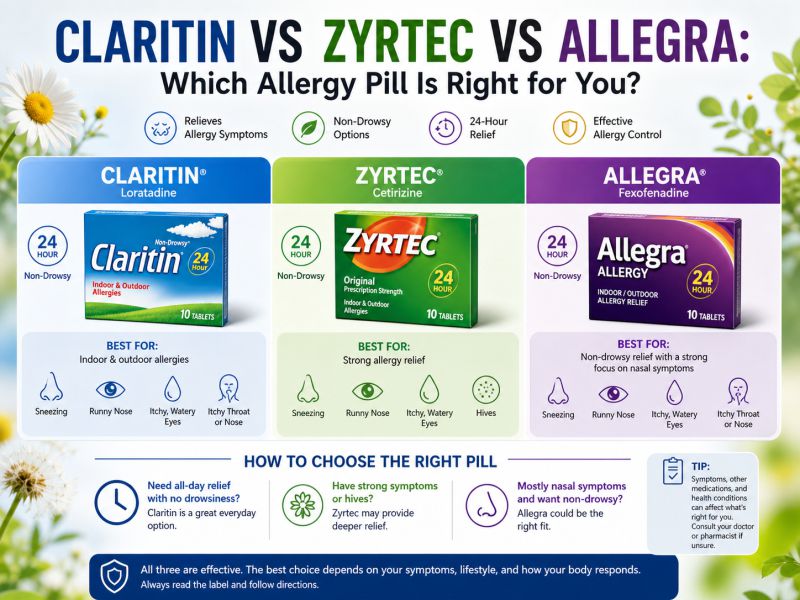
She was right. Claritin, Zyrtec, and Allegra — three of the most-purchased allergy pills in America — are all second-generation antihistamines, and they all block histamine receptors to reduce allergy symptoms. But beyond that shared mechanism, they have meaningfully different profiles: different speeds of action, different potency levels, different rates of drowsiness, and different situations where one clearly outshines the others.
Mike's problem wasn't that he was buying allergy medicine. It was that he was buying the wrong one for him — and switching randomly meant he never gave any of them a real chance to work consistently.
If you've ever stood in the allergy aisle wondering whether it actually matters which one you pick — this guide is for you. We'll break down the real differences between Claritin (loratadine), Zyrtec (cetirizine), and Allegra (fexofenadine) so you can make an informed, deliberate choice and stick with it. When you're ready to stock up, AllCare Store has you covered with free shipping and a 30-day return policy.
First, the Common Ground: What All Three Share
Before getting into differences, it's worth appreciating what Claritin, Zyrtec, and Allegra have in common — because their shared characteristics are why they dominate allergy medication sales.
All three are second-generation H1 antihistamines. They work by binding to histamine H1 receptors throughout the body, blocking histamine from attaching and triggering allergy symptoms like sneezing, runny nose, itching, and watery eyes. Unlike first-generation antihistamines (like Benadryl/diphenhydramine), all three are designed to not cross the blood-brain barrier significantly — which is why they're far less sedating than older antihistamines.
All three are available over the counter, taken once daily, and effective for 24 hours. All three are safe for adults and most children (with age-appropriate formulations). And all three are now widely available as inexpensive generics — loratadine, cetirizine, and fexofenadine — that work identically to their brand-name counterparts at a fraction of the cost.
The differences lie in their individual pharmacology — specifically, how strongly they work, how quickly they act, and how much (if any) sedation they cause. These differences are clinically meaningful and determine which one is the best fit for your specific situation.
The Complete Head-to-Head: Claritin vs Zyrtec vs Allegra
| Feature | Claritin (Loratadine) | Zyrtec (Cetirizine) | Allegra (Fexofenadine) |
|---|---|---|---|
| Active Ingredient | Loratadine 10mg | Cetirizine HCl 10mg | Fexofenadine HCl 180mg |
| Drowsiness Rate | Very low (1–3% above placebo) | Low-moderate (3–8% above placebo) | Minimal (1–2% above placebo) |
| Onset of Action | 1–3 hours | ~1 hour (fastest) | 1–3 hours |
| Peak Effect | 8–12 hours after dose | 1–2 hours after dose | 2–3 hours after dose |
| Duration | 24 hours | 24 hours | 24 hours |
| Relative Potency | Moderate-High | High (strongest binder) | High |
| Best for Sneezing/Runny Nose | Very good | Excellent | Excellent |
| Best for Itching / Hives | Good | Best (highest potency for itch) | Very good |
| Best for Eye Symptoms | Good | Very good | Very good |
| Safe for Pilots (FAA) | Conditional | No | Yes — only FAA-approved antihistamine |
| Safe for Older Adults | Yes — preferred choice | Generally yes, some caution | Yes |
| Safe in Pregnancy | Preferred (Category B) | Generally acceptable (Category B) | Less data; consult doctor |
| Food/Drink Interactions | None significant | Alcohol increases sedation | Avoid fruit juice (reduces absorption up to 36%) |
| Kidney/Liver Considerations | Reduce dose with severe kidney or liver disease | Reduce dose with kidney disease | Reduce dose with kidney disease |
| Available as Generic | Yes (loratadine) | Yes (cetirizine) | Yes (fexofenadine) |
Claritin (Loratadine): The Reliable, All-Day, Truly Non-Drowsy Choice
Loratadine — sold under the Claritin brand — is the most widely used OTC antihistamine in the United States, and for good reason: it strikes the best balance between effectiveness and tolerability for the broadest population of allergy sufferers.
How It Works
Loratadine is a second-generation antihistamine that binds to peripheral H1 histamine receptors. Unlike cetirizine, it has very low penetration of the blood-brain barrier, which accounts for its minimal sedation. It reaches peak blood levels within 1–2 hours but takes a full 8–12 hours to reach its maximum antihistamine effect — which means it works better as a sustained, consistent daily medication than as an acute relief option.
The Case For Claritin
Loratadine is the right choice when non-drowsy performance is your top priority. Its sedation rate — approximately 1–3% above placebo in clinical trials — is so low it's essentially indistinguishable from taking nothing for most people. It's the most consistently recommended antihistamine for adults over 65, for people who drive professionally, operate machinery, or whose alertness is safety-critical. It's also the preferred antihistamine during pregnancy, with the most safety data in that population.
Loratadine is also exceptionally well tolerated at all ages, and its pediatric formulations (Children's Claritin) are available from age 2. For children and adults with multiple sensitivities, loratadine's clean side effect profile makes it the lowest-risk starting point.
The Honest Trade-Off
Loratadine is not the most potent of the three. Head-to-head clinical studies have found cetirizine slightly more effective for moderate-to-severe nasal symptoms and significantly more effective for itching and hives. If you've tried Claritin and found it helpful but not quite sufficient for your symptom severity, Zyrtec or Allegra may work better.
Best for: People who prioritize non-drowsy performance; older adults; pregnant women (after consulting their OB); drivers and machinery operators; mild-to-moderate seasonal allergies; people who are sensitive to medication side effects.
Zyrtec (Cetirizine): The Most Potent, Fastest-Acting Option
Cetirizine — the active ingredient in Zyrtec — is the most pharmacologically potent of the three major second-generation antihistamines. It binds to histamine receptors more strongly and more rapidly than loratadine or fexofenadine, and clinical studies consistently find it provides the strongest symptom relief for severe allergy presentations and skin-related allergy conditions like hives.
How It Works
Cetirizine is actually the active metabolite of hydroxyzine (an older prescription antihistamine). It reaches peak plasma concentrations within about 1 hour of dosing — the fastest onset of the three — and achieves near-maximum antihistamine effect by 1–2 hours. It also has slightly more central nervous system penetration than loratadine or fexofenadine, which accounts for its higher (though still low by historical standards) drowsiness rate.
The Case For Zyrtec
If your allergy symptoms are moderate to severe — significant nasal congestion and runny nose, pronounced itching, hives, or eye symptoms that loratadine hasn't adequately controlled — cetirizine is often the upgrade that makes the difference. Studies on chronic urticaria (hives) consistently find cetirizine more effective than loratadine, often with faster initial response. Its 1-hour onset also makes it more useful for reactive dosing when you know you're about to be exposed to an allergen.
People who find Claritin "just doesn't work" for them very often find Zyrtec more effective — the difference in receptor binding affinity is clinically meaningful for this group.
The Honest Trade-Off
The cetirizine drowsiness question is real and personal. Clinical trials show a 3–8% incidence of drowsiness above placebo — which sounds small, but means roughly 1 in 15 to 1 in 30 people taking it will notice meaningful sedation. For some people, this is significant enough to affect work performance or driving safety. For others, no drowsiness occurs at all. You won't know which camp you're in until you try it. Taking cetirizine in the evening sidesteps this concern effectively and has the advantage of providing peak coverage overnight when dust mite exposure tends to be highest.
Best for: Moderate-to-severe allergy sufferers; people with hives or significant skin itching; people who found Claritin insufficient; those who prefer to take their antihistamine at night; situations requiring fast onset of action.
Allegra (Fexofenadine): The Zero-Compromise Non-Drowsy Option
Fexofenadine — sold as Allegra — is the youngest of the three, having received FDA approval in 1996 as the active metabolite of terfenadine (an older antihistamine withdrawn due to cardiac safety concerns). In the years since, it's established a unique clinical profile: strong antihistamine efficacy with the most reliably non-sedating performance of any second-generation antihistamine available.
How It Works
Fexofenadine has the lowest central nervous system penetration of the three, making it the safest choice from a cognitive and psychomotor performance perspective. The Federal Aviation Administration (FAA) specifically cleared fexofenadine as the only antihistamine approved for use by commercial airline pilots — a regulatory decision that reflects rigorous non-impairment data. This is the most concrete evidence that fexofenadine truly doesn't impair alertness or reaction time in the way that even Claritin might in sensitive individuals.
The Case For Allegra
Multiple clinical studies have found fexofenadine 180mg comparable or superior to cetirizine 10mg and loratadine 10mg for overall nasal symptom control in adults with seasonal allergic rhinitis. A 2001 meta-analysis published in the Annals of Allergy, Asthma and Immunology found fexofenadine 180mg provided greater nasal symptom relief than loratadine 10mg with equal non-drowsy performance. For people whose job, hobby, or lifestyle absolutely cannot tolerate any cognitive impairment, Allegra gives the strongest combination of efficacy and alertness.
The Honest Trade-Off
Fexofenadine has one genuinely important interaction: fruit juices — particularly grapefruit, orange, and apple juice — inhibit the intestinal transporter (OATP1A2) that fexofenadine relies on for absorption, reducing blood levels by up to 36%. This is not a minor interaction. Taking Allegra with orange juice instead of water can meaningfully blunt its effectiveness. The solution is simple — always take fexofenadine with water, not juice — but it requires awareness.
Fexofenadine also costs slightly more than generic loratadine in most markets, though generic fexofenadine has significantly reduced this gap.
Best for: People who require zero sedation risk (pilots, professional drivers, surgeons, operators of heavy machinery); those who found cetirizine too sedating and want stronger efficacy than loratadine; people who prefer to take their antihistamine in the morning with complete confidence about daytime alertness.
Situation-by-Situation Decision Guide
Real-life allergy management isn't abstract — it's Wednesday morning and you're sneezing and need to know which bottle to grab. Here's a practical guide:
"I need to drive / work a job requiring alertness / operate machinery"
→ Allegra first (zero impairment data, FAA-approved), then Claritin. Avoid Zyrtec or take it at night only.
"My symptoms are severe — lots of sneezing, runny nose, itchy eyes"
→ Zyrtec for maximum potency. Take at night if drowsiness is a concern. Or try Allegra 180mg, which matches Zyrtec's efficacy in many studies with less sedation risk.
"I have hives or significant skin itching"
→ Zyrtec. Cetirizine is the most studied and most effective antihistamine for chronic urticaria and histamine-driven skin symptoms. This is where its extra potency shows up most clearly.
"I'm over 65 or taking multiple medications"
→ Claritin. Loratadine has the cleanest drug interaction profile and the lowest risk of cognitive side effects in older adults. Discuss with your pharmacist or physician before starting any antihistamine if you're managing multiple health conditions.
"I'm pregnant or breastfeeding"
→ Claritin (loratadine) is the most established OTC antihistamine for use in pregnancy — consult your OB/GYN before taking any allergy medication while pregnant or nursing.
"Claritin stopped working for me (or never worked well)"
→ Try Zyrtec or Allegra 180mg. The higher potency of both cetirizine and fexofenadine provides meaningful additional symptom control for people who find loratadine insufficient. Try one for 2 weeks consistently before evaluating.
"I switched from Zyrtec and it felt less effective"
→ Some people develop functional tolerance to cetirizine with long-term use. Rotating to Allegra or Claritin for a month, then returning, can restore effectiveness. Discuss with your pharmacist or allergist if symptom control remains inadequate despite switching.
"I tried Allegra and it didn't work as well as expected"
→ First question: were you taking it with juice? Grapefruit, orange, or apple juice reduces fexofenadine absorption by up to 36%. Always take Allegra with water only. If you're already doing that and it's insufficient, Zyrtec's higher receptor binding affinity may work better for your physiology.
Brand-Name vs. Generic: Does It Matter?
The short answer: no, it doesn't matter medically. By FDA requirement, generic medications must contain the same active ingredient in the same dose, with the same route of administration, and demonstrate bioequivalence — meaning they reach the same concentration in your blood at the same rate.
- Generic loratadine = identical to Claritin
- Generic cetirizine = identical to Zyrtec
- Generic fexofenadine = identical to Allegra
Inactive ingredients (binders, dyes, flavorings) can differ slightly between generics and brands, which matters only for people with specific allergies to dye or filler ingredients — a rare situation. For virtually everyone else, buying generic is pure savings with zero efficacy difference. Generic loratadine, in particular, is often available in 365-tablet value packs that make it extremely economical for year-round allergy sufferers.
Shop AllCare Store's Medicine & Monitors collection for allergy relief options and related health management products.
Why Consistency Matters More Than Brand Loyalty
Mike's core problem — randomly switching between allergy medications — is actually one of the most common allergy management mistakes. Second-generation antihistamines work best when taken consistently every day throughout allergy season, not just on high-symptom days. Here's why:
Antihistamines don't work retroactively. They block histamine receptors before histamine attaches — they can't remove histamine that's already bound and triggered inflammation. Taking an antihistamine daily maintains a consistent blockade so your body's allergic response is blunted before it fully ramps up. People who take antihistamines only when symptoms are already bad get the least benefit. People who take them daily before exposure — even before allergy season begins — get the most consistent relief.
Switching brands randomly means you never build the steady-state blood levels that provide optimal 24-hour coverage, and you can't accurately compare the effectiveness of different options because you're not giving any one of them a fair trial. The right approach: choose one based on your profile (using the guide above), commit to it for 2–3 weeks of consistent daily use, then evaluate how well it's working.
When Antihistamines Alone Aren't Enough
Even the best antihistamine may not fully control allergy symptoms on its own — particularly nasal congestion, which antihistamines treat less effectively than other medications. If one of these three doesn't fully control your symptoms, consider these complementary approaches:
Nasal Corticosteroid Sprays (Flonase, Nasacort, Rhinocort): These are considered the gold-standard treatment for allergic rhinitis by most allergists, working via a completely different anti-inflammatory mechanism. Combining a daily antihistamine with a daily nasal steroid spray provides the most comprehensive nasal symptom control available OTC.
Antihistamine Eye Drops (Zaditor, Alaway): If eye itching and redness are dominant symptoms, topical antihistamine eye drops work faster and more directly than oral antihistamines for those specific symptoms.
Saline Nasal Rinse: Physically removing allergens from nasal passages with saline irrigation reduces allergen load and has solid clinical evidence supporting its use as an adjunct to medication.
Allergen Avoidance: No medication fully compensates for high allergen exposure. Checking daily pollen counts, keeping windows closed on high-pollen days, showering after outdoor time, and using HEPA air filtration all reduce the allergen burden that antihistamines have to manage.
Browse our Personal Care collection and Medicine & Monitors collection for a full range of allergy management products.
Frequently Asked Questions: Claritin vs Zyrtec vs Allegra
Which is stronger — Claritin, Zyrtec, or Allegra?
Zyrtec (cetirizine) generally has the highest receptor binding affinity of the three, making it the most potent for severe symptoms and skin-related allergies like hives. Allegra (fexofenadine) is comparable to Zyrtec in clinical efficacy for nasal symptoms in most published studies. Claritin (loratadine) is slightly less potent than the other two, though it remains highly effective for mild-to-moderate seasonal allergies. The differences in potency are most meaningful for people with moderate-to-severe symptoms or specific conditions like chronic urticaria.
Does Zyrtec really cause more drowsiness than Claritin or Allegra?
Yes, on a population level. Clinical trials consistently show cetirizine (Zyrtec) has a higher rate of drowsiness — approximately 3–8% above placebo — compared to loratadine (Claritin) at 1–3% and fexofenadine (Allegra) at 1–2%. In practice, this means most people taking Zyrtec will experience no drowsiness, but a meaningful minority will notice it — especially at first, or if they're sensitive to medications. Taking Zyrtec at night effectively eliminates this concern for most people. If you must take it in the morning and notice sedation, switching to Allegra gives you similar efficacy without the drowsiness risk.
Can I switch between Claritin, Zyrtec, and Allegra?
Yes, you can switch between them — you don't need to "wean off" one before starting another, and there is no dangerous interaction from switching. However, for accurate comparison, you should give each one a consistent 2-week trial before evaluating its effectiveness. Random switching day to day makes it impossible to judge how well any individual medication is working. Some people do benefit from rotating antihistamines over months if they notice diminishing effectiveness with long-term use of one option.
Why does it say not to take Allegra with juice?
Fexofenadine (Allegra) relies on a specific intestinal transporter protein called OATP1A2 for absorption into the bloodstream. Grapefruit juice, orange juice, and apple juice all contain compounds that inhibit this transporter, reducing fexofenadine absorption by up to 36%. This is a significant enough reduction that it can meaningfully blunt the medication's effectiveness. The solution is simply to always take fexofenadine with water — not juice. Other antihistamines (cetirizine and loratadine) do not have this interaction and can be taken with any beverage.
Can I take Claritin-D, Zyrtec-D, or Allegra-D instead of the regular version?
The "-D" versions add pseudoephedrine (a decongestant) to the antihistamine. They are more effective for nasal congestion than the regular versions, but they come with added considerations: pseudoephedrine should not be used by people with high blood pressure, heart disease, hyperthyroidism, glaucoma, or prostate issues without medical clearance. It can also cause insomnia and jitteriness. In most states, "-D" products are kept behind the pharmacy counter (though still OTC) due to laws restricting pseudoephedrine sales. If nasal congestion is a major part of your allergy symptoms, the "-D" version may help significantly — but discuss with a pharmacist first if you have any health conditions.
My allergy medicine seems to stop working after a while. What should I do?
Some people experience reduced effectiveness from a specific antihistamine with prolonged use — particularly cetirizine. This may be due to changes in receptor sensitivity rather than true drug tolerance in the classical sense. The most common approach is to rotate: switch to a different antihistamine class (for example, from Zyrtec to Allegra or Claritin) for 4–8 weeks, then return to the original medication. You may also want to add a nasal corticosteroid spray, which works through a completely different mechanism and doesn't show the same reduced-effectiveness pattern. If symptoms remain poorly controlled despite rotation, consult an allergist — you may benefit from allergy testing, prescription medications, or immunotherapy.
Is it safe to take allergy pills every day year-round?
Yes, for all three second-generation antihistamines. Loratadine, cetirizine, and fexofenadine are all considered safe for daily long-term use. Many people with perennial allergies (year-round triggers like dust mites or pet dander) take them every single day indefinitely without significant safety concerns. This is one of the meaningful differences from first-generation antihistamines like Benadryl, which are not recommended for daily long-term use due to higher side effect burden. If you're managing a complex health situation, discuss ongoing antihistamine use with your pharmacist or physician.
Mike's Resolution — and Yours
Mike took his wife's advice. He read the labels, researched the differences, and realized that what he actually needed was Allegra — he worked as a forklift operator, and the last thing he wanted was any sedation risk at work. He committed to taking fexofenadine 180mg every morning with water (not his usual orange juice), every day from early March through late May.
His spring went better than it had in years. Not because he found a miracle drug, but because he finally matched the right medication to his specific situation — and used it consistently instead of randomly cycling through whatever was on sale.
That's really the secret to getting the most from Claritin, Zyrtec, or Allegra: understand what makes each one different, choose the one that fits your life and symptom profile, take it consistently, and give it a fair chance to work.
Ready to stock up? AllCare Store carries a full range of allergy relief products with free shipping on qualifying orders and a 30-day return policy. Explore our Medicine & Monitors collection or browse our complete catalog for all your health and wellness needs. Questions? Our team is available at 1-888-889-6260.
Here's to breathing freely — whatever the season.
— The AllCare Store Team | AllCareStore.com
Medical Disclaimer: This article is for informational purposes only and does not constitute medical advice. Individuals at high risk for pressure injuries should consult a physician, occupational therapist, or certified rehabilitation engineer before selecting a wheelchair cushion.