DISCLAIMER: This article is for informational purposes only and is not a substitute for professional eye care. Reading glasses purchased over the counter do not correct astigmatism, nearsightedness, or other refractive errors. If you experience sudden vision changes, eye pain, double vision, or haven't had a comprehensive eye exam in over two years, please consult a licensed eye care professional.
Reading Glasses: How to Choose the Right Strength for Clear, Comfortable Vision
Linda's Story: The Day the Menu Wouldn't Cooperate
Linda was 47 when she first noticed it. At dinner with friends, she found herself holding the menu farther and farther away, squinting at the tiny print under the dim restaurant lighting. She laughed it off — the font was too small, the lighting was terrible. But then it happened with her phone. And with the labels on her medicine bottles. And with the crossword puzzle she'd been doing every Sunday morning for fifteen years.
"I'm not ready for reading glasses," she told herself. But her eyes had other plans.
When she finally stopped at a pharmacy and tried on a pair of +1.50 readers off the rack, the words on the display card snapped into crisp, effortless focus. Linda stood there in the aisle for a long moment. It had been so long since reading felt that easy that she'd forgotten what it was supposed to feel like.
If Linda's story sounds familiar, you're in excellent company. Presbyopia — the gradual loss of near-focusing ability that begins in our mid-40s — affects virtually every person on the planet who lives long enough to experience it. It's not a disease, a failure, or a sign of anything going wrong. It's simply the lens inside your eye becoming less flexible with age. And over-the-counter reading glasses are one of the most practical, affordable solutions ever invented.
But here's where people run into trouble: those racks of readers at the pharmacy display a bewildering range of numbers — +1.00, +1.25, +1.50, all the way up to +3.50. Which one do you need? What do those numbers mean? And how do you know if off-the-shelf readers are even right for you? This guide answers all of that, so you can walk into any store (or browse online at AllCare Store) with confidence and walk out with the pair that actually works.
What Is Presbyopia — and Why Does It Happen?
Your eye focuses on near objects using a crystalline lens that can change shape — getting rounder to focus up close, and flatter to focus far away. This ability is called accommodation, and it's controlled by tiny muscles inside your eye (the ciliary muscles) that squeeze and relax to flex the lens.
Throughout childhood and early adulthood, the lens is soft and flexible, and accommodation works beautifully. But starting around age 40–45, the lens gradually stiffens. The ciliary muscles are still working fine — it's the lens itself that can no longer flex as much as it once did. The result: you can still see clearly in the distance, but your near-focusing range shrinks. Text that was once perfectly clear at 12 inches now requires 18, then 24 inches to read comfortably.
This is presbyopia, and it's universal. By age 50, nearly everyone has it to some degree. By age 60, most people need meaningful optical help for close work. By age 65, the near-focusing ability of the natural lens is essentially gone — all near-vision clarity at that point comes from reading glasses, bifocals, progressive lenses, or other optical aids.
The good news: reading glasses are a proven, effective solution for the vast majority of presbyopic adults. They don't slow the progression of presbyopia, but they restore clear near vision effortlessly — and affordable OTC readers work just as well as expensive prescriptions for many people.
Understanding Reading Glasses Strength: What the Numbers Mean
Reading glasses are measured in diopters — a unit of optical power that indicates how strongly the lens bends light. All OTC reading glasses have positive diopter values (hence the "+" symbol), which means they add focusing power for near vision. Higher numbers indicate stronger magnification.
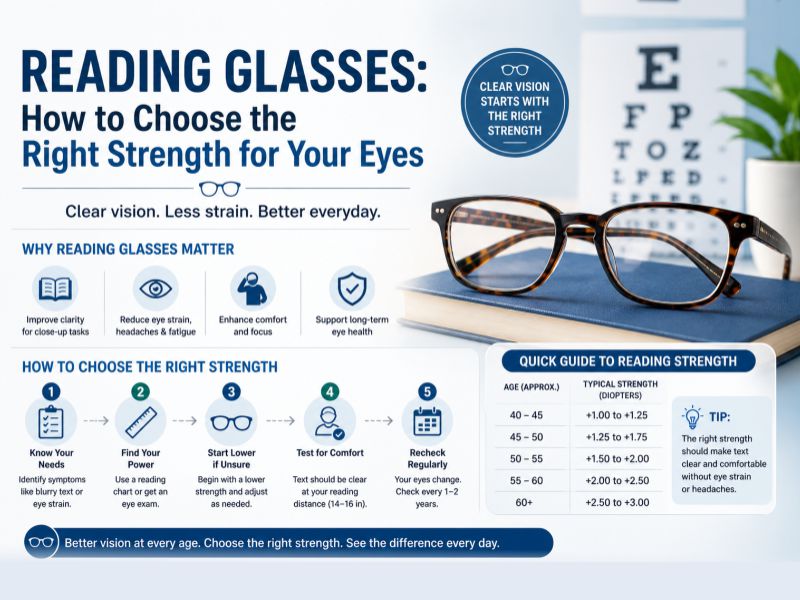
The typical range of OTC reading glasses runs from +1.00 to +3.50, in increments of 0.25 diopters. Here's what that range looks like in practice:
| Strength | Typical Age Range | Best For | Signs You Need This Level |
|---|---|---|---|
| +1.00 | 40–44 | Early presbyopia, fine print, screens | Need to hold reading material slightly farther than 16 inches |
| +1.25 | 42–46 | Books, smartphones, menus | Comfortable reading distance now 18–20 inches |
| +1.50 | 44–49 | All-purpose readers, most near tasks | Text gets blurry at a normal arm's-length hold (most common first-reader strength) |
| +1.75 | 46–51 | Extended reading sessions, craft work | Need more than +1.50 for comfortable sustained reading |
| +2.00 | 49–54 | Books, paperwork, fine detail work | Holding material at 12–14 inches gives clearest view |
| +2.25 | 51–56 | Reading, needlework, hobby tasks | Comfortable reading only at 10–12 inches without correction |
| +2.50 | 53–58 | Standard readers for mid-50s adults | Near vision requires correction even for large print |
| +2.75 | 55–60 | Detail work, extended close tasks | Even moderate print requires magnification |
| +3.00 | 58–64 | Strong reading aid for mature eyes | Near focus without correction is very limited |
| +3.25 / +3.50 | 63+ | Maximum OTC strength for close work | Very limited near vision without significant magnification |
Important note: Age-based estimates are guidelines, not rules. Individual variation is significant — some 42-year-olds genuinely need +1.75, while some 55-year-olds are comfortable with +1.50. The only reliable way to know your correct strength is to test it.
How to Test Your Reading Glasses Strength at Home
You don't need a prescription or a trip to the optometrist to find your basic reading glasses strength. Here's a reliable home testing method:
The Printout Test (Most Accurate at Home)
Print a standard reading test chart at actual size (many free ones are available online — search for "reading glasses strength test chart"). Alternatively, you can use any book or magazine with mixed print sizes. Hold the printed text at a comfortable, natural reading distance — typically 12 to 16 inches from your eyes. Try different reading glass strengths (at a pharmacy display rack, for example) until the text appears sharp and clear without straining. The lowest strength that gives you clear, comfortable focus is your ideal starting point.
The Pharmacy Rack Test
Many pharmacies keep a reading test card near the eyeglass display. Put on a pair, hold the card at your natural reading distance, and read the smallest print you can comfortably make out. Work your way through different strengths until you find one that feels effortless — not over-magnified (which causes its own strain) and not under-powered (so you're still squinting). This is the real-world standard and it works well for most people.
The Smartphone Test
Open a news article on your phone with the text size set to default (not zoomed in). Hold it at your typical reading distance. Put on readers of various strengths and see which one brings the text into crisp focus without distortion or fishbowl effect. This works particularly well for people whose primary reading glasses need involve screens.
When the Test Doesn't Seem to Work
If no OTC strength gives you satisfactory clarity in both eyes simultaneously, or if one eye needs significantly more power than the other, OTC readers may not be the right fit for you. Over-the-counter reading glasses are made with the same power in both lenses — they don't account for a difference between eyes (anisometropia). If your eyes differ by more than about 0.50 diopters, you'll likely be more comfortable with a prescription from an optometrist or ophthalmologist.
Types of Reading Glasses: More Options Than You Might Think
Once you know your strength, you still have meaningful choices to make about style and design. Different reading glasses types work better for different activities and lifestyles.
Full-Frame Reading Glasses
The classic style — the entire lens is your reading prescription. These are ideal when your primary activity is sustained reading or close work. The large reading area is comfortable for extended sessions. The trade-off: you need to remove them to see clearly at a distance, which can be annoying if you frequently look up from your work.
Half-Frame ("Half-Eye") Reading Glasses
These sit lower on your nose, allowing you to look over the top of the frame for distance and through the lenses for close work. They're particularly popular with people who frequently shift between near and far tasks — answering the phone while reading paperwork, for example. They have a distinctive look that some people love and others find old-fashioned.
Folding Reading Glasses
Compact, portable, and practical — folding readers collapse to a fraction of their size for easy pocket or purse storage. Quality varies significantly; look for hinges that feel solid and lenses that don't pop loose. These are excellent as backups or for people who hate losing their glasses because they're easy to keep with you at all times.
Computer Reading Glasses (Blue Light Blocking)
Designed specifically for screen use at typical monitor distance (20–26 inches rather than the 12–16 inches of traditional reading distance), computer readers are often slightly lower in diopter power than your standard reading glasses. They frequently include blue light filtering to reduce digital eye strain, though research on blue light's direct role in eye strain remains ongoing. If you spend long hours at a computer, these can significantly improve comfort.
Bifocal Reading Glasses
These OTC versions mimic prescription bifocals — the lower portion of the lens has reading power, while the upper portion has no correction. They're particularly useful for activities like playing music (reading sheet music below while looking across a room), or for gardening and outdoor activities where you need both near and distance clarity.
Progressive (No-Line) Readers
Some OTC reading glasses use progressive lens technology — power gradually changes from the top (minimal or zero power) to the bottom (full reading power). These eliminate the visible line of standard bifocals. Quality varies considerably more than standard readers; if you find progressive OTC readers, try them carefully for distortion and adaptation before committing.
OTC Reading Glasses vs. Prescription Reading Glasses: Which Do You Need?
This is one of the most common questions people have, and the answer depends on your specific vision situation.
OTC Reading Glasses Work Well If:
- Both your eyes need roughly the same near-vision correction (within 0.50 diopters of each other)
- You have no significant astigmatism that needs correction
- You're not nearsighted (myopic) — OTC readers don't address distance vision problems
- You've had a comprehensive eye exam within the past 2 years and your eye health has been confirmed
- You find a strength that gives you clear, comfortable vision without eye strain
You Likely Need a Prescription If:
- No single OTC strength works well for both eyes simultaneously
- You have significant astigmatism (you may see clear but slightly distorted with OTC readers)
- You're nearsighted and need reading glasses on top of that correction
- You experience headaches, double vision, or eye strain even with readers that seem the right strength
- You need vision correction for specific distances (progressive lenses in prescription form are very effective)
The American Academy of Ophthalmology recommends comprehensive eye exams every 1–2 years for adults over 40, even if you're currently satisfied with OTC readers. Many serious eye conditions — glaucoma, macular degeneration, diabetic retinopathy — are detectable during a comprehensive exam long before symptoms appear. Reading glasses treat the symptom (blurry close vision), but they don't replace an eye health evaluation.
How Many Pairs Should You Own?
One of the practical realities of reading glasses is that you'll inevitably need them when you've left them somewhere else. Most regular reading glasses wearers benefit from having several pairs — and at the affordable price points of quality OTC readers, this is very practical.
Consider keeping:
- A pair by your bedside — for reading before sleep and labels/phone in the morning
- A pair in your kitchen or workspace — for cooking, bills, paperwork
- A pair in your bag or pocket — folding readers are perfect for this
- A pair at your desk or computer workstation — consider computer-optimized readers for this purpose
- A spare pair — in your car, a coat pocket, or a travel bag
Having multiple pairs in multiple locations is one of the most practical strategies for reading glasses wearers. It eliminates the frustrating hunt and ensures you're never caught needing readers you can't find. Visit AllCare Store's Personal Care collection to browse reading glasses options and related vision care accessories.
Tips for Comfortable, Effective Reading Glasses Use
Get the Right Distance for Each Task
Reading glasses are calibrated for a specific working distance. Standard readers are designed for approximately 12–16 inches. If your task is at a different distance — a computer monitor at 24 inches, or close detail work at 8 inches — you may need a different strength than your standard readers. A low-power pair (+0.75 or +1.00) may serve better for monitors; a slightly stronger pair may help for very close detail work.
Don't "Borrow" Strength
Some people assume stronger is better — "if +1.50 is good, +2.00 must be better." Not so. Reading glasses that are too strong for your needs cause eye strain, headaches, and a distorted "fishbowl" effect. Use the lowest power that gives you clear, comfortable focus.
Clean Your Lenses Properly
Smudged, scratched lenses are a common source of reading-related eye strain that gets blamed on the wrong prescription. Use a microfiber cloth designed for lenses. Avoid paper towels, tissues, and clothing — these materials scratch lens coatings over time. Use lens cleaner solution rather than window cleaner, which can damage coatings.
Replace Scratched Lenses Promptly
Reading through scratched lenses causes more strain than reading without glasses at all. Since OTC readers are very affordable, don't hesitate to replace a scratched pair.
Give New Readers a Fair Trial
If a new pair of readers feels slightly off, try wearing them for 30–60 minutes doing your normal near-vision tasks before deciding they're wrong. Some mild adaptation is normal, especially if you're switching strengths. If they still cause discomfort or blurriness after a fair trial, try the next strength up or down.
When to See an Eye Doctor — Even If Your Readers Seem Fine
OTC reading glasses effectively manage presbyopia for many people, but they don't replace professional eye care. See an eye care provider promptly if you experience:
- Sudden vision change — especially if only in one eye, or accompanied by floaters or flashes
- Eye pain or redness — not related to rubbing or minor irritation
- Double vision — with or without glasses
- Persistent headaches that worsen with near work
- Halos or glare around lights, especially at night
- Any vision loss that reading glasses don't correct
These symptoms can indicate conditions — glaucoma, cataracts, retinal issues — that require professional evaluation and treatment, not just stronger glasses.
Frequently Asked Questions About Reading Glasses Strength
What reading glasses strength should I start with?
The best starting point is to test at a pharmacy rack using their reading test card, trying multiple strengths until you find one that makes text effortlessly clear at a normal reading distance of 12–16 inches. If you're in your early-to-mid 40s and just noticing the need for readers, +1.00 to +1.50 is a reasonable starting range to test. In your late 40s to mid-50s, +1.50 to +2.25 is a common range. Never assume a strength — always test, because individual variation is significant.
Will wearing reading glasses make my eyes worse?
No. This is a very common concern, but there is no scientific evidence that wearing reading glasses accelerates presbyopia or weakens your eyes in any way. Presbyopia is caused by the natural stiffening of the eye's lens — a biological process that occurs regardless of whether you wear glasses or not. Using the correct reading glasses actually reduces eye strain and does not change the rate at which presbyopia progresses. Not wearing needed reading glasses when you need them just causes unnecessary strain.
How do I know if I need a stronger reading glass prescription over time?
Signs you need a stronger pair include: holding reading material farther away than you did when you got your current readers, increasing eye strain or headaches during reading, needing to squint or use extra light to read comfortably, or finding that close work feels harder than it used to. Presbyopia typically progresses until your mid-60s, after which the natural lens has little residual flexibility remaining. During the progression years (40s–60s), most people need to increase their reading glasses strength every few years.
Can I use the same reading glasses for my phone and for reading books?
Often yes, if you hold your phone at a similar distance to your reading material. Standard OTC readers are designed for approximately 12–16 inches, which is a typical distance for both phone use and book reading. However, if you tend to hold your phone closer than your books (many people do), you may find a slightly stronger pair more comfortable for phone use. Computer use at a monitor (typically 20–26 inches) usually calls for a lower diopter than your standard reading glasses.
Are expensive reading glasses better than cheap ones?
Not necessarily for optical quality — the diopter of the lens is the same whether you pay $5 or $50. However, more expensive readers often offer better lens coatings (anti-reflective, scratch-resistant, UV-protective), better frame materials and construction durability, better optical centering (the pupillary distance alignment), and more comfortable frame designs. For occasional use, budget readers work fine. For all-day wear, investing in better-quality readers with good coatings and proper centering will generally be more comfortable for extended use.
What does it mean if reading glasses make me dizzy?
Dizziness, nausea, or a "swimming" feeling when wearing reading glasses usually indicates one of these issues: the strength is too high (try a lower diopter), the lenses are optically poor quality (try a different brand), the glasses aren't centered properly for your pupillary distance, or you have an uncorrected astigmatism or imbalance between eyes that OTC readers can't address. If you consistently feel dizzy with multiple brands and strengths, see an eye care professional for a proper prescription evaluation.
My reading glasses number is different between both eyes on my prescription. Can I still use OTC readers?
OTC reading glasses have the same diopter power in both lenses, so they're designed for people with symmetric near-vision needs. If your eyes differ by 0.25–0.50 diopters, many people adapt fine to OTC readers set to the average or the stronger eye's need. If the difference is 0.75 diopters or more, you'll typically be more comfortable and see more clearly with prescription readers made to your individual specifications. Your optometrist can write a reading glasses prescription that specifies different powers for each eye.
Shop Vision Aids and Personal Care at AllCare Store
At AllCare Store, we carry a wide range of personal care and health products to support your everyday wellness. Browse our Personal Care collection for vision aids, eye care accessories, and more. If you're also managing other health needs, explore our comprehensive full product catalog for everything from mobility aids to health monitors and nutritional supplements.
We offer free shipping on qualifying orders, discreet packaging, and a 30-day return policy. Have questions about our products? Our knowledgeable team is ready to help — call us at 1-888-889-6260.
Clear Vision Is Within Reach
Linda figured it out — and it took less than five minutes of trying on readers at a pharmacy rack. Once she found her +1.50 sweet spot, reading went from a chore back to a pleasure. She now keeps a pair in every room and a folding pair in her purse. Problem solved.
Finding the right reading glasses strength doesn't need to be complicated. Start with the age guide above, test at a display rack or with a printout chart, choose the lowest diopter that gives you effortless clarity, and make sure to keep up with regular comprehensive eye exams for overall eye health. With the right pair of readers in hand, the fine print isn't fine print anymore — it's just print. Easy, comfortable, and clear.
— The AllCare Store Team | AllCareStore.com
Medical Disclaimer: This article is for informational purposes only and does not constitute medical advice. Individuals at high risk for pressure injuries should consult a physician, occupational therapist, or certified rehabilitation engineer before selecting a wheelchair cushion.