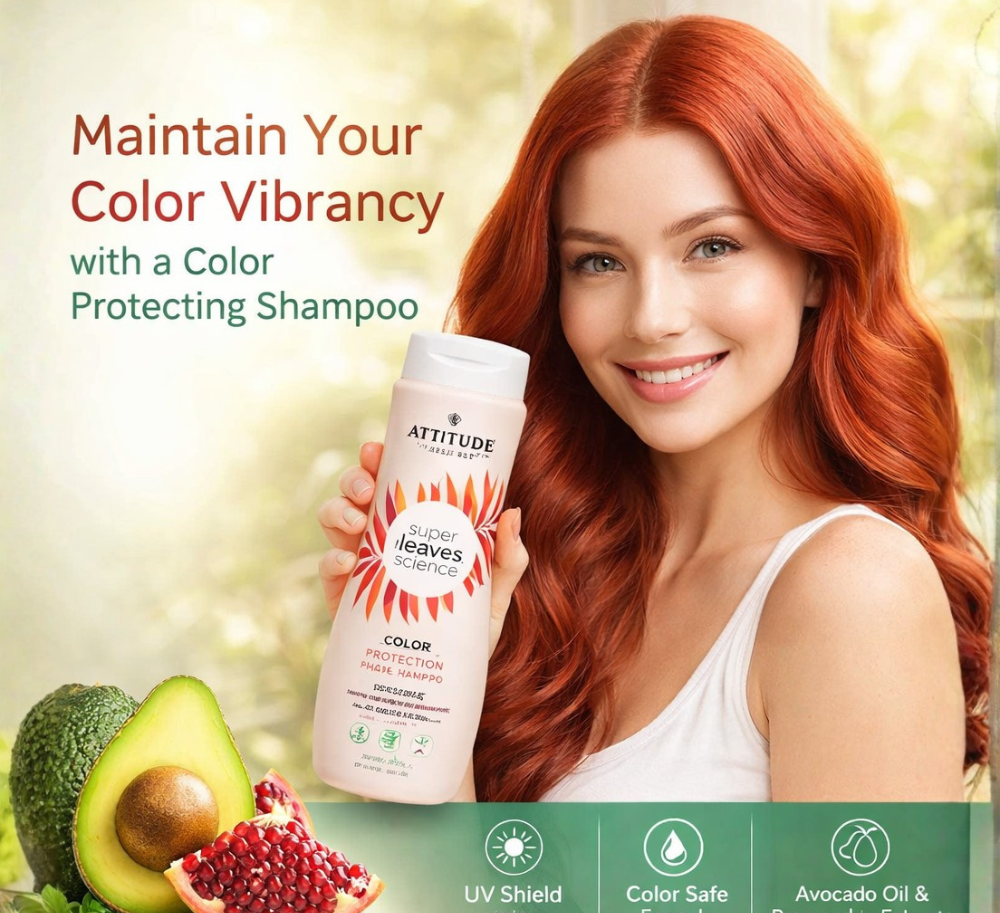
"Colour-safe" is not a regulated term. There is no standard a shampoo has to meet before it can print those words on the front, which means the phrase covers everything from a genuinely well-formulated product to an ordinary shampoo with a new label.
That does not make the category meaningless. There are real formulation differences between a shampoo designed for colour-treated hair and a standard one, and they are worth understanding, because once you know what to look for you can read the ingredients list instead of trusting the marketing. This is the chemistry side of colour care. The habits side, which matters at least as much, is covered separately in a wash-day routine for colour-treated hair.
Why colour leaves hair at all
Permanent hair colour works by opening the cuticle, the overlapping outer scales of the hair, and depositing pigment molecules inside the cortex beneath. Once the cuticle settles back down, those molecules are largely trapped.
Colour loss is essentially the reverse of that process. Anything that swells or lifts the cuticle gives pigment a route out, and anything that dissolves or breaks down the pigment removes it directly. In practice that means water and detergents, heat, and ultraviolet light. Semi-permanent and direct dyes sit closer to the surface and fade faster than permanent colour for exactly this reason.
So a shampoo aimed at coloured hair has two jobs: clean the scalp adequately, and do it while disturbing the cuticle and the pigment as little as possible. Everything below follows from that.
Surfactants: the part that actually matters most
Surfactants are the detergents that do the cleaning. They are also the ingredient most responsible for pulling colour out, because the same properties that let them lift oil and dirt let them carry away pigment.
- Anionic surfactants such as sodium lauryl sulfate and sodium laureth sulfate are efficient, cheap and foam well. They are also the most aggressive at removing colour and natural oils. Sodium lauryl sulfate is the harsher of the two.
- Amphoteric surfactants such as cocamidopropyl betaine are milder and often used alongside others to soften a formula.
- Non-ionic and glucoside-type surfactants such as decyl glucoside or coco glucoside are gentler still, foam less, and clean less aggressively.
This is the substance behind "sulfate-free". It is a genuine formulation difference, not just a slogan, and it is the single most useful thing on the label. But be aware that sulfate-free is a claim about one ingredient family only. Some non-sulfate detergents are still fairly stripping, and the concentration matters as much as the name. Read where the surfactants sit in the ingredients list, not just what they are called.
The trade-off is real: gentler detergents leave more residue behind. If you use a lot of styling product or have a very oily scalp, an ultra-mild shampoo may leave hair feeling coated, which people often misread as damage.
pH and why it appears on labels
Hair and scalp sit naturally on the acidic side, roughly around pH 4.5 to 5.5. Alkaline products cause the cuticle to swell and lift; acidic ones encourage it to lie flatter. This is why colouring processes are alkaline and why a slightly acidic shampoo or conditioner is a sensible pairing afterwards.
Most modern shampoos are formulated in a mildly acidic range whether or not they advertise it, so a stated pH is more a signal of formulation care than a unique advantage. It is a reasonable thing to look for and not something to pay a large premium for.
Added pigments and toning shampoos
Some colour-oriented shampoos contain small amounts of direct dye. These do not preserve your existing colour; they deposit a little new pigment on the outside of the hair with each wash. Purple and blue toning shampoos work this way, neutralising yellow or orange tones in blonde and lightened hair.
Two honest caveats. First, the effect is cosmetic and washes out, so it needs repeating. Second, overuse genuinely can leave a dull or grey-lilac cast on very porous or very pale hair. Toning shampoos are best used occasionally and alternated with your regular one, not adopted as a daily product.
Chelating agents, UV filters and conditioning ingredients
- Chelating agents such as EDTA and its relatives bind metal ions from hard water. This is one of the better-supported functional ingredients in the category, because mineral deposits genuinely do leave colour looking dull and can affect tone in lightened hair. Dedicated chelating shampoos exist for periodic use.
- UV filters appear in some formulas. Ultraviolet light does degrade hair pigment, so the principle is sound. In a rinse-off product the practical benefit is limited, since most of it goes down the drain. A leave-in product or a hat does more.
- Conditioning agents such as cationic polymers, silicones and fatty alcohols deposit on the hair and smooth the cuticle. They do not lock pigment in chemically, but a smoother cuticle reflects light better, so colour looks richer. That is a real benefit; it is just an optical and surface one rather than a chemical seal.
- Oils and botanical extracts mostly serve conditioning and marketing purposes. Some fatty ingredients genuinely reduce water absorption into the hair shaft. Many extracts are present at concentrations too low to do much.
Claims worth trusting, and claims worth ignoring
A quick translation guide for the front of the bottle.
- "Sulfate-free" — checkable and meaningful. Verify it against the ingredients list.
- "Seals the cuticle" — loose language for surface smoothing by conditioning agents. Nothing is sealed shut.
- "Locks in colour" — marketing. Nothing locks pigment in place. A well-formulated shampoo removes less of it than a harsh one; that is the whole mechanism.
- "Keeps colour vibrant for X weeks" — a number with no standard behind it. Fade rate depends on your colour type, hair porosity, wash frequency, water and sun exposure far more than on the shampoo.
- "Salon quality" or "professional formula" — describes a distribution channel, not a specification.
- "Natural" or "chemical-free" — no regulatory meaning, and no bearing on how gentle a product is.
Reading a label in thirty seconds
Ingredients are listed in descending order by weight until you reach the ones present below one percent, after which order stops being informative. Water is almost always first. The next two or three entries are your surfactant system, and that is the part that tells you most about how the product will behave. If sodium lauryl sulfate is high on the list, it is a strong cleanser regardless of what the front of the bottle says.
After that, look for a chelating agent if you have hard water, and for conditioning agents if your hair is porous or lightened. Everything further down the list is unlikely to be doing much.
All Care Store's hair care range covers shampoo and conditioner options if you want to compare labels.
Related reading
- For frequency, water temperature, technique and between-wash care, read a wash-day routine for colour-treated hair.
- For what each product in a routine is actually for, see what each hair product actually does.
- If your scalp is itchy or reactive rather than your colour fading, read about gentle shampoo for a sensitive or eczema-prone scalp.