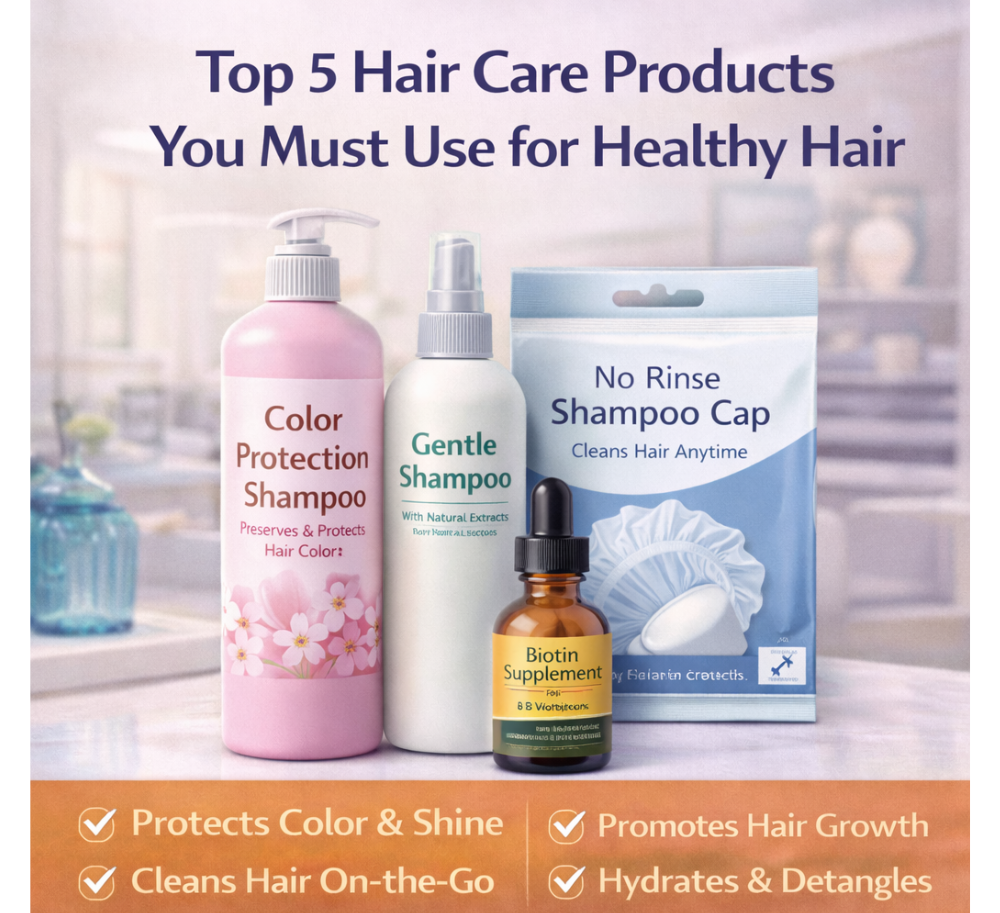
A bathroom shelf can hold eight products and still not answer a simple question: what is each of these for, and do I actually need it?
Marketing tends to present hair care as a set you assemble, where more steps mean better results. That is not how it works. Most products fall into a small number of functional jobs, several of those jobs overlap, and a routine of three well-chosen items usually outperforms one of eight bought at random. Here is what each category genuinely does, what it cannot do, and how to tell when you do not need it.
Shampoo: cleans the scalp
That is the whole job. Shampoo is a detergent system designed to remove sebum, sweat, dead skin and product residue from your scalp. The lengths of your hair get cleaned incidentally by the suds running down during rinsing, which is all they need.
This is why the most useful technique change most people can make is to apply shampoo to the scalp and let the rinse handle the rest. Scrubbing the ends adds dryness without adding cleanliness.
What shampoo cannot do: repair damage, thicken individual hairs, or change how much hair you grow. Those claims belong to a different conversation.
Do you need it? Yes, almost everyone. How often is personal and depends on your scalp, not on rules from the internet. For what is inside the bottle and how to read the label, see what is actually in a colour-safe shampoo.
Conditioner: reduces friction on the lengths
Conditioner works almost entirely by surface deposition. Cationic ingredients and fatty alcohols cling to the hair, smooth the raised edges of the cuticle, and reduce the friction that causes tangling, breakage and frizz. Smoother hair also reflects light better, which reads as shine.
Apply it from mid-length to ends. Roots do not need it and it can leave fine hair looking flat. Squeezing excess water out of the hair first stops you diluting it, and leaving it on for a minute or two is better than rinsing immediately.
Do you need it? If your hair is longer than a few centimetres, tangles, or is chemically treated, yes. Very short hair often does fine without it.
Deep conditioner or mask: the same job, turned up
A mask is a conditioner with a higher concentration of conditioning agents and usually a longer contact time. It is not a different mechanism.
Once a week, in place of your normal conditioner, suits most people. Using one daily is not more effective and can leave hair limp.
Do you need it? Useful if your hair is coloured, lightened, heat-styled, coarse or dry. Genuinely optional if your hair is short, fine or untreated.
Protein and bond-building treatments: for damage, not for maintenance
These are worth separating from ordinary conditioning. Protein treatments temporarily reinforce damaged areas of the hair shaft; bond-building products target specific chemical bonds affected by bleaching and chemical processing.
They matter most if your hair has been lightened or chemically straightened. They are close to pointless on healthy, virgin hair, and overusing them causes a specific problem: hair that goes stiff, rough and snappy rather than soft. People often misread that as more damage and apply more protein, which makes it worse. If your hair feels rigid and breaks cleanly rather than stretching, pause the protein and use moisture only for a few weeks.
Do you need it? Only if your hair is chemically processed or genuinely damaged.
Leave-in conditioner, serum and oil: everyday protection for the ends
These stay on the hair and keep working. Ends are the oldest part of your hair and the most worn, so this is where they earn their place. They reduce friction during drying and styling, help with detangling, and reduce frizz.
Use a small amount. The most common mistake is applying too much and too high up the hair, which leaves it greasy. Start with less than you think and add if needed.
Do you need it? Very useful for long, curly, coarse or damaged hair. Fine, short hair often does not need it.
Heat protectant: the one people skip and should not
If you use a dryer, straightener or curling iron, this is the highest-value thirty seconds in your routine. Heat protectants work by slowing heat transfer to the hair and by reducing friction from the tool.
Two details matter more than the brand. Let it dry before the hot tool touches your hair, and use the lowest temperature that actually does the job — most straighteners run far hotter than most hair needs.
Do you need it? Only if you use heat. If you do, it is not optional.
Dry shampoo: absorbs oil, does not clean
Dry shampoo is usually starch or clay that soaks up sebum at the roots so hair looks less greasy. It removes nothing. It buys you an extra day between washes, which is genuinely useful, but the build-up has to come out on wash day or it contributes to scalp irritation.
Apply to the roots only, let it sit a minute before brushing through, and do not use it as a substitute for washing over long stretches.
Do you need it? Handy rather than essential.
No-rinse shampoo caps and rinse-free products: cleaning without a shower
These are a genuinely different category rather than a convenience version of shampoo. A no-rinse cap contains a cleanser and conditioner that you warm, massage in, and towel off without water.
They exist mainly for situations where a normal wash is not possible: reduced mobility, recovery after surgery, hospital stays, or care at home. They also suit travel. They are not a permanent replacement for washing, but for someone who cannot get to a shower, they are the difference between clean hair and none.
Do you need it? Only for specific circumstances — but in those circumstances, very much so. See how to wash hair in bed for the practical method.
What no hair product can do
Worth being direct about the limits, because this is where money gets wasted.
- Nothing repairs a split end. Products can glue and smooth the appearance temporarily. Only cutting removes them.
- Nothing applied to the outside of the hair changes how much hair you grow. Growth happens at the follicle, below the skin.
- Shampoos and conditioners do not treat hair loss. If you are losing noticeably more hair than usual, that is a medical question, not a shopping one.
- Supplements are not a hair product. They only address hair problems caused by an actual nutritional deficiency, which is less common than the marketing suggests.
A minimal shelf that covers most people
- A shampoo that suits your scalp.
- A conditioner for the lengths.
- A heat protectant, if you use hot tools.
- A weekly mask, if your hair is treated or dry.
- A leave-in or light oil for the ends, if your hair is long or coarse.
That is five items, and two of them are conditional. Everything else on the shelf is a refinement. All Care Store's hair care and no-rinse hair care ranges cover these basics.
Related reading
- A wash-day routine for colour-treated hair — how to put these products in order.
- Gentle shampoo for a sensitive or eczema-prone scalp — if irritation is your main issue.
- What is actually in a colour-safe shampoo — reading an ingredients list.