Medical Disclaimer: This article is for informational purposes only and does not constitute medical advice. Varicose veins can be associated with underlying circulatory conditions. If you have signs of deep vein thrombosis (DVT), peripheral artery disease, open leg ulcers, or significant leg swelling with skin changes, consult your physician before starting compression therapy. Compression that is too strong for your condition can cause harm.
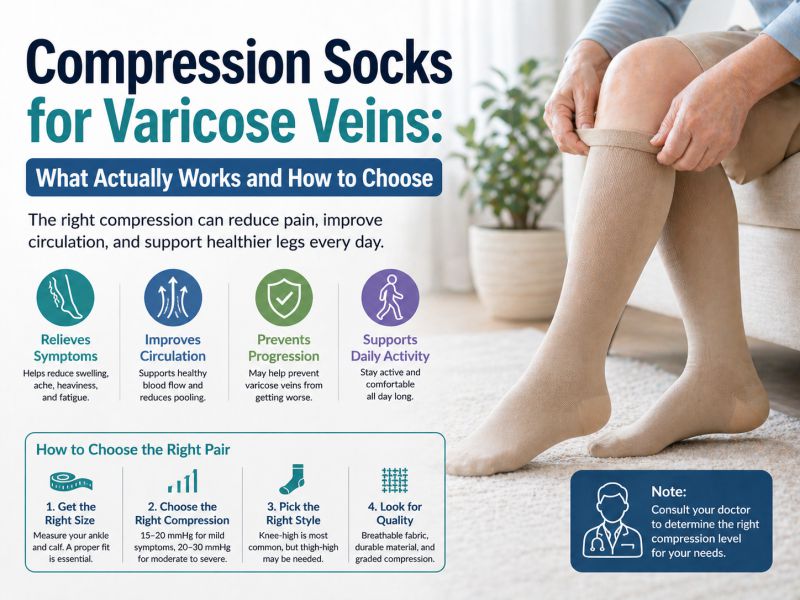
Compression Socks for Varicose Veins: The Complete 2026 Guide
Robert's Tired, Aching Legs
Robert, 59, had been a restaurant manager for over 30 years. He spent eight to ten hours a day on tile floors, rarely sat down during a shift, and had developed prominent, rope-like varicose veins on both calves by his mid-forties. The veins themselves didn't bother him cosmetically — he'd made his peace with that years ago — but the aching, the heaviness that started around hour four of every shift, and the swollen ankles that greeted him when he finally got home were another matter entirely.
His doctor recommended compression stockings. Robert was skeptical. He imagined they'd be hot, uncomfortable, and useless — something for his grandmother, not for a man who still ran a full dining room. He was wrong on all counts. Within two weeks of consistent wear, the afternoon aching was significantly reduced. Within a month, his ankles were swelling noticeably less. The stockings weren't a cure — his varicose veins didn't disappear — but they changed the experience of standing all day in a way that surprised him.
This guide explains the science behind why compression works for varicose veins, how to choose the right type and pressure level, and what real-world compliance looks like. When you're ready to explore options, AllCare Store's Compression Stockings collection carries a full range of graduated compression garments with free shipping and a 30-day return policy.
What Are Varicose Veins — and Why Do They Form?
Veins are the vessels that return blood from the body's tissues back to the heart. Unlike arteries (which have the heart's pumping pressure to drive flow), veins in the legs must push blood upward against gravity. They accomplish this partly through the pumping action of leg muscles during walking, and partly through one-way valves inside the veins that prevent blood from flowing backward between muscle contractions.
Varicose veins form when these one-way valves weaken or fail — a condition called chronic venous insufficiency (CVI). When the valves don't close properly, blood pools between heartbeats in the segments below the damaged valve. This increased pressure causes the vein walls to stretch and bulge outward, creating the visible twisted, enlarged veins beneath the skin surface. Over time, this pooling causes the inflammation, aching, heaviness, itching, and swelling that varicose vein patients experience.
Varicose veins affect approximately 23% of adults — about 1 in 4 — making them one of the most common vascular conditions worldwide. Risk factors include prolonged standing or sitting, pregnancy, obesity, age, family history, and female sex (hormones affect vein wall elasticity). Once valves are damaged, they cannot repair themselves — management focuses on reducing symptoms and slowing progression.
How Compression Socks Help Varicose Veins
Graduated compression stockings work by applying firm, calibrated external pressure to the leg — greatest at the ankle and gradually decreasing toward the knee or thigh. This external compression does several important things for varicose veins:
1. Reduces venous diameter. External pressure physically narrows the stretched, dilated varicose vein segments, restoring more normal blood flow velocity and reducing the pooling that causes symptoms.
2. Compensates for valve failure. By reducing the diameter of the vein, compression helps the damaged valves function more effectively — they don't need to close completely over as large an opening to prevent backflow.
3. Reduces capillary filtration and swelling. By increasing interstitial pressure in the leg tissues, compression reduces the leakage of fluid from capillaries into surrounding tissue — addressing the edema (swelling) component of venous insufficiency.
4. Enhances venous return via muscle pump. Compression increases the efficiency of the calf muscle pump during walking, accelerating venous return and reducing the pressure buildup that drives symptom formation.
Multiple randomized controlled trials have demonstrated that graduated compression stockings reduce pain, heaviness, swelling, and edema in patients with varicose veins and chronic venous insufficiency. They do not make varicose veins disappear, but they substantially reduce symptoms in the majority of patients who wear them consistently.
Understanding Compression Levels (mmHg) for Varicose Veins
Compression strength is measured in millimeters of mercury (mmHg). Choosing the right level matters — too little won't be therapeutic, too much can be harmful.
| Compression Level | mmHg Range | Appropriate For | Notes |
|---|---|---|---|
| Mild / Support | 8–15 mmHg | Tired, achy legs; prevention during travel or prolonged standing; early, very mild vein changes | Often available as fashion/athletic compression; over-the-counter |
| Mild-Moderate | 15–20 mmHg | Mild varicose veins; moderate standing/travel fatigue; minor swelling; spider veins | Most widely available OTC compression level; good starting point for mild CVI |
| Moderate (Class 1) | 20–30 mmHg | Mild-to-moderate varicose veins; moderate edema; varicose veins during pregnancy; post-sclerotherapy maintenance; mild CVI | Most commonly recommended level for established varicose veins. Available OTC but physician confirmation of appropriate level is advisable. |
| Firm (Class 2) | 30–40 mmHg | Moderate-to-severe varicose veins; significant edema; post-thrombotic syndrome; lymphedema; severe CVI | Often physician-recommended or prescribed; measure for proper fit; not appropriate for peripheral artery disease |
| Extra Firm (Class 3) | 40–50 mmHg | Severe edema; lymphedema; severe venous insufficiency | Prescription/medical use; requires professional fitting and physician supervision |
For most people with symptomatic varicose veins, 20–30 mmHg is the standard first-line recommendation. The 15–20 mmHg range is appropriate for prevention, mild symptoms, or people who find 20–30 mmHg difficult to tolerate initially. If in doubt, discuss with your physician or vascular specialist before purchasing — correct pressure level selection is important both for effectiveness and safety.
Knee-High vs. Thigh-High vs. Compression Pantyhose
The right stocking length depends on where your varicose veins are located and what symptoms you're managing.
Knee-high stockings are appropriate for varicose veins and swelling in the lower leg (calf and ankle). They're the most widely used format because they're easier to put on, more comfortable in warm weather, and address the most common location of venous insufficiency. The vast majority of varicose vein patients do well with knee-highs.
Thigh-high stockings are needed when varicose veins extend into the upper thigh, or when the physician specifically recommends thigh-length coverage. They're more difficult to keep in place and harder to don, but necessary when the problem isn't limited to the lower leg.
Compression pantyhose cover the full leg and are often used during pregnancy (when varicose veins can develop anywhere from the ankle to the vulva), or for people who find thigh-highs uncomfortable due to the band at the top.
Getting the Right Fit: Why Sizing Matters More Than You Think
Compression stockings only deliver the intended pressure when they fit correctly. An oversized stocking applies less than the labeled compression; an undersized stocking can apply too much pressure unevenly and cause discomfort or even restrict circulation. Most compression stockings use multiple measurements rather than simple shoe sizes.
For knee-high stockings, measure:
- Ankle circumference: at the narrowest point, just above the ankle bone
- Calf circumference: at the widest part of the calf
- Calf length: from the floor (or bottom of heel) to just below the knee
Critical timing rule: Take all measurements in the morning, before you've been up and moving for more than 30 minutes. As the day progresses, legs swell — measuring a swollen leg will result in a stocking that's too loose when measured correctly at rest. Morning measurements give the truest baseline.
Most reputable compression stocking brands provide clear sizing charts that map these measurements to a size. When you're between sizes, generally go with the smaller size for better therapeutic compression — but check the brand's guidance, as recommendations vary.
Putting Them On: The Biggest Compliance Challenge
The most common reason people stop wearing compression stockings — especially therapeutic-grade 20–30 mmHg garments — is difficulty putting them on. They are intentionally snug and can be genuinely hard to don, particularly for people with limited mobility, strength, or flexibility.
Techniques that help:
- Don them first thing in the morning, before legs swell and while lying in bed or sitting — this is when the leg is smallest and donning is easiest.
- Turn the stocking inside-out down to the heel, place the foot portion over your foot, and gradually roll the body of the stocking up over the calf rather than pulling from the top.
- Use rubber gloves or grip aids — they dramatically increase grip on the stocking fabric and reduce hand fatigue.
- Use a stocking donning device (a plastic or metal frame that holds the stocking open) — these are particularly helpful for people with limited mobility, arthritis, or back problems that make bending difficult.
- Apply a small amount of cornstarch or talcum powder to the leg to reduce friction and make sliding the stocking up easier. (Not moisturizer — it increases friction.)
Wearing Schedule and Daily Habits
For compression stockings to work, they need to be worn consistently — specifically during the hours when you're upright and gravity is working against venous return. The standard protocol is: put stockings on in the morning before getting out of bed (or immediately upon rising), wear throughout the day, and remove in the evening before bed. You do not wear compression stockings to bed unless specifically instructed by your physician.
It typically takes 4–6 weeks of consistent daily wear to experience the full benefit. Many people notice improvement in aching and fatigue within the first 1–2 weeks, with swelling reduction following over subsequent weeks.
Wash compression stockings after every wear (or every other wear) in cool water — heat degrades elastic fibers and shortens garment life. Most quality compression stockings last 3–6 months with daily wear before the elastic begins to lose its therapeutic compression level. Replace them on schedule; a worn-out stocking that no longer provides accurate pressure is not therapeutic.
When Compression Stockings Aren't Enough
Compression therapy is the first-line conservative treatment for varicose veins and venous insufficiency — but it manages symptoms rather than correcting the underlying venous anatomy. For people with significant varicose veins who want the veins themselves treated (not just symptoms managed), minimally invasive procedures have transformed options:
- Endovenous laser ablation (EVLA) and radiofrequency ablation (RFA): catheter-based procedures that close off the incompetent saphenous vein from within, redirecting blood to healthy veins. Highly effective with quick recovery times.
- Sclerotherapy: injection of a chemical solution that damages the vein wall, causing it to close and be absorbed. Used for smaller varicosities and spider veins. Often paired with compression stockings post-procedure.
- Ambulatory phlebectomy: surgical removal of surface varicosities through tiny skin punctures, usually performed under local anesthesia. Used for larger surface varicosities not suitable for injection alone.
These procedures are typically covered by insurance when CVI is documented. Compression stockings are often required as a first-line trial (typically 3–6 months) before insurance approves procedural treatment. Keeping records of compression therapy compliance can support insurance approval for procedural interventions if conservative management proves insufficient.
Frequently Asked Questions: Compression Socks for Varicose Veins
What mmHg compression is best for varicose veins?
For most people with symptomatic varicose veins, 20–30 mmHg (Class 1 graduated compression) is the standard physician-recommended level. This pressure level has strong clinical evidence for reducing pain, heaviness, and swelling associated with venous insufficiency. The 15–20 mmHg range is appropriate for mild or early symptoms or as a tolerance-building starting point. Higher pressures (30–40 mmHg) are used for more severe cases and typically require physician guidance. Do not use 30–40 mmHg stockings without medical input — this pressure level is not safe for everyone.
Can compression socks make varicose veins go away?
No — compression socks manage symptoms but do not eliminate varicose veins. Once vein valves are damaged and veins are stretched and enlarged, the structural changes are permanent without procedural treatment. Compression stockings reduce the pooling, pressure, inflammation, and symptoms caused by the varicosities, and may slow progression — but they don't reverse existing vein changes. Minimally invasive procedures (endovenous laser ablation, radiofrequency ablation, sclerotherapy) are needed to actually close or remove varicose veins.
Should I wear compression socks all day for varicose veins?
Yes — for maximum benefit, compression stockings should be worn from morning until evening whenever you're upright. Put them on before getting out of bed in the morning (or as soon as you rise), and wear them continuously throughout the day. Remove them at bedtime. This schedule coincides with the hours gravity is working against your circulation. Wearing them only some days or only for a few hours provides significantly less benefit than consistent daily all-day wear.
Are compression socks safe with peripheral artery disease (PAD)?
No — compression stockings are contraindicated (not safe) in people with significant peripheral artery disease (PAD), where blood flow to the legs is already reduced. Adding external compression to an already compromised arterial supply can cause serious harm including skin breakdown and limb damage. Always screen for PAD before starting compression therapy — your physician can check ankle-brachial index (ABI) if PAD is suspected. Other contraindications include: active skin infection or cellulitis, severe peripheral neuropathy with inability to detect excessive pressure, and uncontrolled congestive heart failure. When in doubt, consult your physician before starting compression therapy.
How long do compression stockings last before needing replacement?
Quality compression stockings typically maintain therapeutic compression for 3–6 months with daily wear and proper care. The elastic fibers that provide compression degrade over time with washing and wearing. Signs that replacement is needed: the stocking feels looser or easier to put on than when new, visible stretching or wrinkling that doesn't smooth out, or the fabric has thinned significantly. Washing in cool water (not hot) and air drying (not machine drying) extends garment life. Most people rotate between two pairs to extend longevity.
Can I wear compression socks during exercise with varicose veins?
Yes, and this is actually one of the best times to wear them. Exercise — particularly walking, cycling, and swimming — activates the calf muscle pump and is highly beneficial for venous insufficiency. Wearing compression during exercise enhances the muscle pump's effectiveness and reduces the venous pressure that drives symptom formation. Athletic-style compression socks (typically 15–20 or 20–30 mmHg) designed for activity are widely available and more comfortable for exercise use than traditional medical stockings. Regular low-impact exercise combined with compression therapy is one of the most effective lifestyle strategies for varicose vein management.
Robert's Legs, Two Years Later
Robert still has his varicose veins — they haven't gone anywhere. But the afternoon aching that used to hit him like clockwork by hour four is largely gone on days he wears his compression stockings consistently. His swelling is minimal. He's been fitted for 20–30 mmHg knee-highs, rotates between two pairs, and puts them on every morning before the shift starts. It's become as routine as putting on his shoes.
He's also consulted a vascular specialist about endovenous laser ablation, which his insurance will cover after his compression therapy documentation. That's the next step — closing the veins that are causing the problem, not just managing the symptoms. But in the meantime, compression therapy has made a job he loves manageable again.
Browse AllCare Store's Compression Stockings and Compression Therapy collections for a full range of graduated compression options. Questions? Our team is available at 1-888-889-6260 and we offer free shipping on qualifying orders with a 30-day return policy.
— The AllCare Store Team | AllCareStore.com