Dental Disclaimer: This article is for informational purposes only and does not constitute dental or medical advice. Always follow the guidance of your dentist or prosthodontist for denture care specific to your situation.
Dorothy had worn her dentures for twelve years without a single problem — until she started noticing a faint odor she couldn't shake. She brushed them every morning, the same way she always had. What she didn't know was that brushing alone, without soaking, leaves a thin biofilm of bacteria and fungi that builds up invisibly over months and years. A conversation with her dentist changed everything: within a week of adding a nightly effervescent soak, the odor was gone. "I didn't realize how much I was missing," she said.
Denture care is one of those routines that's easy to underdo. Most people brush their dentures once a day and consider the job finished. But dentures — full or partial, immediate or implant-supported — accumulate plaque, tartar, stains, and microbial biofilm in ways that toothbrushing alone can't address. The right cleaning regimen protects your oral tissues, extends the life of your prosthetic, and keeps your breath fresh.
Explore our full range of oral care products at AllCare Store, including denture cleaners, brushes, and accessories — with free shipping on every order.
Why Denture Hygiene Matters More Than You Think
Dentures sit against the gum tissue and palate all day. That contact creates a warm, moist environment where bacteria and the fungus Candida albicans (which causes oral thrush) thrive. Research shows that up to 67% of denture wearers develop some degree of denture stomatitis — inflammation and infection of the tissue beneath the denture — largely driven by inadequate cleaning.
Beyond oral infections, poorly cleaned dentures develop calculus (tartar buildup), permanent stains, and odor that no amount of brushing can reverse. Regular soaking with an effective cleaner prevents these problems from taking hold in the first place.
For implant-supported dentures and partial dentures, rigorous cleaning is even more important: bacteria accumulating at the base of implant posts or around remaining natural teeth can accelerate bone loss and gum disease.
Types of Denture Cleaners
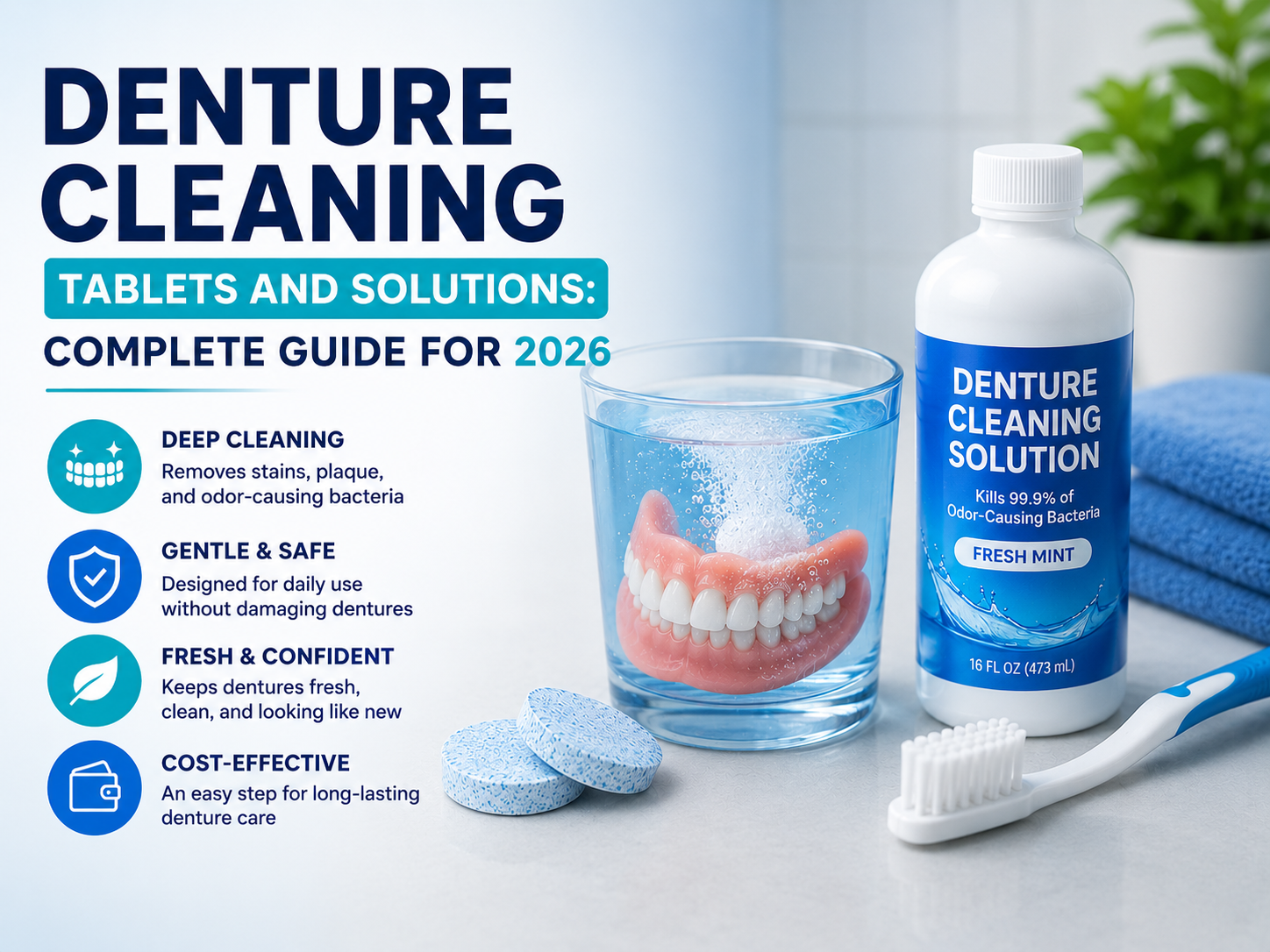
Effervescent tablets are the most widely used and recommended type of denture cleaner. You drop a tablet into a glass of warm water, let it dissolve, and soak the denture for the recommended time (typically 3–15 minutes for express tablets, up to overnight for standard formulas). The effervescent action — the fizzing — isn't just satisfying to watch. It creates thousands of tiny bubbles that physically disrupt the biofilm on the denture surface, loosening food particles, bacteria, and staining agents. Most effervescent tablets also contain active ingredients such as sodium percarbonate (an oxidizing agent that bleaches stains and kills bacteria), sodium bicarbonate (baking soda, which neutralizes odors and softens deposits), and enzymes that break down proteins in food residue. Brands like Efferdent, Polident, and Fixodent Clean all use variations of this formula.
Liquid soaking solutions perform a similar function but come pre-mixed. You pour the solution into a soaking container and submerge the denture for the prescribed time. Liquid solutions are convenient for people who find tablets fiddly, and some formulations are gentler on certain acrylic materials. They're a good option for overnight soaking.
Ultrasonic cleaners are small devices that use high-frequency sound waves to create microscopic bubbles in water (a process called cavitation). The bursting of those bubbles generates enough mechanical energy to scrub the denture surface at a microscopic level — cleaning areas that no brush can reach. Ultrasonic cleaners are used extensively by dental offices and are increasingly affordable for home use. They're particularly effective for partial dentures with clasps and intricate metalwork, where plaque hides in crevices. Most dental professionals recommend combining ultrasonic cleaning with a cleaning tablet solution for best results.
Denture pastes and powders are mild abrasive cleaners used with a denture brush. They're gentler than regular toothpaste (which is too abrasive for most acrylic dentures and will scratch the surface over time) but effective at removing light surface staining when used as part of a daily brushing routine.
Choosing the Right Denture Cleaner for Your Denture Type
Full acrylic dentures (the most common type): Effervescent tablets and liquid soaks are both appropriate. Avoid bleach-based products if your denture has metal components, as bleach can corrode metal clasps and attachments.
Partial dentures with metal clasps: Choose an effervescent cleaner specifically formulated for partials, or confirm the product label states it is safe for metal components. Most major brands offer a partial-safe variant. Ultrasonic cleaners work exceptionally well for partials.
Implant-supported dentures (snap-on/overdentures): Clean removable implant overdentures as you would any full denture. Additionally, clean the implant posts in the mouth with a soft brush and antimicrobial rinse as directed by your dentist.
Soft-lined or flexible dentures (Valplast, etc.): Some effervescent products can degrade soft liners over time. Check with your dentist and use a product specifically labeled as safe for soft-lined or flexible dentures.
Immediate (temporary) dentures: Follow your dentist's specific guidance during the healing period after extraction. Soaking protocols may differ during the first weeks.
How to Clean Dentures Properly: Step-by-Step
The right cleaning routine takes only a few minutes morning and evening and dramatically reduces the risk of infections, staining, and odor.
After each meal: Rinse the denture under running water to remove loose food particles. This one step prevents food from drying onto the surface and becoming harder to remove later.
Each morning: Brush the denture thoroughly with a soft-bristled denture brush and denture paste or mild dish soap. Brush all surfaces — the inner and outer faces, and the areas that contact your gum tissue. Do not use regular toothpaste (too abrasive) or hard-bristled brushes. Rinse well.
Each night: After removing your dentures, drop an effervescent tablet into a glass or denture soaking cup filled with warm (not hot) water. Submerge the denture and soak according to the product's instructions — typically 3–15 minutes for daily cleaners, or overnight for standard formulas. In the morning, rinse the denture thoroughly under running water before placing it back in your mouth. Do not swallow the soaking solution.
Store properly when not wearing: Dentures should stay moist when not being worn. Soak them in plain water or a mild soaking solution, or keep them in a sealed container with a small amount of water. Never leave dentures to dry out — this can cause warping and cracking that permanently distorts the fit. Never soak in hot water, which can also warp the acrylic.
Clean your gums too: Before inserting your dentures each morning, gently brush your gum ridges, tongue, and palate with a soft-bristled brush. This removes bacteria, stimulates circulation, and reduces the risk of stomatitis.
What to Avoid
Regular toothpaste contains abrasives designed for tooth enamel — which is extremely hard. Acrylic denture material is much softer, and regular toothpaste will scratch it microscopically over time, creating a rough surface that traps bacteria and stains. Always use a product labeled specifically for dentures.
Bleach (household chlorine bleach) can whiten stained acrylic but will corrode any metal components and, with repeated use, can weaken the acrylic itself. Don't use bleach unless your dentist advises it for a specific problem and you have a metal-free denture.
Hot water, microwaves, and dishwashers will warp your dentures permanently. Warm water only.
Stiff-bristled brushes cause microscopic scratches. Use only brushes designed for dentures — they have the right combination of softness and reach for denture surfaces.
When to See Your Dentist
Even with excellent home care, dentures require professional attention. Your dentist can remove calculus buildup (tartar that has hardened onto the denture surface) using professional-grade ultrasonic scalers and polishing compounds — processes that can't be replicated at home. Plan to bring your dentures to your regular checkups for professional cleaning.
See your dentist promptly if you notice: persistent soreness or redness of the gum tissue under the denture; white patches on your gums or palate (possible oral thrush); cracking, chips, or a loose fit; or a strong odor that doesn't resolve with thorough cleaning. A loose-fitting denture is one of the most common causes of gum irritation and stomatitis — the fit should be reassessed every few years as gum tissue and bone naturally change shape over time.
Shop Denture Care Products at AllCare Store
At AllCare Store, we carry a complete selection of denture care products including effervescent cleaning tablets, soaking solutions, denture brushes, ultrasonic cleaners, and storage containers. Browse our oral care collection or shop our full personal care range. Free shipping on every order. Questions? Call us at 1-888-889-6260.
Frequently Asked Questions: Denture Cleaning
How often should I use denture cleaning tablets?
Most dental professionals recommend using an effervescent denture cleaning tablet or soaking solution every night. Daily soaking is the most effective way to prevent biofilm buildup, control bacteria and fungal growth, and keep your dentures odor-free. At minimum, soak your dentures at least several times per week. Some overnight formulas are designed for extended soaking; follow the product label's recommended soak time.
Can I use regular toothpaste to clean my dentures?
No. Regular toothpaste contains abrasives formulated for tooth enamel, which is much harder than the acrylic resin used in most dentures. Using regular toothpaste will scratch the denture surface over time, creating microscopic grooves that harbor bacteria and accelerate staining. Use only denture paste, mild dish soap, or products specifically labeled for denture cleaning.
Is it safe to leave dentures in water overnight?
Yes — soaking in plain water overnight is better than letting dentures dry out, which can cause warping. However, soaking in a denture cleaning solution is significantly better than plain water because it controls bacteria and removes staining agents. Use cool or room-temperature water; never hot water, which can warp the acrylic. If your dentist has prescribed a specific soaking agent or instructed you to store your dentures dry, follow their guidance.
What is the white buildup on my dentures?
White or off-white buildup on dentures is typically calculus (tartar) — the same mineralized plaque that forms on natural teeth. It develops when plaque is not fully removed and hardens over time. Mild buildup can often be loosened with effervescent tablets and removed with a denture brush. Heavier calculus requires professional removal by a dentist or prosthodontist using ultrasonic scaling equipment. Regular nightly soaking is the most effective prevention.