Note: This article is for informational purposes only and does not replace medical advice. Severe menstrual pain (dysmenorrhea) can sometimes indicate underlying conditions such as endometriosis, fibroids, or adenomyosis. If your cramps are severe, significantly impact daily activities, or have changed in character, consult your healthcare provider for proper evaluation.
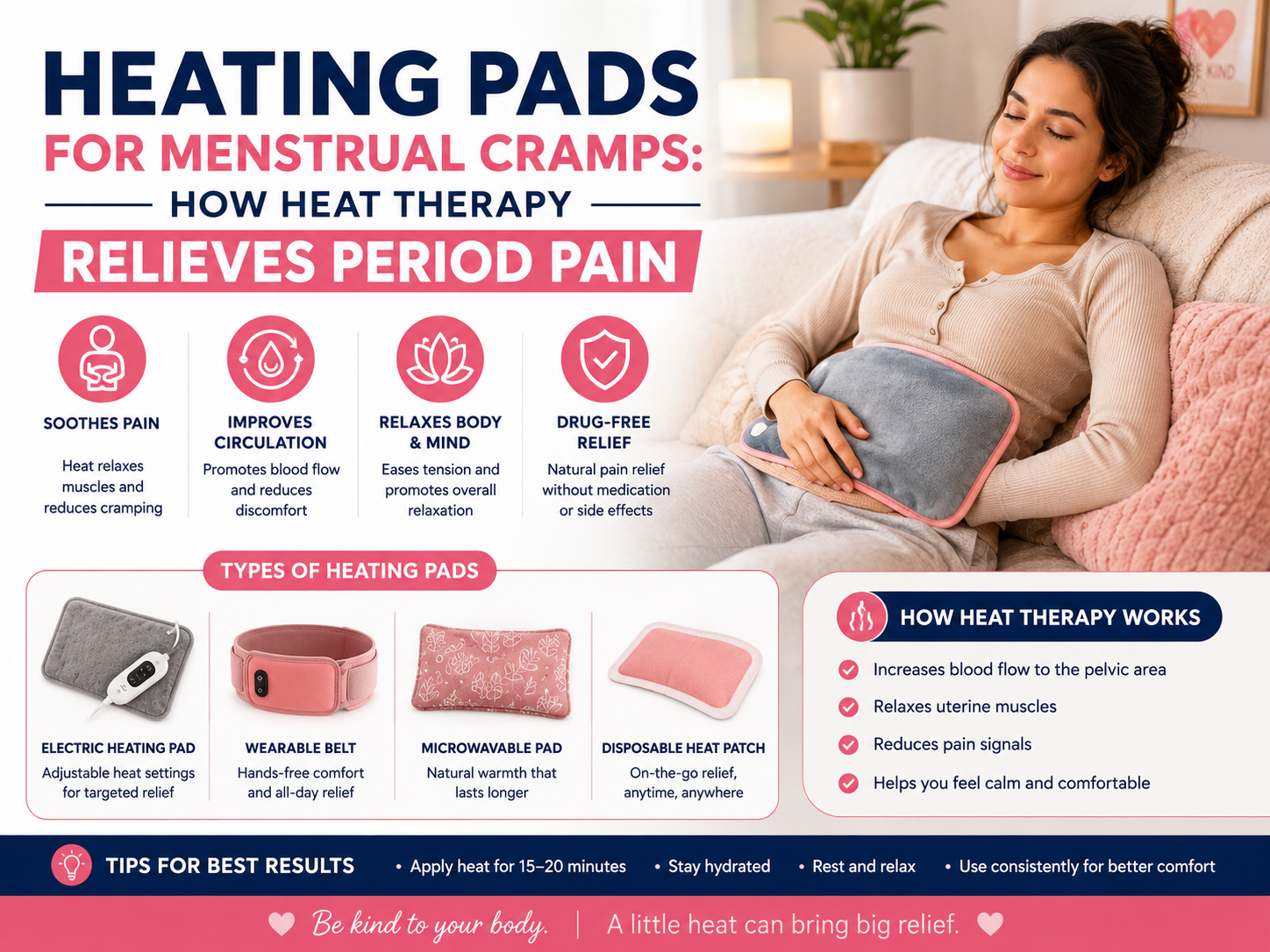
Heating Pads for Menstrual Cramps: How Heat Therapy Relieves Period Pain
Why Heat Works for Period Pain
Menstrual cramps — clinically known as dysmenorrhea — affect an estimated 50–90% of people who menstruate, and for many, the pain is severe enough to interfere with daily life. The pain originates from the uterus contracting to shed its lining, driven by hormone-like compounds called prostaglandins. Higher prostaglandin levels are associated with more intense cramping.
Heat therapy works through multiple mechanisms that directly address the physiology of cramp pain. Applied to the abdomen, heat causes the smooth muscle of the uterine wall to relax, reducing the intensity of contractions. Heat also dilates blood vessels in the area, improving circulation and helping clear prostaglandins from the tissue. And crucially, heat activates heat receptor pathways in the nervous system that literally compete with and suppress pain signal transmission — a mechanism similar to how certain pain medications work, but without systemic drug effects.
Multiple clinical studies have confirmed that localized heat application (around 40°C / 104°F) is as effective as ibuprofen for menstrual cramp relief — and in some studies, more effective than acetaminophen. For many people, combining heat with an OTC pain reliever provides better relief than either approach alone.
Browse our Rest & Comfort collection at AllCare Store for heating pads, heat wraps, and related comfort products.
Types of Heating Pads for Menstrual Cramps
Electric Heating Pads
Electric heating pads are the most versatile and controllable option for managing menstrual cramps at home. They plug into a wall outlet and maintain a consistent, adjustable temperature for as long as needed — no reheating required, and no concern about the heat fading at the peak of pain.
Best features to look for:
- Multiple heat settings — at minimum low, medium, and high. The ability to start lower and increase as needed is important because sensitivity varies across different days of the cycle.
- Auto-shutoff — most electric pads shut off after 2 hours for safety. Some models allow the shutoff to be disabled or extended, which matters for overnight use.
- Moist heat option — some electric pads have a moisture chamber that adds steam. Moist heat penetrates deeper than dry heat and many users find it more effective for cramping.
- Flexible design — a pad that conforms to the lower abdomen and can be held in place while moving is significantly more practical than a flat, rigid pad.
- Washable cover — essential for hygiene, especially for a product used during menstruation.
- Adequate size — a pad large enough to cover the lower abdomen and potentially wrap partially around the lower back addresses both frontal cramping and the referred back pain that accompanies many menstrual cycles.
Microwavable Heat Packs
Microwavable heat packs filled with grain (wheat, flaxseed, rice) or clay beads provide moist heat that many users prefer over dry electric heat. They are wireless, completely portable, and require no cords — a significant advantage when trying to rest comfortably. The main limitation is that the heat fades over 20–40 minutes and must be reheated, which interrupts rest during severe cramping episodes. They are an excellent supplementary or travel option alongside an electric pad.
Disposable Heat Wraps
Air-activated disposable heat wraps (such as ThermaCare-style pads) are designed to be worn under clothing and adhere to the lower abdomen. They provide low-level continuous heat for up to 8 hours. Their primary advantages are discretion and mobility — they can be worn during work, school, or while running errands without restricting movement or requiring proximity to an outlet. The trade-off is that heat intensity is not adjustable and heat takes 20–30 minutes to reach full temperature. They are more expensive per use than reusable pads but valuable for active days.
Cordless / Rechargeable Heating Pads
Rechargeable wireless heating pads have become increasingly available and offer a middle ground between electric pads (consistent heat, cord dependent) and disposable wraps (wireless but single-use). Battery life varies — most provide 2–4 hours of heat per charge, which is adequate for most cramp relief sessions. Look for models with at least three heat settings and a battery indicator. Useful for travel and for people who move around frequently during painful days.
How to Use a Heating Pad for Menstrual Cramps Effectively
Where to place it: Apply the heating pad to the lower abdomen, centered just above the pubic bone — this is directly over the uterus. For cramps that radiate into the lower back (a common pattern), a second pad or a wrap long enough to cover both the abdomen and lower back addresses the full pain area simultaneously. Heating the lower back alone without abdominal coverage is less effective for uterine cramping.
Temperature: Start at medium heat and adjust as needed. The target temperature for therapeutic effect is approximately 40°C (104°F) — warm enough to penetrate tissue and relax smooth muscle, but not so hot as to cause skin irritation or burns. On the highest setting, most electric pads reach temperatures that require a fabric barrier between the pad and skin to prevent superficial burns, especially with prolonged use.
Duration: Sessions of 20–30 minutes provide meaningful relief; many people use heat for 1–2 hours during heavy cramping. For overnight use, a heating pad with auto-shutoff is the safest option. Do not sleep with a heating pad directly against skin on high heat without a protective cover.
Combine with position: Lying on your side with knees drawn up (fetal position) while using a heating pad reduces abdominal muscle tension and can enhance the effectiveness of heat therapy. A pillow between the knees adds lower-back support.
Timing: Starting heat therapy at the first sign of cramping — before pain escalates — is more effective than waiting until pain is severe. Many people find that applying heat preemptively on the first day of their period, even before cramping starts, shortens the overall duration of painful episodes.
Comparing Heat Therapy to Medication for Cramp Relief
| Approach | How It Works | Best For |
|---|---|---|
| Heat therapy | Relaxes uterine muscle, improves circulation, blocks pain signals via heat receptors | Immediate localized relief; suitable for those who cannot take NSAIDs; no systemic effects |
| Ibuprofen / NSAIDs | Inhibits prostaglandin production — reduces the cause of cramping | Addresses root cause; works systemically; most effective when started before cramping peaks |
| Acetaminophen | Pain signal modulation; does not affect prostaglandins | Mild to moderate pain; those who cannot take NSAIDs due to stomach or kidney concerns |
| Heat + NSAIDs combined | Complementary mechanisms — heat acts locally while medication works systemically | Moderate to severe cramps; clinical evidence shows greater relief than either alone |
Safety Guidelines for Heating Pad Use
Heating pads are safe when used correctly. Key precautions:
- Never place directly on bare skin at high heat. Always keep at least one layer of fabric between a high-setting electric pad and skin, particularly for extended sessions. Low and medium settings are generally safe against clothed skin.
- Do not use on broken or irritated skin. This includes skin affected by rashes or any condition that reduces sensation.
- Check skin periodically during long sessions. Redness that fades quickly when pressure is removed is normal warmth; persistent mottled redness can indicate early superficial irritation — reduce temperature or take a break.
- Do not fold the pad while in use. Folding an electric heating pad creates hot spots that can cause burns.
- Inspect cords and pads for wear. Damaged electric heating pads with frayed cords or visible damage to the heating element should be replaced.
- Consult your doctor before use if pregnant. External heat over the abdomen during pregnancy requires medical guidance — this guide is written for menstrual cramp management specifically.
Other Heat Therapy Approaches for Menstrual Pain
Warm bath or shower: Immersion in warm water provides whole-body relaxation alongside targeted abdominal and lower-back heat. A 20-minute warm bath is effective for mild to moderate cramping and is particularly helpful for relieving the muscle tension and fatigue that accompany heavy periods. Adding Epsom salts (magnesium sulfate) may provide additional muscle relaxation benefit, though evidence is primarily anecdotal.
Hot water bottle: A traditional rubber hot water bottle provides moist-heat-adjacent comfort and is wireless and low-cost. The main limitations are that water cools over time (requiring refilling), and water temperature can be difficult to regulate precisely — overfilling with very hot water can cause burns through fabric. Always wrap a hot water bottle in a cloth cover.
Heating wraps with lumbar coverage: For cramps that radiate heavily into the lower back, heated back wraps that cover both the lumbar area and can be positioned around the front address the full pain pattern more comprehensively than an abdominal pad alone.
When to See a Doctor About Menstrual Cramps
For some people, severe menstrual pain is not simply a variation of normal cramping but a symptom of an underlying gynecological condition. Endometriosis — where tissue similar to the uterine lining grows outside the uterus — affects approximately 1 in 10 people who menstruate and is a leading cause of debilitating period pain. Uterine fibroids and adenomyosis are other common conditions associated with more severe cramping. These conditions are treatable, and many people go years without a diagnosis because severe cramping is normalized or dismissed.
Consider speaking with a healthcare provider if:
- Cramps regularly interfere significantly with work, school, or daily activities
- Over-the-counter pain relief (NSAIDs, heat) provides insufficient relief
- Pain has worsened over time rather than remaining consistent
- You experience pain between periods or during sex
- You have heavy bleeding (soaking through a pad or tampon every hour for several hours)
Shop Heating Pads and Comfort Products at AllCare Store
AllCare Store carries heating pads, heat wraps, and comfort products for pain relief and daily wellness. Browse our Rest & Comfort collection or visit allcarestore.com to explore our full range.
- Free Shipping on every order — no minimum required
- Discreet Packaging — all orders arrive in plain, unmarked packaging
- 30-Day Returns — shop with confidence
- Expert Help — reach our team at 1-888-889-6260, Monday–Friday 7 AM–4 PM CST
Frequently Asked Questions: Heating Pads for Menstrual Cramps
Do heating pads actually help with period cramps?
Yes — and there is solid clinical evidence to support it. Multiple studies have found that continuous low-level heat applied to the lower abdomen (approximately 40°C / 104°F) is as effective as ibuprofen for relieving primary dysmenorrhea (menstrual cramps). Heat works by relaxing the smooth muscle of the uterine wall, improving local circulation to clear pain-producing prostaglandins, and activating heat receptor pathways that directly suppress pain signal transmission. Combining heat with an OTC pain reliever typically provides better relief than either approach used alone.
Where should I place the heating pad for period cramps?
Place the heating pad on the lower abdomen, centered just above the pubic bone — directly over the uterus. For cramps that radiate into the lower back (a common pattern), a larger pad or wrap that covers both the lower abdomen and lower back provides more comprehensive relief. Heating the lower back alone without abdominal coverage is less effective for uterine cramping specifically.
How long should I use a heating pad for menstrual cramps?
Sessions of 20–30 minutes provide meaningful relief, and many people use heat for 1–2 hours during the worst cramping. For overnight relief, an electric heating pad with auto-shutoff is the safest option. Starting heat therapy at the first sign of cramping — before pain escalates — is more effective than waiting until severe pain has set in. There is no strict maximum session length as long as you follow safety guidelines (keeping a layer of fabric between the pad and skin, checking skin for irritation, not folding the pad).
Is moist heat or dry heat better for cramps?
Many people find moist heat more effective and more comfortable than dry heat for menstrual cramps, particularly for muscle relaxation. Moist heat (from a microwavable grain pack, a wet-heat electric pad, or a warm bath) penetrates tissue slightly more effectively and feels less drying on the skin. That said, dry heat from a standard electric heating pad is still clinically effective for menstrual pain. The most important factor is consistent, maintained heat at the right temperature — whichever format you can sustain comfortably is the right choice for you.
Can I use a heating pad for cramps while sleeping?
You can use a heating pad while sleeping with appropriate precautions. Use an electric heating pad with an automatic shutoff feature (most modern pads include this). Set the temperature to low or medium rather than high for overnight use. Keep at least one layer of fabric between the pad and skin. Do not fold the pad during use. Disposable heat wraps (designed to be worn under clothing) are a safer overnight option as they operate at lower, consistently controlled temperatures. Avoid falling asleep on top of a heating pad — the prolonged direct pressure with heat can cause skin irritation or superficial burns.