Note: This article is for informational and educational purposes only and does not constitute medical advice. If you have a specific medical condition affecting your sleep, spine, or joints, consult your healthcare provider for personalized guidance.
Knee Pillows for Side Sleepers: Complete Guide 2026
Why Side Sleepers Need Knee Support
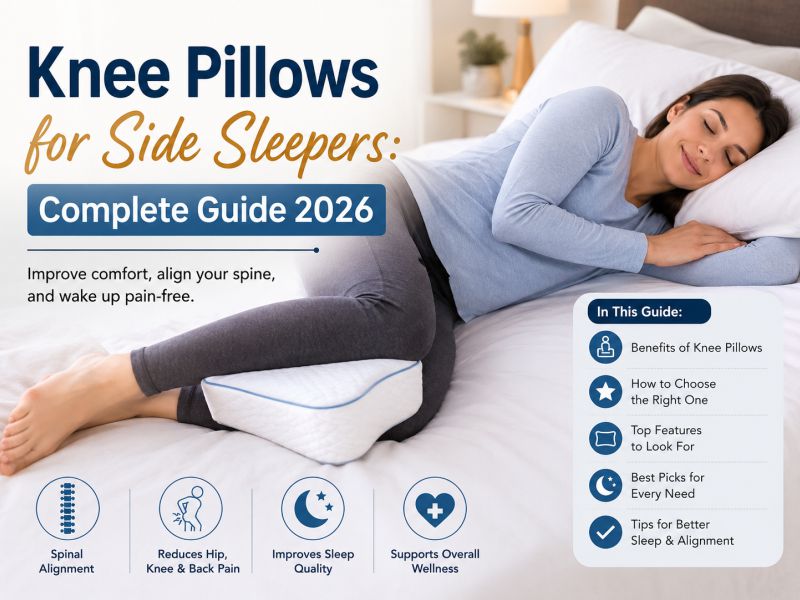
Side sleeping is the most common sleep position among adults — and for good reason. It reduces snoring, can ease acid reflux, and is generally recommended for people with sleep apnea. But side sleeping without proper support creates a biomechanical problem: when your legs lie stacked on top of each other, the upper knee drops forward, rotating your pelvis and pulling your lumbar spine out of neutral alignment. Over the course of a night, that sustained misalignment creates strain at the lower back, hips, and even the knees themselves.
A knee pillow solves this by filling the gap between your knees (or beneath the upper knee), keeping your hips, pelvis, and spine stacked in neutral alignment throughout the night. The result for many side sleepers is noticeably reduced morning back stiffness, decreased hip discomfort, and better overall sleep quality.
Browse our full rest and comfort collection for knee pillows, body pillows, wedge pillows, and other sleep support products.
How a Knee Pillow Works
The key concept is spinal alignment. When your spine is in its natural, neutral S-curve — the same position it holds when you stand comfortably upright — discs, muscles, and joints are under minimal stress. Side sleeping without knee support breaks this alignment at the lumbar spine because the unsupported upper hip rotates downward with gravity, twisting the pelvis and stretching the muscles and ligaments along the lower back.
Placing a supportive pillow between or beneath the knees prevents that rotation. Your hips remain stacked, your pelvis stays level, and your lumbar spine maintains its natural curve. Pressure is distributed more evenly rather than concentrated at specific joints. For people who wake with hip or lower back pain that eases as the day progresses — a classic sign of sleep-position-related strain — this adjustment alone can make a significant difference.
Who Benefits Most from a Knee Pillow
People with chronic lower back pain: Lower back pain is among the most common reasons people report disrupted sleep. Misalignment during side sleeping can aggravate existing lumbar disc problems, muscle tension, and facet joint irritation. A knee pillow is one of the most consistently recommended non-pharmacological interventions for improving sleep comfort when lower back pain is involved.
People with hip pain or hip bursitis: Hip bursitis — inflammation of the fluid-filled sac over the bony prominence of the hip — can make side sleeping acutely painful, especially when lying on the affected side. A knee pillow positions the upper hip and takes pressure off the bursa by preventing the upper leg from dragging the hip inward.
Sciatica sufferers: Sciatic nerve pain that runs from the lower back through the buttocks and down the leg is often worsened by sleep positions that increase lumbar rotation or compress the piriformis muscle. Keeping the knees separated and the pelvis aligned reduces this compression and can ease nighttime sciatic symptoms.
Pregnant women: Left-side sleeping is recommended during pregnancy, particularly in the third trimester, to optimize circulation to the baby. A knee pillow reduces hip and lower back strain in this position and takes pressure off the pubic symphysis — a common source of pregnancy-related pelvic pain. Many pregnant sleepers use both a knee pillow and a full-length body pillow for complete support.
People recovering from hip or knee surgery: After hip replacement, knee replacement, or other orthopedic procedures, maintaining specific limb positioning during sleep is often medically required. A structured knee pillow — particularly one with a strap to keep it in place — helps maintain the prescribed position throughout the night. Always follow your surgeon's specific positioning instructions; some post-surgical positioning requires custom wedges rather than standard knee pillows.
People with knee osteoarthritis: Knee-on-knee contact while side sleeping creates direct bony pressure on painful, sensitive joint surfaces. A knee pillow eliminates this contact, reducing pain at the knees themselves in addition to addressing spinal alignment.
Types of Knee Pillows
Contoured Between-the-Knees Pillow
The most common design: an hourglass or contoured foam pillow that fits between the knees and inner thighs, keeping them separated with anatomically shaped support. The contoured shape holds the pillow in place better than a flat pillow and distributes support across a broader contact area. Most are made from memory foam for pressure-conforming comfort. This is the right choice for most side sleepers dealing with back or hip pain.
Half-Moon (Bolster) Pillow
A cylindrical or half-moon shaped pillow that tucks under the top knee to prop it up, rather than fitting between both knees. Useful for people who find the between-knees design uncomfortable or who prefer a different kind of elevation. Also useful beneath the knees when lying on your back to reduce lumbar strain in that position.
Wedge Knee Pillow
A triangular wedge that elevates the upper leg on an incline. Often used by post-surgical patients who need a specific leg elevation angle, or by people with leg edema who benefit from elevation during sleep. More specialized than contoured models; best chosen based on a specific therapeutic need.
Leg Separator with Strap
A knee pillow with an attached elastic strap that wraps around the legs to hold the pillow in place during the night. Particularly useful for restless sleepers who tend to shift position frequently and find that standard knee pillows fall out from between the legs. The strap keeps the pillow positioned correctly even through movement.
Body Pillow (Full-Length)
A full-length pillow (typically 48–54 inches) that supports the entire body — you hug it with your upper arm, rest your head on it, and drape your top leg over it. Provides knee and hip support as well as upper body and shoulder alignment. Particularly popular for pregnant sleepers and people who find that they tend to roll toward their stomach during the night. A body pillow addresses the same alignment issues as a dedicated knee pillow but in a more comprehensive way.
What to Look for When Choosing a Knee Pillow
Material
Memory foam is the most popular fill for knee pillows. It conforms to the shape of your legs, distributes pressure evenly, and holds its position. The main consideration is firmness — too soft and the pillow compresses completely under the weight of your leg, providing no support; too firm and the pressure on your inner thigh or knee becomes uncomfortable. Medium-firm memory foam is the right target for most users.
Gel-infused memory foam addresses the heat retention that standard memory foam is known for. If you sleep hot, a gel layer on the surface of the pillow can make a noticeable comfort difference over a full night.
Polyester fiberfill (similar to a standard pillow) is softer and more compressible than foam. It adjusts easily to your position but offers less firm structural support. Better for people who want gentle cushioning rather than structural alignment correction.
Latex is a durable, responsive alternative to memory foam. It doesn't retain heat as much as memory foam and has a slightly bouncier feel. A good choice for people who have found memory foam too slow to respond when they shift position.
Size
Knee pillows come in a range of sizes. A pillow that is too small won't adequately fill the space between the knees; one that is too large creates an awkward positioning angle. Most standard contoured knee pillows are sized for average adult proportions. If you have shorter or longer legs, or a significantly larger or smaller build, check the dimensions before purchasing. Many contoured designs measure approximately 9–10 inches wide at their widest point and 7–8 inches in height — dimensions that accommodate the gap between the knees for most adults.
Firmness
The ideal firmness keeps the knees apart without creating uncomfortable pressure on the inner thighs or knees. For structural alignment support, you need enough firmness that the pillow doesn't fully compress under your leg's weight — but not so firm that contact pressure is a problem. Medium-firm is the most universally recommended starting point. If you have very sensitive knees due to arthritis or a recent procedure, a slightly softer option may be more comfortable.
Cover Material and Washability
A removable, machine-washable cover is important for hygiene given that the pillow will be in close contact with skin nightly. Look for covers made from breathable materials — cotton, bamboo-derived fabrics, or cooling knit fabrics are preferable to non-breathable synthetic covers that trap heat and moisture.
Strap vs. No Strap
If you tend to move around during sleep, a knee pillow with a leg strap will stay in position much better than a loose pillow. If you're a relatively still sleeper, a strap may feel restrictive and unnecessary. Consider your typical sleep movement patterns when deciding.
How to Use a Knee Pillow Correctly
Correct positioning is important — a knee pillow used incorrectly provides little benefit. The pillow should sit between the knees and inner thighs, not just at the knees, so that it fills the gap created by the leg-stacking position. The goal is for your hips to feel stacked — as if you were standing on your side rather than having one hip drop toward the mattress.
The pillow should feel like it's doing the work of holding your upper leg up, rather than your leg resting heavily against the pillow. If you need to actively hold your knee up, your mattress may be the limiting factor — a mattress that is too soft can create a significant valley that the knee pillow cannot fully compensate for.
It typically takes 1–2 weeks of consistent use before side sleepers adapt to sleeping with a knee pillow. Many people notice some improvement in morning comfort within the first few nights; the full benefit often becomes more apparent after a longer adjustment period.
Knee Pillow vs. Body Pillow: Which Is Better?
| Feature | Knee Pillow | Body Pillow |
|---|---|---|
| Primary benefit | Hip and spinal alignment | Full-body support and alignment |
| Best for | Targeted knee/hip/back support | Pregnancy, shoulder pain, full alignment |
| Bed space needed | Minimal | Significant |
| Partner-friendly | Yes | Can crowd a shared bed |
| Ease of use | Simple to position | Requires more adjustment |
| Cost | Lower | Higher |
For most side sleepers dealing primarily with lower back or hip pain, a dedicated knee pillow is the more practical solution. For pregnant sleepers or those who want comprehensive alignment support including the shoulders and upper body, a body pillow (used with or without an additional knee pillow) provides more complete support.
Shop Knee Pillows and Sleep Support at AllCare Store
AllCare Store carries knee pillows, body pillows, wedge pillows, and a full range of sleep comfort products to help you wake feeling more rested and less stiff. Browse our rest and comfort collection to find the right support for your sleep position.
- Free Shipping on every order — no minimum required
- Discreet Packaging — all orders ship in plain, unmarked packaging
- 30-Day Returns — shop with confidence
- Expert Help — reach our team at 1-888-889-6260, Monday–Friday 7 AM–4 PM CST
Frequently Asked Questions: Knee Pillows for Side Sleepers
Does sleeping with a knee pillow actually help back pain?
For many side sleepers, yes — a knee pillow meaningfully reduces lower back and hip discomfort. The mechanism is straightforward: side sleeping without knee support causes the upper knee to drop, rotating the pelvis and straining the lumbar spine and hip flexors over several hours. A knee pillow prevents that rotation by keeping the hips stacked in alignment. People who wake with lower back stiffness or hip soreness that eases as they move around during the morning are good candidates for a knee pillow, as that pattern often reflects sleep-position strain rather than a structural injury. It is not a medical treatment and won't address serious underlying conditions, but it's a low-cost, zero-risk intervention worth trying before more involved interventions.
Should the knee pillow go between my knees or under them?
For side sleepers, the pillow goes between the knees — not under them. Placing it between the knees and inner thighs fills the gap created by stacked legs, preventing the upper hip from dropping forward. Placing a pillow under the knees is the correct position for back sleepers, where it supports the natural curve of the lower back by slightly bending the knees. The two techniques address the same underlying alignment goal but from different sleep positions.
Can a regular pillow work as a knee pillow?
A standard pillow can serve as a temporary substitute, but it has significant drawbacks compared to a dedicated knee pillow. Regular pillows are too large and too compressible — they don't hold their shape under the weight of your leg, they shift position throughout the night, and they take up a lot of bed real estate. A dedicated knee pillow is shaped to fit the anatomy of the inner knee and thigh gap, provides firmer support that doesn't compress away, and is sized appropriately. If you're unsure whether a knee pillow will help you, trying a folded regular pillow between the knees is a reasonable first test — but expect a dedicated knee pillow to perform significantly better.
Are knee pillows good for sciatica?
Knee pillows can help reduce sciatic nerve irritation during sleep for some people, though results vary depending on the cause of the sciatica. Many sciatica cases involve compression of the sciatic nerve in the lumbar spine or piriformis muscle, both of which are aggravated by the pelvic rotation that occurs during unsupported side sleeping. By keeping the hips aligned, a knee pillow reduces this rotation and associated nerve compression. Sleeping on the side opposite the affected leg (so the painful leg is on top) and using a knee pillow is a commonly recommended positioning strategy. If sciatic pain is severe or persistent, it requires evaluation by a healthcare provider regardless of sleep position adjustments.
How do I keep a knee pillow in place all night?
The most effective solution is a knee pillow with an attached leg strap, which holds the pillow between the knees even as you shift position during sleep. If you prefer a strap-free design, look for contoured memory foam pillows with a defined hourglass or figure-eight shape — the contouring grips the legs better than a flat or cylindrical pillow and is less likely to fall out. Some people find that the pillow stays better when the cover has a slightly textured, non-slip fabric rather than a slippery satin-type finish. If the pillow still moves, a strap-style design is the most reliable long-term solution for restless sleepers.