Medical Disclaimer: This article is for informational purposes only. Nebulizer therapy requires a prescription for medication and should be used under the guidance of your healthcare provider. Always follow your doctor's instructions for dosing and treatment frequency.
When Patricia's seven-year-old grandson was diagnosed with moderate asthma, their pediatrician prescribed a nebulizer for home use during flares. "I had no idea what I was looking at," Patricia recalls. "The pharmacist just handed me a box." After spending an hour researching online, she found AllCare Store's respiratory care section — and within two days had a compact mesh nebulizer set up on her grandson's dresser. Two years later, it has helped him through dozens of attacks without an ER visit.
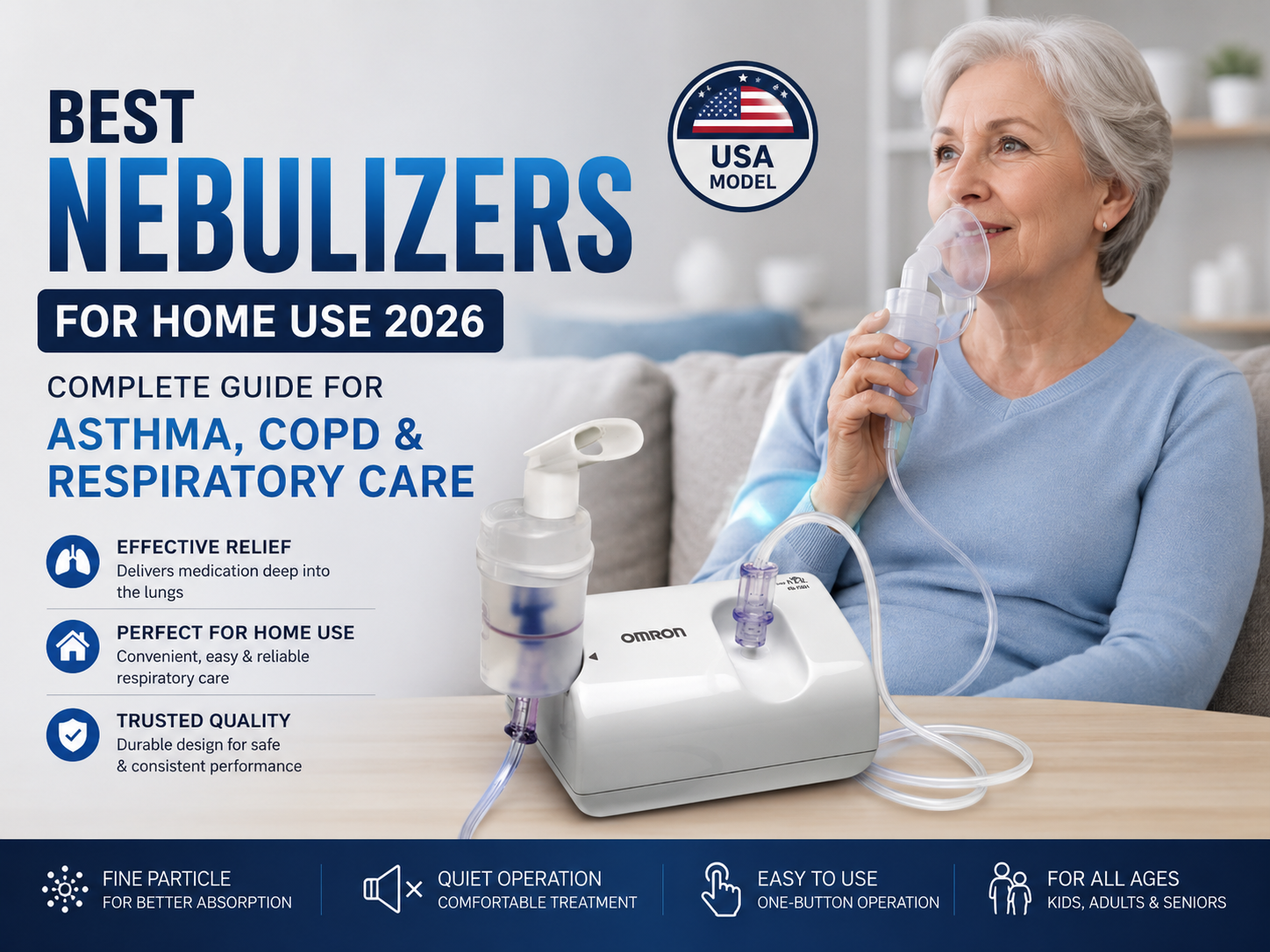
Nebulizers are among the most effective tools for managing asthma, COPD, cystic fibrosis, and other respiratory conditions. Unlike inhalers that require precise timing and breathing coordination, nebulizers deliver medication as a continuous mist that patients breathe in naturally — making them particularly effective for children, seniors, and anyone who struggles with inhaler technique.
Shop our Nebulizers & Respiratory Care collection at AllCare Store.
How Nebulizers Work
A nebulizer converts liquid medication into a fine aerosol mist that can be inhaled directly into the lungs through a mouthpiece or mask. The medication reaches the bronchial airways and lung tissue much more directly than medications taken orally, making nebulizers highly effective for fast relief during acute respiratory episodes.
Common medications delivered by nebulizer include:
- Bronchodilators (albuterol, levalbuterol) — relax and open airways during asthma or COPD flares
- Corticosteroids (budesonide) — reduce airway inflammation for long-term control
- Anticholinergics (ipratropium) — reduce mucus secretion, often used in COPD
- Saline solutions — loosen and thin mucus for easier clearance
- Antibiotics (tobramycin, aztreonam) — for cystic fibrosis and bronchiectasis management
Types of Nebulizers
Jet (Pneumatic) Nebulizers
The traditional and most widely used type. Jet nebulizers use a stream of compressed air from an air compressor to convert liquid medication into a mist. They are durable, effective, inexpensive, and can handle the full range of medications — including thicker solutions that mesh nebulizers may not atomize as well.
Pros: Lowest cost, widely available medication compatibility, very durable (often lasting 5+ years), parts are inexpensive and replaceable.
Cons: Bulkier and louder than other types; requires an electrical outlet; treatment times are 8–15 minutes.
Best for: Home use, adults and children, users on a budget, COPD and asthma management.
Ultrasonic Nebulizers
Uses high-frequency sound waves to create the medication mist. Quieter than jet nebulizers and faster (treatment times of 5–10 minutes), but ultrasonic nebulizers can degrade certain medications (particularly proteins and some suspensions) through heat generation. Not appropriate for all medication types — check with your pharmacist before using.
Best for: Saline treatments, users who need quieter operation, situations where medication compatibility has been confirmed.
Mesh Nebulizers (Vibrating Mesh)
The newest and most advanced type. A mesh nebulizer uses a vibrating mesh plate with thousands of tiny holes to create an ultra-fine aerosol. Mesh nebulizers are:
- Compact and lightweight (often under 3 oz.)
- Very quiet (near-silent operation)
- Fast (treatment times of 5–7 minutes)
- Battery-powered options available for travel and portability
- More efficient — less medication is wasted compared to jet nebulizers
Cons: More expensive ($40–$200+); the mesh requires careful cleaning to prevent clogging.
Best for: Active users, travelers, children, anyone who needs quiet operation or portability.
Key Features Comparison
| Feature | Jet Nebulizer | Ultrasonic | Mesh Nebulizer |
|---|---|---|---|
| Price range | $25–$80 | $30–$100 | $40–$200+ |
| Treatment time | 8–15 min | 5–10 min | 5–7 min |
| Noise level | Moderate | Low | Very low |
| Portability | Low | Medium | High |
| Battery option | Some models | Some models | Most models |
| Medication compatibility | Excellent | Good (not all) | Very good |
| Durability | Excellent | Good | Good (mesh requires care) |
Choosing a Nebulizer for Specific Conditions
Asthma
For acute asthma episodes, speed matters. A mesh nebulizer delivers albuterol in 5–7 minutes vs. 10–15 for a jet nebulizer. For home management, either type works well. For children, look for pediatric masks and child-friendly designs (some are shaped like animals to reduce treatment anxiety).
COPD
COPD patients often use nebulizers multiple times daily for bronchodilator and anticholinergic medications. A durable jet nebulizer with a compressor designed for high-frequency use is a solid choice. Look for compressors with a high piston rating (typically 50,000+ hours). Mesh nebulizers are excellent for travel and outings.
Cystic Fibrosis
CF treatments involve specialized medications (dornase alfa, TOBI) that require specific nebulizer systems recommended by your CF care team. The PARI LC series and Altera handsets are commonly prescribed. Do not substitute a general-purpose nebulizer without consulting your pulmonologist.
Children
A quiet, fast mesh nebulizer significantly reduces treatment time and anxiety for young patients. Pediatric masks (0–18 months, 18 months–5 years) ensure proper fit. Some children do better with mouthpieces than masks by age 3–4.
Seniors
Many seniors benefit from nebulizers because they eliminate the coordination challenge of MDI inhalers. Jet nebulizers with simple controls are easiest to operate. Large-print labels and simplified setup (two or three parts rather than many) reduce confusion.
Nebulizer Cleaning & Maintenance
A contaminated nebulizer can cause respiratory infections. Cleaning protocol:
- After each treatment: Rinse the nebulizer cup, mask, and mouthpiece with warm water. Shake off excess water and air dry on a clean cloth.
- Daily: Wash all parts (except tubing and compressor) with warm soapy water. Rinse thoroughly. Air dry completely before storing.
- Every other day or per manufacturer instructions: Disinfect by soaking in a solution of one part distilled white vinegar to three parts water for 30 minutes, or use the dishwasher (top rack, without detergent) if the manufacturer allows.
- Replace the nebulizer cup/chamber every 3–6 months or per manufacturer recommendations. Replace filters per schedule.
- Never blow into tubing to dry it — this introduces bacteria. Hang tubing to air dry instead.
Shop Nebulizers & Respiratory Care at AllCare Store
AllCare Store carries a complete selection of jet nebulizers, mesh nebulizers, replacement cups, masks, mouthpieces, filters, and tubing from trusted brands including PARI, Omron, Drive Medical, and Philips Respironics. We also carry CPAP machines, oxygen concentrator accessories, and related respiratory care supplies.
Browse our Nebulizers collection, Respiratory Care supplies, and CPAP Products at AllCare Store. Free shipping on every order.
Questions? Speak with our team at 1-888-889-6260.
Frequently Asked Questions: Home Nebulizers
Does insurance cover home nebulizers?
Medicare Part B covers nebulizers as durable medical equipment (DME) when prescribed by a physician and deemed medically necessary. Coverage is typically 80% of the Medicare-approved amount after your Part B deductible. Most private insurance plans also cover nebulizers with a prescription for qualifying conditions (asthma, COPD, cystic fibrosis, etc.). Contact your insurer before purchasing to confirm your coverage and approved suppliers. Mesh nebulizers may require additional documentation.
Is a nebulizer better than an inhaler?
Neither is universally better — they're different tools for different situations. Inhalers (MDIs and DPIs) are portable, discreet, and deliver medication in seconds. Nebulizers require no coordination with breathing, work well for high-dose treatments, and are ideal for children under 5, seniors with coordination issues, and patients during severe acute episodes when inhaler technique becomes unreliable. Many patients use both: an inhaler for daily management and a nebulizer for acute flares or scheduled treatments at home.
How often should nebulizer parts be replaced?
Nebulizer cups and chambers should be replaced every 3–6 months with regular use, or sooner if they show cloudiness, discoloration, or damage. Masks and mouthpieces should be replaced every 6 months. Tubing should be replaced every 3–6 months or any time it becomes discolored, cracked, or mold is visible. Compressor air filters should be replaced per manufacturer instructions — typically every 6 months to 1 year. Medicare and most insurance plans cover replacement supplies on a set schedule.




