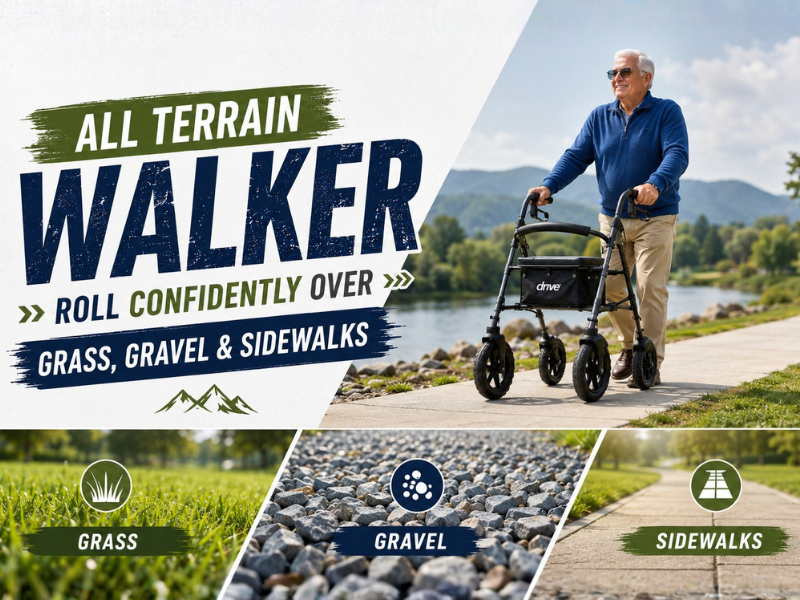
A standard indoor walker feels great on smooth tile or hardwood, but take it outside onto a gravel driveway, a grassy backyard, or a cracked sidewalk, and it can suddenly feel shaky and hard to control. That's exactly the gap an all terrain walker is built to close. With larger wheels, tougher tires, and reinforced frames, these walkers are designed to keep you steady no matter what's under your feet.
In this guide, we'll look at what actually makes a walker "all terrain," how the best outdoor models on the market compare, and how to choose the right one so you can walk the dog, garden, or take a stroll around the block without worrying about every bump in the path.
What Makes a Walker "All Terrain"?
Not every walker with wheels is built for the outdoors. Indoor-focused models use small, hard plastic wheels that turn tightly in hallways but catch on cracks, roots, and loose gravel. An all terrain walker or all terrain rollator is engineered differently, with a few key upgrades:
- Larger wheels, typically 8 to 12 inches in diameter, that roll over bumps instead of catching on them
- Pneumatic or puncture-proof tires that absorb shock on gravel, dirt, and grass
- Reinforced, wider frames for extra stability on uneven or sloped ground
- Stronger braking systems, often with multiple lock positions, to control speed on inclines
- Wider, deeper seats so you can rest comfortably mid-walk on longer outdoor outings
How Competing Outdoor Walkers Stack Up
Looking across the mobility market in the US, a clear pattern shows up in the top-rated outdoor and all-terrain models: the walkers reviewers consistently recommend all lean on the same core formula. They pair large 8 inch or bigger wheels with air-filled or shock-absorbing tires, add a reinforced triangular or dual-cross frame for stability on slopes, and include a padded, height-adjustable seat with a wide backrest for comfort on longer trips. Weight capacities on outdoor-ready models commonly range from 300 lbs on standard frames up to 500 or even 600 lbs on bariatric versions, and most fold flat for storage in a car trunk.
The tradeoff reviewers point out again and again is the same one you'll want to keep in mind: the more rugged the wheels and frame, the heavier the walker tends to be, which can make it a bit harder to lift, fold, and load. The best all terrain walkers balance outdoor durability with a design that's still light enough to manage day to day.
Types of All Terrain Walkers to Consider
All Terrain Rollators (4 Wheel)
The most popular choice for outdoor use is a 4 wheel rollator walker with large wheels, hand brakes, and a seat. It rolls continuously across grass and gravel and lets you sit down whenever you need a break, making it ideal for parks, trails, and neighborhood walks.
Upright and Stand Up Walkers
For users who want better posture support on uneven ground, an upright walker or stand up walker keeps you standing tall instead of hunched forward, which can make outdoor walks more comfortable for people with back or shoulder concerns.
Bariatric All Terrain Walkers
If you need a higher weight capacity, a bariatric walker built with reinforced tubing and wider wheelbases can handle outdoor terrain while supporting up to 500 or 600 lbs. Our bariatric walker buying guide breaks down the best heavy duty options.
Compact All Terrain Options
Not every outdoor walker has to be bulky. Some lightweight walker models now use smaller pneumatic tires that still grip uneven ground while staying easy to fold and lift into a car.
Grass, Gravel, and Sidewalks: What to Look for by Surface
Grass
Soft, uneven grass is one of the toughest surfaces for a walker. Look for wide tires and a low center of gravity so the frame doesn't tip when a wheel sinks slightly into soft ground.
Gravel
Loose gravel needs pneumatic or thick rubber tires that won't get caught on small stones. A wider wheelbase also helps prevent tipping as the wheels shift over uneven rock.
Sidewalks and Cracked Pavement
Cracks, tree roots, and curb cuts call for larger wheel diameters, since bigger wheels roll over small obstacles instead of stopping short against them. Strong hand brakes also matter here for controlling speed on ramps and sloped curb cuts.
Choosing the Right All Terrain Walker for You
- Match the wheel size to your terrain. Frequent grass or gravel use calls for 8 inch or larger pneumatic wheels; occasional sidewalk use can work with smaller all-terrain tires.
- Check the weight capacity. If you need extra support, a bariatric all terrain walker offers a sturdier frame and higher limit.
- Think about storage and transport. A folding walker design makes it easier to fit in a car trunk after outdoor outings.
- Look for a comfortable seat. A walker with seat lets you rest partway through longer walks, which matters more outdoors than indoors.
- Don't overlook storage space. A walker with basket is handy for carrying keys, water, or gardening tools on outdoor trips.
Shop All Terrain Walkers at All Care Store
Ready to walk outside with more confidence? Browse our full range of walkers and rollators, including all terrain, bariatric, and folding models built to handle grass, gravel, and sidewalks with ease.
This article is for informational purposes only and is not a substitute for professional medical advice. Always consult your doctor or physical therapist before choosing a mobility aid.