The Most Dangerous Room in the House
Margaret, 74, had lived in the same house for 38 years without a serious fall. She walked every morning, did her own grocery shopping, and managed her garden. Then one Tuesday in February, she got up at 2 a.m. to use the bathroom and slipped on the hallway hardwood in her socks. She caught herself on the wall — barely — and didn't fall that night. But the incident shook her. She told her daughter what had happened, and they started looking at what could be done.
The answer they found was almost embarrassingly simple: non-slip grip socks, a bedside lamp on a motion sensor, and a grab bar in the hallway. Margaret has not fallen in the two years since.
Falls are the leading cause of injury-related death in adults 65 and older, and the leading cause of traumatic brain injury and hip fracture. The CDC estimates that one in four adults over 65 falls each year, and 20% of those falls result in serious injury. The majority of falls happen at home, and a significant proportion occur on smooth hard floors while wearing conventional socks — which provide virtually no traction on hardwood, tile, or laminate.
Non-slip socks are not a complete fall prevention solution on their own, but they are one of the most cost-effective interventions available. AllCare Store carries non-slip socks for seniors in a range of styles, sizes, and grip strengths for home, hospital, and rehabilitation use.
How Non-Slip Socks Work
Standard socks — cotton, wool, nylon — provide a smooth fabric surface that glides against hard floors. The coefficient of friction between sock fabric and smooth flooring is very low, meaning even a modest sideways force (a quick turn, a reach, a gait imbalance) can cause slipping.
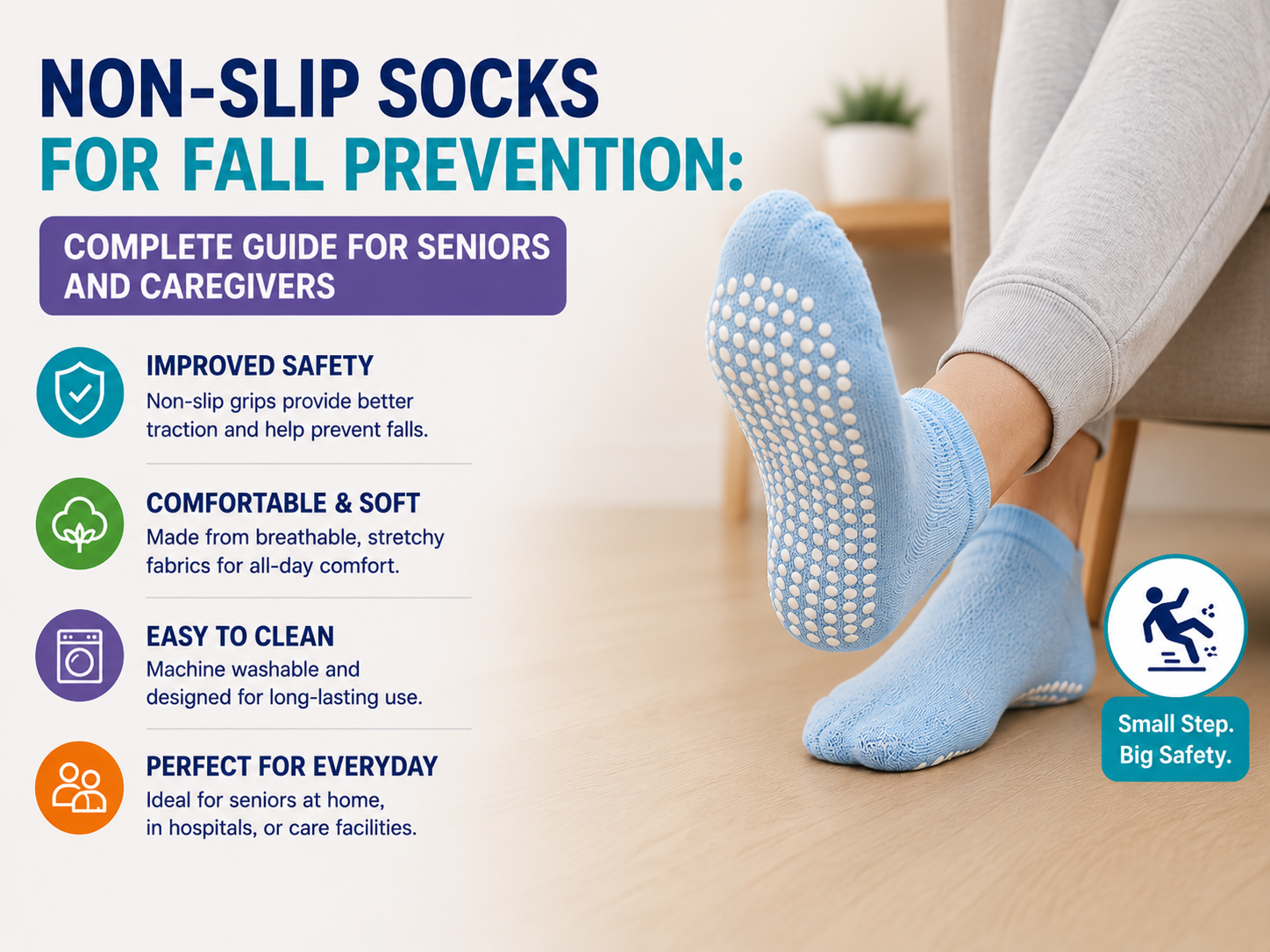
Non-slip socks add traction through rubber, silicone, latex, or thermoplastic rubber (TPR) grips applied to the sock surface — typically the sole and heel, sometimes the toe area as well. These grips dramatically increase friction against hard surfaces, functioning similarly to the tread on athletic shoes.
The grip material is typically applied in one of three patterns:
- Dot pattern: Small silicone or rubber dots distributed across the sole. Common in hospital-issued grip socks and entry-level home versions. Effective on smooth floors; may wear down faster than larger grip patterns.
- Full-sole pattern: Grip material covers most or all of the sole surface. Maximum traction; better for users with significant gait instability or those recovering from surgery. Heavier feel underfoot than dot patterns.
- Heel and toe pattern: Grip concentrated at the heel (where most weight-bearing occurs during walking) and toe (for push-off). Lighter feel than full-sole; good for more mobile users.
Who Benefits Most from Non-Slip Socks
While non-slip socks are beneficial for nearly anyone walking on smooth indoor floors, certain groups have a particularly high risk profile for slips and should prioritize them:
- Adults 65 and older — Age-related changes in balance, gait speed, reaction time, and lower limb strength all increase fall risk
- Hospital and rehabilitation patients — Hospital-acquired falls are a significant patient safety issue; grip socks are standard issue in many facilities for this reason
- Post-surgical patients — After hip replacement, knee replacement, spinal surgery, or any procedure affecting mobility and strength
- People with neuropathy — Peripheral neuropathy reduces sensory feedback from the feet, making it harder to detect surface conditions and adjust gait; grip socks compensate for reduced tactile information
- People with Parkinson's disease — Shuffling gait and reduced foot clearance significantly increase slip risk
- People with MS or stroke-related weakness — Foot drop and asymmetric gait patterns increase fall risk on smooth surfaces
- Individuals taking medications that cause dizziness — Blood pressure medications, sedatives, sleep aids, and some pain medications can impair balance
- People with diabetes and peripheral neuropathy — Reduced sensation in the feet plus vascular changes that affect balance
What to Look for When Buying Non-Slip Socks
Grip Coverage and Strength
For seniors or individuals at higher fall risk, prioritize socks with grip coverage on the full sole and heel rather than just a few dots. The grip material should feel substantial — not paper-thin — and should have some texture you can feel when you press it between your fingers. Higher-quality grip materials are typically rated for more wash cycles before they lose traction.
Fabric Comfort and Breathability
Socks worn for extended periods — all day at home, or overnight in a hospital bed — need to be comfortable. Cotton and cotton-blend socks breathe well and are comfortable for most people. For individuals with diabetes or poor circulation, look for socks with non-binding tops that don't restrict blood flow. Cushioned soles add comfort for people on their feet for long periods.
Ankle Height and Coverage
| Style | Coverage | Best For |
|---|---|---|
| No-show / ankle | Stays below ankle | Active users wearing shoes indoors; warmer weather |
| Crew length | Mid-calf | General home use; most common non-slip sock style; fits under most footwear |
| Knee-high / compression | Just below or over the knee | Users who also need compression therapy; post-surgical; edema management |
| Open-toe | Exposes the toes | Post-operative foot and toe procedures; individuals with toe conditions or swelling |
Non-Binding Tops for Circulation
Standard sock elastic can restrict circulation in people with diabetes, peripheral artery disease, or lower limb edema. Look for socks specifically labeled "non-binding top" or "diabetic-friendly" — these use wider, looser cuffs that don't constrict blood flow. Non-binding tops are appropriate for most seniors, not just those with diagnosed circulatory conditions.
Durability and Washability
Check how many machine washes the grip is rated for before it begins to degrade. Lower-quality grip socks may lose traction after 10–15 washes; better-quality socks maintain grip for 50+ wash cycles. Washing inside-out on a gentle cycle and air-drying extends grip life considerably. Avoid fabric softener, which coats the grip material and reduces its traction.
Sizing
Ill-fitting socks create their own fall hazard. Socks that are too large bunch at the toe or heel; socks that are too small pull down at the ankle and expose the heel. Use the manufacturer's size chart and measure foot length in inches or centimeters if you're unsure of your size. Wide-width options are available for people with edema or wide feet.
Hospital-Grade vs. Home-Use Non-Slip Socks
Hospital grip socks — the yellow, blue, or white socks often given to patients during admission — are designed for single use or short-term use in a controlled environment. They are typically made from lightweight polyester with small rubber dot grips and a loose fit for easy on/off by staff. They are not designed for the repeated washing, extended wear, or varied surface conditions of home use.
Home-use non-slip socks are constructed for durability. They use heavier fabric, more robust grip materials, and sizing systems that allow a proper, consistent fit. If you were sent home from the hospital with facility grip socks, replace them with home-grade options within a few weeks — hospital socks are not intended for long-term daily use.
Non-Slip Socks as Part of a Broader Fall Prevention Plan
Non-slip socks reduce one specific risk factor — slipping on smooth floors in sock feet — but fall prevention is a multi-factor challenge. For seniors or caregivers developing a complete fall prevention plan, consider these additional measures:
- Remove loose rugs: Area rugs and bath mats that slide or have curled edges are a major fall hazard, particularly in hallways and bathrooms. Secure them with non-slip pads or remove them entirely.
- Install grab bars: Grab bars in the shower, beside the toilet, and in hallways provide fixed support for balance. AllCare Store carries grab bars in multiple lengths and configurations for permanent and removable installation.
- Improve lighting: Poor lighting is a significant fall risk, particularly at night. Motion-sensor night lights in hallways and bathrooms allow safe navigation without waking to turn lights on.
- Exercise for balance: Programs like Tai Chi, Otago Exercise, and physical therapist-guided balance training significantly reduce fall risk. Ask your healthcare provider about referrals to fall prevention exercise programs.
- Medication review: Many medications — including blood pressure drugs, sedatives, antihistamines, and muscle relaxants — increase fall risk as side effects. Ask your physician or pharmacist to review your medications for fall risk annually.
- Vision checks: Uncorrected vision problems substantially increase fall risk. Annual eye exams and updated prescriptions are particularly important for fall prevention in seniors.
- Proper footwear: When not in non-slip socks, wear shoes with good grip, low heels, and closed backs rather than slippers or flip-flops. Many falls occur while wearing loose slippers.
Caring for Non-Slip Socks
To maximize the life of the grip material:
- Wash inside-out on a gentle or delicate cycle
- Use cold or warm water — hot water degrades silicone and rubber grips faster
- Skip the fabric softener — it coats grip surfaces and reduces traction
- Air dry or tumble dry on low — high dryer heat accelerates grip breakdown
- Inspect the grip surface periodically; replace socks when grips become thin, cracked, or begin to peel away
Frequently Asked Questions
Are non-slip socks enough to prevent falls in seniors?
Non-slip socks significantly reduce the risk of slipping on smooth indoor surfaces, which accounts for a meaningful proportion of senior falls at home. However, they are one component of a multi-factor fall prevention approach, not a complete solution on their own. A comprehensive fall prevention plan also addresses environmental hazards (loose rugs, poor lighting), strength and balance through exercise, medication review, footwear choices, and home modifications like grab bars. Non-slip socks are most effective when used as part of this broader approach rather than as a standalone measure.
Can non-slip socks be worn with shoes?
Yes — non-slip socks can be worn inside shoes, though the grip function only activates when the sock sole contacts the floor directly. Inside shoes, they function as regular socks. The grip material on the sole may feel slightly textured inside a shoe but is not uncomfortable for most people. If you're wearing non-slip socks both inside and outside of shoes during the day, look for crew-length styles that are comfortable for both uses. Open-toe or loose-fit hospital-style grip socks are generally less comfortable inside shoes.
How often should non-slip socks be replaced?
Replace non-slip socks when the grip material becomes thin, cracked, or begins to peel — at this point the grip no longer provides reliable traction and the sock should be treated as a regular (less safe) sock. Quality home-use non-slip socks typically maintain effective grip for 50–100 wash cycles with proper care. Hospital-grade single-use grip socks should be replaced after a few weeks of home use. A practical approach is to replace non-slip socks on a schedule (every 3–6 months for daily users) rather than waiting until visible failure.
Do non-slip socks work on carpet?
Non-slip socks provide their greatest benefit on smooth hard surfaces like hardwood, tile, laminate, and vinyl — the surfaces where conventional socks provide near-zero traction. On carpet, conventional socks already have better natural friction due to the carpet pile catching the fabric. Non-slip socks can still be worn on carpet without any downside, and some users prefer to wear them throughout the home rather than switching footwear between rooms. If carpet is the primary surface in a home, non-slip socks are somewhat less critical than on hard floors, though still beneficial for transitional surfaces like bathroom tile and kitchen linoleum.
Are there non-slip socks for people with diabetes?
Yes — diabetic-friendly non-slip socks are specifically designed for the foot care needs of people with diabetes. They combine grip soles with features including non-binding tops (to avoid restricting circulation), seamless or flat-seam construction (to prevent pressure points and blisters that could go unnoticed due to neuropathy), extra padding at the heel and ball of the foot (to protect areas prone to ulceration), and moisture-wicking fabric (to reduce infection risk). For people with diabetes and peripheral neuropathy — who are at elevated fall risk due to reduced foot sensation — diabetic non-slip socks address both the fall risk and the specific foot care concerns simultaneously.
Simple Protection for a Serious Risk
Margaret's near-fall cost about $12 to prevent — the price of two pairs of quality grip socks. The potential alternative — a hip fracture in a 74-year-old with osteopenia — would have meant surgery, rehabilitation, potentially months of recovery, and a meaningful reduction in her independent function. Non-slip socks are not glamorous. They do not require a prescription or a home visit or an expensive installation. They are, however, one of the most cost-effective safety investments a senior or caregiver can make.
Browse non-slip socks and fall prevention products at AllCare Store. Questions? Call us at 1-888-889-6260 or visit AllCareStore.com.
— The AllCare Store Team