Disclaimer: Sharps disposal regulations vary by state and locality. This guide provides general information only. Always check your state and local regulations for specific requirements in your area. If you use sharps for medical purposes, consult your healthcare provider for guidance on safe handling and disposal.
The Needle in the Park
In 2019, a groundskeeper at a public park in Phoenix found a used insulin syringe in a trash can — no sharps container, no cap, just a loose needle point-up in an ordinary garbage bag. He was not injured, but the incident triggered a citywide awareness campaign and a reminder from the Arizona Department of Environmental Quality that improper needle disposal is a Class 1 misdemeanor in the state.
More than 7.8 million Americans use needles, syringes, and lancets at home for conditions including diabetes, multiple sclerosis, rheumatoid arthritis, hepatitis C, and fertility treatments. That volume — the FDA estimates 3 billion needles are used outside of hospitals each year — creates a significant public health challenge. Needles discarded in household trash or flushed down toilets endanger sanitation workers, waste handlers, children, and pets. A used needle can transmit HIV, hepatitis B, and hepatitis C.
The solution is simple and inexpensive: an FDA-cleared sharps container. If you use needles or lancets at home, AllCare Store carries FDA-cleared sharps containers in a range of sizes for every home care need — from compact travel containers to large-capacity household units.
What Counts as a Sharp?
The term "sharps" covers any device with a point or edge capable of puncturing skin. For home users, sharps most commonly include:
- Insulin syringes and pen needles — used by diabetics for insulin injection
- Lancets — used for blood glucose fingerstick testing; among the most frequently discarded sharps in home settings
- Auto-injector pens — used for medications including insulin analogs, GLP-1 agonists (Ozempic, Mounjaro, Wegovy), biologics for rheumatoid arthritis and MS, and fertility treatments
- Infusion set needles — used with insulin pumps
- Epinephrine auto-injectors (EpiPens) — the needle mechanism after use
- IV catheters and butterfly needles — used in home infusion therapy
- Acupuncture needles — if self-administered at home
Needles that have been used (or even just uncapped) should go directly into a sharps container — never into a regular trash bag, recycling bin, or toilet.
What Is an FDA-Cleared Sharps Container?
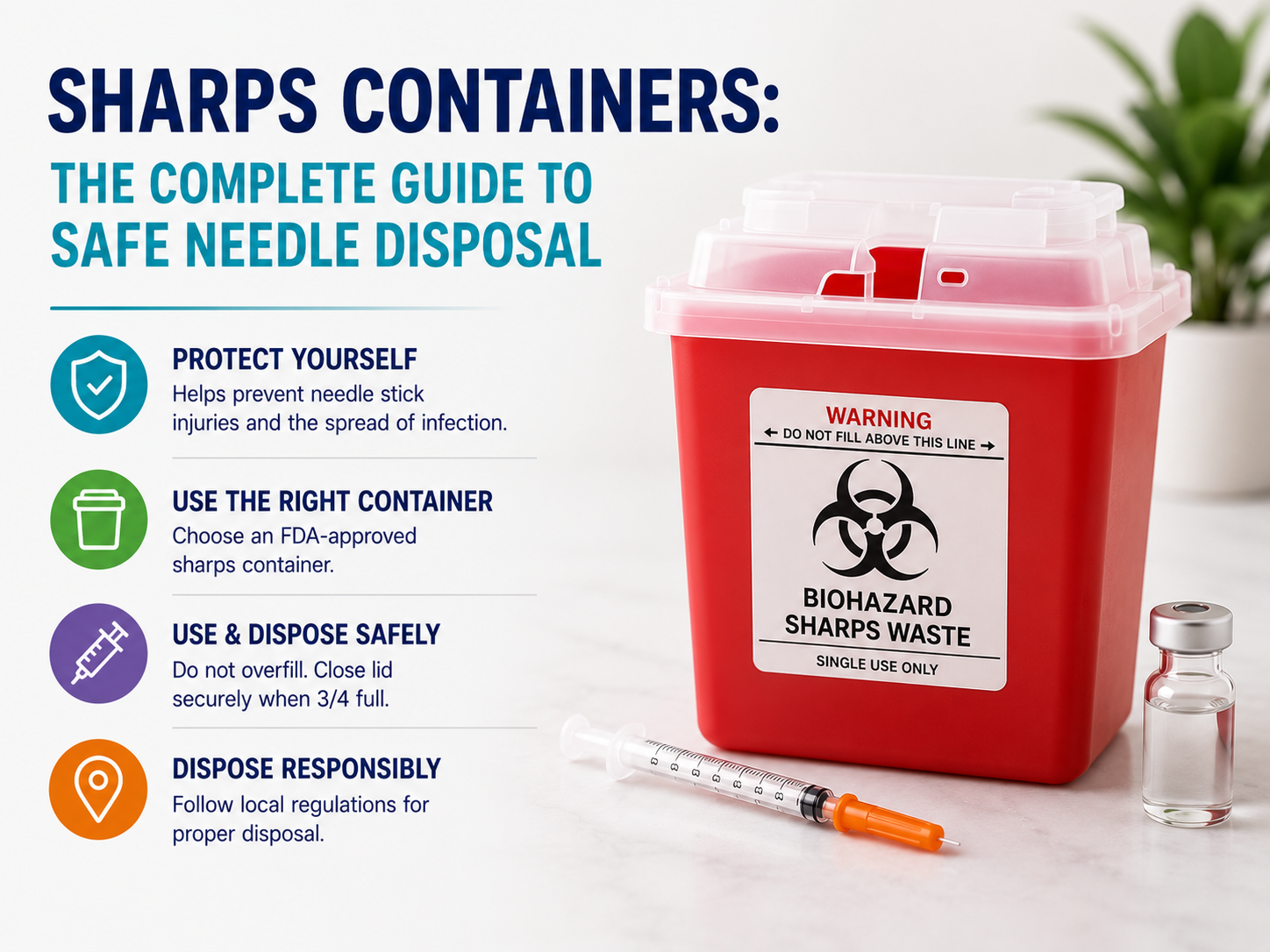
An FDA-cleared sharps container is a rigid, puncture-resistant, leak-proof container specifically designed for safe storage and disposal of used sharps. The FDA's requirements for cleared sharps containers specify:
- Puncture-resistant construction (typically high-density polyethylene or polypropylene)
- Leak-proof sides and bottom
- A lid that can be closed securely and, ideally, locked to prevent re-opening
- Red or orange color with a biohazard symbol to signal hazardous contents
- A fill line marking 75–80% capacity (do not fill above this line)
- Labeled to identify the container as a sharps disposal container
Using any improvised container — a water bottle, a coffee can, a laundry detergent jug — instead of a proper FDA-cleared container is discouraged or prohibited in many states, even where it is not technically illegal. Proper containers provide the engineered safety margins improvised ones cannot.
Choosing the Right Sharps Container Size
Sharps containers are sold by volume capacity. The right size depends on how many sharps you generate per week and how often you plan to dispose of the container.
| Container Size | Typical Capacity | Best For |
|---|---|---|
| 0.7–1 quart | ~50–100 lancets or syringes | Light users (1–2 lancets/day); travel; purse or bag storage |
| 1–2 quart | ~100–200 sharps | Daily insulin injections (1–4 per day); moderate lancet use; fits in a nightstand drawer |
| 3–5 quart | ~200–400 sharps | Multiple daily injections; pump users; households with 2+ sharps users |
| 8 quart | ~600–800 sharps | High-volume users; home infusion therapy; medical professionals seeing patients at home |
A practical rule: if you use 4 insulin syringes per day plus 6 lancet pricks, you generate roughly 10 sharps per day, or 300 per month. A 3-quart container typically holds 200–350 lancets and syringes comfortably — that's about one container per month at that rate.
How to Use a Sharps Container Correctly
- Place the container close to where you inject. Having the container within arm's reach prevents the dangerous habit of recapping needles or setting used sharps down temporarily before disposal.
- Drop sharps in immediately after use. Do not recap needles before disposal — needle stick injuries most commonly occur during recapping. Modern sharps containers have one-handed drop slots specifically so you can drop the needle directly from injection to container without needing to handle the tip.
- Never reach into the container. Once a sharp goes in, it does not come out. Never push sharps down or shake the container to fit more in.
- Close the container when it reaches the fill line. The fill line is marked at 75–80% capacity. Above this point, sharps near the opening create a puncture risk when the lid is secured.
- Secure the lid before disposal. Most containers have a two-step lid-closing mechanism — a rotating outer ring that locks the container permanently shut. Close and lock it completely before placing it in any disposal stream.
- Label the container if required by your disposal method. Some mail-back and community programs require identifying information on the container. Check the program's requirements before sealing.
How to Dispose of a Full Sharps Container
This is where most home users get confused, because disposal options vary significantly by state and locality. The FDA identifies five main pathways for home sharps disposal:
1. Drop-Off at a Collection Site
Many hospitals, physician offices, pharmacies, fire stations, police stations, and community health clinics accept sealed sharps containers for disposal. This is the most widely available and least expensive option. The Safe Needle Disposal locator at safeneedledisposal.org lists collection sites by zip code. Many major pharmacy chains — CVS, Walgreens, Walmart — also sell sharps containers and participate in collection programs.
2. Residential Pickup Programs
Some cities and counties include sharps containers in their household hazardous waste collection programs. These may operate as permanent drop-off facilities, periodic collection events, or scheduled curbside pickup. Check your local municipal waste authority for availability.
3. Mail-Back Programs
FDA-cleared mail-back sharps disposal systems include a pre-paid, pre-labeled envelope or box for mailing the sealed container to a licensed medical waste facility. These are available from pharmacies, medical supply retailers, and online. Mail-back programs are particularly convenient for users who cannot easily travel to drop-off locations — rural residents, homebound patients, or those with mobility limitations. Browse mail-back sharps disposal kits at AllCare Store.
4. Household Hazardous Waste Facility
Many counties maintain permanent household hazardous waste (HHW) facilities that accept sealed sharps containers along with paint, batteries, and other hazardous materials. Hours and accepted materials vary; call your local facility before visiting.
5. In-Home Needle Destruction Devices
Needle clippers and destruction devices use electrical heat to melt and encapsulate the needle tip, rendering it dull and safe for regular trash disposal. The syringe barrel and plunger typically go into regular trash (check state regulations). These are only appropriate for lancets and syringes — not for auto-injector pens, IV catheters, or other larger sharps.
State Regulations: What You Need to Know
The FDA regulates the manufacture of sharps containers and provides guidance on disposal, but sharps disposal regulations for residents are set at the state level — and in some cases at the county or municipal level. State rules vary substantially:
- Some states (California, New York, New Jersey) have detailed sharps management programs with specific requirements for home users
- Some states permit regulated medical waste to go into household trash in FDA-cleared containers if state rules are followed
- Some states prohibit any sharps from household trash regardless of container
- Some states require healthcare providers to give patients written information about sharps disposal at the time of prescription
The most current state-by-state rules are maintained by the North American Syringe Exchange Network (NASEN) at safeneedledisposal.org. If in doubt, use a drop-off location or mail-back program — these are legal in every state and eliminate any compliance uncertainty.
Traveling with Sharps
If you use injectable medications, you will need to manage sharps disposal while traveling. Key points:
- Air travel: The TSA permits syringes, needles, and lancets in carry-on or checked baggage if accompanied by injectable medication. Carry a compact 1-quart sharps container and drop used sharps into it during the flight. Do not ask flight attendants to dispose of sharps — they are not equipped to do so safely.
- Hotel stays: Hotels are not required to accept your sharps container, and most housekeeping staff are not trained to handle them. Seal used sharps in your travel container and dispose of it through a mail-back program or drop-off site at your destination or upon return home.
- International travel: Carry documentation from your prescribing physician and check the sharps regulations of your destination country before traveling. Some countries have strict rules about importing needles and syringes.
Children, Pets, and Sharps Safety at Home
Children and pets are at particular risk from unsecured sharps. Best practices for households with children or animals:
- Store the sharps container in a locked cabinet or on a high shelf out of reach when not in use
- Never leave a used or uncapped needle on a countertop, nightstand, or table — even briefly
- Explain sharps safety to children old enough to understand; include it in household safety conversations alongside medication safety
- If a pet or child comes into contact with a used needle, seek medical or veterinary attention immediately and inform the provider of the needle's use and the medication involved
Frequently Asked Questions
Can I put used needles in a plastic water bottle or coffee can instead of a sharps container?
The FDA and public health authorities strongly discourage using improvised containers such as water bottles, coffee cans, or detergent jugs for needle disposal, even though some states technically permit "puncture-resistant" household containers as an alternative. Improvised containers lack the engineered safety features of FDA-cleared containers: they can crack under pressure, lids may not lock, and they lack the biohazard labeling required for most disposal programs. Many disposal drop-off locations and mail-back programs will not accept improvised containers. For safety and compliance, use an FDA-cleared sharps container.
How full should a sharps container be before I dispose of it?
Dispose of a sharps container when it reaches the fill line, which is marked at 75–80% capacity on FDA-cleared containers. Filling above the fill line makes it difficult to secure the lid safely and creates a puncture risk as sharps near the opening. Never overfill, push sharps down to fit more in, or shake the container. When the fill line is reached, close and lock the lid and move to disposal immediately — do not continue using an overfilled container.
Does Medicare cover sharps containers?
Medicare Part B covers insulin syringes and pen needles when they are used to administer insulin for diabetes. As of 2021, the Medicare Diabetes Prevention Program expanded coverage, but sharps containers themselves are not typically covered as a separate durable medical expense under standard Medicare. Some Medicare Advantage plans include sharps container coverage as a supplemental benefit — check your specific plan's formulary. Medicaid coverage varies significantly by state; some state Medicaid programs cover sharps containers as part of diabetes supply coverage. Check with your plan or state Medicaid office for specifics.
Can I flush needles or lancets down the toilet?
No. The FDA and the EPA strongly advise against flushing needles, syringes, or lancets down the toilet. Needles can damage sewage treatment equipment, pass through water treatment systems intact, and contaminate waterways. They can injure wastewater workers and, in some cases, end up in waterways where they present a public hazard. Flushing sharps is not a legal or safe disposal method anywhere in the United States.
What should I do if I accidentally needle-stick myself with someone else's used needle?
If you experience a needle stick with a used needle, wash the wound immediately with soap and water for several minutes. Do not squeeze or suck the wound. Seek medical attention urgently — ideally within 1–2 hours — at an emergency room or urgent care center. Post-exposure prophylaxis (PEP) for HIV is most effective when started within 72 hours of exposure. Your healthcare provider will evaluate the risk based on the needle's use history (if known) and recommend appropriate testing and treatment. Needle-stick injury from someone else's used needle is a medical emergency.
Disposal Done Right
Safe sharps disposal is one of the most straightforward home safety practices available — the right container, used consistently, eliminates virtually all the risk. The groundskeeper in Phoenix wasn't injured, but the millions of people who handle waste, work in parks, and let their children play in public spaces deserve the protection that proper disposal provides.
Shop sharps containers and disposal kits at AllCare Store — FDA-cleared containers in every size, plus mail-back disposal systems for convenient, legally compliant disposal from home. Questions? Call us at 1-888-889-6260 or visit AllCareStore.com.
— The AllCare Store Team