Medical Disclaimer: This article is for educational purposes only and does not constitute medical advice. Medication management tools are organizational aids and do not replace the guidance of a physician or pharmacist. Always consult your healthcare provider before making changes to your medication routine.
Why Medication Adherence Is a Serious Health Issue
Robert, a 74-year-old retired engineer managing type 2 diabetes, hypertension, and high cholesterol, was taking seven medications daily — some once a day, others twice, one with food. After a minor stroke, his cardiologist reviewed his medication history and discovered he'd been missing doses inconsistently, sometimes doubling up without realizing it. "I thought I was managing fine," Robert said. "I had no idea how many times I was getting it wrong until we actually tracked it."
Robert's experience reflects a widespread problem. According to the World Health Organization, approximately 50% of patients with chronic diseases do not take medications as prescribed — a phenomenon called medication non-adherence. The consequences include poorly controlled blood pressure and blood sugar, preventable hospitalizations, and in serious cases, life-threatening events. For adults managing five or more medications daily (polypharmacy), the risk of dosing errors increases substantially.
The good news: the right medication management system makes adherence dramatically easier. For most people, the solution doesn't require technology — a well-designed weekly pill organizer used consistently prevents the vast majority of dosing errors at virtually no cost.
Types of Pill Organizers: Matching the Tool to the Need
Basic Daily or Weekly Pill Boxes
The simplest and most widely used format. A 7-day pill organizer has seven compartments, one per day, each filled at the start of the week. You fill it Sunday morning, and each evening you simply take what's in that day's compartment. The visual confirmation — the compartment is empty or full — immediately tells you whether you've taken today's dose.
For people taking medications once daily, a basic weekly organizer is almost certainly all you need. These range from $5 to $20 and are available in dozens of configurations: flat, stackable, large-compartment for easy access with arthritic hands, and travel-friendly compact versions.
AM/PM and Multiple-Dose Organizers
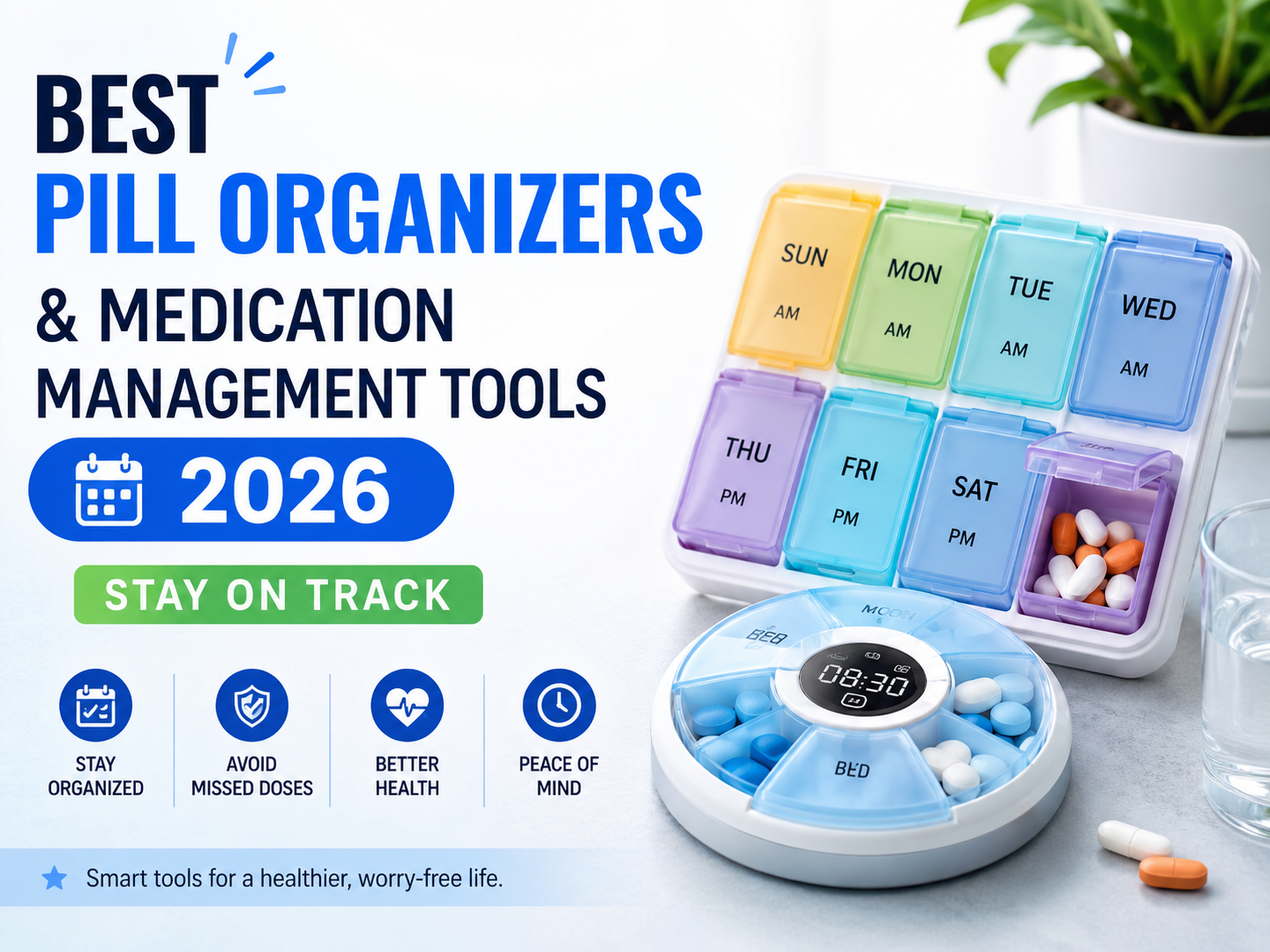
If you take medications at multiple times each day — morning, noon, evening, and bedtime are common schedules — a pill organizer with multiple compartments per day is essential. 7-day AM/PM organizers provide two slots per day; 4-times-daily organizers provide four. Color-coding (different colors for morning/evening slots) significantly reduces mix-up risk.
For complex regimens, look for organizers where compartments are clearly labeled and physically distinct. Accidental opening of the wrong time slot is a common error with cheaply made organizers where the lids are too similar.
Monthly Pill Organizers
For those who prefer to fill a full month's supply at once — or who have caregivers who organize medications on a monthly schedule — large monthly organizers provide 28–31 individual day compartments. These are particularly useful when coordinating with pharmacy blister-pack dispensing, which delivers 28-day supplies. Monthly organizers can also help patients and caregivers spot refill timing at a glance.
Travel Pill Organizers
Compact, lockable, and TSA-friendly. The best travel organizers are slim (fit in a jacket pocket or small bag), have secure snap closures that won't pop open in luggage, and are large enough to hold multiple tablets per compartment. If you travel frequently, having a separate dedicated travel organizer — pre-filled from your main weekly organizer before each trip — reduces the risk of forgetting to pack medications.
Automatic Pill Dispensers
For people with cognitive impairment, memory concerns, or complex high-stakes medication regimens, automatic pill dispensers represent a meaningful step up from manual organizers. These devices are pre-loaded (often by a caregiver or pharmacist) with a week or month of medications, then programmed to dispense the correct dose at the correct time — with audible alarms, flashing lights, or even phone notifications to the patient and remote caregivers.
Some advanced models lock all other compartments until the scheduled time, preventing early access or accidental double-doses. Prices range from around $30 for basic timed-alarm dispensers to $200+ for app-connected smart dispensers with caregiver monitoring.
Features That Matter Most
Compartment Size
This is frequently overlooked until it causes a problem. If you take large capsules, multiple tablets at once, or fish oil softgels — which are notably large — you need organizers with genuinely deep compartments. Many budget organizers advertise weekly capacity but have compartments too shallow to close properly once filled with three or more larger pills. Read dimensions and reviews carefully.
Lid Design for Arthritic Hands
Standard push-and-flip lids can be difficult for people with reduced hand strength or arthritis. Look for organizers with large, easy-open lids that require a simple press rather than a pinch-and-lift mechanism. Some organizers are designed specifically for arthritis-affected hands with ergonomic, spring-assisted lids. This is a meaningful quality-of-life difference for daily use.
Labeling and Readability
Day labels should be large and high-contrast. For seniors with reduced vision, labels that are embossed or braille-supplemented, or organizers color-coded by day of the week, reduce misidentification risk significantly. Clear (transparent) compartment lids allow visual verification of pill color without opening, which helps catch fill errors before taking a dose.
Portability
If you take daytime medications that require a mid-day dose while at work, in transit, or running errands, consider whether your organizer travels well. Flat weekly organizers with secure snap-locking individual lids are far more portable than stacking tray designs. Some organizers come with individual day-pods that can be removed and pocketed separately — a clever feature for people with busy schedules.
Material and Cleaning
Pill organizers accumulate dust, humidity, and occasionally powdered residue from tablets. Look for organizers made from food-safe, BPA-free plastic with smooth interiors that wipe clean easily. Weekly cleaning with a dry cloth or occasional gentle wash with soap and water prolongs hygiene and longevity. Avoid organizers with decorative texturing on interior compartment surfaces — these trap residue and are harder to clean.
Building a Medication Management System That Works
Fill on a Consistent Day and Time
Choose a fixed day and time each week for filling your organizer — Sunday evening is popular. Anchor this habit to something you already do consistently (after dinner, while watching the evening news). Filling at a consistent time reduces the chance of forgetting and provides a weekly checkpoint to verify you have enough supply for the coming week.
Use a Medication List
Keep an up-to-date written medication list — name, dose, timing, and purpose of each drug — stored with your pill organizer or in your wallet. This is invaluable in emergency medical situations, pharmacy consultations, and when filling the organizer to double-check each dose. Review this list with your physician or pharmacist at every appointment.
Set Alarms or Use a Reminder App
For medications that require precise timing (blood pressure medications, thyroid medications, diabetes medications, anticoagulants), phone alarms set to the scheduled time provide a reliable backup to the visual cue of the pill organizer. Several free apps (Medisafe, MyTherapy) allow you to log each dose and track adherence over time — useful for identifying patterns if you find you consistently miss certain times.
Involve a Caregiver or Family Member
For seniors or individuals with early cognitive decline, having a trusted person help fill the weekly organizer provides both accuracy checking and a built-in accountability system. Filling together also creates a natural opportunity to review the medication list, note any new prescriptions or changes, and flag any side effects or concerns.
Coordinate With Your Pharmacy
Many pharmacies offer blister-pack (bubble-pack) dispensing as a service, pre-packaging each patient's medications by day and time. This eliminates the filling step entirely and is particularly valuable for complex regimens or patients who struggle with manual organization. Ask your pharmacist if this service is available.
When to Consider an Automatic Dispenser
A basic pill organizer is the right solution for most adults. But an automatic pill dispenser may be the better choice when:
- The person has early-stage dementia or significant memory impairment
- Medication timing is clinically critical (anticoagulants like warfarin, insulin, psychiatric medications)
- Multiple caregivers share responsibility and communication coordination is a challenge
- There have been repeated dangerous errors — double-dosing, missed critical medications, taking another person's pills
- A remote caregiver wants monitoring and alerts for a person living independently
For family caregivers managing a parent's medications from a distance, app-connected smart dispensers that send dose-taken notifications can provide significant peace of mind and reduce the need for daily check-in calls.
AllCare Store: Products for Independent, Healthy Living
At AllCare Store, we carry a carefully selected range of home health, personal care, and wellness products designed to support independence and healthy living at every stage of life.
- Free Shipping on every order — no minimum required
- Discreet Packaging — plain, unmarked packaging on all orders
- 30-Day Returns — shop with full confidence
- Expert Help — reach our team at 1-888-889-6260
Explore our Personal Care collection and Diabetic Care collection for medication management tools and health essentials.
Frequently Asked Questions: Pill Organizers and Medication Management
What is the best pill organizer for someone with arthritis?
Look for pill organizers with large, flip-open lids that can be opened with a palm press rather than a pinch. Organizers with oversized, color-coded tabs or lids designed with arthritis in mind typically require significantly less grip strength. Large-compartment organizers that don't require forceful pressing to close are also easier to fill. Read product descriptions carefully for mentions of "easy open" or "arthritis-friendly" design, and check reviewer comments from users with limited hand mobility.
How do I know if I took my medication today?
This is the most common reason people use pill organizers — the empty compartment tells you at a glance whether you've taken today's dose. If your compartment is empty and you didn't consciously take the medication, you've likely already taken it (or it fell out). If full and it's past your usual dose time, you've missed it. For added certainty, phone reminder apps like Medisafe allow you to log each dose and check your history. Never double-dose to make up for a missed dose without first consulting your physician or pharmacist, as the right action varies by medication.
Is it safe to store medications in a pill organizer?
Yes, for most medications it is safe to store them in a pill organizer for up to one week. Store the organizer in a cool, dry location away from humidity — not in a bathroom medicine cabinet, where shower steam creates moisture that can degrade some medications. A bedroom nightstand or kitchen counter away from the stove is ideal. Some medications (certain liquids, medications requiring refrigeration, or drugs that are especially sensitive to light or humidity) should not be pre-filled into organizers — check with your pharmacist if unsure about specific medications.
What is the difference between a pill organizer and an automatic pill dispenser?
A standard pill organizer is a manual tool — you fill it, and you decide when to open and take each compartment. An automatic pill dispenser is a device programmed to dispense only the correct dose at the scheduled time, often with alarms, locked compartments to prevent early access, and in smart versions, phone notifications to the patient and caregivers. Automatic dispensers are significantly more expensive ($30–$200+) and are best suited for people with cognitive impairment, complex high-stakes regimens, or situations where caregiver monitoring is needed. For most adults with intact memory, a quality pill organizer used consistently is all that's needed.
Can I take a pill organizer through airport security?
Yes. TSA does not prohibit pill organizers. Solid medications (tablets and capsules) are not subject to the liquid restrictions. Some travelers with uncommon medications carry an original pharmacy-labeled bottle in addition to the organizer in case questions arise, though this is not required. If you are traveling internationally, check the destination country's medication importation rules for any controlled substances you are carrying, as regulations vary widely.