Most comparisons of pull-on underwear and tab-style briefs describe the products: this one is thinner, that one holds more. Useful, but it is rarely where the decision actually goes wrong. The style that works is decided by the person wearing it, not by the packet. How steady they are on their feet, what their hands can do, and who is doing the changing will settle the question far more reliably than a feature list.
Here are the questions worth answering before you order anything.
Question one: can they stand safely for a minute or two?
A pull-on garment has to be stepped into and drawn up, which means balancing on one leg, however briefly, usually in a bathroom full of hard surfaces. That is fine for someone who walks unaided or can steady themselves on a grab rail. It is a genuine falls risk for someone who is unsteady, who has had a stroke affecting one side, who feels dizzy on standing, or who cannot lift a foot clear of the floor.
Ask honestly: could they do this at three in the morning, half asleep, in a hurry? Daytime ability is not the same as night-time ability, and a great many falls happen on the way to the toilet.
If standing is unsafe, a tab-style brief that can be applied sitting or lying down is not a step down in dignity. It is the option that keeps someone out of hospital.
Question two: what can their hands actually do?
This is the factor most often missed. Both styles ask something of the hands, but they ask different things.
- Pull-ons need a firm grip and enough shoulder and wrist movement to pull fabric up over the hips. Arthritis, tremor, reduced grip strength after a stroke, or painful shoulders all make this considerably harder than it looks.
- Tear-away side seams help enormously with removal, but they need a decisive pull that some people simply cannot generate.
- Tab briefs need the fingers to position and press a fastener accurately. That is fiddly for someone with tremor or poor fine motor control, but very manageable for someone who can sit down and take their time.
A simple everyday test: can they manage a coat zip and a shirt button without frustration? If not, whichever style you choose will need help at least some of the time, and it is better to plan for that than to hope.
Question three: who is doing the changing, and where?
If the person changes themselves in a bathroom, pull-ons usually win. If someone else is doing the changing, the answer flips almost entirely.
Changing a pull-on garment on someone who cannot stand means rolling them, working it down over the hips and off past the feet, often over shoes and sometimes with soiling involved. Changing a tab brief means one roll, unfasten, clean, fasten a fresh one. For a carer doing this several times a day, that difference adds up to a great deal of lifting and a considerably higher risk of back injury.
The same logic applies to anyone changed in a bed or a recliner rather than standing in a bathroom. If most changes happen lying down, tabs are the practical choice, and bed protection underneath makes the whole job faster. Our caregiver's logistics guide to routines and supply management covers how to set that up so a change takes minutes rather than half an hour.
Question four: do they still use the toilet at all?
Someone with partial control who reaches the toilet most of the time is far better served by a pull-on, because it can be lowered and pulled back up like ordinary underwear without a full change. Putting that person into a tab brief removes an ability they still have, and abilities that stop being used tend to be lost.
Someone with no warning and no control gains nothing from that flexibility, and gains a lot from the capacity and adjustable fit of a tab brief.
Question five: can they tell you when they are wet?
Awareness matters more than volume. A person who notices and says something can be changed on demand in whatever style suits them. A person living with dementia, reduced sensation, or difficulty communicating needs a garment a carer can check quickly and discreetly, and a tab brief can be opened at one side and refastened without undressing anyone. That makes routine checks far less intrusive, which matters more than it sounds.
What each style is genuinely better at
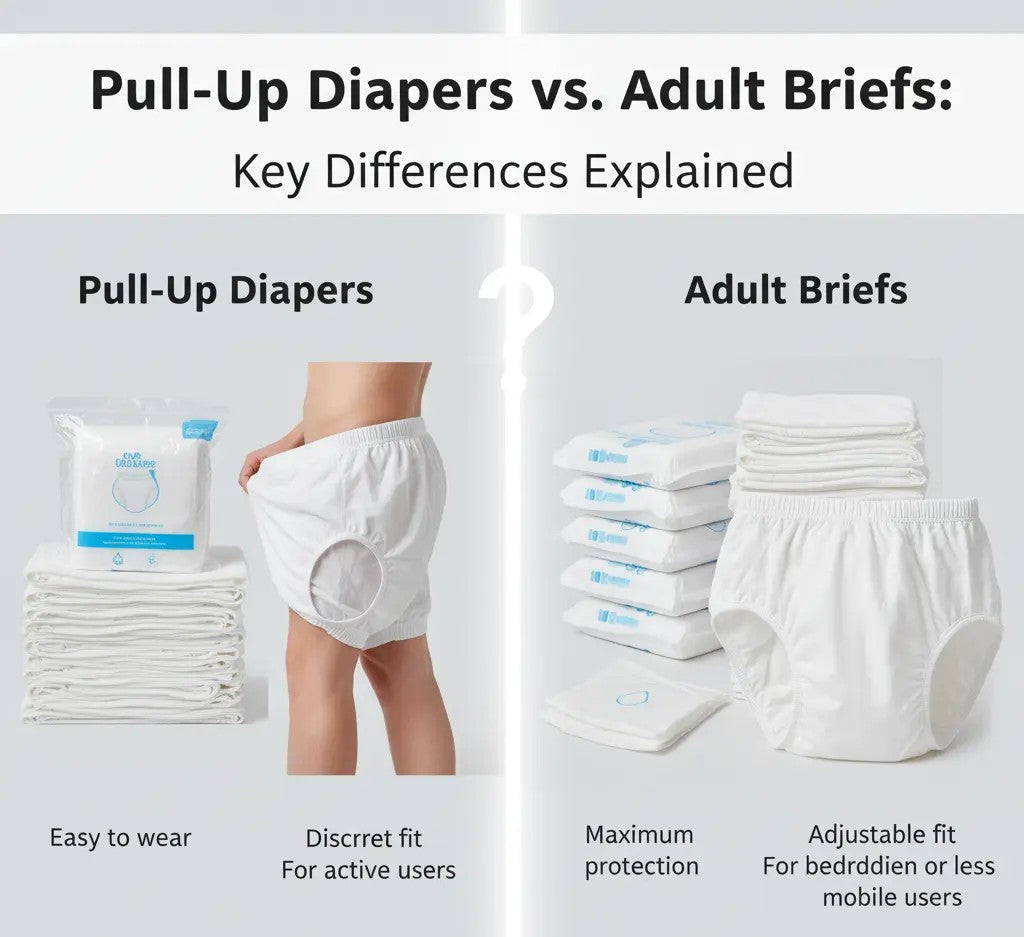
Pull-ons are better for independence, discretion under clothing, self-toileting, and being out of the house. They feel like underwear, and for many people that is the difference between wearing protection and refusing it outright.
Tab briefs are better for higher capacity, adjustable fit around unusual body shapes, changes performed lying down, and situations where a carer needs to check without a full undress. They also cope far better with bowel leakage, because the fit can be tightened independently at the leg and the waist.
Both formats sit side by side in our pull-on underwear range and our tab-style brief range.
Needs change, so expect to use both
Very few people stay in one category. Ability varies across a single day: steadier after breakfast, much less steady in the evening or after a broken night. It also varies with illness. A chest infection or a short hospital stay can temporarily wipe out standing balance that took months to build back up.
A common and sensible pattern is a pull-on during the day, when the person is up and about and can manage the bathroom, and a tab brief overnight when capacity matters most and nobody wants to be standing up at four in the morning. Keeping a small stock of both means a bad week does not turn into an emergency shopping trip.
Making a change without a confrontation
Moving someone from pull-ons to tab briefs is often read as a demotion, and the resistance is usually about identity rather than the garment itself. It helps to frame the change around a specific, concrete problem, such as night-time leaks or the difficulty of standing after dark, rather than around decline in general. It also helps to make the change partial rather than total. "Just for nights" is a much easier conversation than "from now on."
If that conversation is coming, our guide to talking with a parent or spouse about incontinence without shame is worth reading first. And if all of this is new, a new caregiver's starter kit for the first two weeks sets out what to have in the house before you start refining the details.
Bring in professional eyes
An occupational therapist can assess standing balance, grip and transfers properly, and will often suggest adaptations, such as a rail in the right place or a different chair height, that keep someone in pull-ons for longer than you expected. A continence nurse can assess the leakage itself and advise on capacity.
It is also worth saying plainly: new or worsening incontinence should be raised with a clinician, because a number of causes are treatable, from urinary infections and constipation to medication side effects and pelvic floor weakness. The product decision is easier once you know whether the underlying problem can be reduced.
Common questions
Is a tab brief always more absorbent than a pull-on?
Generally yes at the top of each range, but not always. A high-capacity pull-on can out-perform a light tab brief. Compare the stated absorbency level on the packaging rather than assuming the format settles it.
Can someone who uses a wheelchair wear pull-ons?
Often yes, if they can stand briefly for transfers or manage a seated hip lift. If every change happens in the chair or in bed, tabs are far easier on everyone involved.
What if they refuse tab briefs outright?
Try them overnight only and keep pull-ons for the day. Partial acceptance nearly always works better than an all-or-nothing switch, and it preserves the sense of control that makes the whole situation bearable.
Does the wrong style cause skin problems?
Indirectly, yes. A style that is awkward to change gets changed less often, and prolonged contact with moisture is what damages skin. Ease of changing is a skin-health decision as much as a convenience one.
How do I know when it is time to reassess?
After any fall, any hospital admission, any new diagnosis, or any noticeable change in walking or hand strength. Those are the moments when a style that worked perfectly well last month quietly stops being the right one.