MEDICAL DISCLAIMER: This article is for informational and educational purposes only. Always follow your surgeon's specific post-operative instructions and work with your physical therapist to create a recovery plan tailored to your procedure and health status. Do not start any exercise or therapy program without clearance from your surgical team.
Diane's Recovery: What She Wished She'd Known
Diane was a 58-year-old landscape architect when her rotator cuff finally gave out. Years of overhead work — sketching, carrying plans, the occasional heavy lift — had worn her right shoulder down to a painful, catching mess. She'd managed it with cortisone shots and physical therapy for two years before her orthopedic surgeon said the words she'd been dreading: "You need surgery."
The procedure went well. But coming home from the hospital, Diane realized she hadn't truly prepared for recovery. She had her sling, her pain prescription, and vague instructions to "keep it elevated and stay iced." What she didn't have was any of the practical equipment that would have made the next six weeks dramatically easier. She struggled to sleep without a proper wedge pillow. She couldn't keep her shoulder properly iced without help. Her first attempt at physical therapy exercises left her frustrated because she was using a basic resistance band that wasn't calibrated for post-surgical use.
"If someone had given me a recovery supply list before I went into surgery," she told her PT, "I'd have spent the first two weeks resting instead of improvising." Her physical therapist laughed — she heard some version of this story from nearly every post-surgical shoulder patient.
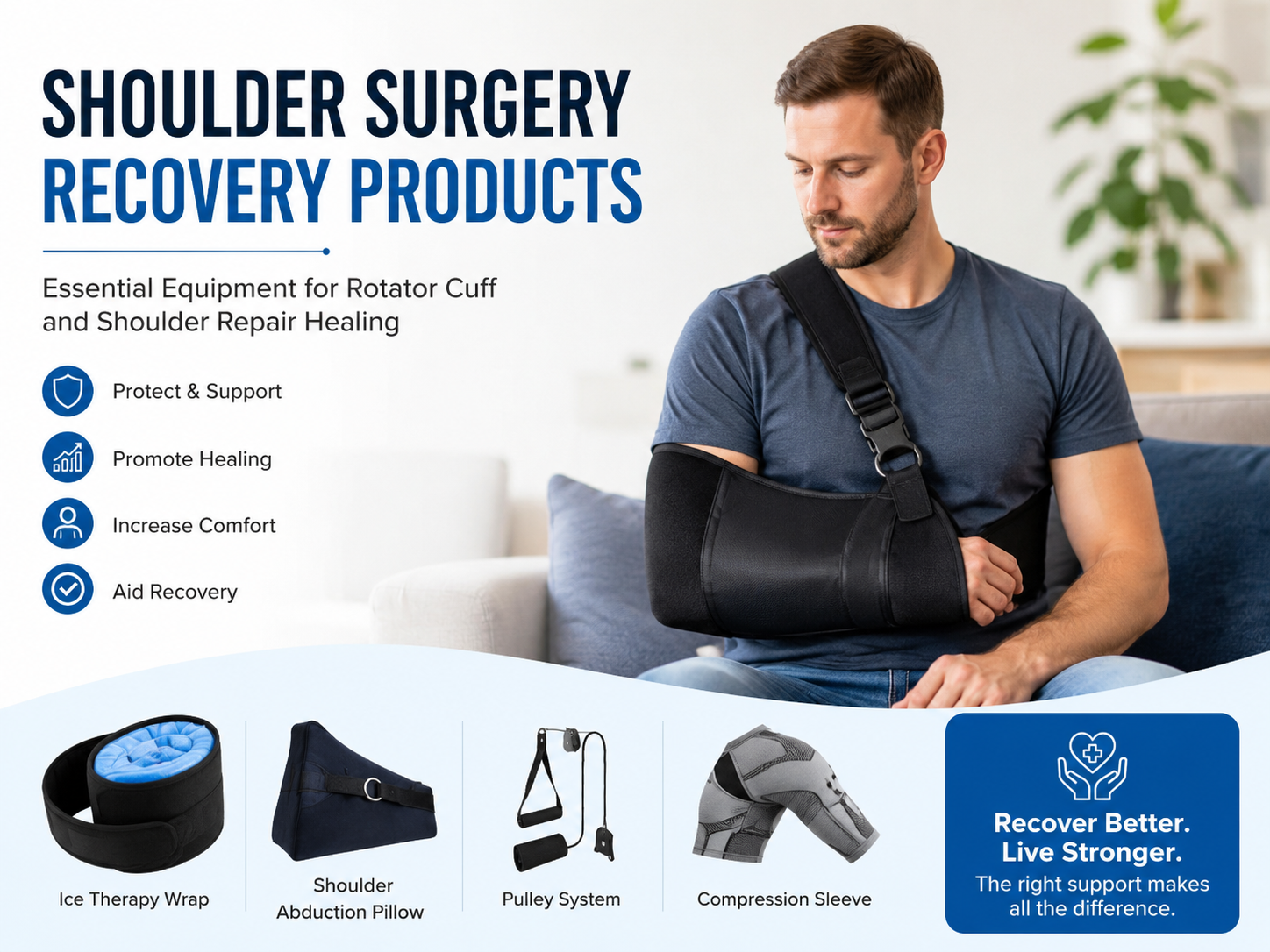
At AllCare Store, we want to help you avoid Diane's experience. Whether you're preparing for rotator cuff repair, total shoulder replacement, bankart/labrum repair, or another shoulder procedure, this guide will walk you through exactly what products support healing — and why each one matters.
Understanding Shoulder Surgery Recovery
Shoulder surgeries vary significantly in complexity, recovery timeline, and specific product needs. Understanding your procedure helps you prepare appropriately.
Common Shoulder Procedures
- Rotator cuff repair: Reattaches torn rotator cuff tendons to the humerus. Recovery typically takes 4-6 months; full strength restoration can take 12 months or longer. The repaired tissue is fragile for the first 6-12 weeks, making proper immobilization critical.
- SLAP/Labrum repair: Repairs the cartilage ring (labrum) that stabilizes the shoulder joint. Common in younger, more active patients; recovery is 4-6 months.
- Total shoulder replacement (arthroplasty): Replaces damaged joint surfaces; typically performed for severe arthritis. Recovery involves a longer immobilization phase followed by progressive movement.
- Acromioplasty / subacromial decompression: Removes bone spurs and increases space for the rotator cuff. Less invasive; typically faster recovery of 2-4 months.
- Bankart repair: Addresses shoulder instability and dislocation; recovery 4-6 months.
The Three Phases of Shoulder Recovery
Regardless of your specific procedure, shoulder surgery recovery typically progresses through three phases that dictate which products are most important at each stage:
Phase 1 — Immobilization and pain management (Weeks 0-6): The repaired tissue is healing and must be protected. Your arm will be in a sling, and managing pain and swelling is the priority. Cold therapy, proper sleeping support, and adaptive equipment for daily living are essential.
Phase 2 — Passive and assisted movement (Weeks 6-12): Your physical therapist introduces range-of-motion exercises. Compliance with PT exercises at home becomes critical. Resistance bands (at very light levels) may be introduced.
Phase 3 — Active strengthening (Weeks 12+): Progressive strengthening with resistance bands and other equipment. Full return to activity is typically not until 4-6+ months post-surgery.
Essential Shoulder Surgery Recovery Products
1. Cold Therapy System: Your First Line of Defense Against Pain and Swelling
In the first days and weeks after shoulder surgery, cold therapy is your most important pain management tool. Ice reduces swelling, numbs surgical pain, and decreases the need for opioid pain medication. Most surgeons recommend icing 15-20 minutes every 1-2 hours during waking hours for the first several days.
Standard bags of ice work, but they're messy, lose temperature quickly, and require constant attention. A dedicated cold therapy system designed for shoulder use is dramatically more effective.
The Ice It! ColdComfort System provides a conforming, reusable cold pack that molds to the shoulder area for thorough coverage. Its flexible design stays in place without assistance — critical during the immobilized phase when you can't easily hold an ice pack. This system stays cold longer than standard ice bags and eliminates the mess of melting ice.
For shoulder surgery recovery, also consider our Heat & Cold Therapy collection which includes multiple formats of therapeutic cold packs in sizes and shapes appropriate for shoulder coverage.
Cold therapy tips for shoulder recovery:
- Always place a thin cloth between the cold pack and your skin to prevent frostbite
- Set a timer — 20 minutes maximum per session
- Ice before and after any physical therapy exercises to manage inflammation
- Keep a second cold pack in rotation so one is always cold while the other warms up
2. Resistance Bands: The Cornerstone of Shoulder Rehabilitation
Once your surgeon and physical therapist clear you for movement — typically around 6-12 weeks post-surgery — resistance bands become your most important rehabilitation tool. Shoulder strengthening exercises prescribed by physical therapists almost universally incorporate elastic resistance bands because they provide progressive, controlled resistance that matches the fragile early strength of healing tissue.
The TheraBand 6-Yard Gold Resistance Band is the gold standard in physical therapy resistance bands, trusted by PTs worldwide. TheraBand's color-coded resistance system allows precise progression — starting at the lightest resistance that doesn't stress healing tissue, and advancing as strength improves. The 6-yard length provides the material for all standard shoulder PT exercises including:
- External rotation strengthening
- Internal rotation strengthening
- Shoulder flexion and extension
- Scaption (raising arm in the plane of the scapula)
- Rowing and pulling exercises for posterior rotator cuff
TheraBand comes in multiple resistance levels: yellow (easiest), red, green, blue, black, silver, and gold (heaviest). Most post-surgical shoulder patients start with yellow or red. Your physical therapist will advise on the appropriate starting resistance for your situation.
Also explore our full Physical Therapy & Rehab Equipment collection for additional resistance training tools to support your shoulder rehab program.
3. Shoulder Sling and Immobilizer
Your surgical team will likely provide a sling, but having a quality backup sling for home use is valuable. After rotator cuff surgery, an abduction sling (which holds the arm slightly away from the body) is commonly used to reduce tension on the repair. Standard slings hold the arm close to the body.
Wear your sling according to your surgeon's instructions — typically 24 hours a day (including while sleeping) for the first 4-6 weeks after rotator cuff repair. Never remove it to "give your arm a break" without surgical clearance; the healing tendon attachment is extremely vulnerable.
Browse our Braces & Supports collection for shoulder immobilizers and support products appropriate for post-surgical use.
4. Bed Wedge or Body Pillow for Sleeping
Sleeping after shoulder surgery is one of the most frequently underestimated challenges. Lying flat puts the shoulder in a position that can increase pain and disrupt healing. Most surgeons recommend sleeping in a recliner or semi-reclined position for the first several weeks.
If you don't have a recliner, a bed wedge pillow can recreate a semi-reclined position in your own bed. Propping yourself to approximately 45 degrees reduces traction on the repaired tissue and typically significantly reduces nighttime pain. A body pillow alongside your operative arm can provide additional support.
Browse our Cushions & Pillows collection for wedge pillows and positioning supports suitable for shoulder surgery recovery.
5. Dressing and Grooming Aids
With one arm immobilized, daily tasks like dressing, bathing, and grooming become surprisingly challenging. Adaptive tools reduce frustration and prevent the common mistake of moving the operative arm prematurely because getting dressed seemed to demand it.
- Button hook and zipper pull: Allows one-handed fastening of shirts and pants
- Long-handled sponge or bath brush: Allows bathing without rotating the shoulder
- Sock aid: Helps put on socks with one arm
- Front-opening clothing: Button-front shirts and pants with elastic waistbands are essential during immobilization
- Shower chair: Standing to shower while fatigued and medicated is a fall risk; a shower chair adds safety during early recovery
Our Daily Living Aids collection includes adaptive tools that support independence during recovery when one arm is limited.
6. Reaching and Grabbing Aids
A reacher/grabber tool is invaluable during immobilization. It allows you to retrieve items from high shelves, pick up dropped objects, and perform daily tasks without bending over or stretching your operative arm. A quality reacher extends your reach by 24-36 inches and can grip objects up to several pounds.
Explore our Daily Living Aids for reachers, grabbers, and other independence tools.
7. Pain Relief Products
While prescription medications handle acute post-surgical pain, OTC pain relievers often remain part of the ongoing management strategy as you taper off prescriptions. NSAIDs (ibuprofen) reduce inflammation as well as pain — but check with your surgeon before using them, as some surgeons restrict NSAIDs immediately post-surgery due to potential effects on bone healing.
Our Pain Relief collection includes ibuprofen, acetaminophen, and topical pain products that may complement your recovery protocol under doctor guidance.
Recovery Timeline: What to Expect Week by Week
Recovery varies considerably by procedure and individual, but here's a general framework for rotator cuff repair — one of the most common and demanding shoulder surgeries:
Weeks 1-2: Acute Recovery
Focus: Pain management, wound care, arm protection. Your arm will feel heavy and uncomfortable. Cold therapy every 1-2 hours is critical. Sleep in a recliner or with a wedge pillow. Keep your sling on at all times except for prescribed pendulum exercises. Don't be a hero — rest is part of healing.
Weeks 3-6: Continued Immobilization
The sling remains on most or all of the time. Pendulum exercises (gravity-assisted shoulder circles) continue. Physical therapy may have begun. Swelling decreases, but the repair is still fragile. Cold therapy for pain management continues as needed.
Weeks 6-12: Assisted Movement Phase
The sling is gradually discontinued as directed by your surgeon. Physical therapy introduces passive and active-assisted range of motion. This phase is mentally challenging — you have more freedom, but the repair is not yet strong. Resist the temptation to rush. Begin light resistance band exercises only as directed by your PT.
Months 3-6: Active Strengthening
Progressive resistance with TheraBands and other equipment. Return to most daily activities. Avoid heavy lifting and overhead work until cleared by your surgeon. Regular PT appointments continue. Most patients see the greatest functional improvements during this phase.
Months 6-12: Return to Full Activity
Return to sports, overhead work, and full strength activities — with surgeon clearance. The repaired tendon continues to mature and strengthen throughout this period. Ongoing home exercise with resistance bands supports long-term shoulder health.
Physical Therapy at Home: Making the Most of Your Recovery
Compliance with home physical therapy exercises is one of the most significant predictors of surgical outcome. Studies consistently show that patients who perform their prescribed home exercises as directed have better range of motion, strength, and overall satisfaction at 6 and 12 months post-surgery than those who are less consistent.
Setting yourself up for home PT success involves:
- A dedicated space: Clear a small area where you can perform exercises without moving furniture each time
- Proper equipment: A sturdy anchor for your TheraBand (a door anchor or secure furniture leg), and the right resistance level
- A written exercise log: Tracking your reps and sets keeps you motivated and helps you and your PT monitor progress
- Scheduled exercise times: Attach exercises to existing daily habits (before or after meals) to improve consistency
- Communication with your PT: If an exercise causes sharp or unusual pain, stop and report it before your next session — don't push through pain that feels wrong
Nutrition for Shoulder Recovery
Tendon and tissue healing is a biologically demanding process that requires adequate nutritional support. Consider focusing on:
- Protein: Collagen synthesis (critical for tendon repair) requires adequate protein intake. Aim for 1.2-1.6g protein per kg body weight daily during recovery.
- Vitamin C: Essential for collagen production. Found in citrus, peppers, and leafy greens.
- Omega-3 fatty acids: Anti-inflammatory properties may support recovery. Found in fatty fish, flaxseed, and walnuts.
- Vitamin D and calcium: Bone health supplements if your procedure involved bone work or if you're at risk for deficiency.
Our Vitamins & Supplements collection includes a wide range of nutritional support products appropriate for recovery.
Frequently Asked Questions About Shoulder Surgery Recovery
How long should I use cold therapy after shoulder surgery?
Most surgeons recommend active cold therapy (icing 4-6 times per day, 15-20 minutes per session) for the first 2-3 weeks following shoulder surgery. After that, cold therapy can be used as needed for pain and swelling management — particularly before and after physical therapy sessions. Many patients find cold therapy helpful for 3-4 months post-surgery. As recovery progresses, heat therapy may also be introduced by your physical therapist to support muscle flexibility before exercise.
When can I stop wearing my sling after rotator cuff surgery?
Sling wear time varies significantly depending on the size of the tear repaired and your surgeon's philosophy. Small tears may require only 2-4 weeks of sling wear; large or massive tears may require 6-8 weeks of near-constant sling wear. Do not make this decision independently — follow your surgeon's specific instructions. Removing the sling too early is one of the most common causes of re-tear, which requires another surgery. When your surgeon does clear sling removal, the transition is usually gradual rather than all-at-once.
What resistance band level should I start with for shoulder PT exercises?
Most post-surgical shoulder patients begin with TheraBand yellow (lightest resistance) or red (light resistance). The principle is that you should be able to perform the exercise through the full prescribed range of motion with minimal pain — if any resistance makes the movement painful or causes compensation, you're starting too heavy. Your physical therapist will prescribe the appropriate starting resistance for your specific repair and current strength. Do not progress resistance levels without PT guidance, as increasing resistance too quickly is a common cause of setback.
What sleeping position is best after shoulder surgery?
Semi-reclined sleeping (45 degrees or more) is typically most comfortable after shoulder surgery. A recliner is ideal; a bed wedge pillow can recreate this position in bed. Sleeping flat typically increases pain because gravity pulls the arm down, creating traction on the repair. Do not sleep on the operative shoulder. Many patients find that placing a pillow under the operative arm for support also reduces nighttime discomfort. Most patients can transition back to their normal sleeping position by 3-4 months post-surgery, but this varies by procedure and individual healing.
Is pain normal during shoulder rehabilitation exercises?
Some discomfort during PT exercises is normal — stiffness, muscle fatigue, and mild stretching pain are expected. Sharp, sudden, or severe pain during an exercise is not normal and should stop the exercise immediately. Soreness lasting more than 24 hours after a PT session suggests the intensity was too high. A useful rule is the "pain scale" guideline: mild discomfort of 3-4 out of 10 during exercise is acceptable; pain above 5 out of 10 is a signal to stop. Always report exercise pain to your physical therapist so they can modify your program appropriately.
Preparing Before Surgery: A Supply Checklist
The best time to gather your recovery supplies is before surgery. You won't feel like shopping in the days following your procedure, and having everything in place when you arrive home makes a dramatic difference in early recovery comfort. Here's a pre-surgery checklist:
- ☐ Cold therapy system with shoulder-appropriate coverage
- ☐ TheraBand resistance bands in at least two levels (discuss with your PT what levels to have on hand)
- ☐ Bed wedge pillow or access to a recliner
- ☐ Button-front shirts and easy-dress clothing in multiple sets
- ☐ Long-handled sponge or bath brush
- ☐ Reacher/grabber tool
- ☐ Pain relief supplies (per your surgeon's guidance)
- ☐ Healthy, easy-to-prepare foods stocked (you'll cook one-handed)
- ☐ Entertainment and reading material for the early immobilization phase
- ☐ Emergency contacts and your surgeon's after-hours number visible
Shop Shoulder Recovery Products at AllCare Store
AllCare Store is your comprehensive source for shoulder surgery recovery products. Whether you need cold therapy, resistance bands, adaptive daily living aids, or nutritional support, we carry the trusted brands that physical therapists and orthopedic surgeons rely on.
Explore our Physical Therapy & Rehab Equipment and Heat & Cold Therapy collections, or visit our Braces & Supports and Daily Living Aids sections for everything you need before and after surgery.
Need help building your recovery supply list? Our team is here for you. Call 1-888-889-6260 — our knowledgeable staff can help you identify the right products for your specific procedure and recovery stage. A well-equipped recovery isn't a luxury; it's an investment in your surgical outcome.
Heal well, follow your physical therapist's plan, and know that with the right support in place, you're giving your shoulder the best possible chance at a full, strong recovery.