Medical Disclaimer: This article is for informational purposes only and does not constitute medical advice. Warts on the face, genitals, or in immunocompromised individuals should be evaluated and treated by a healthcare provider. If you are unsure whether a skin growth is a wart, consult a dermatologist before self-treating.
Wart Removal Products: The Complete 2026 Guide
The Stubborn Plantar Wart That Wouldn't Quit
Elena, 44, ignored the small, rough spot on her right heel for months. It didn't hurt at first, and she assumed it would go away on its own — the way minor skin irritations sometimes do. By the time it started causing pain during her morning runs, it had grown to the size of a pencil eraser and had developed the characteristic black dots that mark a plantar wart. She tried an over-the-counter salicylic acid pad, applied it inconsistently for three weeks, noticed no change, and concluded that OTC products didn't work.
Her dermatologist looked at it, confirmed the diagnosis, and said something that changed how Elena approached the problem: "These things take time and consistency. Salicylic acid does work, but you have to use it every day for 8–12 weeks and remove the dead tissue in between. Most people stop after two weeks, see no dramatic change, and give up." She handed Elena a protocol: soak the foot, file the dead skin, apply the product, cover it. Every night. Don't skip. Elena followed it. Ten weeks later, the wart was gone.
Warts affect up to 12% of the population at any given time — they are among the most common skin conditions treated in primary care and dermatology. Most respond well to OTC treatment when used correctly. This guide explains the options, how they work, and how to get the best results. Find wart removal products at AllCare Store's First Aid & Skin Care collection.
What Are Warts and What Causes Them?
Warts are benign skin growths caused by certain strains of the human papillomavirus (HPV) — a large family of viruses with over 100 identified types. The strains that cause common skin warts (types 1, 2, 4, and others) are different from the strains associated with genital warts or cervical cancer. Skin warts are spread through direct contact with the virus, often via small cuts or breaks in the skin, and are most common on hands, fingers, feet, and knees.
The virus infects the outer layer of skin (the epidermis), causing the cells to grow rapidly and form the characteristic rough, raised lesion. The small black dots visible inside a wart are not seeds — they are thrombosed (clotted) capillaries that have grown up into the thickened tissue.
Warts are more common in:
- Children and teenagers (immune systems haven't encountered the virus before)
- People who bite their nails or pick at hangnails (creates entry points for the virus)
- People who walk barefoot in public showers, pools, or locker rooms (plantar warts)
- People with weakened immune systems due to illness or immunosuppressive medications
- Healthcare workers (more frequent skin contact)
Types of Warts
Not all warts are the same. Recognizing the type helps choose the right treatment:
- Common warts (verruca vulgaris): Rough, raised, rounded growths most often on hands, fingers, and knuckles. Often have a cauliflower-like surface texture. Very common and highly responsive to OTC treatment.
- Plantar warts (verruca plantaris): Appear on the bottom of the foot, often on the heel or ball of the foot. Because of the pressure of walking, they tend to grow inward rather than outward, making them flat or even depressed in appearance. Can be painful to walk on. May form clusters called mosaic warts. Generally take longer to treat than hand warts.
- Flat warts (verruca plana): Small, smooth, flat-topped growths, often flesh-colored or slightly pink. More common on the face, neck, and backs of hands. Tend to appear in larger clusters (20–100 at a time). More difficult to treat at home due to location and number.
- Filiform warts: Long, narrow, thread-like projections often appearing on the face around the eyes, nose, and mouth. Should generally be treated by a physician rather than self-treated due to location.
- Periungual warts: Around or under the fingernails and toenails. Can be difficult to treat and may affect nail growth if left untreated.
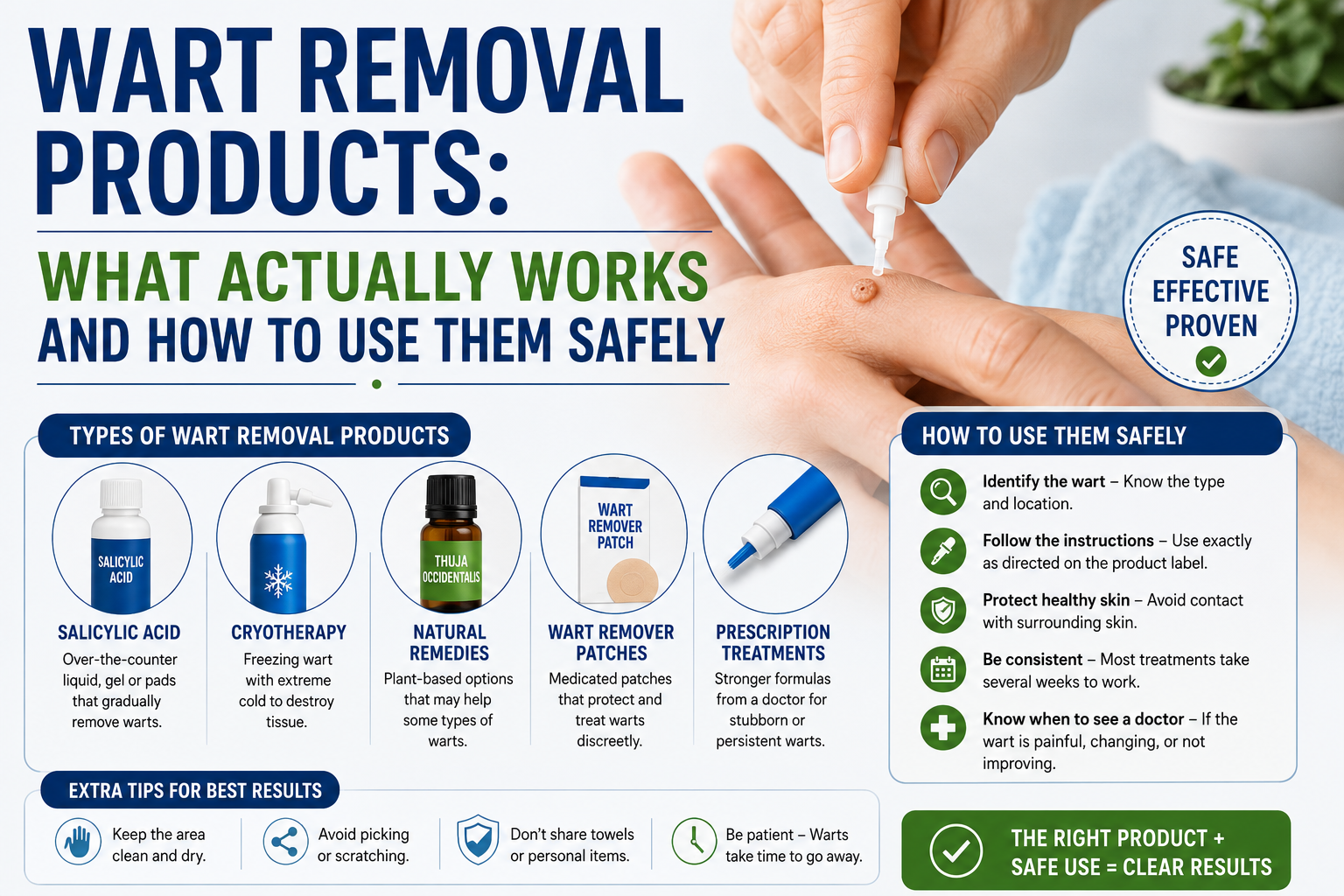
Over-the-Counter Wart Removal Methods
1. Salicylic Acid (Most Evidence-Based OTC Option)
Salicylic acid is the most extensively studied OTC wart treatment and the first-line recommendation of most dermatologists for common and plantar warts. It is a keratolytic agent — it softens and dissolves the thickened, abnormal keratin layer that makes up the wart, gradually breaking down the growth over time.
Available forms:
- Medicated pads/patches (Dr. Scholl's Freeze Away, Compound W pads): Convenient, pre-measured, good for plantar warts
- Liquid solutions (Compound W Liquid, Ocusal-HP): Good for irregular-shaped warts on hands and fingers; apply precisely with applicator
- Gels: Similar to liquid but easier to apply to flat surfaces without running
Standard concentrations: 17% salicylic acid is typical for OTC products (the maximum allowed by the FDA for nonprescription use). Some plantar wart products use 40% patches, which are more aggressive and should be used carefully to protect surrounding healthy skin.
How to use salicylic acid effectively:
- Soak the wart in warm water for 5–10 minutes to soften the skin
- Use a pumice stone or emery board to gently file away the dead, white surface tissue
- Dry the area completely
- Apply the salicylic acid product only to the wart itself — not surrounding skin
- Cover with a bandage or medicated pad
- Repeat every day or as directed on the label
- Remove all white, dead tissue before each new application
How long does it take? Hand and finger warts typically respond in 4–8 weeks of consistent daily treatment. Plantar warts may require 8–16 weeks. Skipping days dramatically slows progress — consistency is the most critical factor in treatment success.
2. Cryotherapy Products (Freeze Treatments)
Cryotherapy destroys wart tissue by freezing it, causing the cells to rupture and die. In-office dermatological cryotherapy uses liquid nitrogen, which reaches −196°C. OTC freeze products use dimethyl ether/propane mixtures that reach approximately −57°C — colder than a standard freezer, but significantly warmer than liquid nitrogen. This means OTC freeze products are somewhat less effective per application than in-office treatment, but multiple applications can achieve similar results for many warts.
Common products: Dr. Scholl's Freeze Away, Compound W Freeze Off, Wartner
How to use freeze products:
- Apply the foam applicator to the wart for the time specified on the label (usually 20–40 seconds)
- The treated area will typically blister within 24–72 hours — this is expected
- The blister and treated tissue will dry up and fall off over 1–2 weeks
- If the wart persists, re-treat after 2 weeks
- Most products allow up to 3–4 treatments per wart
Limitations: OTC cryotherapy works best on small, thin, or recently appeared warts. Thick plantar warts may be better addressed with salicylic acid, which can penetrate deeply over time. OTC freeze products should not be used on the face, genitals, mucous membranes, or by people with diabetes, circulatory problems, or numbness in the feet.
3. Duct Tape Occlusion
Several small clinical studies have examined duct tape occlusion therapy — covering the wart with duct tape continuously for weeks — as a wart treatment. The most cited study (Focht et al., 2002) found it more effective than liquid nitrogen for common warts in children. However, subsequent larger studies have produced more mixed results. The mechanism, if effective, is thought to involve local immune stimulation from irritation of the covered skin.
Duct tape therapy is safe to try as a complement to salicylic acid (apply the medicated product, then cover with tape) or as a standalone method, particularly for children reluctant to use chemical treatments. It is unlikely to work for thick plantar warts without adjunct salicylic acid treatment.
4. Combination Approaches
For stubborn or thick warts — particularly plantar warts — dermatologists often recommend combining salicylic acid treatment with periodic freeze treatment. The freeze treatment disrupts the outer layers, the salicylic acid breaks down the softened tissue, and daily filing removes the dead material. This combination approach often achieves resolution in warts that failed with either method alone.
Protecting Healthy Skin During Treatment
Both salicylic acid and cryotherapy products can damage surrounding healthy skin if applied carelessly. Protective strategies include:
- Apply petroleum jelly (Vaseline) to the skin surrounding the wart before applying salicylic acid liquid or gel
- Use a hole punch on a bandage or medicated pad to expose only the wart through the adhesive, protecting surrounding skin
- With freeze products, use the applicator carefully and avoid contact with surrounding skin
- Do not file so aggressively that healthy skin is removed — only the white, dead surface tissue should be filed away
When to See a Doctor Instead
OTC wart treatment is appropriate for most common and plantar warts in otherwise healthy adults. However, you should consult a dermatologist or physician in the following situations:
- You are not sure the growth is a wart (skin lesions that appear suddenly, change in color or shape, bleed easily, or have irregular borders should be evaluated by a physician — these features can also appear in skin cancers)
- The wart is on your face, genitals, or around your eyes or mouth
- You have diabetes, poor circulation, or neuropathy (particularly for foot warts)
- You have a weakened immune system
- The wart has not responded to 12 weeks of consistent OTC treatment
- The wart is causing significant pain, spreading rapidly, or multiplying
- You have genital warts (these require physician evaluation and treatment)
In-office treatment options include liquid nitrogen cryotherapy, cantharidin application, immunotherapy, prescription topical treatments, laser therapy, and surgical excision.
Can Warts Be Prevented?
There is no vaccine for common skin wart strains of HPV (the HPV vaccine used in adolescents targets high-risk strains associated with cervical cancer and genital warts, not common skin wart strains). However, transmission risk can be reduced:
- Wear shower shoes or sandals in public locker rooms, pool areas, and communal showers
- Keep feet clean and dry (HPV thrives in warm, moist environments)
- Do not share towels, razors, nail clippers, or pumice stones
- Avoid touching other people's warts
- Cover your own warts with a bandage to reduce shedding of virus-containing skin cells
- Avoid biting nails or picking at hangnails — these create entry points for the virus
- Wash hands thoroughly after touching a wart
Frequently Asked Questions
Do warts go away on their own without treatment?
Yes — many warts do resolve spontaneously without treatment as the immune system eventually recognizes and clears the HPV infection. In children, approximately two-thirds of warts disappear within two years without any treatment. In adults, the timeline is less predictable and spontaneous resolution is slower, sometimes taking years. Because warts are contagious (they can spread to other body parts and to other people), and because active treatment typically resolves them within weeks to months, treatment is generally preferred over waiting for natural resolution.
What are the black dots inside a wart?
Despite the popular name "wart seeds," the black dots visible inside a wart are not seeds and have nothing to do with the wart's ability to spread. They are thrombosed (clotted) capillaries — tiny blood vessels that have grown upward into the thickened, abnormal tissue of the wart and have become occluded. Their presence confirms that the growth has a blood supply, and seeing them is actually a useful diagnostic sign that you are looking at a wart rather than a callus (calluses do not have these dots).
Which is better for plantar warts — salicylic acid or freeze treatment?
For thick plantar warts, salicylic acid applied consistently over 8–16 weeks typically outperforms a single course of OTC cryotherapy, because the acid can penetrate deeply into the thickened tissue over time. OTC freeze products are less cold than medical liquid nitrogen and may not penetrate thick plantar lesions effectively in just a few applications. Many dermatologists recommend combining both: periodic freeze treatment to disrupt the surface followed by daily salicylic acid. For very thick or stubborn plantar warts, in-office cryotherapy with liquid nitrogen is significantly more effective than OTC alternatives.
Is it okay to cut or scrape a wart off at home?
Cutting, scraping, or picking at warts at home is not recommended. Wart tissue contains live HPV virus. Cutting or picking breaks the skin, which can spread the virus to surrounding tissue, cause the wart to multiply and spread to new sites, and create an open wound that can become infected. Filing the dead, white surface layer with a pumice stone or emery board during salicylic acid treatment is appropriate — this removes dead keratin, not living tissue — but cutting into the wart with implements is not safe to do at home.
Can a wart come back after successful treatment?
Yes. Successful wart removal eliminates the visible lesion but does not necessarily clear the underlying HPV virus from the surrounding skin. Recurrence rates after treatment (both OTC and clinical) are significant — studies show that 20–30% of treated warts recur within 12 months. Recurring warts in the same location or a nearby site should be treated again using the same method. People with recurring or multiple warts may benefit from dermatology consultation to explore immune-stimulating treatment options such as topical immunotherapy.
Elena's Last Mile
Elena ran a half marathon three months after her plantar wart resolved. She tells the story partly as a testament to the frustrating but simple truth: most people quit treatment too soon. The product wasn't the variable — the consistency was. Ten weeks of nightly soaking, filing, and applying is a commitment, but it's a commitment that works for most people without a doctor's visit.
Warts are among the most common and most manageable skin conditions in existence. The right product, the right technique, and the willingness to stay the course are all you need for the vast majority of cases.
Browse salicylic acid products, freeze treatments, and wound care supplies at AllCare Store's First Aid & Skin Care collection. Free shipping on qualifying orders. Questions? Call us at 1-888-889-6260 or visit AllCareStore.com.
— The AllCare Store Team