Home oxygen is prescription medical treatment. A doctor decides whether you need supplemental oxygen, at what setting, and for how many hours a day. Nothing here changes any of that, and you should not adjust a prescribed setting based on anything you read online.
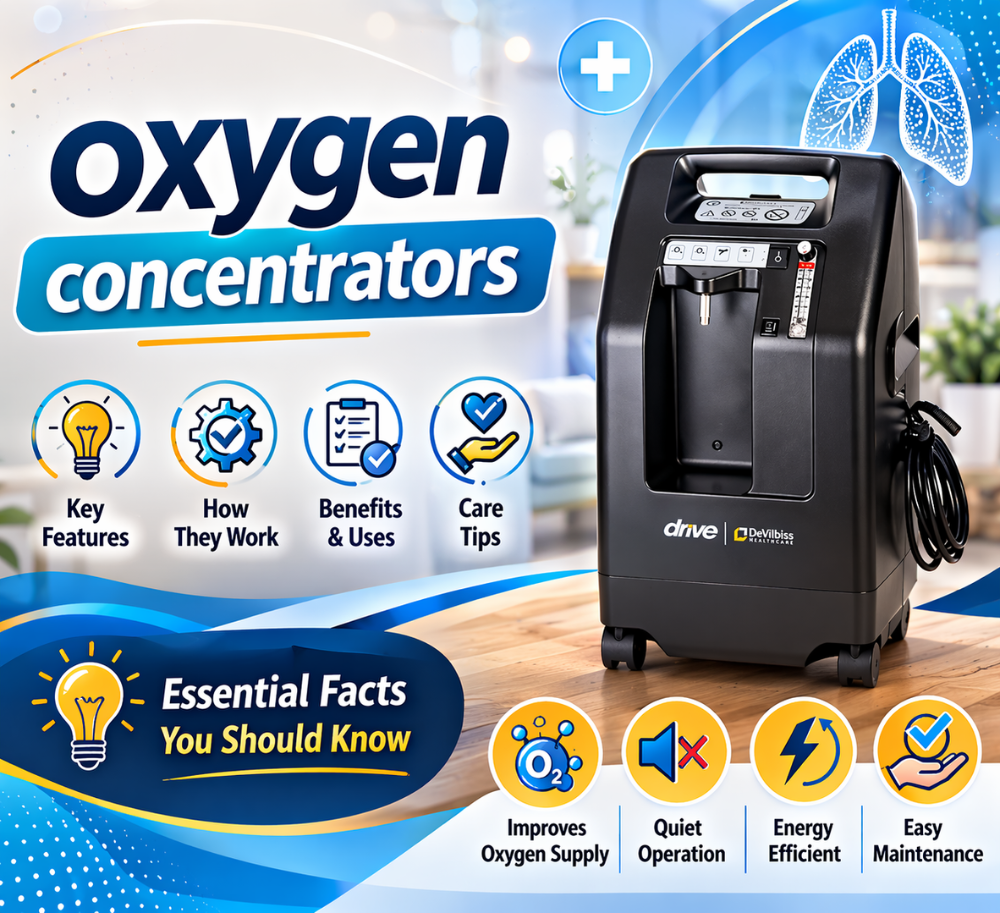
What this article does is explain the machine — how a concentrator produces oxygen from ordinary room air, what the specifications on the box actually mean, and why the choice between a stationary and a portable unit is a genuine trade-off rather than a matter of budget. Understanding this makes the conversation with your prescriber and your equipment supplier a much shorter one.
What a concentrator does
Air is roughly 78% nitrogen and 21% oxygen. A concentrator does not store oxygen or manufacture it. It takes in room air and removes most of the nitrogen, leaving a stream that is mostly oxygen.
The mechanism in almost every home unit is called pressure swing adsorption:
- A compressor draws in room air and pushes it, under pressure, through a vessel packed with a mineral called zeolite — a molecular sieve.
- Under pressure, the zeolite holds on to nitrogen molecules and lets oxygen pass through. The oxygen-rich gas goes on to a small reservoir and then to your tubing.
- Meanwhile the pressure in a second, identical vessel is released. The nitrogen it was holding is let go and vented back out of the machine.
- The two vessels swap roles, several times a minute, forever. That alternating cycle is the rhythmic sound a concentrator makes.
Two consequences follow from this. First, the sieve material is a consumable — it degrades over years and is one of the things a service technician checks. Second, the machine needs to breathe: it must draw room air freely, which is why placement and filter cleanliness matter so much.
What the numbers on the specification sheet mean
Litres per minute (LPM)
The volume of gas the machine delivers per minute. Home stationary units are commonly rated up to 5 LPM, with higher-output models available. Your prescription specifies your setting; the machine simply has to be capable of it, with headroom.
Oxygen concentration — and why it falls
Concentrators do not deliver pure oxygen. Manufacturers typically specify something in the region of 87–96% across the device's rated range. Crucially, concentration is not constant: on most machines purity is highest at low flow settings and declines as you approach the maximum. A unit rated to 5 LPM may hold its stated purity comfortably at 2 LPM and be working at its limit at 5. This is why buying a machine whose maximum exactly equals your prescribed setting is a poor idea, and why an oxygen purity alarm is a feature worth having.
Continuous flow vs. pulse dose
This is the single most important distinction in the category, and the one most often misunderstood.
- Continuous flow delivers gas steadily, whether you are inhaling or not. Nearly all stationary home units work this way.
- Pulse dose (demand delivery) detects the start of each breath and releases a measured bolus of oxygen only during inhalation. This is dramatically more efficient, which is what makes small battery-powered units possible at all.
The catch is that pulse dose depends on the machine sensing your breath. It can be unreliable for people who breathe through their mouth, and it behaves differently during sleep, when breathing is shallower. Pulse settings are also not equivalent to LPM — a "setting 2" on a pulse unit is not the same as 2 LPM continuous, and the relationship differs between manufacturers. Whether pulse delivery is suitable for you, and at what setting, is a clinical decision.
Noise
Measured in decibels. Stationary units are typically noticeably louder than portables at rest. If the machine will run overnight in a bedroom, this is not a minor specification — long tubing that lets the unit sit in an adjacent room is a common workaround.
Stationary units: what you gain and give up
Gain: higher continuous flow capability, no battery management, generally lower cost per litre delivered, and a machine built to run continuously for years. For anyone prescribed oxygen for long hours or overnight, a stationary unit is usually the core of the setup.
Give up: mobility. Stationary units are heavy — typically in the range of 30–50 lb — and mains-powered. They are rolled from room to room, not carried. They also add measurably to the electricity bill, since they run whenever you are using oxygen.
Portable units: what you gain and give up
Gain: the ability to leave the house. Portable concentrators run on rechargeable batteries, usually charge from a car outlet as well as mains, and many models hold FAA approval for use on commercial flights.
Give up: capacity. Most portables are pulse-dose only or offer continuous flow at low settings only. Battery life is quoted at the lowest setting — real endurance at a higher setting can be a fraction of the headline figure. They are also generally more expensive per unit of oxygen delivered, and small units work harder for their size.
Why many households end up with both
The stationary-or-portable question often has the answer "both," for the same reason a house has a cooker and a kettle. A stationary unit covers the many hours at home, including sleep; a portable covers errands, appointments and social outings. Suppliers frequently package them together for exactly this reason.
A separate point worth making: an electrically powered concentrator stops working in a power cut. Anyone dependent on oxygen should have a backup plan agreed with their supplier — usually a compressed cylinder held in reserve — and should notify their electricity provider that they have medical equipment in the home.
Questions worth asking before you buy or rent
- What did my prescription specify — flow rate, hours per day, and continuous or pulse?
- Does this machine hold its rated oxygen concentration at my setting, not just at its lowest?
- Is there an oxygen purity alarm, and a low-pressure alarm?
- What is the servicing interval, and who performs it?
- What is my backup for a power outage?
- If portable: what is the actual battery life at my setting, and is the model FAA-approved?
Related reading
- Getting started with home oxygen therapy: prescription, setup and caregiver support
- Using oxygen safely at home: fire risk, tubing and cannula comfort
- Oxygen concentrator maintenance: filters, tubing, humidifier bottles and servicing
- Oxygen away from home: batteries, air travel, altitude and power cuts
- Concentrator, compressor nebuliser or ultrasonic nebuliser — which does what
Browse oxygen management, respiratory care and oxygen management and respiratory care.
Supplemental oxygen is a prescription medical treatment. This article is general information only. Do not start, stop or change an oxygen prescription or flow setting except on the instruction of the healthcare professional who prescribed it.