Note: This article is for informational purposes. Persistent or worsening urinary incontinence should be discussed with a healthcare provider, as many causes are treatable.
Adult Incontinence Pads: The Complete 2026 Buying Guide
Linda's Quiet Compromise
For two years, Linda, 58, quietly rearranged her life around her bladder. She stopped going to her book club because the walk from the parking lot to the library made her anxious. She sat near the aisle on airplanes and at theaters. She passed on the evening walks her husband loved because she couldn't predict when the urge would hit. She wasn't wearing any protection — she'd tried using menstrual pads after a friend suggested it, but they didn't really absorb quickly enough, and she'd had an embarrassing moment that made her trust them even less.
When her gynecologist finally asked — directly — about bladder leakage at a routine appointment, Linda admitted what had been going on. The conversation that followed was practical and nonjudgmental. Her doctor explained that what she was experiencing was stress urinary incontinence (leakage triggered by coughing, sneezing, laughing, or physical activity) combined with mild urgency incontinence, and that it affected more than one in three women her age. She left with a referral to a pelvic floor physical therapist and a recommendation to start using dedicated incontinence pads in the meantime. That week, she found a product that fit her flow level, her underwear, and her daily routine — and began the process of getting her life back.
This guide is for every Linda who has been quietly managing, wondering what to use, or unsure whether the products at the store are really right for her. When you're ready to find the right product, AllCare Store's Incontinence Pads collection carries a full range of absorbency levels and styles with free shipping on qualifying orders.
What Are Incontinence Pads — and How Are They Different from Menstrual Pads?
This is the single most important distinction in incontinence product shopping, and it's widely misunderstood. Many people assume any absorbent pad can handle bladder leakage. The reality is that incontinence pads and menstrual pads are designed around different fluid properties and different leakage patterns.
| Feature | Incontinence Pads | Menstrual Pads |
|---|---|---|
| Fluid type | Urine (thin, watery) | Menstrual blood (thicker, viscous) |
| Absorbency speed | Fast-absorbing (urine arrives suddenly) | Slower-absorbing (flow is gradual) |
| Odor control | Specifically designed for urine odor neutralization | Designed for blood odor; less effective for urine |
| Liquid lock | Strong internal barriers to prevent re-wet and leakage | Less critical (blood doesn't re-wet as easily) |
| Shape | Often shaped for the anatomy and underwear of both sexes; longer in some designs | Shaped primarily for female anatomy and menstrual flow patterns |
| Available absorbency range | Very wide (drops to maximum/overnight) | Light to heavy menstrual flow |
The bottom line: using a menstrual pad for urinary incontinence typically results in slower absorption, more odor, more risk of side leakage, and a less secure feeling of dryness. For anyone experiencing bladder leakage more than very occasionally, a dedicated incontinence pad is meaningfully better.
Types of Incontinence and Which Pad Works Best
Stress Urinary Incontinence (SUI)
Leakage that occurs with physical exertion — coughing, sneezing, laughing, lifting, exercising, or even just walking briskly. Caused by weakened pelvic floor muscles or a weakened urethral sphincter (common after childbirth, menopause, or prostate surgery in men). Leakage amounts are typically small to moderate per episode but can be frequent.
Best pad match: Light to moderate absorbency pads; thin-profile pads that don't restrict movement; products shaped for active wear
Urgency Urinary Incontinence (UUI) / Overactive Bladder
A sudden, intense urge to urinate followed by involuntary leakage before reaching the bathroom. Often associated with overactive bladder (OAB). Leakage volumes can be larger — sometimes the full contents of the bladder.
Best pad match: Moderate to maximum absorbency; rapid-acquisition pads that handle a sudden large rush of fluid; longer pads that extend coverage
Mixed Incontinence
A combination of stress and urgency incontinence — very common in women over 50. Requires a pad that handles both small frequent leaks (stress) and occasional larger voids (urgency).
Best pad match: Moderate to heavy absorbency; consider using a lighter pad during active daytime hours and a heavier product in the evening
Post-Void Dribbling
Leakage of a small amount of urine immediately after leaving the bathroom — more common in men (due to residual urine in the urethra) but can occur in women. Very small volume.
Best pad match: Light or thin shields; male-specific guards (for men) designed for small-volume post-void leakage
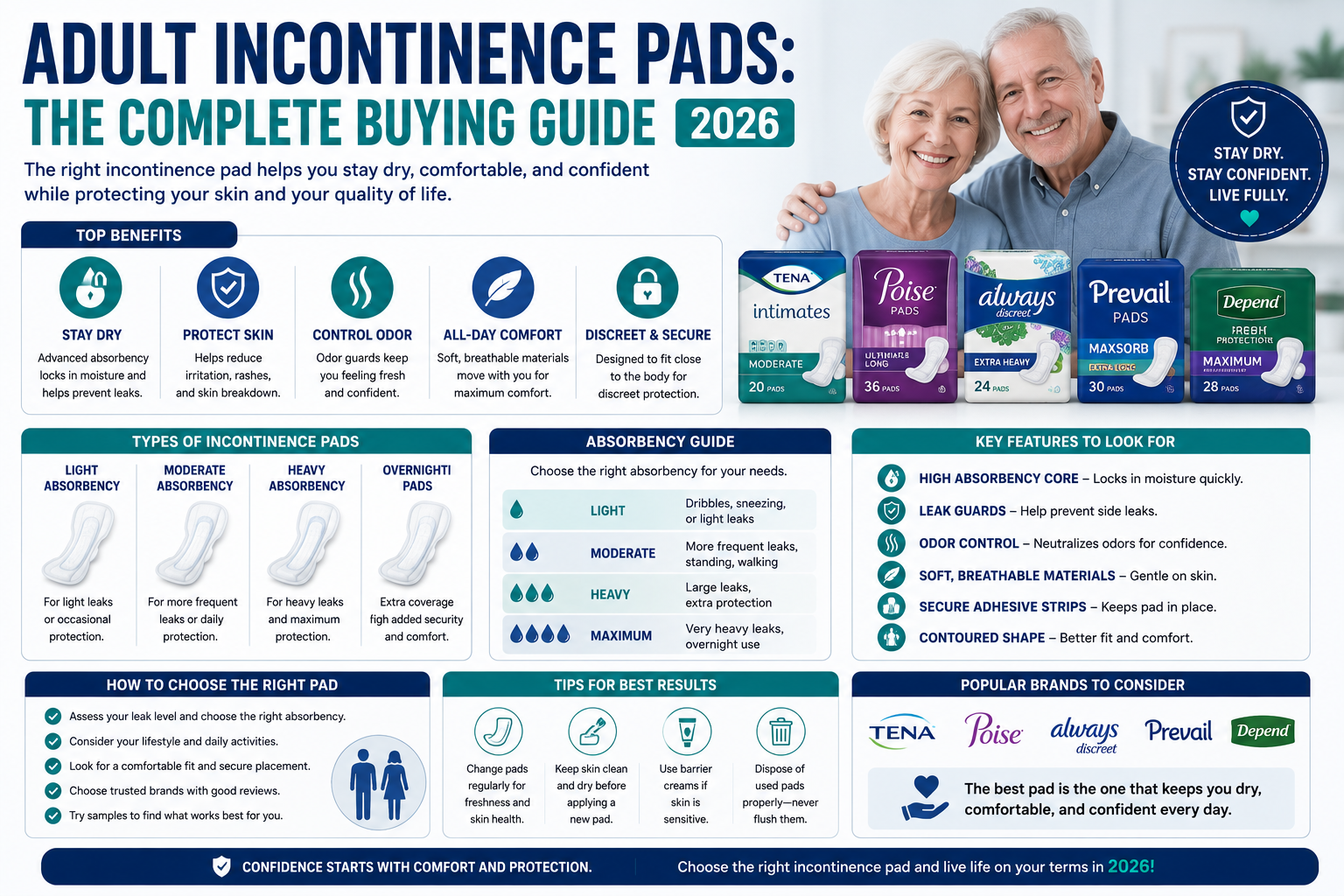
Absorbency Levels Explained
Incontinence pad manufacturers use various terms and drop-rating systems to indicate absorbency. Here's how to navigate them:
| Absorbency Level | Typical Drop Rating | Volume Handled | Best For |
|---|---|---|---|
| Very Light / Liner | 1–2 drops | Up to ~50 mL | Occasional drips, post-void dribble, minor stress leakage |
| Light | 2–3 drops | 50–120 mL | Light stress incontinence; active use; everyday light leakage |
| Moderate | 3–4 drops | 120–250 mL | Regular stress or urgency incontinence; most daytime use |
| Heavy | 4–5 drops | 250–400 mL | Frequent moderate leakage; urgency incontinence; overnight |
| Maximum / Ultimate | 5–6 drops | 400 mL+ | Heavy urgency incontinence; overnight; post-surgical recovery |
Tip: When in doubt, start with a moderate absorbency pad and adjust based on experience. Using too light a pad leads to leaks and anxiety; too heavy a pad is uncomfortable and expensive. Many users eventually use two levels — a lighter pad for daytime active hours and a heavier product at night.
Key Features to Compare When Choosing a Pad
Acquisition Speed
How quickly the pad pulls liquid away from the skin when it arrives suddenly. This matters most for urgency incontinence, where the volume hits the pad in a sudden surge. Look for pads specifically marketed for urinary incontinence (rather than just absorbency) — the polymer technology inside is designed for fast fluid capture.
Odor Control
High-quality incontinence pads include odor-neutralizing technology (often activated carbon, baking soda-based compounds, or specific polymer chemistry) that neutralizes urine odor at the source rather than masking it with fragrance. Fragrance-containing pads can cause skin irritation for sensitive users — fragrance-free pads with active odor control are generally better for sensitive skin.
Wetness Barrier / Dryness Layer
A good pad pulls fluid through a top layer and locks it away from the skin, keeping the surface that touches the body dry. This is the single most important feature for comfort, as prolonged skin-to-moisture contact causes irritation and increases infection risk.
Adhesive Wings and Backing
The adhesive strip on the back of the pad must be strong enough to hold the pad in place through movement. Wings (side adhesive extensions) are helpful in wider underwear styles. For active users, longer adhesive strips and contoured shapes that follow the anatomy prevent bunching and shifting.
Pad Shape and Length
Incontinence pads come in several shapes. Longer pads provide additional back coverage important for urgency incontinence. Shaped pads (curved or hourglass profiles) fit the anatomy more naturally. Flat rectangular pads are simpler but can bunch more during movement. Consider your primary activity level and leak pattern when choosing shape.
Skin-Friendly Materials
The top sheet (the layer touching the skin) should be soft and breathable. Plastic-backed pads trap heat and moisture. Cloth-like outer layers allow more air circulation and feel less uncomfortable for extended wear. For users with sensitive skin or dermatitis, look for hypoallergenic, fragrance-free, dye-free options.
Male Incontinence Pads
Standard feminine incontinence pads are anatomically shaped for female bodies. Men using these products often find poor fit and coverage. Male-specific incontinence guards and pads are shaped as a pouch or funnel to fit the male anatomy, providing targeted coverage for the leakage patterns common in men (post-prostatectomy, post-void dribble, urgency incontinence).
Major brands including TENA Men, Depend for Men, and Prevail Male Guards offer products designed specifically for men at various absorbency levels. If you are a man managing incontinence, male-specific guards are significantly more comfortable and effective than female-designed products. Browse AllCare Store's Men's Incontinence collection for male-specific options.
Overnight Incontinence Protection
Nighttime incontinence poses unique challenges: longer duration between changes, position changes during sleep, and the need for protection from multiple angles. Options for overnight use include:
- Heavy/maximum absorbency pads: Suitable for moderate overnight leakage if the user can change position without significant leakage
- Pull-up protective underwear: All-around coverage; better for people who move significantly during sleep or who experience leakage from multiple positions
- Tab-style adult briefs: Maximum coverage and absorbency for heavy nighttime incontinence
- Underpads (chux): Disposable or reusable absorbent pads placed under the sheet; a good supplement to any worn protection
See AllCare Store's Adult Diapers & Underwear collection for a full range of overnight incontinence options.
Skin Care with Incontinence Pads
Even the best incontinence pads involve some moisture exposure, and moisture on skin for extended periods can cause irritation, redness, and breakdown — a condition called incontinence-associated dermatitis (IAD). Best practices include:
- Change pads regularly: Don't wear a pad past the point of saturation. For light pads with light leakage, this may mean every 4–8 hours; for heavier products, every 4–6 hours or when saturated
- Cleanse after each change: Use a gentle, pH-balanced cleanser or incontinence wipes — not harsh soap — to clean the perineal area
- Apply a skin barrier: A thin layer of zinc oxide cream or a petrolatum-based barrier helps protect skin from moisture exposure. This is especially important for people who wear protection continuously
- Allow air exposure when possible: Periods of time without any protection, when practical, reduce the risk of skin irritation
- Watch for warning signs: Persistent redness, burning, or skin breakdown in the pad area should be assessed by a healthcare provider
AllCare Store carries incontinence skin care products including perineal cleansers, moisture barrier creams, and incontinence wipes.
Managing Costs: Quantity and Brand Options
Incontinence products are an ongoing expense. Some strategies to manage costs without compromising quality:
- Buy in bulk: Per-unit cost decreases significantly with larger packages. Buying a month's supply at once is typically 20–40% less expensive than smaller packs
- Consider store brands: Many pharmacy and retail store-brand incontinence pads use similar absorbent polymer technology to name brands at lower prices
- Match absorbency to actual need: Using a heavier pad than necessary is wasteful; lighter products are less expensive. Accurately assessing your leakage level helps you buy the right product
- Check insurance and FSA/HSA eligibility: Incontinence supplies may be covered by certain insurance plans (particularly for diagnosed medical conditions), and are eligible for purchase with Health Savings Account (HSA) or Flexible Spending Account (FSA) funds in the United States
Frequently Asked Questions
Can I use menstrual pads for urinary incontinence?
Menstrual pads can absorb urine, but they are not designed for it. Urine is a thin watery fluid that arrives suddenly in incontinence situations, whereas menstrual blood is thicker and flows gradually. Menstrual pads absorb more slowly, provide less effective odor control for urine, and are more likely to allow leakage. For anyone managing bladder leakage regularly, dedicated incontinence pads will be more effective, more comfortable, and more reliable. They are also specifically designed to neutralize urine odor at the source.
How do I choose between a pad and pull-up underwear for incontinence?
Incontinence pads are generally preferred for lighter leakage (stress incontinence, post-void dribble, moderate urgency), as they are less bulky, less expensive, and feel more similar to regular underwear. Pull-up protective underwear (like Depend or Prevail pull-ups) is better for heavier urgency incontinence, overnight use, or for people who find pads shifting or bunching. Pull-ups provide all-around coverage and are easier to use for people with limited dexterity or mobility issues. Many people use pads during the day and pull-ups at night.
Are incontinence pads FSA or HSA eligible?
Yes — incontinence supplies including pads, guards, briefs, and underpads are generally eligible for purchase with Health Savings Account (HSA) or Flexible Spending Account (FSA) funds in the United States when used for managing a medical condition (urinary incontinence). This can represent significant savings. Check with your specific HSA/FSA plan for confirmation. Some insurance plans also cover incontinence supplies with a physician's documented diagnosis; contact your insurer for details.
How often should I change an incontinence pad?
Change an incontinence pad when it is saturated or approaching saturation, or at a minimum every 4–6 hours regardless of saturation level. Wearing a saturated pad increases skin moisture exposure, elevating the risk of incontinence-associated dermatitis (IAD) and urinary tract infections. For lighter leakage, some people change pads only once or twice a day. The right frequency depends on your leakage volume — choose a pad absorbency level that doesn't saturate within 2–3 hours of normal use.
Is incontinence just something I have to live with, or can it be treated?
Urinary incontinence is very often treatable or significantly improvable — but it is undertreated because many people do not discuss it with their doctor. Pelvic floor physical therapy has strong evidence for treating stress and urgency incontinence, with many patients achieving significant or complete resolution of symptoms. Behavioral interventions (bladder training, scheduled voiding), medications, minimally invasive procedures, and in some cases surgery are all options depending on the type and severity of incontinence. Discussing it with a primary care provider, gynecologist, or urologist is the first step. Incontinence pads are an effective management tool while pursuing treatment — not an alternative to it.
A Note from Linda
Linda finished her course of pelvic floor physical therapy eight months after that gynecology appointment. Her stress incontinence improved substantially — not completely, but enough that she stopped sitting near the aisle at every event and started walking with her husband again in the evenings. She still uses a light incontinence pad during longer outings, more as a confidence measure than a necessity. She went back to book club. She took a trip to Italy she'd been putting off for two years.
The pad wasn't the solution — the treatment was. But the pad was what made it possible to live fully while she was getting there. That's the right way to think about these products: as tools for living, not symbols of limitation.
Browse AllCare Store's Incontinence Pads collection for light liners through maximum absorbency pads, male guards, and specialty overnight options. Free shipping on qualifying orders. Questions? Call us at 1-888-889-6260 or visit AllCareStore.com.
— The AllCare Store Team