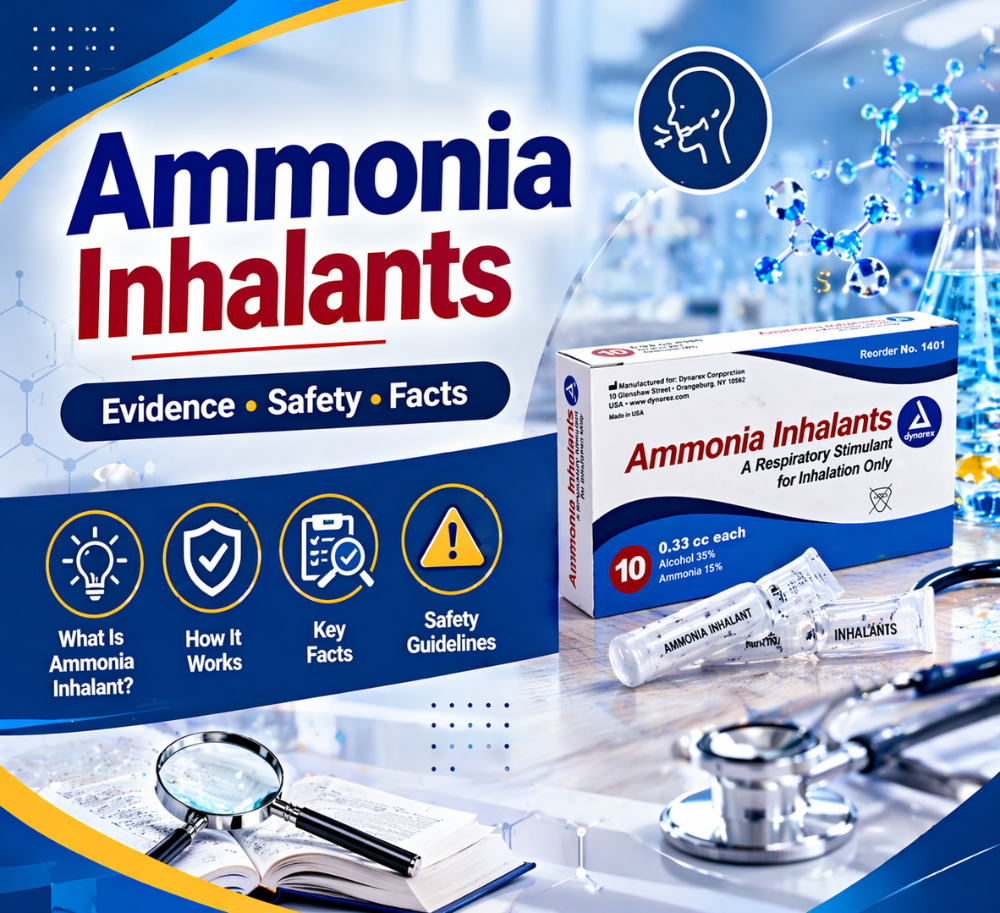
Ammonia inhalants — most people call them smelling salts — are among the oldest items still found in first aid kits, gym bags, and training rooms. They are also among the most misused. Because they work fast and are sold without a prescription, it is easy to assume there is nothing to get wrong.
There is. Most of the problems people report with ammonia inhalants come down to three things: holding them too close, using them too often, or using them in a situation where the real answer was medical attention. This article is about technique, limits, and the beliefs that lead people astray.
If you want the background on what these products are and the physiology behind them, start with our explainer on what ammonia inhalants are and how they work, then come back here.
A One-Paragraph Refresher
An ammonia inhalant releases a small amount of ammonia vapor. The vapor irritates the lining of the nose and airway, which provokes a reflex gasp and a brief jolt of alertness. That is the whole mechanism. It is an irritant reflex, not a medication, and it does nothing to the underlying reason a person felt faint.
Correct Technique, Step by Step
Before you activate it
- Check the expiry date. Product that has dried out or leaked will not work when you need it.
- Make sure the person is lying down or seated and supported. A reflex gasp in someone who is standing and unsteady can make a fall more likely, not less.
- Have your other hand free. You want to be able to pull the inhalant away immediately.
Distance and duration
- Crush or open the product away from your own face, and away from the other person's eyes.
- Hold it roughly four to six inches from the nostrils — not under the nose, and never touching the skin.
- Pass it briefly beneath the nose rather than holding it still. One or two seconds is the intended exposure.
- Remove it as soon as the person responds. There is no benefit to a longer exposure and a real risk of airway irritation.
Afterwards
- Keep the person seated or lying down for several minutes. Standing up quickly is how second faints happen.
- Dispose of a single-use ampoule immediately — do not leave a crushed one loose in a bag or pocket.
- Cap and reseal a reusable product straight away so it does not vent into the kit.
When Not To Use One
Ammonia inhalants are an airway irritant. That is fine for most healthy adults in a brief, one-off exposure and a poor idea for some people. Skip them, and seek medical advice instead, if the person:
- Has asthma, COPD, or any chronic respiratory condition
- Is having difficulty breathing, wheezing, or is short of breath
- Has a known sensitivity to strong fumes or a history of reacting badly to them
- Has an injury to the head, face, or neck, or may have a spinal injury — do not move or stimulate them, call for help
- Is unresponsive and not simply lightheaded — that is an emergency, not a smelling-salts situation
- Is a young child, unless a clinician has specifically advised it
If you are pregnant, managing a heart or lung condition, or on medication that affects blood pressure, ask your doctor before keeping ammonia inhalants for personal use. General consumer guidance cannot account for your specific situation.
Fainting: The Part That Matters More Than the Inhalant
People reach for smelling salts during a faint, but the inhalant is the least important thing you do. The fundamentals:
- Get the person flat and raise their legs. Gravity does most of the work.
- Loosen tight collars and give them space and air.
- Most simple faints resolve within a minute without any intervention.
- Call emergency services if the person does not come round quickly, is injured, has chest pain, is breathing abnormally, or faints repeatedly.
Repeated fainting is a symptom that needs investigating. An inhalant that shortens the episode can mask a pattern worth showing a doctor.
Four Myths Worth Retiring
“They're addictive”
Ammonia inhalants do not produce chemical dependence. The habit people form is behavioural — reaching for one before every heavy set becomes a ritual. Not addiction, but not a reason to use them constantly either, since repeated exposure irritates the nasal lining.
“Stronger is better”
A more concentrated product does not produce a better outcome. It produces a harsher irritant exposure. If a standard product is not getting a response, the answer is medical attention, not a stronger vial.
“They treat dizziness”
They do not treat anything. They produce a brief alerting reflex. Dizziness caused by dehydration, low blood pressure, anaemia, blood sugar problems, inner-ear conditions, or medication side effects is unaffected by an inhalant. Treat the cause.
“They can clear a dazed athlete's head”
This is the most consequential misconception. An athlete who has taken a blow to the head and seems foggy must be assessed by qualified medical staff and removed from play. Using an ammonia inhalant to make someone look alert enough to continue is dangerous. Read more in our piece on ammonia inhalants beyond the sports arena.
Storage, Handling, and Disposal
- Store in a cool, dry place. Heat and humidity degrade the product.
- Keep them sealed in their original packaging until needed — loose ampoules crush by accident.
- Keep out of reach of children.
- Avoid skin and eye contact; rinse with water if exposure happens and seek advice for eye contact.
- Do not store in a car glovebox through summer or winter extremes.
- Replace expired stock rather than keeping it “just in case”.
Signs You Should Stop and Talk To a Clinician
Stop using ammonia inhalants and speak to a healthcare professional if you notice persistent nasal burning or soreness, nosebleeds, coughing or wheezing after use, or if you find yourself needing one more than occasionally. Frequent need is information about your health, not a supply problem.
Where To Go Next
- Ammonia inhalants: what they are and how they work — the background explainer
- Choosing and stocking ammonia inhalants — formats, quantities, and rotation
- Beyond the sports arena — sideline use and everyday first aid
You can browse related supplies in Respiratory Care & Oxygen Management and First Aid.
This article is general consumer safety information and is not medical advice. If you faint, feel faint repeatedly, or have a respiratory or cardiac condition, talk to your doctor before using ammonia inhalants.