Posture Correctors and Lumbar Cushions for Desk-Sitting Back Pain: A 2026 Guide
Priya spends most of her workday exactly the way millions of people do now: parked in a desk chair, laptop propped on a stack of old notebooks, phone wedged between shoulder and ear during calls. She isn't lifting anything heavier than a coffee mug, and she didn't twist wrong reaching for a box. But by 3 p.m. most afternoons, her lower back has a dull, nagging ache that climbs into her shoulders by the time she logs off. She tried a rigid back brace a coworker recommended for a lifting injury, and it felt bulky and pointless for what she was actually dealing with — because it was built for a different problem.
If Priya's afternoon sounds familiar, you're not dealing with a torn muscle or a herniated disc. You're dealing with sedentary posture strain — a very different mechanism than the acute injuries, sciatica flare-ups, and heavy-lifting stress that most back brace guides focus on. This guide is written specifically for desk workers, remote employees, students, and drivers whose backs hurt from sitting still too long in the wrong position, not from an injury or diagnosed disc problem.
Why Sitting All Day Actually Hurts Your Lower Back
It seems counterintuitive — sitting looks like rest, not strain. But prolonged sitting places a surprising amount of mechanical stress on your lower spine, and it does so in ways that lifting-focused braces were never designed to address.
- Posterior pelvic tilt: Most office chairs and car seats encourage your pelvis to tuck under and roll backward as you slouch. This flattens the natural inward curve (lordosis) of your lower back, straining the ligaments and small stabilizing muscles that are supposed to hold that curve in place.
- Increased disc pressure while seated: Research on spinal loading has repeatedly shown that the discs in your lower back bear more pressure sitting than standing, and even more when you slouch forward. Hours of that sustained pressure, day after day, adds up even without a single "injury moment."
- Weakened glutes and core from disuse: Sitting turns off your glute muscles and lets your deep core stabilizers go quiet. Over months, those muscles get weaker and slower to engage, so your lower back ends up doing stabilization work it was never meant to handle alone.
- Forward head posture cascading downward: When your monitor, phone, or laptop sits too low, your head drifts forward. Every inch of forward head position adds significant load to your neck and upper back — and your body compensates by shifting your ribcage and pelvis, which changes the alignment (and strain pattern) all the way down to your lower back.
- Static positioning itself: Muscles and discs both rely on movement to stay nourished and flexible. Staying in one position for 45+ minutes at a stretch — even a "good" position — reduces circulation to spinal tissues and lets stiffness set in.
None of this involves a structural injury, which is exactly why the solutions look different from a rigid LSO brace or a sacroiliac belt. What helps here is a combination of a postural cue, better seated support, and — most importantly — moving more.
How Posture Correctors Work (and What They Really Do)
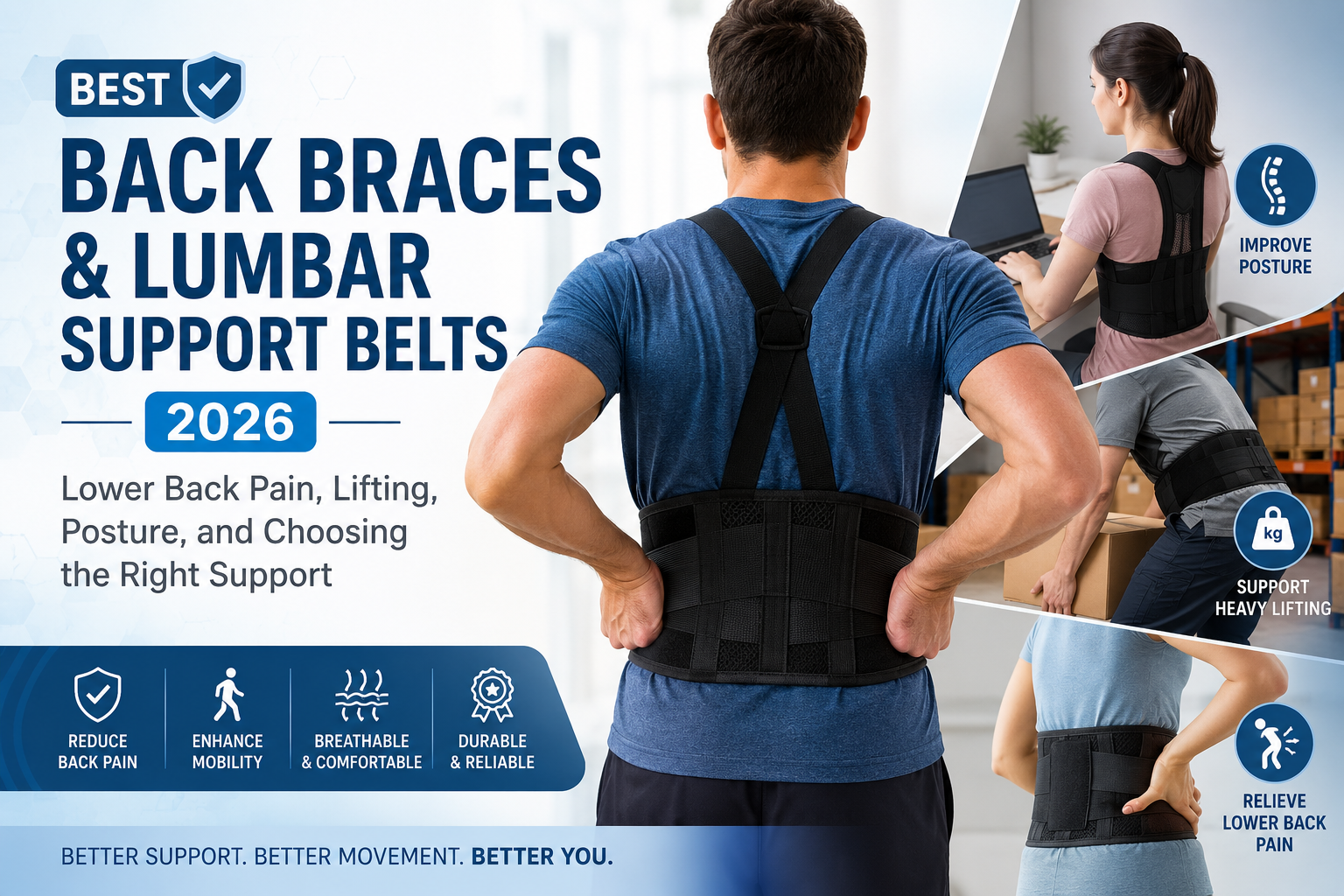
A posture corrector is a wearable brace, typically worn across the upper back and shoulders (sometimes extending to the lower back), that gently pulls your shoulders back and discourages slouching. It's a fundamentally different product from a lumbar support belt built for lifting or an LSO brace built for post-injury stabilization.
Who they tend to help
- People whose pain is clearly tied to hours of slouched sitting rather than a specific injury
- People who notice their shoulders "round forward" by mid-afternoon
- People building new postural habits after starting a desk job, returning to a long commute, or increasing screen time
- People doing rehab exercises for upper back and postural muscles who want a reminder cue between sessions
Realistic expectations — please read this part
A posture corrector is a training cue, not a cure. It does not strengthen your muscles by itself, and wearing one all day, every day, can actually backfire by letting your postural muscles get lazier rather than stronger. The products that tend to work best are used the way physical therapists generally recommend: for short, intentional periods (often 15–30 minutes at a time, a few times a day) paired with actual movement and strengthening work, so your body gradually learns what upright posture feels like and starts to hold it on its own. Think of it as a coach tapping your shoulder, not a cast holding a bone together.
If you're looking for orthopedic-grade support products, including postural aids, browse the orthopedic care collection for options.
Lumbar Cushions vs. Posture Braces: Which One Fits Your Setup?
These two product categories solve overlapping but distinct problems, and a lot of people buy the wrong one. A posture corrector changes how your upper body holds itself. A lumbar cushion changes what your lower back rests against. Many desk workers end up needing elements of both, but knowing the difference helps you spend your money in the right place first.
| Feature | Posture Corrector (worn) | Lumbar Support Cushion | Ergonomic Chair Setup |
|---|---|---|---|
| What it does | Physically cues shoulders back and discourages slouching | Fills the gap between your lower back and the chair to maintain natural curve | Positions your whole body correctly at the source (chair height, monitor, desk) |
| Best for | Rounded shoulders, forward head posture, upper-back slump | Flattened lower back curve, pain that worsens the longer you sit | Long-term, whole-day prevention across any seated activity |
| Portability | Wearable — moves with you between chair, car, and standing | Stays with the specific chair or seat, though many are strap-on and portable | Not portable — tied to the specific workstation |
| Effort required | Low effort to wear, but requires consistency and short-session use | Very low — mostly passive once positioned correctly | One-time setup effort, then passive benefit every day |
| Limitations | Doesn't build strength alone; not for use all day | Doesn't correct upper-body slouch or forward head posture | Doesn't help in the car, on a couch, or at a different desk |
Quick guidance by setup
- Office chair without built-in lumbar support: Start with a lumbar cushion — it directly addresses the flattened-curve problem most standard office chairs create.
- Long commutes or road trips: A compact, strap-on lumbar cushion travels well between your car seat and office chair. Explore options in the seat cushions collection.
- Noticeable shoulder rounding or "text neck": A posture corrector addresses the upper-body pattern a lumbar cushion can't reach.
- Recliner or couch "work from home" setup: Both a lumbar cushion and a posture reminder can help, but the bigger fix is usually limiting how long you work from a recliner at all — it rarely supports a neutral spine position.
- Pain that's present no matter what you sit in: This is a sign the issue may not be purely postural. See the red flags below.
Setting Up a Workstation That Actually Reduces Strain
Products help, but workstation setup is where most of the real, lasting improvement happens. A few adjustments matter far more than people expect:
- Chair height: Feet flat on the floor (or a footrest), knees at roughly a 90-degree angle, hips level with or slightly above your knees.
- Lumbar contact: The chair or a cushion should touch and support the inward curve of your lower back — not leave a gap, and not push it flat.
- Monitor height: Top of the screen at or just below eye level, about an arm's length away, so you're not tipping your chin down or craning your neck forward.
- Elbow and wrist position: Elbows close to your body at roughly 90 degrees, keyboard and mouse at a height that doesn't force your shoulders up or forward.
- Movement breaks: This is the single most evidence-backed intervention for sedentary back pain. Stand, walk, or stretch for 1–2 minutes every 30–45 minutes. A cushion or a corrector supports good position — but no product replaces getting up regularly. Set a recurring timer if you tend to lose track of time.
- Alternate positions: If you have a sit-stand desk, use it. Even alternating positions every hour reduces the sustained loading that causes most desk-related back pain.
- Strengthen the support system: Short daily glute and core activation exercises (bridges, bird-dogs, planks appropriate to your fitness level) address the root weakness that sitting creates. This is where lasting relief tends to come from, not from any single product.
When It's Not Just Posture — Red Flags for Desk-Related Back Pain
Most desk-related back pain responds to a combination of ergonomic fixes, movement, and short-term postural support within a few weeks. But some symptoms mean sitting posture isn't the whole story, and a product isn't the answer. Contact a healthcare provider if you experience:
- Pain that doesn't meaningfully improve after 2–3 weeks of consistent ergonomic changes, movement breaks, and appropriate use of postural support
- Pain, numbness, tingling, or weakness that radiates down one or both legs
- Pain that wakes you up at night or is present first thing in the morning regardless of activity
- Any loss of bladder or bowel control (seek emergency care immediately)
- Unexplained weight loss alongside back pain
- Back pain following any fall, accident, or direct injury, even a minor one
- Fever combined with back pain
- Pain that is worsening in intensity or frequency rather than staying steady or improving
If your pain involves any of the above, or you suspect a disc issue, sciatica, or an injury rather than posture, our companion guide covers those situations in depth: Best Back Braces 2026: Lower Back Pain, Sciatica, and Choosing the Right Level of Support.
Frequently Asked Questions
Can a posture corrector fix years of bad posture on its own?
Not by itself. A posture corrector is most effective as a short-session training cue combined with strengthening exercises and workstation changes. Wearing it passively for years without addressing the underlying muscle weakness or workstation setup is unlikely to create lasting change.
How long should I wear a posture corrector each day?
Most guidance suggests short, intentional sessions — often 15 to 30 minutes at a time, a few times per day — rather than all-day wear. Wearing it too long can let your own postural muscles become more dependent on it rather than stronger. If you have specific questions about duration for your situation, ask your physical therapist or doctor.
Do I need a lumbar cushion if my office chair already has lumbar support built in?
Not necessarily. Many built-in lumbar supports are adjustable and work well once positioned correctly. A separate cushion is most useful when the built-in support doesn't match your body's curve, when the chair has no lumbar support at all, or when you need portable support for a car seat or a second workspace.
Is it better to sit up perfectly straight all day?
No single "perfect" position held for hours is ideal. The research on prolonged sitting points to movement and position changes as more important than achieving one rigid posture. Aim for a generally neutral, supported position, and prioritize changing position and standing up regularly over holding any one posture perfectly.
My back pain gets better on weekends when I'm not at my desk. Does that confirm it's postural?
It's a reasonable sign that your desk setup and sitting posture are contributing factors, which is encouraging because it means ergonomic changes are likely to help. That said, if the pain still lingers on weekends, is worsening over time, or comes with any of the red-flag symptoms above, it's worth having it evaluated rather than assuming posture is the only cause.
Should I use a posture corrector or a back brace for lifting?
These serve different purposes. A posture corrector is designed for sedentary, seated postural strain — it is not built to stabilize the spine during lifting or heavy activity. If your back pain is related to lifting, physical labor, or a diagnosed injury rather than sitting, see our guide to lumbar support belts and rigid back braces for that use case.
Why Shop at AllCare Store
AllCare Store specializes in home medical supplies and mobility support products, with a team that understands the difference between an injury-support brace and everyday postural support. When you shop with us, you get:
- Free shipping on qualifying orders
- 30-day returns so you can find the right fit and support level for your setup
- Friendly, knowledgeable support — call us at 1-888-889-6260 with questions about sizing or which product fits your situation
Browse our full range of postural and seating support in the orthopedic care collection and seat cushions collection.
MEDICAL DISCLAIMER: The information in this article is intended for general educational purposes and does not constitute medical advice. Posture correctors and lumbar cushions are comfort and support products, not treatments for underlying medical conditions such as herniated discs, spinal stenosis, or nerve compression. If you experience persistent, worsening, or radiating pain, numbness, weakness, or any red-flag symptoms described above, stop self-managing and consult a physician or physical therapist promptly. Individual results from any postural product vary, and no brace, cushion, or wearable device can guarantee pain relief.