The Load Ellen Could Not Put Down
Ellen is 61, and for two years she has been the one who helps her husband out of bed each morning. He had a stroke, he is heavier than she is, and the transfer from mattress to wheelchair is the hardest thirty seconds of her day. Last March, mid-lift, something in her lower back let go. Not a dramatic pop, just a hot, gripping ache that climbed the left side of her spine and stayed. She finished the transfer. She always finishes the transfer. But that night she could not bend to tie her shoes.
Her doctor called it a lumbar muscle strain, common, not serious, the kind of thing that heals in a few weeks if you let it. The problem was that Ellen could not let it. The lifting did not stop because her back hurt. So she started wearing a lumbar support belt for the morning routine and the grocery runs, taking it off the rest of the day, and pairing it with the core exercises the physical therapist gave her.
The belt did not heal her back. What it did was give the strained muscles something to lean on during the exact moments they were most likely to be reinjured, and it reminded her, every time she felt the pull of the straps, to hinge at her hips instead of rounding her spine. Six weeks later the ache was gone. The belt lives in a drawer now, ready for the next heavy week.
That is the honest promise of a back brace, and it is worth saying plainly before we get into types and sizes: the brace is a tool, not a cure. It supports, offloads, cues better movement, or holds the spine still after surgery, and choosing the right one depends entirely on which of those jobs your back actually needs done. If your back pain comes mainly from sitting at a desk all day rather than a strain or injury, our companion guide to posture correctors and lumbar cushions for desk-sitting back pain covers that situation in more depth.
What a Back Brace Actually Does
Back braces do four different jobs, and most buying mistakes come from picking a brace built for the wrong one.
- Support and compression. An elastic belt raises pressure inside the abdomen and gently compresses the trunk, which shares some of the load your spine would otherwise carry alone. It also adds warmth and improves your sense of where your back is in space, which calms muscle guarding and everyday ache.
- Offloading and rest. By taking part of the mechanical load, a brace lets an irritated disc, joint, or strained muscle rest during activity, the same way a sling rests an arm. This is why braces help most during the tasks that provoke pain.
- Postural cueing. The pull of the straps is a constant reminder to stand tall, brace your core, and lift with your legs instead of your lower back. For many people this behavior change does as much good as the fabric itself.
- Rigid stabilization. A structured lumbosacral brace with panels or stays limits how far the spine can bend and twist, protecting healing tissue after surgery, a fracture, or a significant disc injury.
Notice what a brace does not do: it does not strengthen the muscles that hold your spine upright. In fact, relying on a rigid brace around the clock can let those core and back muscles weaken, which is why clinicians pair bracing with movement and exercise. The brace buys you safe, confident activity. The activity, and the strengthening under it, is what actually rebuilds the back.
The Four Types of Back Braces
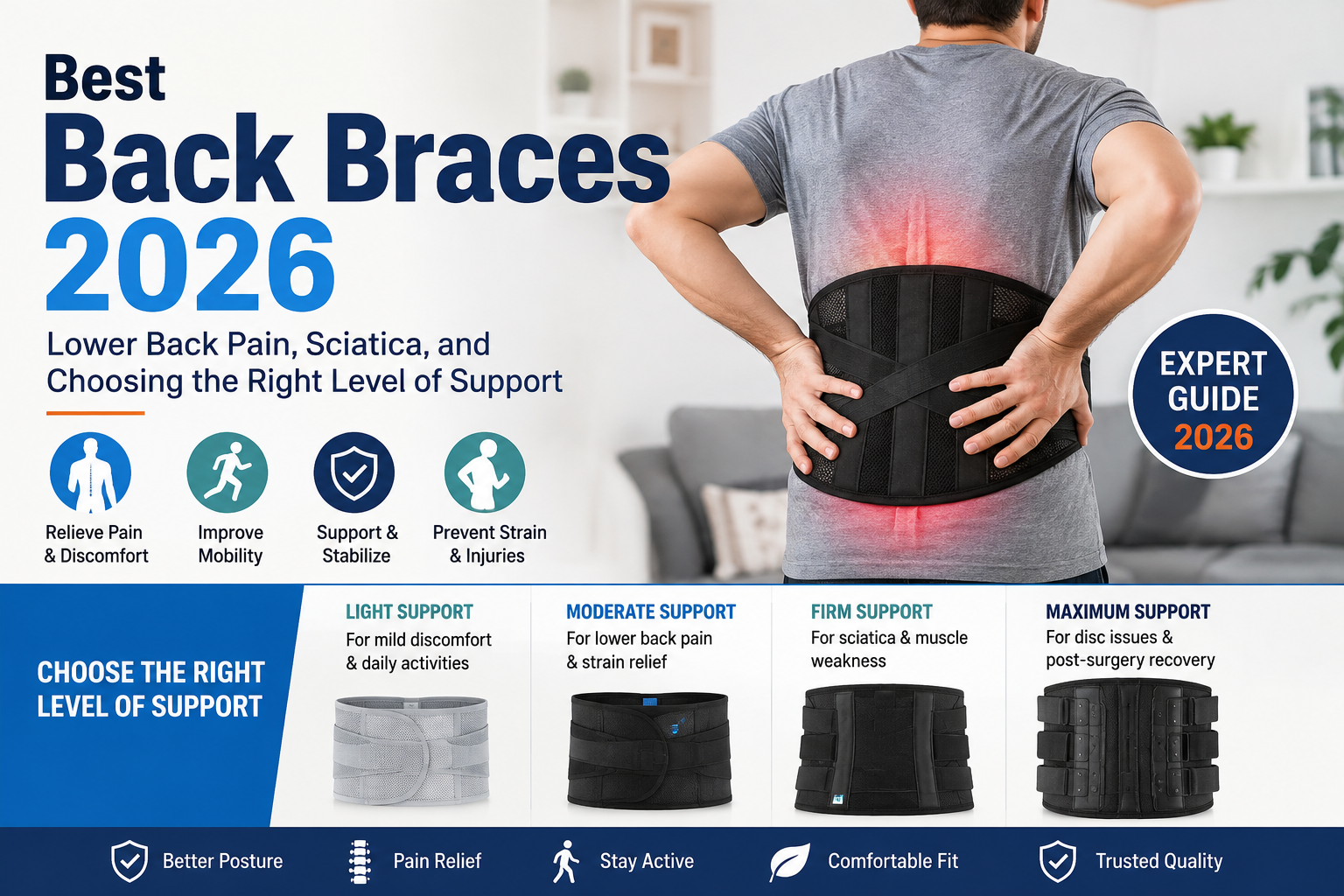
Nearly every back support on the market falls into one of four categories. Match the category to your job first, then worry about brand and price.
1. Elastic Lumbar Support Belts
These are the wide, flexible belts that wrap the lower back and close with hook-and-loop straps, often with a few thin, flexible stays sewn into the back panel and an extra pull-strap for adjustable tension. They provide compression, warmth, light support, and a strong postural reminder, but they do not rigidly immobilize the spine. Most people who buy a back brace need one of these.
Best for: everyday muscle strain, general lower back ache, fatigue from standing or bending, and postural support. A well-priced entry point is the Back Brace Belt with flexible posterior stays (from about $21.27, several sizes). For a breathable, posture-focused option, the ObusForme Back Belt for Women with a ventilated lumbar pad and the matching ObusForme Back Belt for Men (both about $49.53) shape to the curve of the lower back and encourage upright alignment.
2. Rigid and Semi-Rigid LSO Braces
A lumbosacral orthosis, or LSO, is a structured brace with rigid panels, molded shells, or firm stays that meaningfully restrict how far you can bend forward, sideways, and rotate. This is the category for serious support: recovery from spinal surgery, a significant disc herniation, a compression fracture, spondylolisthesis, or stenosis flare-ups where limiting motion reduces pain. These braces are firmer, taller, and more supportive than an elastic belt, and are often fitted or recommended by a clinician.
Best for: post-surgical recovery, herniated or degenerative disc pain, stenosis, spondylolisthesis, and any situation where a clinician wants to limit spinal motion. The Apex LSO Universal Back Brace with adjustable compression tabs and a firm back panel (about $98.38, with an optional lateral-panel version) is a representative semi-rigid LSO that steps well beyond what an elastic belt can offer.
3. Sacroiliac (SI) Belts
These are narrow belts worn low, across the hips and below the beltline, rather than around the waist. Their job is to compress and stabilize the sacroiliac joints, where the base of the spine meets the pelvis. A narrow SI belt is the right tool for SI joint dysfunction, pelvic instability, and the pelvic-girdle pain many women feel during and after pregnancy, none of which respond well to a wide waist belt sitting too high to reach the joint.
Best for: sacroiliac joint pain, pelvic instability, and pregnancy-related pelvic-girdle pain. A silicone-gripped medical SI belt such as the Sacroiliac SI Joint Belt with silicone grip (about $195.95) targets the joint directly; browse more options in the orthopedic care collection.
4. Occupational Lifting Belts
Familiar from warehouses and moving crews, these firm belts, sometimes with suspenders to keep them from sliding, are worn preventively during repetitive lifting to remind the wearer to lift correctly and to add abdominal support during exertion. They are a work-shift tool, not an all-day or therapeutic brace, and they work best paired with good lifting technique rather than as a substitute for it.
Best for: repetitive occupational lifting, moving days, and physically demanding tasks. The Sportaid High Back Belt without suspenders (about $57.87) and the Sportaid Back Belt with suspenders (about $58.73) are built for exactly this kind of lifting support.
Comparison at a Glance
| Type | Support Level | Best For | Typical Price |
|---|---|---|---|
| Elastic lumbar belt | Light to moderate | Muscle strain, everyday ache, posture, standing and bending | $20 to $60 |
| Rigid or semi-rigid LSO | Moderate to maximum | Post-surgery, disc herniation, stenosis, spondylolisthesis, fracture | $90 to $400+ |
| Sacroiliac (SI) belt | Targeted | SI joint pain, pelvic instability, pregnancy-related pelvic pain | $40 to $200 |
| Occupational lifting belt | Moderate (preventive) | Repetitive lifting, work shifts, moving days | $50 to $70 |
Browse the full range in the orthopedic care collection and the back and neck therapy collection.
Match the Brace to the Problem
Here is the part most product pages skip. The single most useful thing you can know is which brace goes with which back problem.
| Your Situation | Usual Brace Choice |
|---|---|
| Lower back muscle strain or spasm | Elastic lumbar support belt |
| General ache from standing, bending, or long days | Elastic lumbar belt or posture-focused support |
| Herniated or degenerative disc pain | Semi-rigid or rigid LSO brace |
| Spinal stenosis or spondylolisthesis | Rigid LSO brace (per clinician) |
| Recovering from spine surgery or a fracture | Rigid LSO exactly as your surgeon directs |
| Sacroiliac joint pain or pelvic instability | Narrow sacroiliac (SI) belt |
| Pregnancy-related pelvic or low back pain | Maternity SI or belly-support belt |
| Heavy or repetitive lifting at work | Occupational lifting belt, worn during the task |
If you have leg pain, numbness, or tingling that travels below the knee, that points toward nerve involvement (sciatica) rather than a simple muscle strain, and it deserves a clinician evaluation before you rely on a brace. If you are recovering from surgery, wear the specific brace your surgeon prescribed on the schedule they set, and do not swap it for a softer, more comfortable belt because comfort is not the same as protection.
Sizing: Measure Your Waist, Not Your Pants
A back brace that does not fit does not work. Too loose and it rides up, bunches, and offers no real support. Too tight and it digs in, restricts breathing, and can worsen discomfort. The single most common mistake is buying by pants size instead of measuring.
How to Measure
Use a flexible tape measure around your body at the level the brace will sit. For a standard lumbar belt, that is around your natural waistline or just below the navel; measure snug but not compressed, standing normally, and match the number to the brand size chart rather than assuming your clothing size. For a sacroiliac belt, measure lower, around the top of the hips, because an SI belt is meant to sit across the pelvis, not the waist. If you fall between sizes on a pull-and-adjust belt, either size usually works because the straps take up the slack; on a fixed rigid brace, follow the chart precisely.
Standard vs High-Back Profiles
Belts come in different heights. A shorter, standard-profile belt is cooler and easier to sit in, and suits general lumbar support. A taller, high-back belt covers more of the lower back and gives firmer support for people with a longer torso or higher pain. If a belt pinches when you sit or folds over at the top, it is either the wrong height for your torso or positioned too high.
Fit Checklist
- Snug and supportive without pinching, numbness, or trouble breathing.
- Stays in place through a few bends and a short walk without rolling up.
- Sits at the right level: waistline for a lumbar belt, across the hips for an SI belt.
- You can slide a flat hand under the belt but not a fist.
- No skin pinching at the top or bottom edge when you sit down.
How to Wear It (and the Mistakes to Avoid)
- Wear it for activity, not around the clock. Unless a clinician directs otherwise, put the brace on for the tasks that stress your back and take it off for rest. Continuous bracing can let the muscles that support your spine weaken.
- Do not cinch it as tight as it will go. Tighter is not stronger, it is just tighter. Aim for firm and secure, not a corset that limits your breathing.
- Wear it over a thin layer. A light shirt under the brace protects your skin, wicks sweat, and keeps the belt cleaner. Bare skin under neoprene can chafe.
- Position it correctly. A lumbar belt centered on the small of your back, an SI belt low across the hips. A brace worn in the wrong spot supports the wrong thing.
- Keep moving and keep strengthening. The brace should enable activity and better mechanics, not replace them. Ask a physical therapist for core and hip exercises; strong muscles protect a spine far better than fabric.
- Keep it clean. Hand-wash and air-dry elastic and neoprene supports. A stretched-out, musty belt supports nothing.
Beyond the Brace: What Actually Helps a Back
A brace works best as one piece of a larger plan. The things that move the needle most on back pain are often the least glamorous.
- Core and hip strengthening. The muscles of your abdomen, back, and hips are the real brace you wear all day. Guided physical therapy or a graded exercise routine reduces recurrence more reliably than any belt. See the exercise and physical therapy collection.
- Heat and cold. Ice calms an acute flare and swelling; heat loosens stiff, achy muscles before activity. Browse wraps and packs in the back and neck therapy collection.
- TENS for pain. A TENS unit uses gentle electrical stimulation to interrupt pain signals, a drug-free option many people use alongside a brace during flare-ups. Explore the electrotherapy collection.
- Posture and ergonomics. A supportive chair, a lumbar cushion, and a workstation set up so you are not hunched forward all day take steady strain off the spine. If desk posture is your main issue rather than an injury, see our dedicated posture correctors and lumbar cushions guide. A cane or supportive footwear helps too; see the canes and crutches collection.
- Lift smart and lighten the load. Hinge at the hips, keep loads close, and avoid twisting under weight. For caregivers, transfer aids and gait belts make lifting another person far safer for your own back.
- Weight and movement. Extra abdominal weight tips the pelvis and increases the load through the lower back, and long periods of sitting stiffen everything. Regular walking is one of the most protective habits for a healthy spine.
When to See a Doctor Instead of Buying a Brace
A brace is a reasonable first move for mild, familiar back strain. It is the wrong first move, and a delay that can cost you, when your back is signaling something more serious. Seek medical care promptly, and urgently for the first group below, if you have any of these:
- Numbness in the groin or saddle area, or new loss of bladder or bowel control (this can signal cauda equina syndrome, a medical emergency).
- Progressive weakness in one or both legs, or a foot that drags.
- Severe pain after a significant fall, crash, or other major trauma.
- Fever, chills, or night sweats with back pain, which can point to infection.
- Unexplained weight loss, or a history of cancer, with new back pain.
- Pain that is worse at night or at rest rather than with activity.
- Leg pain, numbness, or tingling traveling below the knee that keeps worsening.
A brace supports a back. It does not diagnose one. Getting the diagnosis right first is what makes the brace the correct tool rather than a way to ignore a problem.
Why Shop Back Braces and Orthopedic Support at AllCare Store
AllCare Store stocks the full range, from light elastic lumbar belts and posture supports to rigid lumbosacral braces, sacroiliac belts, and occupational lifting belts, across sizes from petite to bariatric, alongside the heat and cold therapy, TENS units, cushions, and canes that round out a back-care plan. Everything ships free within the U.S. with 30-day returns.
Back bracing is one of those categories where a quick phone call beats a guess. The difference between an elastic belt and a rigid LSO is the difference between comfort and real motion control, and matching the brace to your specific diagnosis and measurements is exactly the kind of thing our team helps with every day. Start with the orthopedic care collection or the back and neck therapy collection, and compare related guides like our knee brace guide, ankle brace guide, shoulder brace guide, and our posture correctors and lumbar cushions guide for desk-related back pain.
Frequently Asked Questions
What is the best back brace for lower back pain?
For most everyday lower back pain from muscle strain, standing, or bending, an elastic lumbar support belt gives the best balance of support, warmth, and comfort. For pain from a herniated disc, stenosis, or after surgery, a firmer semi-rigid or rigid LSO brace that limits motion is usually more appropriate, and is best chosen with clinician guidance.
Do back braces actually work?
Yes, for the right job. Braces reliably reduce pain during activity, add support, and cue better posture and lifting mechanics, which helps a strained or recovering back rest during the tasks most likely to reinjure it. What a brace cannot do is heal a disc, strengthen your core, or fix an underlying structural problem, so it works best paired with exercise and, where needed, medical treatment.
Can I wear a back brace all day?
Usually you should not, unless a clinician directs it. Most people wear a brace for the activities that provoke pain and remove it for rest. Wearing a supportive brace continuously can allow the core and back muscles to weaken over time, which works against long-term recovery.
How long should I wear a back brace each day?
A common approach is to wear it only during aggravating activities, often a few hours at a time, rather than the whole day. After surgery or a fracture, follow the specific schedule your surgeon sets, which may be longer. When in doubt, use the least bracing that lets you move safely, and taper off as strength returns.
What is the difference between a lumbar belt and an LSO brace?
A lumbar belt is a soft, elastic band that compresses and supports the lower back but allows most normal movement. A lumbosacral orthosis (LSO) is a structured brace with rigid panels or stays that actively limits how far you can bend and twist. Belts suit everyday strain; LSO braces suit disc injuries, post-surgical recovery, and situations where motion needs to be controlled.
What kind of back brace is best for sciatica?
Sciatica is nerve pain, usually from a disc or nerve-root irritation, so the priority is a proper diagnosis rather than a brace alone. Many people find a semi-rigid lumbar brace helps by reducing motion and load during flare-ups, but if leg pain, numbness, or weakness is present or worsening, see a clinician before relying on a support.
What back brace should I use for a herniated disc?
A semi-rigid or rigid LSO brace that limits forward bending and rotation is the usual choice for disc-related pain, because reducing motion can ease pressure on the injured disc during activity. Because disc injuries vary widely, confirm the type and wear schedule with your clinician rather than self-treating long term.
Do I need a sacroiliac belt or a regular back brace?
If your pain sits low, at the dimples of the pelvis or into the buttock, and worsens with standing on one leg, rolling in bed, or getting out of a car, an SI belt worn low across the hips is often the better fit. Pain centered in the lower back muscles or spine responds better to a standard lumbar belt worn at the waist.
Are back braces good for pregnancy?
Maternity support belts and sacroiliac belts can ease the pelvic and low back pain that comes with a shifting center of gravity in later pregnancy. Choose one designed for pregnancy, wear it for support during activity rather than constantly, and check with your OB or midwife, especially if you have any complications.
How do I size a back brace correctly?
Measure with a flexible tape at the level the brace will sit, around the waist for a lumbar belt or around the top of the hips for an SI belt, and match that number to the brand size chart instead of using your pants size. Between sizes on an adjustable belt, either usually works; on a rigid brace, follow the chart exactly.
Does Medicare or insurance cover a back brace?
Off-the-shelf elastic belts are usually an out-of-pocket purchase, while medically necessary rigid braces prescribed after surgery or for a diagnosed condition may be covered. Coverage generally requires a physician order and documentation, so ask your provider and check your specific plan before purchasing.
Will a back brace weaken my muscles?
It can, if you wear a supportive brace all day, every day, for a long time and stop using your own muscles. That is why the standard advice is to brace for activity, not around the clock, and to pair bracing with core and back strengthening so the muscles stay strong as the brace does its short-term job.
The Takeaway: Support the Back, Then Rebuild It
A back brace does not heal a disc, cure arthritis, or rebuild the core a long layoff took away. It does one of four things, supports, offloads, cues better posture, or immobilizes, and the whole art of choosing one is matching that job to what your back actually needs. Get the diagnosis first when the pain is new or severe. Measure carefully. Pick the lightest brace that does the job, wear it for activity rather than all day, and keep strengthening the muscles underneath it.
Done right, a back brace is not a sign you are giving up on your back. It is the thing that lets you keep using it, the reason Ellen can still help her husband each morning without paying for it all afternoon.
Not Sure Which Back Brace You Need? Let Us Talk It Through.
AllCare Store carries elastic lumbar belts, posture supports, rigid and semi-rigid LSO braces, sacroiliac belts, and occupational lifting belts in sizes from petite to bariatric, plus the heat and cold therapy, TENS units, cushions, and canes that complete a back-care plan. Browse the orthopedic care collection and the back and neck therapy collection to compare options.
Call 1-888-889-6260 to talk with a specialist about brace type, sizing, and insurance documentation, or visit AllCareStore.com to browse the full selection. Free U.S. shipping and 30-day returns on every order.
This guide was written and reviewed by the AllCare Store editorial team. It is educational and not a substitute for individualized medical advice. Product availability and pricing change, so verify current details on each product page, and consult your physician or physical therapist about the right brace for your back.
MEDICAL DISCLAIMER: This article is for general information only and is not a substitute for a diagnosis or treatment plan from a physician, orthopedic specialist, or physical therapist. A back brace supports the spine; it does not identify what is wrong with it. Back pain can have many different causes, and the right brace for one is the wrong brace for another. Get an accurate diagnosis first, follow your clinician on which brace to wear and for how long, and seek urgent care for back pain accompanied by groin or saddle numbness, loss of bladder or bowel control, progressive leg weakness, fever, unexplained weight loss, or a major injury. Prices mentioned were current at the time of writing and may change.