DISCLAIMER: This article is for informational purposes only. If you experience chronic or severe back pain, sciatica, or tailbone pain, consult a healthcare provider for diagnosis and treatment. A seat cushion can provide comfort and postural support but does not treat underlying medical conditions.
For the millions of people who spend 6, 8, or more hours sitting each day — at a desk, in a car, or using a wheelchair — the right seat cushion can make a genuine difference in comfort and pain levels. Done right, seat cushions reduce pressure on the tailbone and sit bones, encourage proper lumbar alignment, and help distribute weight more evenly across the pelvis.
Done wrong — or chosen for the wrong type of pain — they can actually make discomfort worse. This guide focuses on what actually matters: the difference between cushion types, which features help specific types of pain, and what to realistically expect from a seat cushion as part of managing back and sciatica pain.
Why Sitting Causes Back and Sciatica Pain
Understanding the mechanism helps you choose more intelligently. When you sit — especially on a hard, flat surface — several things happen that contribute to pain over time.
The two ischial tuberosities (your "sit bones") bear most of your seated body weight on a relatively small surface area. This creates focal pressure that can cause pain directly in the sitting bones and radiate into surrounding tissue. The coccyx (tailbone) is particularly vulnerable — in many seated positions, it bears direct contact with the chair surface, especially for people with lower body mass or those who tend to sit in a more reclined posture.
Sciatic nerve pain (sciatica) is a separate but often co-occurring issue. The sciatic nerve — the longest nerve in the body — runs from the lower spine through the buttocks and down each leg. When the piriformis muscle in the buttocks tightens during prolonged sitting, or when lumbar disc issues compress the nerve roots, sciatic pain can radiate from the lower back down through the buttock and into the leg. Sitting that tilts the pelvis backward (posterior pelvic tilt) — which nearly all soft seating encourages — tends to worsen sciatic symptoms.
A well-designed seat cushion addresses these issues by: redistributing pressure away from the tailbone and sit bones, encouraging a neutral or slightly forward pelvic tilt (anterior tilt) that reduces compression on lumbar discs and sciatic nerve roots, and providing consistent support that doesn't bottom out over hours of use.
Seat Cushion Types: Materials and What They Do
Memory Foam
Memory foam (viscoelastic polyurethane foam) is the most common material in orthopedic seat cushions. It conforms to your body shape under pressure and distributes weight more evenly than standard foam. The key variable with memory foam is density — measured in pounds per cubic foot (PCF). Higher density memory foam (4-5 PCF) is more durable, provides better pressure distribution, and holds its shape longer. Low-density memory foam (2-3 PCF) may feel comfortable initially but compresses too much under sustained weight, eventually feeling like sitting on a hard surface again.
Memory foam also retains heat more than other materials, which some users find uncomfortable during long sitting sessions. Look for covers with moisture-wicking fabric if heat retention is a concern for you.
Gel and Gel-Infused Foam
Gel seat cushions use a flexible polymer gel (typically a honeycomb or grid structure) that distributes pressure very evenly and provides excellent heat dissipation — gel stays significantly cooler than foam during use. Gel tends to be heavier than foam cushions of equivalent size.
Gel-infused foam combines memory foam with gel particles or gel layers to provide the conforming benefits of foam with improved cooling and slightly better pressure distribution. These hybrid options are increasingly popular as they balance the pros of both materials.
Standard Foam
Higher-density standard (non-memory) foam can provide good support at lower cost than memory foam. It doesn't conform as precisely as memory foam but also doesn't have the heat-retention issue. Medium-to-high density standard foam (45-60 kg/m³ in metric, equivalent to roughly 3+ PCF) is appropriate for support cushions; softer foam compresses too readily.
Inflatable and Wobble Cushions
Inflatable seat cushions and balance disc cushions (often called wobble cushions) work differently than support cushions. They create a slightly unstable surface that engages core muscles during sitting, encouraging active posture rather than passive slumping. These are more appropriate for users who don't have acute pain but want to improve posture and core engagement. They are generally not recommended as primary solutions for tailbone pain or acute sciatica.
The Coccyx Cutout: Why It Matters for Tailbone Pain
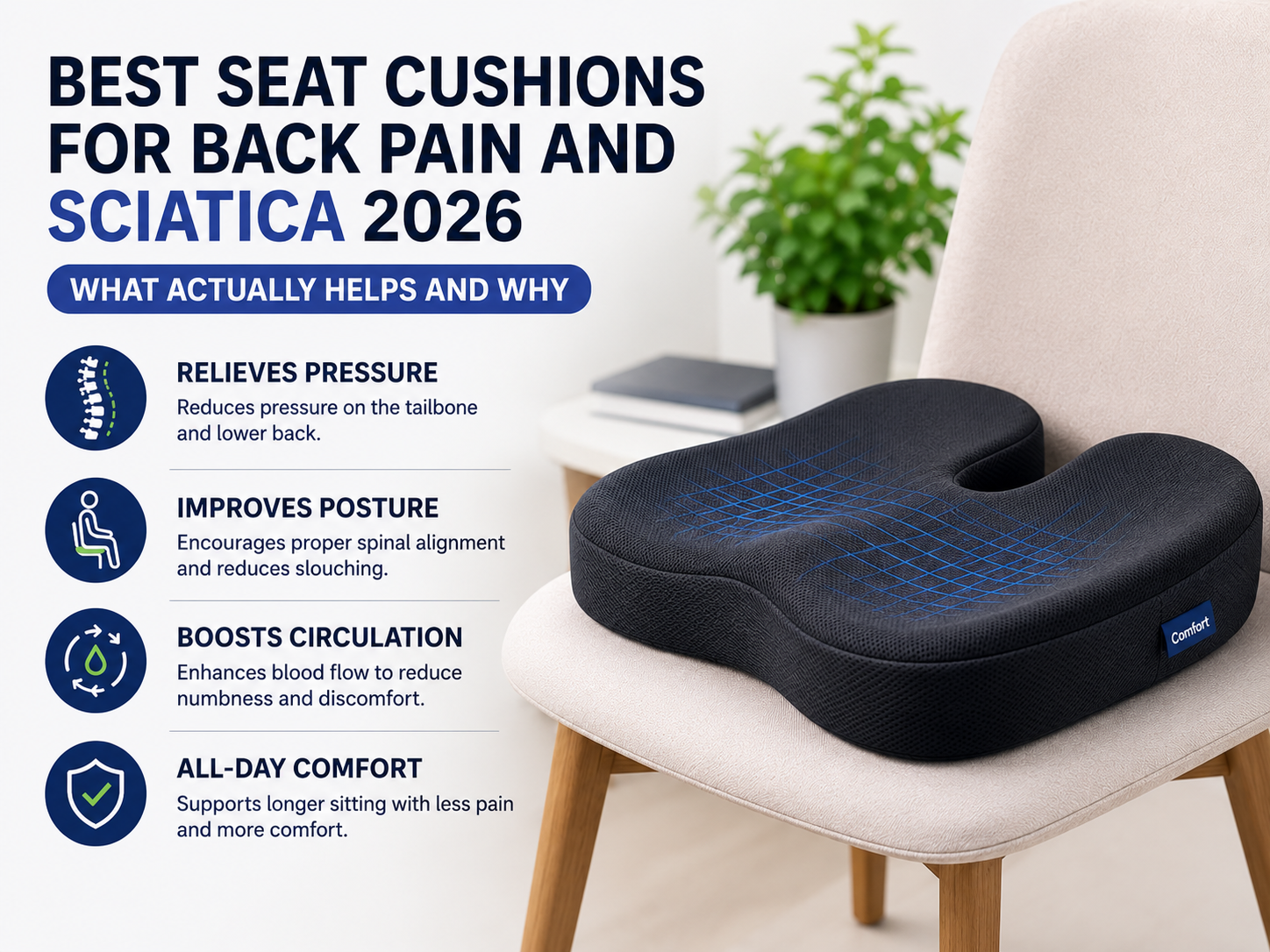
The single most important design feature for tailbone (coccyx) pain is the rear cutout — a U-shaped or V-shaped notch cut from the back of the cushion where the tailbone would normally rest. This removes pressure entirely from the coccyx, allowing you to sit without any direct contact between your tailbone and the cushion surface.
If you have coccydynia (tailbone pain), a coccyx fracture, bruising from a fall, or pain specifically when transitioning from sitting to standing, a cushion with a coccyx cutout is essentially mandatory. Standard flat cushions — no matter how soft — will still apply pressure to the tailbone. The cutout eliminates this entirely.
For people without specific tailbone issues (i.e., the primary concern is lumbar back pain, sciatica, or general sitting fatigue), the cutout is less critical — a well-designed cushion without it may perform equally well.
Cushion Shape and Sciatica
For sciatica specifically, the shape of the cushion affects pelvic tilt — and pelvic tilt directly affects sciatic nerve compression. A cushion that is slightly elevated at the front (wedge shape) encourages a forward pelvic tilt (anterior tilt), which opens the lumbar curve and reduces compression at the L4-L5 and L5-S1 disc levels where most sciatic nerve root irritation originates.
Sitting on a flat or rear-elevated surface encourages the opposite — a posterior pelvic tilt that flattens the lumbar curve and increases disc pressure. Many people who sit on very soft chairs or sofas find their sciatica worsens specifically because this soft seating pulls them into posterior tilt.
A cushion with a gentle wedge shape (front about 1 inch lower than rear) can make a meaningful difference for sciatica sufferers. Pair this with a lumbar support pillow for the back of the chair to further encourage neutral spinal alignment.
How to Choose the Right Cushion for Your Specific Pain
| Pain Type | Key Feature to Prioritize | Recommended Style |
|---|---|---|
| Tailbone / coccyx pain | Coccyx cutout — non-negotiable | Memory foam or gel with deep U-shaped rear cutout |
| Sciatica | Forward tilt / wedge shape; even pressure distribution | Wedge-shaped orthopedic foam; gel-infused foam |
| Lower back pain | Pelvic support and lumbar alignment; forward tilt | Contoured memory foam; pair with lumbar pillow |
| Sit bone pain / ischial bursitis | Pressure distribution across sit bones | High-density gel or gel-foam hybrid |
| General sitting fatigue | Firmness and consistent support over hours | High-density memory foam (4+ PCF) or gel cushion |
| Wheelchair use | Pressure relief, moisture management, durability | Gel cushion or specialty pressure-relief foam |
Size and Fit Considerations
Most standard orthopedic seat cushions are designed for average office chairs and measure approximately 17" x 13" to 18" x 16". For larger individuals or wider chairs, ensure the cushion covers the full seating surface and doesn't leave the sit bones unsupported at the edges — this partially defeats the purpose. For wheelchair use, cushions are typically sized to the specific wheelchair seat width (16", 18", 20") and may have additional features for pressure injury prevention.
Cushion thickness (height) typically ranges from 2" to 4". For people sitting at desks, a thicker cushion may raise your seated height and require chair height adjustment to maintain proper ergonomic positioning (feet flat on floor, knees at roughly 90 degrees, arms at desk level). Plan for this before purchasing a very thick cushion for a fixed-height chair.
Cushion Covers and Maintenance
Most orthopedic seat cushions come with removable, machine-washable covers — this is a feature worth specifically looking for, as the cover accumulates sweat, skin cells, and debris during regular use. For wheelchair users or anyone using a cushion for many hours daily, moisture-wicking and antimicrobial cover materials help prevent skin issues. Wash the cover regularly (every 1-2 weeks for daily use) and allow the foam or gel core to air out periodically.
Realistic Expectations: What a Seat Cushion Can and Cannot Do
A quality seat cushion can meaningfully reduce pressure on the tailbone and sit bones, encourage better pelvic alignment, reduce fatigue and discomfort during long sitting sessions, and help manage symptoms of sciatica, coccydynia, and general back pain. For many people, the right cushion is a significant quality-of-life improvement.
A cushion cannot treat the underlying cause of your pain. Herniated discs, sciatic nerve compression, piriformis syndrome, and other structural issues require medical evaluation and may benefit from physical therapy, medication, or other interventions. A cushion is a supportive measure, not a cure. If your pain is severe, worsening, or accompanied by other symptoms (weakness, numbness, bowel/bladder changes), seek medical attention rather than relying solely on ergonomic aids.
Shop Back Pain Relief Products at AllCare Store
AllCare Store carries orthopedic support products to help manage back pain and improve sitting comfort. Browse our Back Support & Braces collection for seat cushions, lumbar pillows, back braces, and related products.
For pain relief beyond posture support, our Pain Relief collection includes heat therapy, ice packs, TENS units, and topical pain relief options. For wheelchair users, our Wheelchairs & Mobility collection includes pressure-relief cushions and accessories. Shop at AllCare Store with free shipping on qualifying orders. Reach our team at 1-888-889-6260, Monday through Friday, 7:00 AM – 4:00 PM CST.
Frequently Asked Questions: Seat Cushions for Back Pain and Sciatica
Do seat cushions actually help with sciatica?
Yes, the right seat cushion can help reduce sciatic pain during sitting by encouraging a forward pelvic tilt (anterior tilt) that reduces compression on lumbar disc nerves, and by distributing weight more evenly to reduce piriformis muscle tension. A wedge-shaped or contoured orthopedic cushion is typically more helpful for sciatica than a standard flat cushion. However, a cushion manages symptoms during sitting — it doesn't treat the underlying cause of sciatica. For lasting relief, work with a physical therapist or physician to address the root issue.
What is a coccyx cushion and who needs one?
A coccyx cushion (also called a tailbone cushion) has a U-shaped or V-shaped cutout at the rear of the cushion that suspends the tailbone in air rather than letting it rest against the seat surface. This completely eliminates direct pressure on the coccyx. Anyone with tailbone pain — from coccydynia, a bruised or fractured coccyx, post-surgical recovery, or simply chronic discomfort when sitting — benefits from this design. If your pain is specifically worse when you sit down or transition from sitting to standing, a coccyx cutout cushion is likely the right choice.
Is memory foam or gel better for a seat cushion?
Both materials can work well; the right choice depends on your priorities. Memory foam conforms closely to your body shape for personalized pressure distribution but retains heat. Gel cushions distribute pressure very evenly and stay significantly cooler, making them better for people who sit in warm environments or find heat uncomfortable. Gel-infused foam hybrids balance both. For pure pressure relief (wheelchair use, extended sitting), gel is generally superior. For general back support and sciatica management, high-density memory foam or gel-foam hybrids both perform well.
Should I use a seat cushion with a lumbar pillow?
For lower back pain and sciatica, using a seat cushion and a lumbar support pillow together is often more effective than either alone. The seat cushion addresses pressure distribution and pelvic tilt from below; the lumbar pillow supports the inward curve of the lower back (lumbar lordosis) from behind. Together they promote more complete neutral spinal alignment. Position the lumbar pillow in the small of your back — just above the beltline — not against the mid-back or shoulders.
For orthopedic seat cushions, lumbar supports, back braces, and pain relief products, visit AllCare Store. Browse our Back Support collection and Pain Relief products. Free shipping on qualifying orders. Call 1-888-889-6260, Monday–Friday 7 AM–4 PM CST.