Medical Disclaimer: This article is for educational purposes only. Hearing loss has many causes and degrees of severity. A hearing evaluation by a licensed audiologist or hearing healthcare professional is the most reliable way to determine whether hearing aids are appropriate for your specific situation and which type will be most effective. This article does not constitute medical advice.
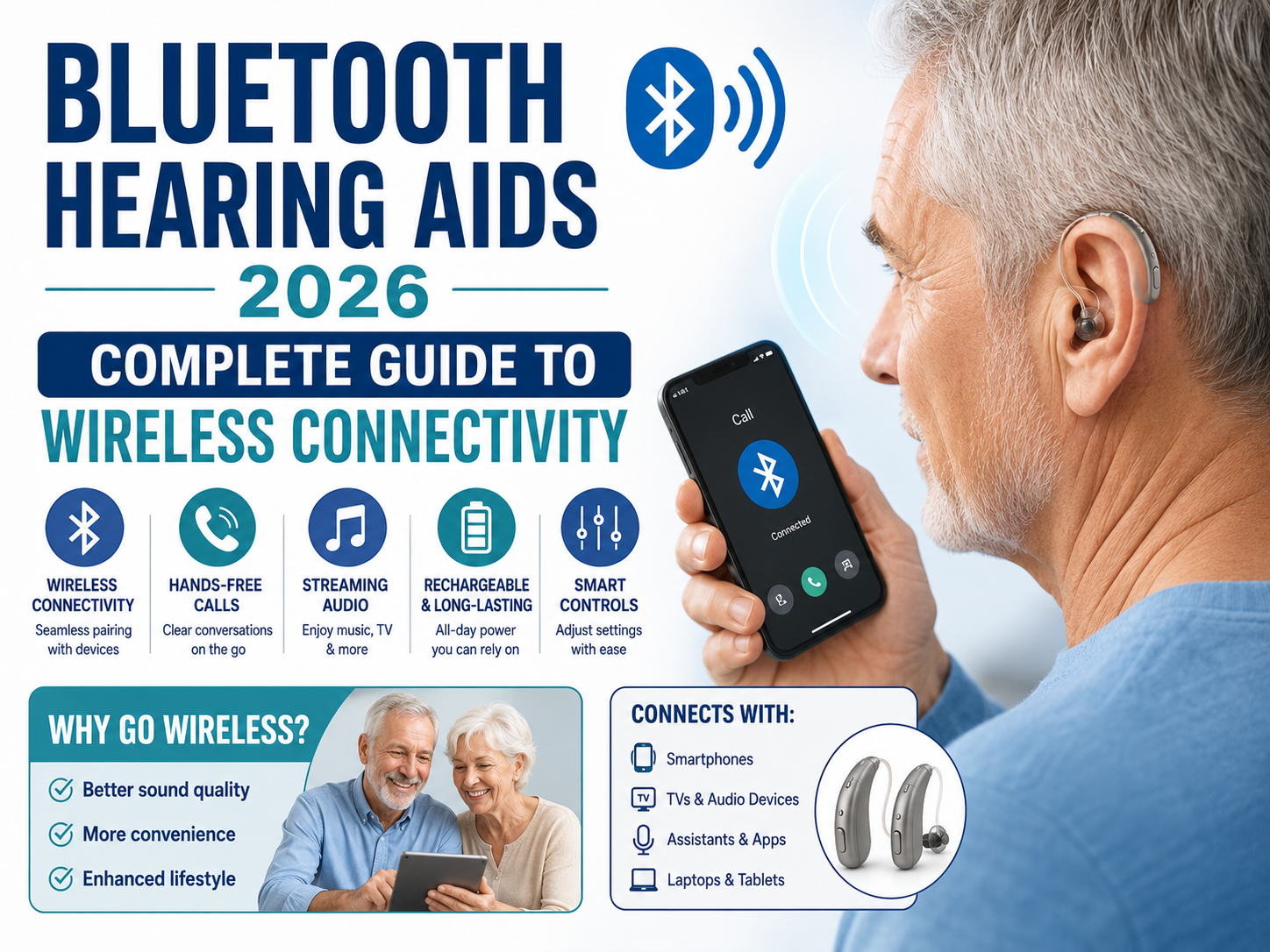
Bluetooth Hearing Aids 2026: Complete Guide to Wireless Connectivity
How Richard Stopped Missing Half of Every Conversation
Richard had worn traditional hearing aids for three years before his audiologist mentioned Bluetooth models. He was skeptical — he was 71, not a tech enthusiast, and the word "Bluetooth" called to mind a frustrating experience setting up his television remote. But when he tried a pair of Bluetooth hearing aids for a week, something changed. Calls from his daughter in Seattle came through both ears, crystal clear. The TV volume — which had been a constant source of tension with his wife — could now be set to a level comfortable for both of them, because the audio streamed directly to his ears. His phone became a remote control for his hearing aids, letting him adjust volume and settings discreetly without touching the aids themselves.
"I didn't realize how much I was missing until I stopped missing it," Richard said. His audiologist called this a common reaction — once patients experience direct streaming, the idea of going back to traditional aids feels like giving up something fundamental.
Bluetooth hearing aids represent one of the most significant advances in hearing technology of the past decade. This guide will explain what they are, how they work, who benefits most, and how to find the right model for your needs.
What Are Bluetooth Hearing Aids?
Bluetooth hearing aids are hearing aids that include a wireless radio chip enabling them to communicate directly with smartphones, tablets, computers, televisions, and other compatible devices. Instead of picking up ambient sound through a microphone and amplifying it (what all hearing aids do), Bluetooth hearing aids also receive audio signals streamed directly from connected devices — phone calls, music, podcasts, TV audio, GPS directions — and deliver those signals directly into the ear canal.
The result is dramatically cleaner, more intelligible audio than what you would hear through a phone speaker or television, because the signal bypasses the acoustic environment entirely and goes straight to the hearing instrument.
How Bluetooth Hearing Aid Connectivity Works
Direct Bluetooth Connection
Modern hearing aids use Bluetooth Low Energy (BLE) — also called Bluetooth LE Audio or earlier, Made for iPhone / Made for Android technology — to connect directly to smartphones and other devices. Once paired (a one-time setup process), the hearing aids appear as audio output devices, just like wireless earbuds, and stream audio automatically when a call or media begins.
Most current models support simultaneous pairing with multiple devices — so you can be connected to your phone, tablet, and TV at the same time, and the hearing aids will automatically route audio from whichever device is active.
Telecoil (T-coil)
Distinct from Bluetooth, many hearing aids also include a telecoil — an electromagnetic coil that picks up signals from hearing loop systems installed in theaters, churches, airports, and other public venues. Many people benefit from having both Bluetooth and telecoil capabilities, as public loops remain common in buildings that pre-date widespread Bluetooth adoption.
Hearing Aid Companion Apps
Virtually all Bluetooth hearing aids come with a companion smartphone app that allows the user (and sometimes a caregiver or remote audiologist) to adjust volume and program settings, switch between listening programs (restaurant noise, quiet conversation, TV, outdoors), check battery level, locate lost hearing aids, and in some systems, access remote adjustment from the audiologist without an office visit. The apps have become significantly more user-friendly in recent years and are generally operable by non-tech-savvy users within a few days of practice.
Types of Bluetooth Hearing Aids
Receiver-in-Canal (RIC) / Receiver-in-the-Ear (RITE)
The most popular style, particularly for Bluetooth models. A small casing sits behind the ear and houses the processor and Bluetooth chip; a thin wire carries the signal to a receiver (speaker) that sits in the ear canal. RIC aids offer excellent sound quality, are relatively discreet, and accommodate a wide range of hearing loss degrees. The majority of premium Bluetooth hearing aids are RIC style.
Behind-the-Ear (BTE)
The traditional over-the-ear style, with all components in a casing behind the ear and sound delivered through tubing to an earmold. BTE aids are more visible than RIC models but are highly durable, easy to handle for users with limited dexterity, and can accommodate more severe hearing loss. Bluetooth versions are available in BTE style.
In-the-Ear (ITE) and In-the-Canal (ITC)
Custom-molded to fit within the outer ear or ear canal. These styles are more cosmetically discreet than BTE or RIC aids but are more challenging to include Bluetooth chips in due to size constraints. Some manufacturers now offer Bluetooth-enabled ITE models; ITC and completely-in-canal (CIC) models with Bluetooth remain limited due to space and battery constraints.
Prescription Hearing Aids vs. OTC Hearing Aids
Since 2022, the FDA has permitted over-the-counter (OTC) hearing aids to be sold directly to adults with perceived mild to moderate hearing loss without a prescription or audiologist visit. This has significantly expanded access and reduced cost. Understanding the difference is important when evaluating Bluetooth models.
Prescription Hearing Aids
Prescribed and fit by a licensed audiologist or hearing instrument specialist following a formal hearing evaluation (audiogram). The audiologist programs the aids to match the individual's specific hearing loss profile — boosting specific frequencies that are deficient, not just overall volume. Premium Bluetooth features, remote fine-tuning, and sophisticated sound processing algorithms are most common in prescription models. Cost: $3,000–$8,000+ per pair, though this often includes audiological services, follow-up adjustments, and warranty.
OTC Hearing Aids
Self-fit devices sold directly to consumers without a prescription. The user sets up and adjusts the aids via an app using a self-guided hearing screening or manual preference-based adjustment. OTC aids are appropriate for adults with perceived mild to moderate hearing loss who want to try hearing amplification without the cost and time investment of a full audiological evaluation. Many OTC models now include strong Bluetooth features — streaming, app control, and rechargeable batteries. Cost: $200–$1,500 per pair.
Important: OTC aids are not appropriate for children, for adults with sudden hearing loss, or for those with significant or severe hearing loss. If you have not had a hearing evaluation in the past two years, having a baseline audiogram is worthwhile before committing to either category.
Key Features to Evaluate
Battery Type: Rechargeable vs. Disposable
Rechargeable hearing aids use lithium-ion or silver-zinc batteries that are charged overnight in a case, similar to wireless earbuds. They eliminate the need to handle tiny disposable batteries — a significant advantage for users with arthritis, reduced finger dexterity, or poor near vision. Most charge to a full day's use (16–20 hours) overnight. Disposable battery models use size 10, 312, 13, or 675 hearing aid batteries that last 3–14 days depending on size and usage. Disposable batteries offer a backup option if the charger is unavailable, which some users find reassuring for travel. For most seniors, rechargeable is the preferred choice.
Streaming Range
Bluetooth hearing aids typically maintain reliable streaming within 30–50 feet of the connected device in clear line-of-sight conditions. Walls and interference reduce effective range. Verify that the intended use case — streaming from a TV across the room, walking around the house while on a call — falls within the device's reliable range.
Sound Quality and Processing
The quality of Bluetooth streaming is only as good as the underlying hearing aid processing. Look for features including directional microphone systems (for understanding speech in noisy environments), noise reduction algorithms, wind noise management (important for outdoor use), and feedback cancellation. Premium prescription models generally outperform OTC models in processing sophistication, especially in challenging acoustic environments.
Battery Life During Streaming
Bluetooth streaming consumes more power than standard microphone use. Check the manufacturer's rated battery life under streaming conditions (not just ambient use), which may be 2–4 hours shorter than the headline figure. Most all-day rechargeable batteries handle typical mixed-use days; heavy streamers should confirm that rated streaming life meets their needs.
Ease of Controls
Evaluate how adjustments are made both via the app and on the hearing aid itself. For users who prefer not to rely on a phone for every adjustment, hearing aids with accessible physical buttons or rocker switches on the device are important. Some newer models also allow control via discreet head gestures or automatic program switching based on acoustic environment detection.
IP Rating (Water and Dust Resistance)
Hearing aids are exposed to sweat, humidity, and occasional splashes. Look for an IP (Ingress Protection) rating of at least IP68 (dustproof and submersible to 1 meter for 30 minutes). Most premium models now meet this standard; budget OTC models may have lower protection.
Bluetooth Hearing Aids and Specific Use Cases
Phone Calls
Direct-stream Bluetooth hearing aids deliver phone call audio to both ears simultaneously — dramatically improving speech intelligibility over listening through one ear or via a phone held to the ear. The microphones in the hearing aids also pick up the user's voice, allowing hands-free calling without holding the phone.
Watching Television
Many users cite TV as the most impactful use of Bluetooth streaming. Most TV manufacturers support audio output via Bluetooth, or a small Bluetooth transmitter can be plugged into any TV's audio output. The user receives TV audio at the volume appropriate for their hearing loss while family members watch at a comfortable shared volume. This is often a significant quality-of-life improvement for household dynamics.
Video Calls
Video calls (FaceTime, Zoom, Google Meet) stream directly to Bluetooth hearing aids just as phone calls do, allowing clearer communication with family members, healthcare providers, and colleagues. The combination of lip-reading cues on screen plus direct audio streaming often produces excellent comprehension even for users who struggle with phone audio.
Assistive Listening in Public
Some premium hearing aids can connect to remote microphones — small devices placed near a speaker at a lecture, across a table at a restaurant, or on a podium at a meeting — to stream that specific speaker's voice directly. This is one of the most powerful and underutilized features of premium hearing aid systems.
Addressing Common Concerns
"I'm not tech-savvy enough for Bluetooth hearing aids."
The initial setup requires pairing the aids to your phone, which typically involves following simple on-screen prompts and takes about 5 minutes. After that, streaming happens automatically. Many users who were initially apprehensive become comfortable within a week. Most audiologists and hearing aid retailers walk patients through setup and provide support.
"Will Bluetooth drain the battery faster?"
Yes, Bluetooth streaming does consume additional power. In practice, modern rechargeable Bluetooth hearing aids are engineered to handle a full day of mixed use (including several hours of streaming) on a single overnight charge. Users who stream extensively all day may want to check mid-day charge levels in the first week to establish their personal usage patterns.
"What if I don't have a smartphone?"
While a smartphone enhances the Bluetooth hearing aid experience significantly, it is not required. Bluetooth hearing aids function as standard hearing aids without a connected phone. Some manufacturers also offer a dedicated remote control device (a small handheld unit) for users who prefer not to use a smartphone for adjustments.
Complementary Hearing Health Products
Bluetooth hearing aids work best alongside good hearing maintenance practices. Consider:
- Hearing aid cleaning kits — daily cleaning with a soft brush and wax loop prevents microphone blockages that reduce performance
- Hearing aid dehumidifiers — nightly UV/electronic dehumidifying cases extend hearing aid lifespan by reducing moisture damage
- Ear wax removal tools — excess cerumen (ear wax) is one of the most common causes of reduced hearing aid effectiveness; maintaining ear hygiene is important
- Hearing aid batteries (for non-rechargeable models) — stock a supply at home and in travel bags to avoid running out at inconvenient moments
Browse our Hearing Care collection at AllCare Store for hearing maintenance supplies and accessories. For broader personal care needs, explore our Personal Care collection.
AllCare Store: Supporting Better Hearing and Independence
At AllCare Store, we stock a range of hearing health and personal care products to support adults through every stage of life. Whether you're exploring hearing health for the first time or supporting a loved one, we're here to help.
- Free Shipping on every order — no minimum required
- Discreet Packaging — all orders arrive in plain, unmarked packaging
- 30-Day Returns — shop with confidence
- Expert Help — reach our team at 1-888-889-6260
Visit our Hearing Care section or browse all our products at AllCare Store — trusted by thousands of families for home health and wellness needs.
Frequently Asked Questions: Bluetooth Hearing Aids
Can Bluetooth hearing aids connect to any smartphone?
Most modern Bluetooth hearing aids are compatible with both iOS (iPhone) and Android smartphones. Older "Made for iPhone" (MFi) hearing aids connected only to iPhones; current models using Bluetooth LE Audio or ASHA (Audio Streaming for Hearing Aids) protocols work with recent Android devices as well. Check the manufacturer's compatibility list for your specific phone model before purchasing.
Do I need a prescription for Bluetooth hearing aids?
No — since the FDA's 2022 rule, over-the-counter hearing aids including many Bluetooth models can be purchased directly without a prescription by adults with perceived mild to moderate hearing loss. Prescription hearing aids, which require a hearing evaluation and professional fitting, offer more precise programming and are better suited for moderate-to-severe or complex hearing loss. Both categories now include strong Bluetooth options.
How long do Bluetooth hearing aid batteries last?
Rechargeable Bluetooth hearing aids typically provide 16–24 hours of use on a full overnight charge, with approximately 4–6 hours of direct Bluetooth streaming included in that time. Disposable battery models last 3–14 days depending on battery size and usage, with Bluetooth streaming consuming somewhat more power than ambient use. For most users, rechargeable models provide all-day use without mid-day charging.
Are Bluetooth hearing aids better than traditional ones?
Bluetooth hearing aids offer significant advantages in connectivity, app-based control, and direct audio streaming. For users who regularly make phone calls, watch TV, or participate in video calls, the clarity advantage of direct streaming over traditional acoustic hearing is substantial. The core hearing function — amplifying ambient sound — is comparable in quality to traditional hearing aids at the same price tier. The question is whether the connectivity features justify any additional cost, which for most modern adults with hearing loss, they do.
What is the difference between OTC and prescription Bluetooth hearing aids?
OTC Bluetooth hearing aids are self-fit by the user using an app and are appropriate for adults with perceived mild to moderate hearing loss. They cost $200–$1,500 and are available without seeing a professional. Prescription Bluetooth hearing aids are programmed by an audiologist to match a specific hearing loss profile measured by audiogram; they offer more precise amplification, more sophisticated sound processing, and audiologist support. They cost $3,000–$8,000+ per pair. For mild-moderate loss, OTC models are a reasonable starting point; for significant, severe, or complex loss, professional evaluation and prescription fitting is strongly recommended.




