Medical Disclaimer: Hair loss can have many causes, some of which require medical evaluation and treatment. This article is for educational purposes only. If you are experiencing significant or sudden hair loss, consult a dermatologist or your primary care physician before beginning any treatment. Some hair loss is reversible when the underlying cause is identified and treated.
More Common Than Most People Realize
Margaret had noticed it gradually over the past two years — the hairbrush collecting more than usual, the part looking a little wider in the mirror, the ponytail that used to be thick now fitting a child-sized elastic. She mentioned it to her doctor almost as an afterthought at a routine appointment. "It's probably just age," she said. Her doctor paused. "That's worth looking into properly," he told her. "Age is part of it, but there are often contributing factors that are very treatable."
Hair loss in older adults is extraordinarily common and consistently underreported. More than half of women over age 80 experience female pattern hair loss. The vast majority of men over 80 have significant androgenetic alopecia. Yet most seniors assume hair thinning is simply an inevitable part of getting old and never seek evaluation or treatment. In many cases, that assumption leaves treatable causes unaddressed and manageable conditions unmanaged.
How Hair Changes With Age
Understanding age-related hair changes requires a brief look at how hair grows. Each hair follicle goes through a growth cycle consisting of an active growth phase (anagen, lasting 2–6 years), a transitional phase (catagen, lasting a few weeks), a resting phase (telogen, lasting a few months), and a shedding phase (exogen). It then restarts. At any given time, roughly 85–90% of your hair is in the anagen phase.
As we age, several changes occur: the anagen phase shortens, meaning each hair grows for less time and thus reaches a shorter final length. Follicles gradually miniaturize — they produce progressively thinner, finer hairs over successive cycles. The rate of follicle cycling slows. Melanocytes (pigment-producing cells) within follicles lose function, producing the gray and white hair we associate with aging. And some follicles cease producing hair altogether.
These changes are partly genetic, partly hormonal, and partly the cumulative result of decades of nutritional status, health history, and environmental exposure. The good news is that many of the accelerating factors — beyond baseline genetics — are addressable.
Causes of Hair Loss in Seniors
Androgenetic Alopecia (Pattern Hair Loss)
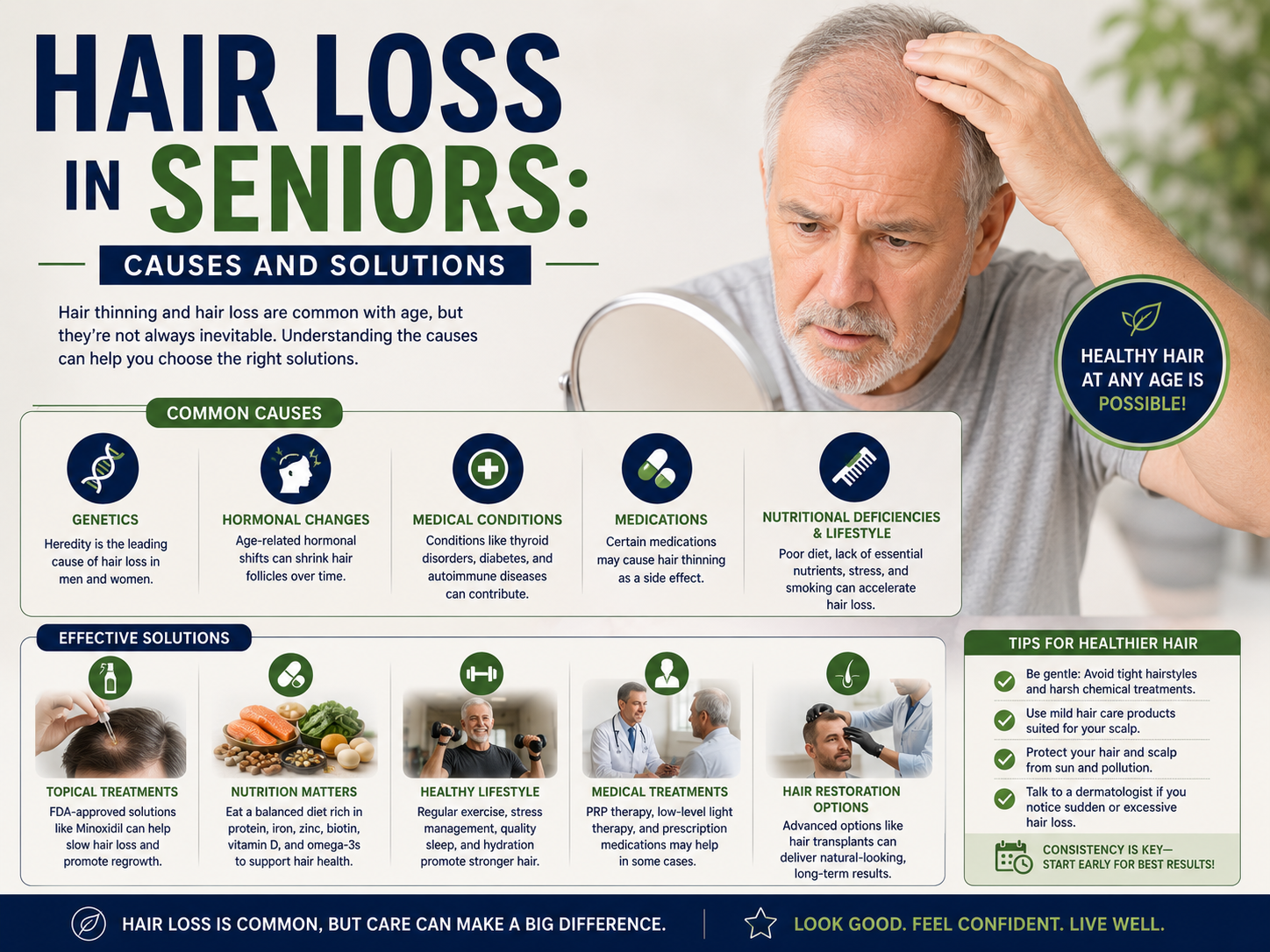
The most common cause of hair loss in both older men and women, androgenetic alopecia is driven by genetic sensitivity of hair follicles to dihydrotestosterone (DHT), a metabolite of testosterone. In men, this typically presents as a receding hairline and crown thinning following the Hamilton-Norwood scale. In women, pattern loss is more diffuse — a widening part and overall thinning across the crown rather than a receding hairline, following the Ludwig scale.
Despite the word "androgenetic," female pattern hair loss is not caused by elevated androgens in most women — it is caused by follicle sensitivity to normal levels of DHT, which increases after menopause as estrogen's protective influence on follicles declines. This is why female pattern hair loss accelerates significantly after menopause.
Hormonal Changes
The hormonal shifts of aging have direct effects on hair health. Declining estrogen after menopause removes a protective factor that had been supporting follicle health throughout reproductive years. Declining testosterone in men (though it paradoxically accelerates DHT-driven follicle miniaturization at the scalp). Thyroid dysfunction — both hypothyroidism and hyperthyroidism — is a well-established cause of diffuse hair shedding and is more common in older adults. Thyroid-related hair loss is often reversible once thyroid levels are properly managed.
Nutritional Deficiencies
Several nutritional deficiencies are directly linked to hair loss and are more common in older adults due to reduced dietary variety, absorption changes, and medication interactions. Iron deficiency (even without anemia) is one of the most common reversible causes of hair loss in older women. Vitamin D deficiency is associated with hair follicle cycling disruption. Zinc deficiency affects keratin production. B12 and folate deficiencies, common in older adults particularly those on metformin or with reduced stomach acid, affect rapidly dividing cells including hair follicles. A serum ferritin level, vitamin D level, and basic nutritional panel are worth discussing with your doctor if hair loss is significant.
Medications
A wide range of commonly prescribed medications can cause or worsen hair loss (drug-induced alopecia). Blood thinners (anticoagulants including warfarin and heparin), beta-blockers, ACE inhibitors, statins, antidepressants, and certain blood pressure medications have all been associated with hair thinning. Chemotherapy agents cause well-known severe hair loss. If you started experiencing hair loss around the time a new medication was introduced, mention it to your prescribing physician — sometimes an alternative medication in the same class can reduce the effect.
Telogen Effluvium
Telogen effluvium is a pattern of diffuse hair shedding that occurs 2–3 months after a significant physical or emotional stressor — illness, surgery, a major infection, a hospitalization, significant weight loss, or bereavement. The stress triggers a larger than normal proportion of follicles to enter the telogen (resting/shedding) phase simultaneously. In older adults, hospitalizations and major health events are more common, making telogen effluvium a more frequent occurrence. The reassuring aspect: telogen effluvium is typically self-resolving once the triggering stressor resolves, though it can take 6–12 months for full regrowth.
Scalp Conditions
Seborrheic dermatitis (chronic scalp flaking and inflammation), scalp psoriasis, and lichen planopilaris (a scarring alopecia) are scalp conditions that can accelerate hair thinning in older adults. Inflammatory scalp conditions damage the follicular environment over time. These conditions are treatable — medicated shampoos, topical corticosteroids, and dermatologist-directed therapy can reduce inflammation and preserve follicle health.
Evidence-Based Solutions
Minoxidil (Topical)
Minoxidil is the most extensively studied and widely available treatment for age-related hair loss. Originally developed as an oral blood pressure medication, topical minoxidil was discovered to stimulate hair regrowth as a side effect and is now available over the counter in 2% and 5% concentrations for both men and women. It works by improving blood flow to hair follicles and extending the anagen (growth) phase. Approximately one-third of patients notice reduced shedding, and another third experience measurable regrowth within 6–12 months of consistent use.
Minoxidil requires ongoing use to maintain results — discontinuing it typically results in loss of gained regrowth within 3–6 months. It is applied once or twice daily to a dry scalp. Common side effects include scalp irritation and, rarely, unwanted facial hair growth in women (more common with the 5% formulation). An oral low-dose minoxidil option has gained popularity under dermatologist supervision, with studies showing comparable efficacy with less scalp irritation.
Finasteride (Oral, for Men)
Finasteride is an oral prescription medication for men with androgenetic alopecia. It works by blocking 5-alpha reductase, the enzyme that converts testosterone to DHT, thereby reducing DHT levels at the scalp. Studies show finasteride reduces further hair loss in approximately 83% of men and produces visible regrowth in 66%. It is generally well tolerated, though potential side effects include sexual dysfunction in a minority of users. Finasteride requires a prescription and ongoing use to maintain benefit. It is not appropriate for women of childbearing age and requires caution in elderly men — discuss with your physician.
Low-Level Laser Therapy (LLLT)
Low-level laser therapy devices — available as laser caps, combs, and helmets — use specific wavelengths of light to stimulate cellular energy production in hair follicles and improve scalp circulation. Multiple randomized controlled trials support modest efficacy in both male and female pattern hair loss. LLLT is considered safe, has no systemic side effects, and can be used alongside other treatments. Results typically require 3–6 months of consistent use (typically 3 sessions per week). It is best considered a complementary treatment rather than a standalone solution for significant loss.
Platelet-Rich Plasma (PRP) Therapy
PRP therapy involves drawing a small amount of the patient's own blood, concentrating the growth-factor-rich platelet fraction, and injecting it into the scalp at areas of thinning. The growth factors in PRP stimulate dormant follicles and improve the follicular microenvironment. Clinical studies show meaningful improvement in hair density in 70–90% of patients receiving a standard series of treatments (typically 3–4 monthly sessions, then maintenance every 4–6 months). PRP is performed in a dermatology or hair restoration clinic and is generally not covered by insurance. It is particularly useful for patients who cannot tolerate or do not respond to topical treatments.
Nutritional Support
Addressing identified deficiencies is the highest-yield nutritional intervention — correcting low ferritin or vitamin D can produce noticeable improvement in hair shedding within 3–6 months. Beyond correcting deficiencies, several supplements have supporting evidence for hair health in older adults: biotin (though benefit is mainly seen in those with actual biotin deficiency), saw palmetto (mild DHT-blocking effect), and marine protein-based supplements (including Viviscal, which has multiple published clinical trials). Discuss any supplements with your doctor, particularly if you take blood thinners, as some supplements affect clotting.
Scalp Care
A healthy scalp is the foundation of healthy follicles. Regular gentle scalp massage (5 minutes daily) has a small but documented positive effect on hair thickness, likely by improving follicular blood flow. Using a mild, sulfate-free shampoo appropriate for aging hair reduces the scalp stripping that can worsen dryness and flaking. For those with seborrheic dermatitis, zinc pyrithione or ketoconazole shampoos used 2–3 times weekly reduce the inflammatory burden on follicles.
Hair Transplant Surgery
For seniors in good health with stabilized pattern hair loss, hair transplant procedures (FUE — follicular unit excision, or FUT — follicular unit transplantation) can produce permanent, natural-looking results by relocating DHT-resistant follicles from the back of the scalp to thinning areas. Transplanted follicles are typically resistant to further miniaturization. Candidacy depends on donor hair density, overall health, and degree of existing loss. A consultation with a board-certified hair restoration surgeon is the appropriate first step for anyone considering this option.
Practical Daily Habits for Aging Hair
Beyond medical treatments, several daily habits help protect and maximize aging hair. Use a wide-tooth comb rather than a fine-tooth comb or brush on wet hair, which is fragile and prone to breakage. Minimize heat styling and chemical treatments. If you color your hair, use gentle, lower-ammonia formulations and maintain scalp health. Sleep on a satin or silk pillowcase to reduce friction-related breakage. Stay well hydrated — dehydration concentrates resources away from non-essential functions like hair growth. And manage stress actively, as chronic stress elevates cortisol, which disrupts the hair growth cycle over time.
AllCare Store: Personal Care Essentials for Every Stage of Life
At AllCare Store, we carry personal care products designed for the specific needs of aging skin, hair, and body.
Browse our Personal Care collection for scalp care, hair care, and grooming essentials suited for seniors and their caregivers.
- Free Shipping on every order — no minimums
- Discreet Packaging — plain, unmarked boxes on every shipment
- 30-Day Returns — full confidence guarantee
- Expert Support — call us at 1-888-889-6260
Frequently Asked Questions: Hair Loss in Seniors
Is hair loss in seniors reversible?
It depends on the cause. Hair loss from nutritional deficiencies, thyroid dysfunction, medication side effects, or telogen effluvium is often largely reversible once the underlying cause is treated. Genetic pattern hair loss (androgenetic alopecia) is not reversible but can be slowed and partially reversed with treatments like minoxidil and finasteride (in men). Getting a proper evaluation from a dermatologist is the most important first step — many seniors assume all their hair loss is genetic when there are treatable contributing factors present.
Does minoxidil work for older adults?
Yes, minoxidil can work at any age. Clinical studies include older adult populations and show meaningful benefit in reducing shedding and stimulating regrowth. As with all ages, results vary — roughly one-third of users see significant improvement and another third see stabilization. Minoxidil must be used consistently and continuously to maintain benefits. Older adults should start with the lower 2% concentration to assess scalp tolerance before moving to 5%.
What blood tests should I ask for if I'm losing hair?
A reasonable panel to discuss with your doctor includes: serum ferritin (iron stores — a level below 40 ng/mL is associated with hair shedding even without anemia), thyroid-stimulating hormone (TSH) and free T4, vitamin D (25-OH), vitamin B12, zinc, and a complete blood count. In women, hormonal testing (estradiol, FSH, DHEAS, free and total testosterone) may also be warranted. These tests are generally inexpensive and can identify reversible contributors to hair loss that would otherwise be missed.
Are hair vitamins and supplements worth taking for seniors?
Supplements are most valuable when they correct an actual deficiency. If your ferritin, vitamin D, B12, or zinc is low, addressing those deficiencies will help hair. General "hair supplement" products with biotin have limited evidence of benefit in people without biotin deficiency. Marine protein-based supplements (such as Viviscal) have more clinical trial data than most supplement products and show modest benefit in reducing shedding and improving thickness. Always check with your doctor before adding supplements, especially if you take blood thinners or other medications.
When should I see a dermatologist about hair loss?
See a dermatologist if your hair loss is sudden rather than gradual, if you notice patchy bald spots rather than diffuse thinning, if your scalp is inflamed, itchy, or scaly, if you are losing hair in other areas of the body (eyebrows, eyelashes), or if over-the-counter treatments have not helped after 6 months of consistent use. A dermatologist can perform a scalp examination, dermoscopy, and targeted blood work to identify the specific type and cause of your hair loss before recommending treatment.