Buying a walker for a child is a different job from buying one for an adult, and not only because the frame is smaller. Children grow, they spend their days in places adults do not, and they have opinions about how their equipment looks. All three of those things change what you should be looking for.
There is also a labelling quirk worth clearing up before you shop, because it trips up a lot of parents.
First, a Word About the Word "Junior"
In mobility equipment, "junior" and "youth" are not interchangeable, and "junior" does not always mean "for children".
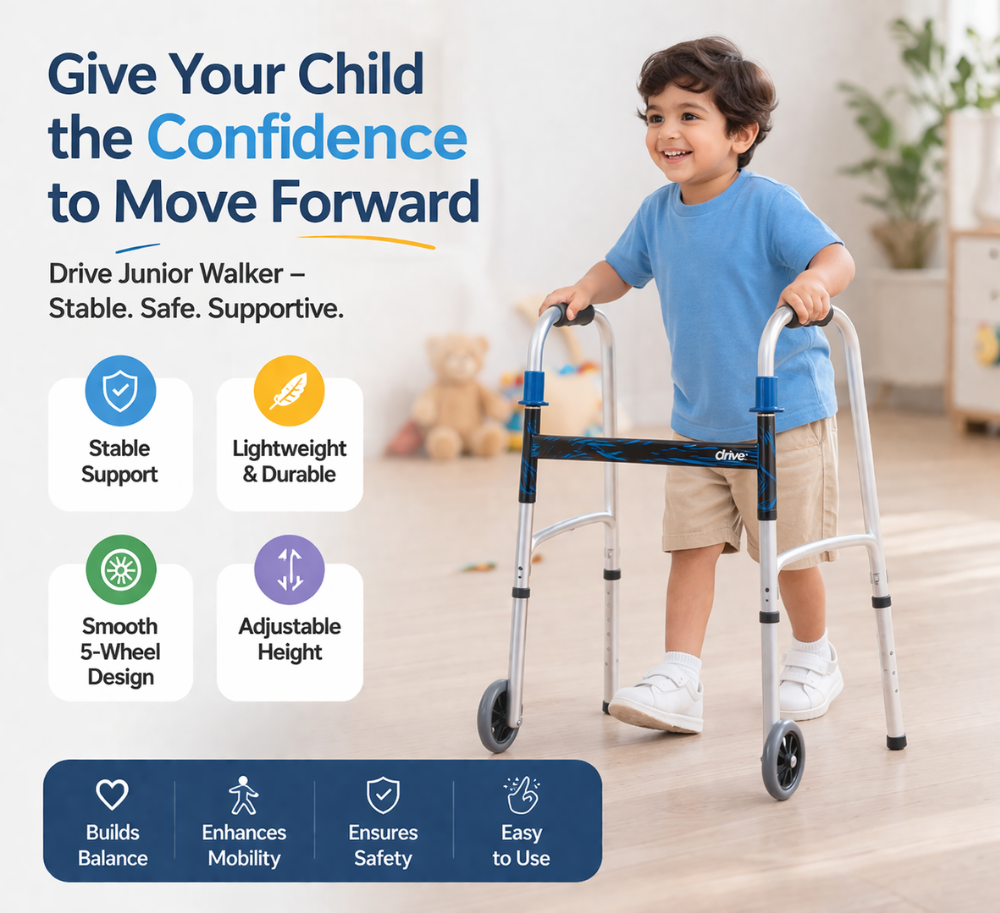
Manufacturers frequently use "junior" to describe a frame sized for a shorter adult, often someone under roughly five feet tall. A junior rollator, for instance, is usually a petite adult product: the handle height range and the seat are scaled down, but the weight capacity and the overall build are adult-grade. "Youth" or "paediatric" is the label more reliably applied to equipment intended for children.
What this means in practice:
- Do not assume a product called "junior" was designed with a child in mind
- Read the actual handle height range in inches rather than trusting the label
- Check the stated user height and weight range, and whether a minimum weight is given
- If you are shopping for a petite adult rather than a child, a junior-sized adult frame may be exactly right
Measure the child, then match the numbers. The word on the box is the least reliable part of the listing.
Growth Is the Central Design Problem
An adult buys a walker and adjusts the height once. A child outgrows the setting, sometimes within months during a growth spurt. This is the single biggest difference in how you should evaluate a paediatric walker.
What to look for
- A generous height range, not just a low starting point. A frame that starts low but only rises a few inches will be outgrown quickly. Look at the top of the range as carefully as the bottom.
- Where the child sits in the range today. Buying a frame the child is already near the top of is buying a short-term solution.
- Easy, tool-free adjustment. If changing the height means finding an Allen key, it will not get done as often as it should.
- Clear, readable height markings. This makes it far easier to keep both handles even, and uneven handles push a child into a crooked posture.
- Whether accessories carry over. Forearm platforms, grips and wheels that fit the next size up save money later.
Build a habit of rechecking the height every few months, and after any noticeable growth spurt or change in shoes. A walker set for a child who was two inches shorter is not a minor issue; it is an unsafe walker.
Get the Fit Assessed, and Reassessed
This matters more for children than for anyone else, and it deserves plain language: a wrongly sized walker increases fall risk. Ask a paediatric physiotherapist or occupational therapist to assess the fit and watch the child walk with it, then to review that fit as the child grows.
A therapist is checking things a parent reasonably cannot: whether the child's posture is improving or being distorted, whether they are leaning to one side, whether the amount of support is helping them develop a walking pattern or letting them avoid one, and whether a forearm platform or a different frame style would serve better. Many children's therapy plans use the walker as a tool towards a goal, not a permanent fixture, and the therapist is the one tracking that.
If you are new to fitting equipment generally, our guide on fitting and adjusting a walker correctly explains handle height, grip and posture principles that apply at any age.
School, Playground and the Places Children Actually Go
Adult walkers get evaluated on kitchens, pavements and car boots. A child's walker has to work in environments no adult product brochure mentions.
School
- Corridors between lessons are crowded and fast-moving, which is a genuine consideration for frame width and manoeuvrability
- There needs to be somewhere to park it in a classroom without it becoming a trip hazard for others
- Someone at school should know how to check and adjust it, so talk to staff early
- Consider whether a second frame that stays at school is practical, so nothing is forgotten at home
- Fire evacuation routes and procedures should account for the child and the equipment
Play
- Playground surfaces are often bark chip, rubber matting or grass, and small hard wheels struggle on all three
- Larger wheels cope far better outdoors, at the cost of a slightly bulkier frame
- Children run, stop suddenly and change direction, so brake reliability and frame stability get tested harder than an adult would test them
- Being able to get in and out of the frame quickly matters, because children want to sit on the floor with friends
Transport
- Does it fold small enough for the school run, and can one adult manage it while also managing a child?
- If a school bus or taxi is involved, ask early about how the equipment travels
Involving the Child in the Choice
This is not a nicety. A child who feels the walker was chosen for them, rather than issued to them, uses it more willingly. Willing use is what produces the benefit.
Practical ways to do it:
- Let the child pick the colour where a choice exists, even if the choice is between two shades you find equally unremarkable
- Let them try more than one frame and say which feels better, and take that answer seriously
- Let them decorate it if they want to, within anything the therapist says about weight and moving parts
- Explain what it is for in terms that matter to them, such as getting to the playground with everyone else, rather than in clinical terms
- Give them a job in the routine, such as checking the wheels or setting it by the door
Expect some resistance and some self-consciousness, particularly around ages when fitting in with peers matters enormously. That is normal and it usually passes. The emotional side of starting to use a mobility aid is written with adults in mind but much of it applies to older children and teenagers too.
Everyday Safety Checks Worth Building Into the Routine
- Check the rubber tips and wheels for wear every few weeks, since children wear them out faster than adults do
- Make sure both height pins are engaged and both sides are set to the same number
- Check that folding mechanisms lock fully open before each use
- Watch for the frame being outgrown, with the sign being a child who starts stooping or reaching up
- Keep spare tips and wheels at home rather than waiting for a failure
Replacement wheels, glides and walker parts are inexpensive, and worn ones are a real cause of slips.
When a Walker Is Not the Right Tool
Sometimes a walking frame is not the answer, or not the only answer. A child may need a wheeled chair for distance and a walker for therapy and short indoor walking, which is a completely normal combination rather than a step backwards. A child with limited hand grip may need forearm platform attachments rather than standard handles. A child whose fatigue is the limiting factor may do better with a chair for the school day so they have energy left for the things they care about.
These are clinical judgements. Raise them with the therapy team rather than deciding alone. If a wheeled option is being discussed, our paediatric wheelchairs range gives an idea of what exists.
Setting Up the Home
Children's equipment has to coexist with the rest of family life, which usually means toys on floors and rugs in doorways. It is worth doing a walk-through of the routes the child uses most and clearing them properly. Our guide on setting up a home so a walker or wheelchair actually works covers doorways, thresholds, rugs and storage, and the principles are the same whatever the age of the user.
The Short Version
Ignore the word "junior" and read the measurements. Buy for the growth range rather than today's height, and recheck the setting every few months. Think about school corridors and playground surfaces, not just the living room. Involve the child in the choice, because a walker they are willing to use is worth more than a better walker they resent. And have a paediatric therapist assess and reassess the fit, because with a growing child the right setting is a moving target rather than a one-off decision.