Medical Disclaimer: This article is for educational purposes only and does not replace the guidance of a Wound, Ostomy, and Continence Nurse (WOCN) or your surgical team. Ostomy management is highly individualized. Always work with your healthcare provider when selecting supplies and addressing skin or stoma complications.
Life After Ostomy Surgery
When Margaret's doctor told her she needed a colostomy following complications from colon cancer surgery, her first thought was that her life was over — no more travel, no more swimming, no more social life. A year later, she had crossed off three destinations from her bucket list, had swum at a resort pool in Florida, and was leading a support group for newly diagnosed ostomates at her local hospital. "The hardest part was those first four weeks," she said. "Once I found the right pouch system and figured out my routine, I realized I could do everything I used to do. You just learn a new normal."
An ostomy is a surgically created opening (stoma) in the abdomen that allows waste to exit the body when the normal route cannot be used. Approximately 750,000 Americans are living with an ostomy, with 100,000+ new ostomy surgeries performed each year. The three main types are colostomy (large intestine), ileostomy (small intestine), and urostomy (urinary diversion). Each has specific supply requirements and management considerations.
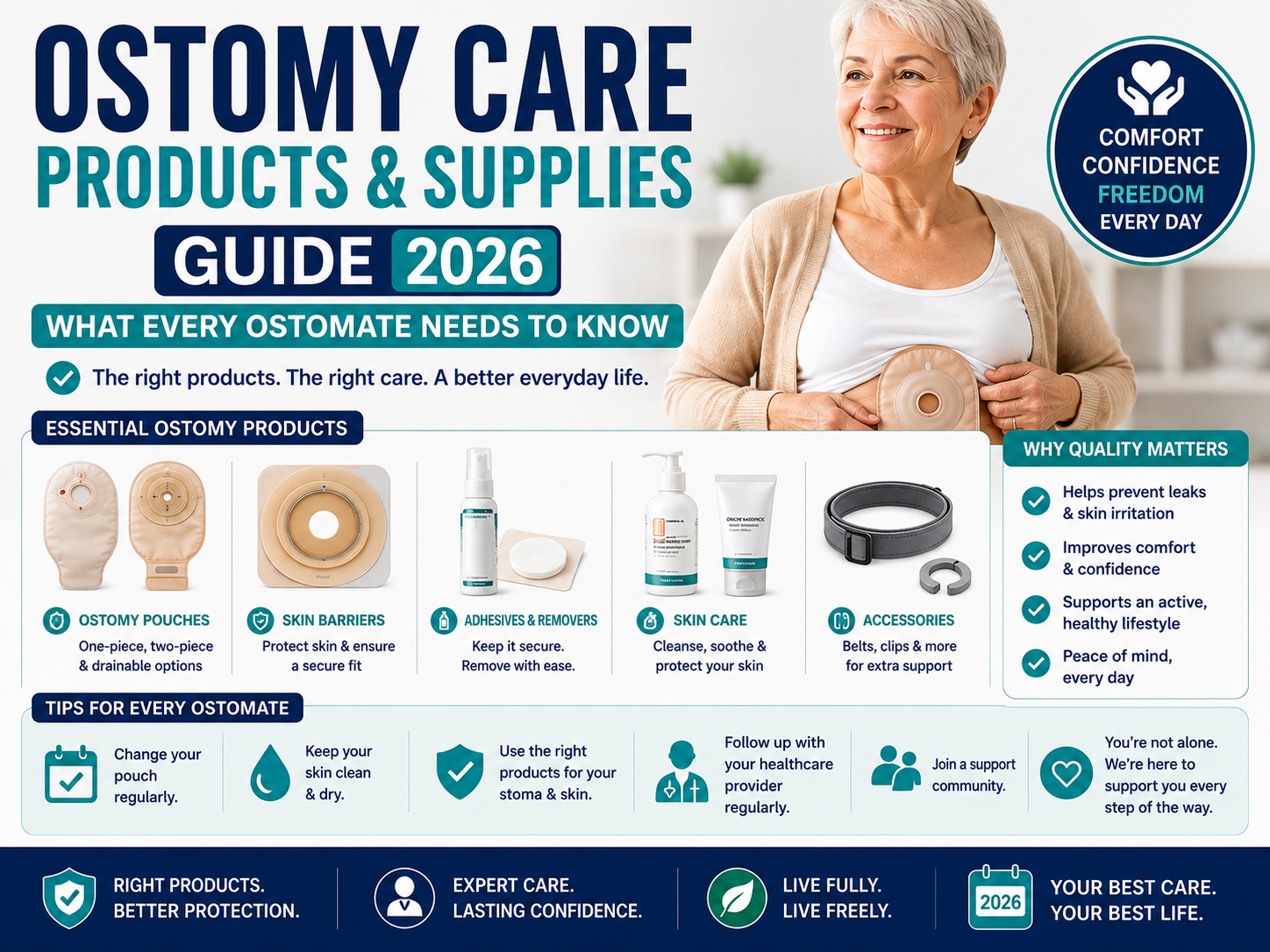
The quality of life for ostomates has improved dramatically over the past two decades, driven by advances in pouch systems, skin barrier technology, and a growing range of accessories designed around active modern lifestyles. This guide provides a foundation for understanding the products available and how to navigate ostomy care at home.
Understanding the Three Main Ostomy Types
Colostomy
A colostomy diverts part of the large colon to the abdominal surface. Output consistency varies by location: a sigmoid colostomy (end of colon) produces formed stool once or twice daily; a transverse colostomy produces softer, more frequent output. Many people with sigmoid colostomies use colostomy irrigation — a technique that allows them to control output timing and go 24–48 hours without wearing a pouch or with just a small stoma cap.
Ileostomy
An ileostomy diverts the small intestine and typically produces liquid to semi-liquid output continuously throughout the day, as digested food passes before the colon absorbs water from it. This continuous output requires a drainable pouch that is emptied (rather than replaced) multiple times daily. High ileostomy output can cause dehydration and electrolyte imbalances; diet and fluid management are important for ileostomates.
Urostomy (Ileal Conduit)
A urostomy diverts urine from the kidneys after bladder removal. The most common type (ileal conduit) uses a short segment of intestine as a conduit from the ureters to the stoma. Urostomy pouches include a one-way anti-reflux valve to prevent backflow of urine to the stoma, and a drainage tap at the bottom for frequent emptying. At night, most urostomates connect a bedside drainage bag via a long tube to allow passive overnight drainage.
The Two Main Pouch System Types
One-Piece System
In a one-piece system, the skin barrier (wafer) and the pouch are permanently attached as a single unit. The entire system is replaced as one piece — typically every 2–4 days for most users.
Advantages: Lower profile, more flexible, fewer components, easier to apply (one step), and generally more comfortable for many users. Some find the flexibility of a one-piece more discreet under clothing.
Disadvantages: Every time the pouch is changed, the barrier must also be changed, which means more barrier changes than a two-piece system. This increases skin exposure to barrier removal over time.
Best for: New ostomates learning the process, those with a very flat abdominal surface, and people who prioritize simplicity and low profile.
Two-Piece System
In a two-piece system, the skin barrier (wafer) and the pouch are separate components. The barrier adheres to the skin around the stoma, and the pouch snaps or attaches to the barrier's flange. The pouch can be changed independently without removing the barrier.
Advantages: The barrier can remain in place for 3–7 days while the pouch is changed daily or as needed. This reduces the number of times the peristomal skin is exposed to adhesive application and removal — protecting skin integrity. Allows switching between a closed-end pouch (for formed stool) and a drainable pouch (for liquid output) using the same barrier.
Disadvantages: Slightly bulkier due to the locking flange ring, which some users find uncomfortable or more visible under clothing. More components to manage.
Best for: Experienced ostomates, those with sensitive or fragile peristomal skin, and situations where minimizing total barrier changes is important.
Closed-End vs. Drainable Pouches
Closed-end pouches are sealed at the bottom and are disposed of when full. They are most appropriate for colostomy users with predictable, formed output — typically 1–2 pouching changes per day. Many colostomy irrigators use closed-end pouches or stoma caps between irrigation sessions.
Drainable pouches have an opening at the bottom sealed by a clip, Velcro closure, or integrated roll-up cuff. They are designed to be emptied multiple times daily and changed every 2–3 days. Standard for ileostomy and many colostomy users with softer or less predictable output.
Urostomy pouches are always drainable, with a tap valve for frequent emptying and a night drainage port for overnight bag connection.
Skin Barriers (Wafers): The Most Important Component
The skin barrier — also called a wafer or baseplate — is arguably the most critical component of the entire pouching system. It adheres to the peristomal skin and protects it from effluent contact. Skin barrier failure causes peristomal skin complications (PSC), which affect up to 80% of ostomates at some point and are the leading cause of emergency ostomy visits.
Flat vs. Convex Barriers
Flat barriers are the standard starting point for most ostomates with a stoma that protrudes adequately above the skin surface (typically 1–2 cm).
Convex barriers have a slight outward curve that applies pressure around the stoma base, pushing the skin surface outward. They are used for flush, retracted, or inset stomas — stomas that sit at or below skin level, which create a higher risk of effluent undermining the seal. Convexity should be recommended by a WOCN; using it inappropriately can cause pressure injury to the peristomal skin.
Pre-Cut vs. Cut-to-Fit Barriers
Pre-cut barriers come with a fixed opening pre-cut to standard stoma sizes. Convenient but require the stoma to match the available sizes precisely.
Cut-to-fit barriers allow the wearer to trim the opening to match their stoma's exact size and shape using included measuring guides. Recommended for stomas that are irregular in shape or during the first 6–8 weeks post-surgery when the stoma is still shrinking to its final size.
Standard vs. Extended Wear
Standard wear barriers are designed for 2–4 day wear; extended-wear barriers include additional adhesive technology for 3–7 day wear. Extended wear barriers are appropriate for active people and those with heavy perspiration, but all barriers should be changed whenever there are signs of leakage, skin irritation, or lifting edges — regardless of scheduled change time.
Essential Ostomy Accessories
Skin Barrier Wipes and Sprays
Barrier wipes or sprays create a thin film over the peristomal skin before applying the wafer, providing an additional layer of protection against effluent and reducing adhesive trauma on sensitive skin. They are particularly important for new ostomates, those with sensitive skin, and anyone who has experienced peristomal dermatitis.
Skin Barrier Rings and Paste
Barrier rings (moldable rings or soft rings) are placed around the stoma opening before applying the wafer to fill in skin creases, folds, or irregularities around the stoma. This "caulking" action prevents effluent from tracking under the barrier along skin folds — one of the most common causes of barrier seal failure. Particularly important for people with abdominal folds, weight changes, or peristomal hernias. Barrier paste serves a similar role but in a squeezable tube format.
Adhesive Remover Wipes or Spray
Adhesive remover significantly reduces skin trauma during barrier changes. Without a remover, pulling a firmly adhered barrier can strip the top layer of epidermal cells — causing pain and skin breakdown over time. Adhesive remover is especially important for people with thin, fragile, or surgically altered peristomal skin. Silicone-based removers are gentler and cause less irritation than solvent-based versions.
Ostomy Deodorant
Internal and external deodorant products reduce odor from ostomy output. Drops placed directly in the pouch after emptying are the most effective approach for neutralizing odors at source. Breath-source deodorants (taken orally) reduce intestinal gas odor. Many ostomates use a combination.
Ostomy Belts
Elastic ostomy belts attach to loops on the pouching system and provide additional security, reducing the risk of the barrier lifting with physical activity or movement. Particularly useful for those with active lifestyles, peristomal hernias, or irregular abdominal surfaces where adhesion is more difficult. Should be snug but not tight enough to indent the skin.
Stoma Guards
Rigid or semi-rigid protective covers that fit over the stoma to protect it from impact during contact sports or physically demanding activities. Important for athletes, manual workers, and anyone engaged in activities where abdominal contact or compression is likely.
Hernia Belts and Support Garments
Peristomal hernia (herniation of abdominal contents alongside the stoma through the abdominal wall) affects up to 50% of ostomates over time. Hernia support belts and compression garments provide abdominal wall support that reduces hernia progression and discomfort. Important: these must have a pre-cut stoma opening and should be recommended by the surgical team; incorrect compression can complicate hernia management.
Skincare for the Peristomal Area
The skin around the stoma is exposed to mechanical trauma (repeated application and removal of barriers), potential chemical exposure (from effluent), and occlusion under adhesive. A focused peristomal skincare routine prevents the complications that are the biggest barrier to quality of life for ostomates.
- Clean peristomal skin with warm water only during barrier changes — soap residue can interfere with adhesive bonding
- Pat dry completely before applying a new barrier — moisture under the barrier is the leading cause of premature barrier failure
- Use adhesive remover for every barrier change to minimize skin stripping
- Apply a skin barrier wipe before the wafer to protect the skin surface
- Inspect the peristomal skin at every change for redness, erosion, or irregular skin changes
Any persistent redness, bleeding, pain, or irregular tissue growth around the stoma should be evaluated by a WOCN or the surgical team promptly. Early intervention for peristomal skin complications prevents minor issues from becoming serious problems.
AllCare Store: Supporting Your Ostomy Independence
At AllCare Store, we carry a comprehensive range of ostomy supplies and accessories from leading brands to support your daily ostomy care needs.
Browse our Ostomy collection for pouching systems, skin barriers, accessories, and more.
- Free Shipping on every order — no minimums
- Discreet Packaging — plain, unmarked boxes on every shipment
- 30-Day Returns — full confidence guarantee
- Expert Support — call us at 1-888-889-6260
Frequently Asked Questions: Ostomy Care and Supplies
How often should I change my ostomy pouch?
Change frequency depends on the pouch type and your individual output. Closed-end pouches for colostomy users are typically changed 1–2 times daily. Drainable pouches for ileostomy users are emptied 4–8 times daily but changed every 2–3 days. The skin barrier (wafer) should be changed every 3–7 days depending on your product and skin condition. Change the barrier whenever you notice leakage, lifting edges, itching under the barrier, or peristomal skin irritation — do not wait for a scheduled change day if these signs appear.
Can I swim or exercise with an ostomy?
Yes, most ostomates can swim, exercise, and engage in virtually all physical activities. Water does not damage the pouching system — modern barriers and adhesives are water-resistant. For swimming, an ostomy belt provides additional security against the barrier lifting in water. For contact sports, a stoma guard protects the stoma from impact. Empty your pouch before physical activity, and be aware that exercise can increase ileostomy output — stay well hydrated.
What should I do if my ostomy barrier keeps leaking?
Frequent barrier leakage is the most common ostomy problem and almost always has a solvable cause. Common causes include the barrier opening being cut too large (leaving peristomal skin exposed to effluent), skin folds or creases around the stoma allowing effluent to track under the barrier, a flush or retracted stoma requiring convexity, or peristomal skin inflammation preventing proper adhesion. Start by measuring your stoma carefully and ensuring the barrier opening is no more than 1/8" larger than the stoma. If leakage continues, consult a WOCN who can assess your stoma and peristomal anatomy and recommend the right products.
How do I manage ostomy odor?
Modern pouching systems are odor-proof when properly sealed — odor should only be noticeable during emptying or changing. To manage odor during emptying: use in-pouch deodorant drops placed in the pouch after each empty, and use a room spray during bathroom changes. Dietary factors affect output odor significantly — foods known to increase ostomy odor include onions, garlic, eggs, fish, broccoli, cabbage, and asparagus. Foods that may reduce odor include yogurt, buttermilk, and cranberry juice. Chlorophyll-containing supplements (available over the counter) can reduce internal gas and output odor for some ostomates.
Will insurance cover my ostomy supplies?
Medicare Part B covers ostomy supplies as Durable Medical Equipment (DME) — typically up to a defined monthly quantity allowance with 80% coverage after the Part B deductible. Most Medicaid programs cover ostomy supplies. Private health insurance coverage varies; most plans with DME benefits include ostomy supplies. To obtain coverage, you generally need a prescription (written order) from your surgeon or physician specifying the ostomy type, product types, and quantity needed. Your WOCN or surgical team can assist with documentation. Coverage is typically provided through a DME supplier; mail-order DME suppliers often provide the widest product selection with insurance billing.