Safety Note: Improper patient transfers are a leading cause of both caregiver back injuries and patient falls. This guide provides educational information. For complex transfer needs, consult a physical or occupational therapist before purchasing equipment — many insurers will cover an OT home evaluation that includes transfer training.
Susan had been caring for her father, George, at home for eight months after his hip fracture. Every morning she helped him from the bed to the wheelchair. Every evening she reversed the process. George weighed 210 pounds; Susan weighed 135. She had been told by the discharge nurse to "use good body mechanics" — bend the knees, keep the back straight — but no one had told her about the equipment that would make those transfers not just safer but genuinely manageable.
Three months in, Susan had a herniated disc. George went to a rehabilitation facility for six weeks — not because of his hip, but because his caregiver was injured. The right transfer equipment, used properly, might have prevented all of it.
This guide covers every category of patient transfer aid available in 2026 so caregivers can make informed choices before injuries happen.
Browse our Mobility Aids collection at AllCare Store.
Why Transfer Equipment Matters
Manual patient transfers — moving a person from bed to wheelchair, wheelchair to toilet, or any combination — are the single most common source of musculoskeletal injury among home caregivers. Studies consistently find that even with perfect technique, moving a person weighing more than 35 pounds without assistive equipment creates meaningful injury risk for the caregiver. For the person being transferred, improper technique or instability increases fall and injury risk at the moment of highest vulnerability.
The good news: the range of available transfer aids has expanded enormously. The right equipment, matched to the person's ability and the caregiver's situation, can make transfers safe for both parties at almost any level of mobility.
Category 1: Transfer Belts and Gait Belts
A transfer belt (also called a gait belt) is the most fundamental transfer aid. It's a sturdy webbing belt fastened around the patient's waist, giving the caregiver a secure grip to guide and support during standing, pivoting, walking, and sit-to-stand transfers.
Standard Gait Belt
A standard gait belt is 1.5–2 inches wide, made of cotton or nylon webbing, with a quick-release buckle. It fastens snugly around the patient's waist (you should be able to fit two fingers under it — not more, not less). Correct grip is an underhand hold on the belt, not the patient's clothing or arms.
Best for: Patients who can bear at least partial weight, need minimal to moderate assistance with standing and walking, and have adequate trunk stability. Cost: $10–$30.
Padded Transfer Belt
Padded belts add foam or gel padding for comfort during longer gait training sessions or for patients with low pain tolerance or sensitive skin around the waist.
Transfer Belt with Handles
Belts with multiple integrated handles (typically 4–6 handles positioned around the circumference) give the caregiver multiple grip positions and allow two-caregiver lifts from stable, defined points. These are strongly preferred for larger patients or transfers requiring two people.
Leg Loop Transfer Belt
Leg loop belts add loops that go under the thighs, giving the caregiver leverage to assist with leg movement when transitioning from supine to sitting or during car transfers. Particularly useful for patients with lower extremity weakness or paralysis.
Category 2: Transfer Boards (Slide Boards)
A transfer board is a smooth, rigid or semi-rigid board that bridges the gap between two surfaces — bed to wheelchair, wheelchair to car seat, wheelchair to toilet — allowing the person to slide across with minimal lifting.
Standard Wooden Slide Board
Solid maple or hardwood boards are durable and inexpensive. The smooth finish allows sliding with minimal friction. Best for patients with good upper body strength who can do much of the transfer work themselves. Typical dimensions: 8" × 24"–28". Cost: $20–$60.
Padded or Plastic Transfer Boards
Plastic boards with a low-friction surface are lighter than wood and more hygienic (wipe-clean). Some feature a cutout notch that fits around wheelchair armrests. Padded versions improve comfort for patients with skin sensitivity or pressure sores.
Curved Transfer Boards
A curved (banana-shaped) transfer board accommodates the arc of a sliding transfer, especially useful for wheelchair-to-car or wheelchair-to-tub bench transfers where the angle isn't straight.
Transfer Board with Attached Rotating Disc
Some boards integrate a rotating seat disc (see below) to combine surface bridging with pivot assistance in one device.
Important: Transfer boards require the patient to have adequate sitting balance and at least minimal upper extremity function. They are not appropriate for patients who cannot maintain sitting position independently.
Category 3: Pivot and Rotating Discs (Turntables)
A pivot disc (also called a transfer disc, turning disc, or lazy Susan) is a low-profile rotating platform placed under the patient's feet. When the patient stands or weight-shifts, the disc rotates smoothly, reducing the need to lift or pivot the feet — the disc turns for them.
Pivot discs are particularly valuable for patients who can bear weight but have difficulty with the foot pivot component of a transfer — common in Parkinson's disease, hip fracture recovery, and leg weakness from stroke. They reduce twisting stress on healing joints and make it possible for one caregiver to manage a safe transfer without a full stand-pivot-sit sequence. Cost: $20–$60.
Look for a model with a non-slip top surface (for the patient's feet) and a non-slip bottom (so the disc doesn't slide on the floor).
Category 4: Stand Assist and Lift Handles
Bed Handles and Safety Rails
Bed handles or half-rails attach to the bed frame and give the patient something to grip and push off of when moving from lying to sitting or from sitting to standing. They turn a two-person transfer into something the patient can often accomplish with minimal caregiver assistance. Cost: $30–$120.
Floor-to-Ceiling Poles (Support Poles)
A tension-mounted floor-to-ceiling pole gives the patient a stable vertical grip anywhere in the room — beside the bed, next to the toilet, or in the shower area — without requiring wall installation. Swivel arms can extend outward at multiple heights. Cost: $60–$200.
Bedside Caddies and Trapeze Bars
A trapeze bar mounted above the bed (on a free-standing frame or attached to the bed) lets the patient pull themselves upright and reposition without caregiver assistance. Particularly valuable for patients recovering from hip surgery or with adequate upper body strength but limited lower extremity function.
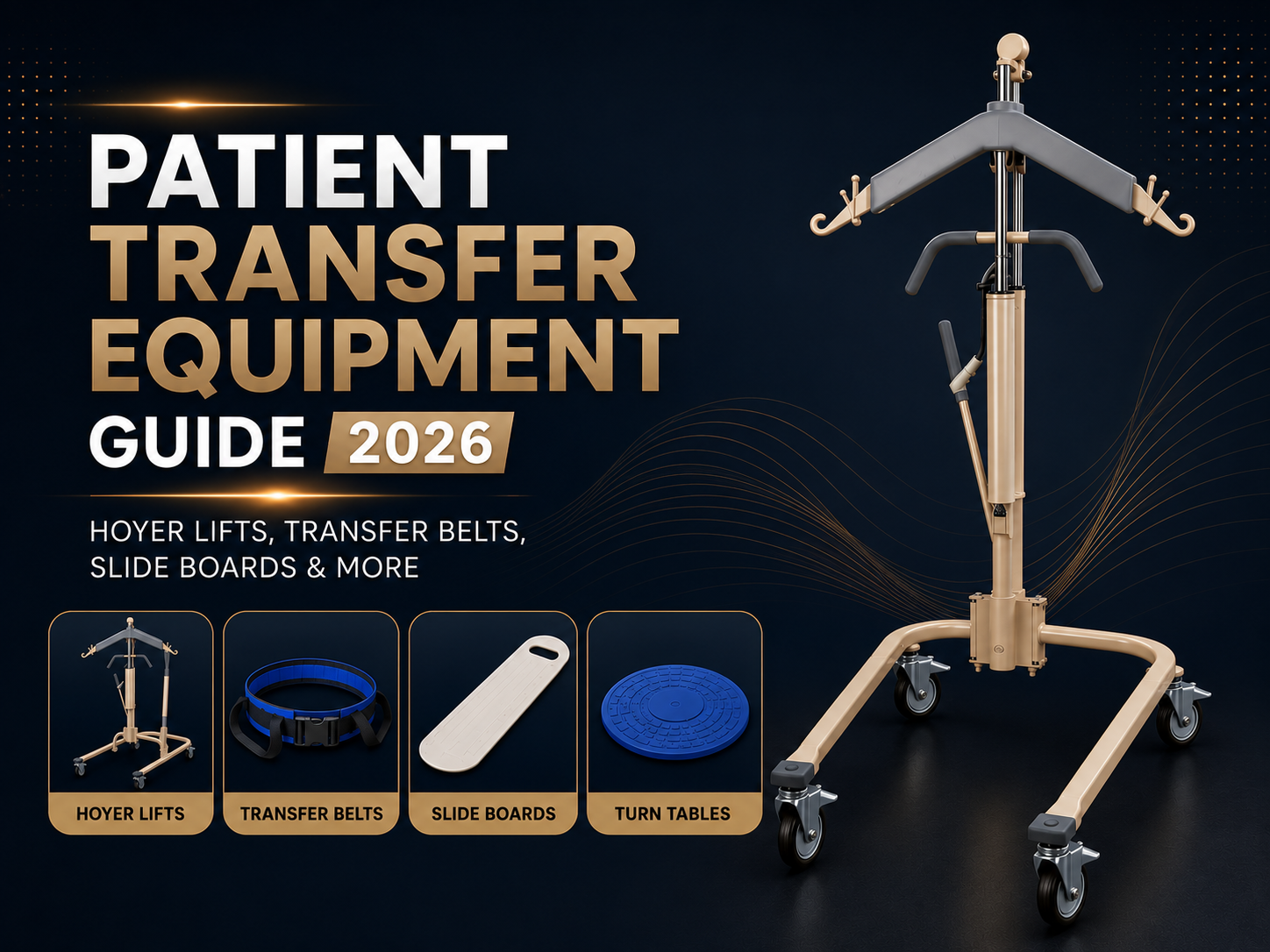
Category 5: Manual and Electric Patient Lifts (Hoyer Lifts)
When a patient cannot bear weight, cannot participate in the transfer, or when caregiver body weight makes manual transfers unsafe regardless of technique, a patient lift is the correct answer. These are often called Hoyer lifts after the brand that popularized the design.
Manual Hydraulic Lifts
The caregiver pumps a handle to raise the sling and patient. Manual lifts are less expensive and require no charging, but demand more caregiver effort — particularly on repeated daily transfers. Best for occasional transfers or households where a powered lift isn't feasible. Cost: $300–$700.
Electric (Battery-Powered) Patient Lifts
Powered by a rechargeable battery, electric lifts raise and lower the patient with a press of a button. The caregiver guides and positions but does no lifting force. This is the standard of care for patients requiring full-body dependent lifting at home. Electric lifts are significantly safer for both caregiver and patient over the long term. Cost: $800–$3,000+.
Ceiling Lifts
For patients requiring transfers multiple times daily, a ceiling track lift system installed in the bedroom and bathroom eliminates the need to maneuver floor equipment, reduces trip hazards, and allows single-caregiver full transfers even for very large patients. More expensive to install but dramatically reduces caregiver injury risk and increases independence. Typically covered (partially or fully) by Medicaid waiver programs in many states when medically necessary.
Sit-to-Stand Lifts
A sit-to-stand lift (standing lift) assists patients who retain some weight-bearing ability but need support through the stand phase. The patient places their feet on a platform, grips handles, and the lift assists them to standing — useful for transfers to and from the toilet, bath, or chair when a full Hoyer is more than needed. Cost: $400–$1,500.
Patient Lift Slings: Getting the Right Type
Every patient lift requires a sling — the fabric seat that wraps around the patient and attaches to the lift. Slings must be compatible with the lift brand and model. Key sling types:
| Sling Type | Best For | Notes |
|---|---|---|
| Universal / U-Style | Most standard transfers | Most common; works for bed-to-wheelchair and most ADL transfers |
| Toileting Sling | Toilet transfers with hygiene access | Open-bottom design allows hygiene care without removing sling |
| Full-Back / Hammock | Patients with no trunk control | Full head and back support; more coverage for very dependent patients |
| Bathing Sling | Bath and shower transfers | Made of mesh or quick-dry material; safe in water |
| Repositioning Sling | Bed repositioning only | Flat sheet-style sling for in-bed repositioning; not for full lifts |
Each patient should have their own dedicated sling — slings should not be shared between patients for infection control reasons. Replace slings that show stitching wear, tears, or compromised hardware.
Choosing the Right Transfer Equipment: A Decision Framework
The right equipment depends primarily on the patient's functional level:
- Independent with supervision: Gait belt for safety, bed handle for sit-to-stand support, non-slip footwear.
- Minimal assist (can bear full weight, needs balance support): Gait belt with handles, pivot disc, floor-to-ceiling support pole.
- Moderate assist (partial weight-bearing): Transfer belt with leg loops, transfer board for lateral transfers, sit-to-stand lift for toilet transfers.
- Maximum assist (cannot initiate transfer independently): Transfer belt + two-person assist, or powered patient lift with appropriate sling.
- Dependent (cannot participate at all): Full patient lift (electric strongly recommended) with appropriate sling type for each transfer.
Insurance and Medicare Coverage
Medicare Part B covers patient lifts and some accessories as Durable Medical Equipment (DME) when a physician certifies medical necessity and the equipment is provided by a Medicare-enrolled supplier. Coverage typically requires documentation of the patient's diagnosis and functional limitations. Hoyer lifts for dependent patients are commonly approved. Gait belts and transfer boards are typically out-of-pocket (low cost). Consult with a Medicare-enrolled DME supplier or a hospital case manager to navigate coverage for higher-cost items.
Shop Patient Transfer Equipment at AllCare Store
AllCare Store carries a complete range of patient transfer equipment — from gait belts and slide boards to electric patient lifts — along with walkers, wheelchairs, rollators, and all supporting mobility aids. Every order ships free.
Visit AllCare Store — your partner in safe home care. Questions about the right equipment for your situation? Call us: 1-888-889-6260.
Related guides: Best Walkers & Rollators for Seniors | Wheelchairs for Seniors Guide | Shower Chairs & Bath Benches Guide | Knee Replacement Recovery Guide
Frequently Asked Questions: Patient Transfer Equipment
What is the safest way to transfer a patient from bed to wheelchair at home?
The safest transfer method depends on the patient's functional level. For patients with some weight-bearing ability, a transfer belt with handles, positioned wheelchair close and locked, feet flat on the floor with a pivot disc, is a common safe technique. For patients who cannot bear weight, an electric patient lift with the appropriate sling is the safest option and eliminates the mechanical load on the caregiver. A physical or occupational therapist can assess the specific situation and provide hands-on training with the chosen equipment — this is the best investment for anyone setting up home care transfers.
Does Medicare cover Hoyer lifts?
Medicare Part B covers patient lifts (including Hoyer-style floor lifts) as Durable Medical Equipment when a physician certifies medical necessity and documents that the patient requires a lift due to their condition — typically meaning the patient cannot bear weight and requires full assistance for transfers. The lift must be purchased from a Medicare-enrolled DME supplier. Coverage is typically 80% of the approved amount after the Part B deductible, with the remaining 20% covered by Medigap or Medicaid for dual-eligible beneficiaries. Contact your physician and a Medicare DME supplier to begin the authorization process.
How much weight can a standard patient lift hold?
Most standard patient lifts have a weight capacity of 400–450 lbs. Bariatric patient lifts are available with capacities of 600, 700, or even 1,000 lbs. Always check and respect the lift's stated weight capacity — both the lift frame and the sling have rated limits that must be matched to the patient's weight. Using a lift beyond its rated capacity is a serious safety risk.
Can one person safely use a Hoyer lift alone?
Electric patient lifts are designed to allow one caregiver to complete the mechanical lift safely — the motor handles the weight. However, the caregiver still needs to position the sling, guide the patient during the lift, and manage the positioning at the destination. For patients who are fully dependent and cannot assist at all, two caregivers are recommended for the sling placement and transfer completion, even with an electric lift. Your occupational therapist or lift supplier can advise on whether single-caregiver operation is appropriate for your specific situation.
Medical Disclaimer: This article is for informational purposes only and does not constitute medical advice. Individuals at high risk for pressure injuries should consult a physician, occupational therapist, or certified rehabilitation engineer before selecting a wheelchair cushion.