Managing your own medications is a memory problem. Managing someone else's is a systems problem. You are dealing with prescriptions you did not choose, changes you did not hear about firsthand, refills on different cycles, and a person who may or may not want your involvement.
The households that do this well are rarely the ones with the best memory. They are the ones with a written list, a fixed fill day, and a way of noticing when something has gone wrong before it becomes a hospital visit.
Everything starts with one authoritative list
Before any organizer is filled, there needs to be a single document that everyone works from. Not a drawer of bottles, not a memory, not three different lists on three different phones.
For each item, record:
- Generic name and brand name, because the same drug arrives under both
- Strength and the actual number of tablets per dose
- When it is taken, and whether it is tied to food, sleep, or anything else
- What it is for, in plain language
- Prescriber and pharmacy
- Start date, and a stop date if there is one
Include over-the-counter products, vitamins, supplements, eye drops, inhalers, patches, and creams. These are the items most often left off a list and most often responsible for an interaction nobody expected.
Keep the list where a paramedic could find it. A copy on the fridge and a photo on your phone covers most situations.
Reconciling after a hospital stay is where errors get in
Discharge is the highest-risk moment in the whole cycle. The person comes home with a new list, but the old bottles are still in the cupboard, and nobody has explicitly said which ones to stop.
Work through it deliberately:
- Put the discharge list beside your existing list and compare line by line.
- Look for the same drug appearing twice under two names, one brand and one generic. This is the classic accidental double dose.
- Identify anything on the old list that is not on the new one, and confirm with the prescriber or pharmacist whether it was intentionally stopped or simply omitted.
- Check for changed strengths. A drug that continues at half the previous dose looks like "no change" at a glance.
- Physically remove discontinued medications from the house or lock them away. Leaving them on the shelf is how they get taken again.
Do the same, on a smaller scale, after every specialist appointment. Ask directly: "What has changed, and what should stop?"
Set a fill day and a refill trigger
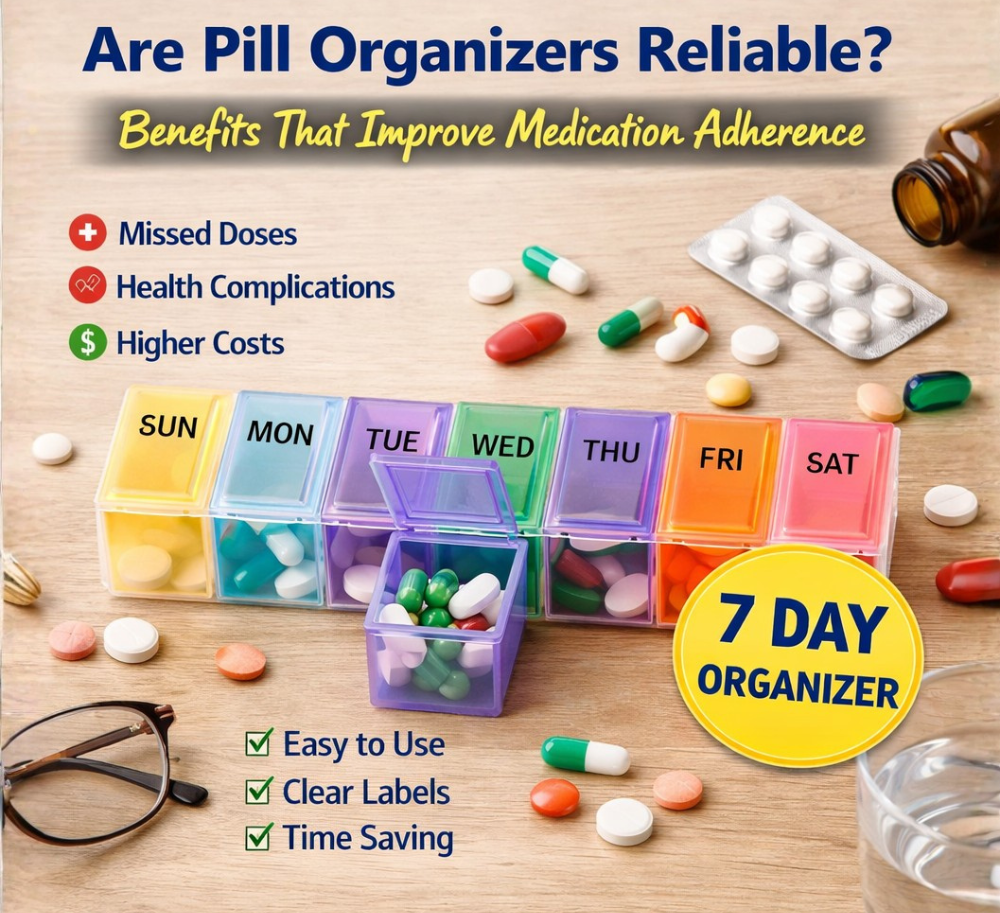
Choose one day of the week and fill the organizer then, every week, at the same time. Sunday evening works for many people because it is quiet and predictable. The specific day matters far less than the fact that it never moves.
Filling the tray is also your inventory check. As you go, note anything with fewer than roughly two weeks left and order it that day. Waiting until a bottle is empty means racing the pharmacy, and pharmacies have public holidays.
A few things make the fill day less tedious:
- Fill in a good light, on a clear surface, with the list in front of you
- Do one medication at a time across all seven days rather than one day at a time, which makes it much easier to spot a gap
- Do not fill while distracted or in conversation
- Consider asking the pharmacy about synchronising refill dates so everything comes due together
Match the organizer layout to the actual schedule
An organizer that does not fit the regimen creates workarounds, and workarounds are where doses get lost.
- Once daily. A simple seven-day tray is enough, and its simplicity is an advantage.
- Morning and evening. A twice-a-day weekly tray keeps the two clearly separated. The comparison of layouts in the twice-a-day weekly organizer guide covers this in more detail.
- Three or four times daily. Do not try to make a two-slot tray work. Use a genuine four-compartment-per-day organizer, otherwise the extra doses live loose in a bottle and stop being tracked.
- Large tablets or many tablets. Check the physical fit. Deep compartments matter more than most people expect once a regimen passes six or seven items.
- Arthritis or reduced hand strength. Push-button or pop-up lids are far easier than lids that need a fingernail to lever open. If the person cannot open it independently, they will wait for you, and that defeats the purpose.
- Poor vision. High-contrast lettering and braille markings exist. Colour coding alone is not enough for many older adults.
Monthly trays and multi-tray sets suit people who fill less often or who travel. Options are grouped under pill organizers and pill trackers and the wider medication management collection.
Reminders that survive a bad day
A single alarm on a phone that is in another room is not a reminder. Layer them:
- Anchor doses to existing habits rather than to abstract times. Breakfast, the evening news, brushing teeth.
- Put the organizer physically where the habit happens.
- Use an audible timer or an alarmed dispenser for anything easy to forget.
- If you are not in the house, a short check-in call at the same time each day does more than any app.
- For someone with memory impairment, consider a locked or automated dispenser that only releases the current dose.
Notice when the system is failing
The value of a weekly tray is not only the organisation. It is the evidence. When you refill, look at what is left behind:
- Compartments still full from earlier in the week
- Doses taken out of order, which suggests confusion rather than forgetting
- Loose tablets in the tray, in a pocket, or on the floor
- Bottles running down faster than they should, which can mean doubling
- A refill that arrives far too early or far too late
Any of these is worth a conversation, not a reprimand. Missed doses are often a signal about side effects, cost, swallowing difficulty, or a belief that a medication is not helping. Ask before you assume.
Storage and safety in the home
- Store away from bathrooms and windowsills; heat and humidity degrade tablets.
- Keep the current week's organizer accessible and the bulk supply out of casual reach, particularly where grandchildren visit.
- Dispose of expired and discontinued medications properly rather than leaving them in the cupboard.
- Never decant several drugs into one unlabelled bottle for convenience.
Keep a go-folder
One envelope, always in the same place, containing the current medication list, allergies, prescriber and pharmacy contacts, insurance details, and any advance directive. It goes with you to every appointment and to the emergency department. Nothing else you do will save as much time on the worst day.
If travel is part of the picture, the guidance on taking medication on the road covers airport screening, time zones, and backup supply. Portable cases for appointments and outings are in the on-the-go travel medication management collection.
None of this requires special expertise. It requires one list, one fill day, one place to look, and the habit of asking what changed.