Travel breaks the routine that most medication schedules quietly depend on. You are out of your own kitchen, out of your own bed, and often out of your own time zone. For people taking one or two prescriptions this is a minor nuisance. For someone on six medications with different timings, a badly planned trip can mean missed doses, doubled doses, or arriving somewhere with no way to refill.
None of that requires a complicated system to prevent. It mostly requires deciding a few things before you leave rather than in an airport queue.
Start by counting doses, not days
The most common packing error is bringing "about a week" of medication for a week-long trip. Trips get extended. Flights get cancelled. Bags get delayed.
Work it out in doses instead:
- Count the number of days you will be away, including both travel days.
- Multiply by the number of doses per day for each medication.
- Add a buffer of several extra days for every medication you cannot easily go without.
Then check whether any prescription is due to run out mid-trip. If it is, sort the refill before you leave rather than trying to arrange one from another state or country.
What airport security actually allows
Rules vary by country, so confirm the current policy for the airports you are using before you fly. In the United States, the Transportation Security Administration publishes its medication guidance on tsa.gov, and the broad shape of it is helpful to know:
- Medication in pill or other solid form can be carried in unlimited quantity in carry-on baggage.
- Liquid medication is treated as an exception to the standard carry-on liquids limit when it is in reasonable quantity for the trip, but you are expected to declare it to the officer at the checkpoint and remove it from your bag for separate screening.
- Accessories that keep medication viable, such as freezer packs, cooler bags, IV bags and pumps, are permitted, though they may be screened separately.
- TSA does not require medication to be in its original labelled container, but individual states and many other countries do have their own rules. Keeping original pharmacy labels, or at least a printed medication list, avoids arguments.
You can ask for a private screening area if you would rather not discuss your medications at an open checkpoint. Travelling with a controlled substance, an injectable, or a large quantity of anything is smoother if you also carry a copy of the prescription or a short letter from your prescriber.
Never split your supply between carry-on and checked bags in the way you think
The instinct is to divide medication across two bags so that losing one bag does not mean losing everything. That is right in principle and wrong in the usual execution.
Keep the full essential supply in your carry-on, on your person, in the bag that never leaves your side. Checked luggage goes missing, sits on hot tarmac, and gets delayed for days. If you want redundancy, put the spare supply in the checked bag, never the primary one.
If you are travelling with a companion, splitting a spare set between two carry-ons is better still.
Crossing time zones without doubling or skipping
This is the part people improvise, and it is the part worth asking a pharmacist about before the trip. The right approach depends entirely on what you take.
- Flexible once-daily medications. For many of these, shifting an hour or two either way is unremarkable. You can often simply switch to local time on arrival.
- Medications where the interval matters. Some drugs are dosed by hours elapsed rather than by clock time. For these, shifting abruptly can mean two doses too close together or a gap that is too long.
- Medications tied to meals, sleep, or blood tests. These need a plan that accounts for when you will actually be eating and sleeping, not just what the clock says.
A practical approach for longer trips is to shift gradually, moving the dose time by an hour or so per day in the days before and after the flight, if your prescriber agrees this is appropriate. For short trips of a couple of days, many people are advised to simply stay on home time. Ask which applies to you, and write the answer down.
It helps to keep one clock set to home time for the first day or two, whether that is a second time zone on your phone or a watch you do not change.
Choosing an organizer that survives a trip
A tray that works beautifully on a bedside table is not automatically the right thing in a bag. The features that matter change on the road:
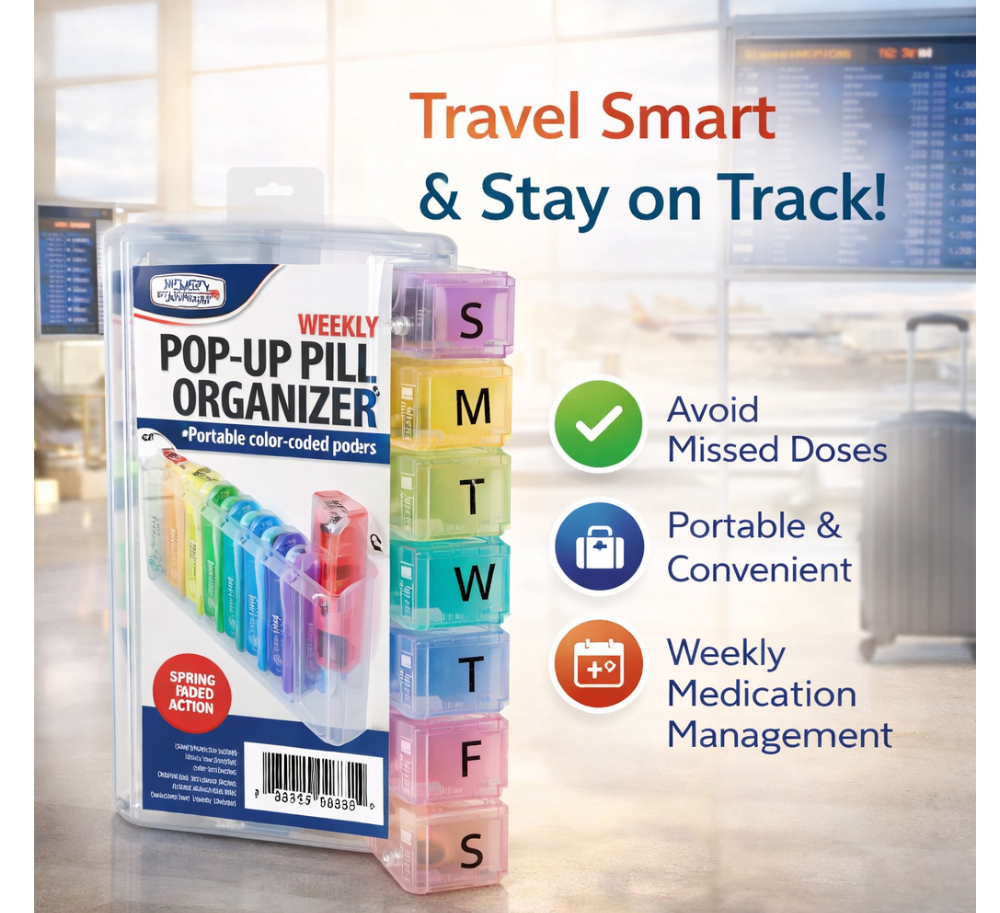
- Latch security. Compartments that pop open under light pressure will empty themselves into your bag. Look for lids that click positively shut or a case that closes over the whole tray.
- Detachable daily sections. Organizers where a single day pops out let you carry one day in a pocket and leave the week in the hotel room.
- Enough doses per day. If you take medication four times a day, a morning-and-evening tray forces you to improvise for two of them.
- Compartment depth. Larger tablets and capsules will not fit in shallow travel trays. Check the actual pill against the actual compartment before you commit.
- Readable labelling. Day markings that rub off in a bag defeat the purpose.
Weekly and daily options are grouped in the pill organizers and pill trackers collection, and travel-oriented cases sit in on-the-go travel medication management. If you are deciding between layouts more generally, the guide to choosing a twice-a-day weekly organizer covers the trade-offs.
Storage while you are actually travelling
Heat is the underrated risk. A car glove box, a beach bag, or a windowsill in a hot climate can push well past the temperature ranges most medications are labelled for. Insulin and other refrigerated medications need active planning: an insulated case, cold packs, and a check on whether the hotel room has a genuine fridge rather than a minibar that runs warm.
Humidity matters too. Bathrooms are the worst place to store an open organizer, whether at home or in a hotel.
If something goes wrong away from home
Build the fallback before you need it:
- Carry a written list of every medication with its generic name, strength, and dose schedule. Generic names travel across borders; brand names often do not.
- Save your pharmacy's phone number and, if it is part of a national chain, note that many can transfer a prescription to a branch near you.
- Note any allergies and your prescriber's contact details on the same sheet.
- Keep a photo of the list on your phone as well as a paper copy, in case the phone dies.
For international travel, check whether anything you take is restricted at your destination. Some common medications, including certain stimulants and strong painkillers, are controlled or banned in particular countries regardless of a valid prescription.
A short pre-departure checklist
- Doses counted, plus a buffer
- Refills sorted for anything expiring mid-trip
- Primary supply in the carry-on, spare in the checked bag
- Original labels or a printed medication list packed
- Time-zone plan confirmed with a pharmacist or prescriber
- Alarms reset for local time on arrival
- Cooling arranged for anything temperature-sensitive
If someone else is managing these medications on your behalf, the same preparation applies with an extra layer of handover. That is covered in the guide to building a medication system as a caregiver. Broader supplies for daily dosing are in the medication management collection.
Travel is not the enemy of a medication routine. Improvising is. Half an hour of planning before you leave removes almost all of the risk.