IMPORTANT MEDICAL DISCLAIMER: Supplemental oxygen therapy requires a valid prescription from a licensed physician. The information in this guide is for educational purposes only and does not constitute medical advice. Always consult your doctor or pulmonologist before purchasing or using oxygen equipment. Your prescribed flow rate, device type, and usage schedule should be determined by your healthcare provider based on your specific condition and oxygen saturation levels.
For people with chronic respiratory conditions — COPD, pulmonary fibrosis, pulmonary hypertension, and others — supplemental oxygen therapy is often life-changing. Historically, oxygen dependency meant tethering yourself to large home oxygen tanks or heavy concentrators. Portable oxygen concentrators (POCs) changed that equation dramatically, enabling millions of people to travel, stay active, and live far more independently than was previously possible.
But choosing the right portable oxygen concentrator is a genuinely complex decision. The technology varies significantly across devices, and choosing wrong means either not getting the oxygen your lungs need or carrying a device that's unnecessarily heavy and limited. This guide walks through everything you need to understand to make an informed choice — in collaboration with your prescribing physician.
What Is a Portable Oxygen Concentrator and How Does It Work?
Unlike oxygen tanks, which hold a finite supply of compressed or liquid oxygen, a portable oxygen concentrator is an active medical device that actually makes oxygen on demand. It pulls ambient air (which is about 21% oxygen and 78% nitrogen) through a molecular sieve — typically zeolite material — that absorbs the nitrogen. What's left is highly concentrated oxygen (typically 87-96% purity) that's delivered to the user through a nasal cannula.
Because the concentrator creates oxygen from the air around it, it never "runs out" as long as it has power. This is the transformative advantage: plug it in (or run it on battery) and you have a continuous oxygen supply without tank refills or deliveries.
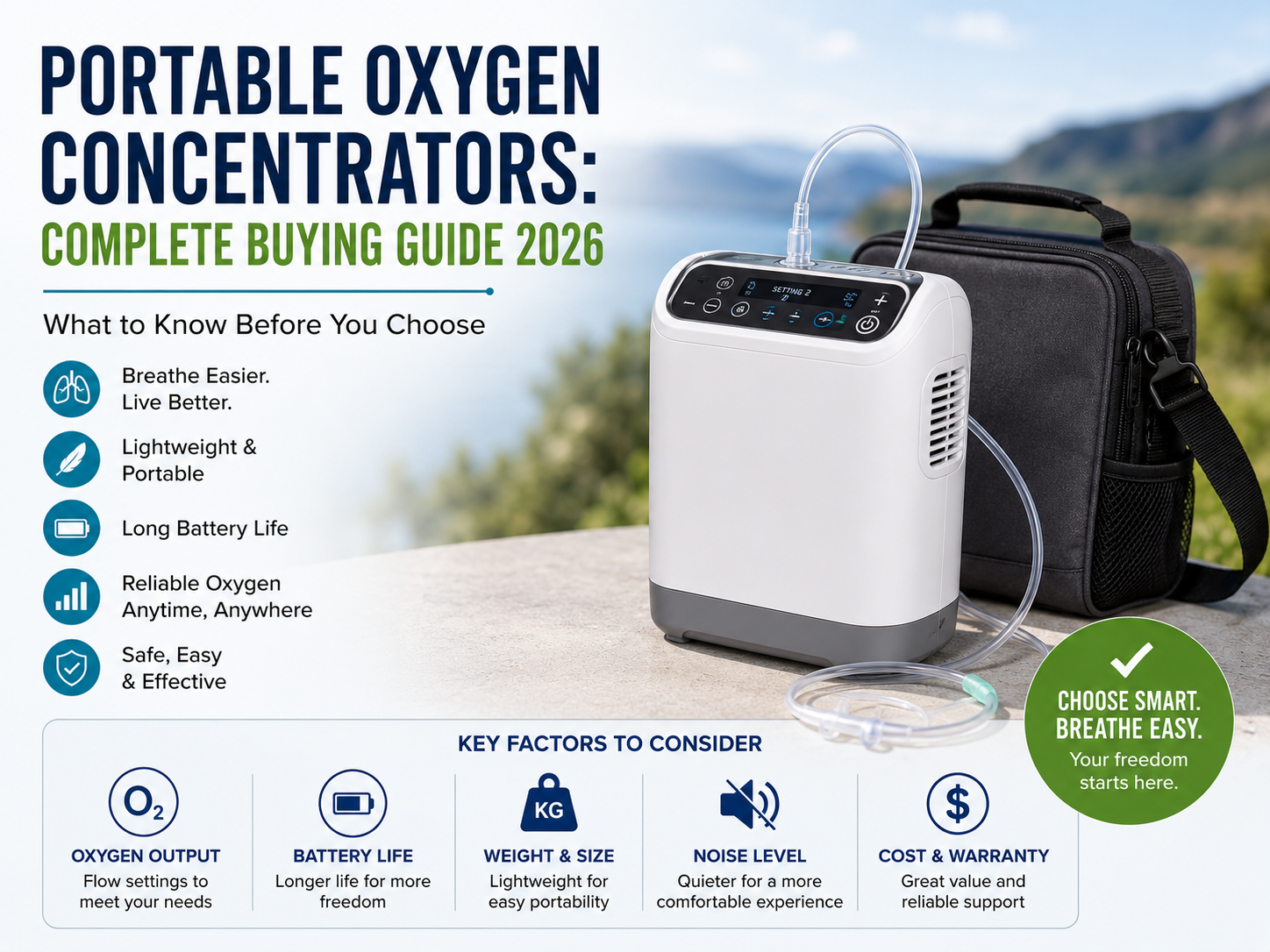
POCs range in size from small units weighing under 3 lbs that fit in a bag, to larger carry units at 5-8 lbs, to heavier portable units that may require a rolling cart. Understanding the trade-offs between size, weight, and oxygen delivery capacity is central to choosing the right device.
Pulse Dose vs. Continuous Flow: The Most Important Distinction
This is the single most important technical decision in portable oxygen concentrator selection, and it must be guided by your physician's prescription.
Pulse Dose (Intermittent Flow)
Pulse dose concentrators deliver oxygen in discrete boluses — small bursts of concentrated oxygen timed to the beginning of each breath inhalation. The device detects when you begin inhaling and delivers a pulse of oxygen at that moment, when your lungs are actually expanding to receive it. Between breaths, the device doesn't flow oxygen.
The advantage: pulse dose devices are far more energy-efficient (since they're not flowing oxygen constantly), which enables much longer battery life and allows manufacturers to make much smaller, lighter devices. Most small and ultralight POCs are pulse-dose only.
The limitation: pulse dose delivery is not effective for all patients. People who breathe through their mouth (common during exertion or sleep), breathe very rapidly (as in severe COPD exacerbations), or have certain conditions affecting breathing patterns may not receive adequate oxygen with pulse dose delivery. It is generally not suitable for use during sleep in most patients — your oxygen saturation needs to be verified during sleep if you use pulse dose overnight.
Continuous Flow
Continuous flow concentrators deliver a steady, uninterrupted stream of oxygen, just like a stationary home concentrator or an oxygen tank. This is the standard of care for most clinical situations and is typically required for nighttime use, for patients with moderate-to-severe respiratory disease, and for patients who cannot maintain adequate saturation on pulse dose.
The limitation: continuous flow requires significantly more power and a larger compressor, which makes continuous flow POCs heavier and larger than pulse-dose-only devices. Battery life is considerably shorter at higher flow rates. Few POCs provide continuous flow above 3 LPM while remaining truly portable.
Dual-Mode Devices
Some POCs offer both pulse dose and continuous flow settings. These devices are larger and heavier than pure pulse-dose units but offer the flexibility to use pulse dose during activity (extending battery life) and switch to continuous flow when needed. If your prescription calls for both modes, a dual-mode device is essential.
Key Specifications to Evaluate
Prescribed Flow Rate and Setting Equivalency
Your doctor will prescribe a specific oxygen flow rate in liters per minute (LPM). This must match the device's capabilities. For pulse dose devices, settings are typically labeled 1-6 (each setting corresponds roughly to a LPM equivalent — though equivalency varies by brand and is not standardized). Your pulmonologist or respiratory therapist should verify that the device's pulse settings meet your oxygen needs through actual saturation testing, not just assumed equivalency.
Weight and Portability
Consider your actual lifestyle. If you plan to carry the device on a shoulder strap while walking, weight matters enormously — under 5 lbs is significantly more manageable than 7-8 lbs over hours of use. If the device will mostly sit on a cart or nearby during activity, weight is less critical. Consider also the carrying system — some units come with well-designed bags and straps, which can make even a heavier device more comfortable.
Battery Life
Battery life on pulse dose at lower settings can be impressive — some units achieve 8-12 hours on a single battery. However, battery life decreases significantly at higher pulse settings and drops sharply for continuous flow operation. Check the battery life specification at your prescribed setting, not the maximum-life figure shown prominently in marketing materials. Also consider: Does the device allow hot-swapping batteries (replacing without powering down)? Does it have an AC/DC power adapter for car use? Can you purchase additional batteries?
Noise Level
Portable concentrators make noise — the compressor and sieve cycling are audible. In quiet settings (restaurants, theaters, offices), noise level matters considerably. Well-designed units operate in the 40-45 decibel range (roughly a quiet conversation level). Budget units or older designs may operate louder. Read user reviews specifically about noise — this is an area where manufacturer specifications are sometimes optimistic.
FAA Approval for Air Travel
If air travel is important to you, ensure the concentrator is FAA-approved for in-flight use. Most modern POCs carry FAA approval, but verify this explicitly. Airlines require the device to have at least 150% of the flight time in battery life — so for a 6-hour flight, you need at least 9 hours of battery capacity at your use settings. You'll also need to notify the airline in advance and may need a letter of medical necessity from your physician.
Home Concentrator vs. Portable Concentrator
Many oxygen users have both. A stationary home concentrator provides the highest flow rates (up to 10 LPM continuous) at the lowest cost and with unlimited runtime, making it ideal for home use during sleep, rest, and stationary activities. A portable concentrator enables freedom outside the home.
If your oxygen needs are modest (1-3 LPM) and you're primarily active during the day, a capable POC may work as your only concentrator. If you have higher flow requirements, a home unit at night and a POC for outings is the typical approach.
Important Maintenance Considerations
Portable concentrators require regular maintenance to operate safely and effectively. The air intake filter should be cleaned weekly and replaced according to the manufacturer's schedule — a clogged filter forces the compressor to work harder and reduces oxygen output. Check your nasal cannula for cleanliness and replace it every 2-4 weeks. The cannula tubing can accumulate bacteria over time and should not be shared between users. Keep the device away from dust-heavy environments during operation. Store and operate in well-ventilated spaces — the unit exhausts concentrated nitrogen and needs fresh air intake.
Getting the Most from Your Portable Oxygen
A few practical tips that significantly improve the experience: Charge the battery fully before each outing and carry a spare battery for longer trips. Verify your oxygen saturation (with a pulse oximeter) at your prescribed settings during different activity levels — what works at rest may not be sufficient during exertion. Alert your medical team if you notice your saturation dropping below your prescribed target range. In very hot or cold temperatures, battery performance can be reduced — factor this into travel planning. At high altitude, oxygen density in the air decreases — your concentrator may need to work harder, and your doctor may adjust your prescription for travel to elevation.
Shop Respiratory Care Supplies at AllCare Store
AllCare Store carries a full range of respiratory care products to support your oxygen therapy and breathing health. Browse our Respiratory Care collection for nebulizers, pulse oximeters, nasal cannulas, and related accessories.
For monitoring your oxygen saturation at home or on the go, our health monitors collection includes pulse oximeters that pair with your oxygen therapy. And for general health support, explore our AllCare Store homepage for a comprehensive selection of health and wellness products. Free shipping on qualifying orders. Contact our team at 1-888-889-6260, Monday through Friday, 7:00 AM – 4:00 PM CST.
Frequently Asked Questions: Portable Oxygen Concentrators
Do I need a prescription for a portable oxygen concentrator?
Yes. In the United States, portable oxygen concentrators are FDA-regulated medical devices that require a physician's prescription. Your doctor will prescribe supplemental oxygen based on your oxygen saturation levels (typically below 88% at rest or with exertion) and specify the flow rate and delivery mode (pulse dose or continuous flow) needed. Do not use or purchase oxygen equipment without a current prescription — incorrect oxygen therapy can be harmful.
What is the difference between pulse dose and continuous flow oxygen?
Pulse dose oxygen is delivered in bursts timed to your inhalation — when you breathe in, the device delivers a concentrated bolus of oxygen. Continuous flow delivers a steady stream of oxygen regardless of your breathing pattern. Pulse dose enables lighter, longer-lasting portable units but is not suitable for all patients, particularly during sleep or in patients with certain breathing patterns. Continuous flow is required for many patients and is the standard for nighttime use. Your physician determines which mode is appropriate for your condition.
Can I use a portable oxygen concentrator on an airplane?
Yes, if the device is FAA-approved (most modern POCs are). You must notify the airline in advance, bring a letter of medical necessity from your physician, and carry enough battery for 150% of the flight duration. Airlines cannot provide oxygen from the aircraft supply to passengers and do not permit personal oxygen tanks onboard — an FAA-approved POC is the correct solution for oxygen users who fly. Contact your airline's special assistance line at least 48-72 hours before your flight.
How long does a portable oxygen concentrator last?
With proper maintenance, a quality portable oxygen concentrator typically lasts 5-7 years. The most common failure point is the sieve beds (the molecular sieve material that extracts oxygen from air), which gradually degrade with use and need replacement every 3-5 years in many devices. Regular filter cleaning, proper storage, and following manufacturer maintenance schedules significantly extend device life. Batteries typically need replacement every 1-3 years depending on usage intensity.
What oxygen saturation level requires supplemental oxygen?
Generally, supplemental oxygen is prescribed when resting oxygen saturation falls below 88% (SpO2), or below 90% with exertion, as measured by pulse oximetry. Normal oxygen saturation for healthy adults is 95-100%. However, the threshold for prescribing oxygen varies based on individual medical conditions, symptoms, and clinical judgment. Your physician makes this determination — do not self-prescribe oxygen based solely on pulse oximeter readings without medical evaluation.
For respiratory care products, pulse oximeters, nebulizers, and related supplies, visit AllCare Store. Browse our Respiratory Care collection. Free shipping on qualifying orders. Call 1-888-889-6260, Monday–Friday 7 AM–4 PM CST.