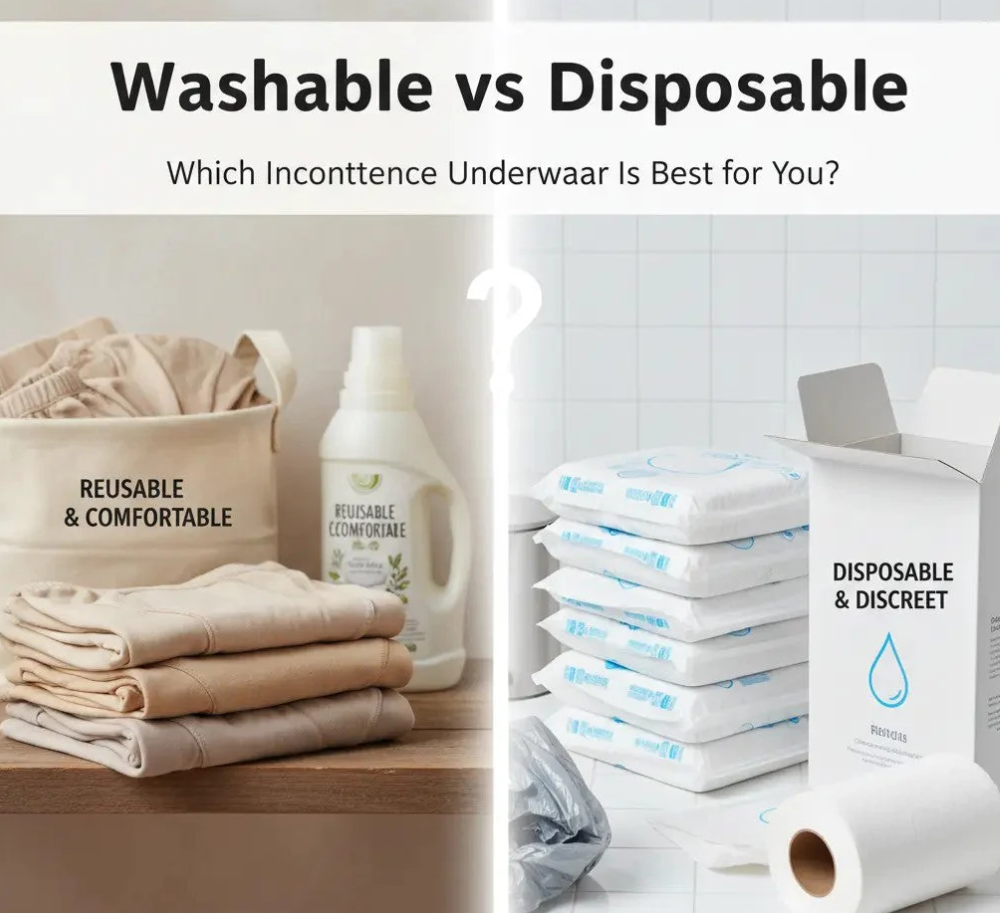
If you have been comparing washable and disposable incontinence underwear, you have probably read a dozen articles that end with "it depends on your preference." True, but not much help. In practice the choice comes down to two concrete things: whether the washing realistically fits into your week, and what each option costs once you count everything rather than just the sticker price.
This article sticks to those two questions. If you are still working out what products you need at all, a new caregiver's starter kit for the first two weeks is a better starting point. This one is for people who already know absorbent underwear is part of the plan and are deciding how to stock it.
The same job, two very different routines
Disposable absorbent underwear uses a polymer core that turns liquid into gel and holds it away from the skin. You wear it, you change it, it goes in the bin. Washable or reusable underwear uses layers of fabric instead: a wicking layer against the skin, an absorbent middle, and a waterproof outer. It goes into the laundry rather than the waste.
That difference sounds small. It is not. Disposables shift the burden onto money and waste. Reusables shift it onto time, machine capacity and drying space. Whichever burden your household can carry more easily is usually the right answer, and no amount of product marketing changes that.
Be honest about the laundry before anything else
A reusable system only works if there is a place to put soiled garments, a way to wash them promptly, and somewhere for them to dry properly. Walk through your own week before you buy:
- Where will wet garments sit between use and wash day? A lidded pail or a zipped wet bag near the bathroom works. A heap in the laundry basket does not.
- Do you have a machine at home, or do you share one, or use a launderette? Shared and public machines make reusables much harder, both practically and for privacy.
- How quickly can things dry? Reusable underwear is thick, and the absorbent core stays damp long after the outer fabric feels dry. If you rely on line drying in a cool, damp home, you will need more pairs than you expect.
- Who is actually doing the washing? If a family member is already stretched thin, adding several loads a week is a real cost, not a rounding error.
The practical side of laundry, storage and supply rotation is covered in more depth in our caregiver's logistics guide to routines, laundry and supply management, and most of it applies to garments just as much as to bed protection.
Working out your real cost per use
Reusable underwear costs far more per garment and far less per wear, but only if it survives long enough to pay for itself. To compare the two fairly, work out the cost of one dry, wearable garment on one ordinary day.
For disposables that is straightforward: the pack price divided by the number of pieces, multiplied by how many you go through in a day. Buying by the case rather than the retail pack usually brings this figure down noticeably, which is worth knowing if storage space allows.
For reusables, take the purchase price of a pair and divide it by a realistic number of washes before the absorbency or the waterproof layer starts to fail. Then add the running cost of the wash itself: detergent, water, electricity, and drying, which is usually the expensive part. Then add the cost of the extra pairs you need simply to keep the rotation turning.
Two things trip people up. The first is underestimating drying costs, especially with a tumble dryer, which is also the thing most likely to shorten the garment's life. The second is assuming every garment will last the full advertised number of washes; heavy soiling, very hot cycles and fabric softener all cut that short. We work through the same style of honest cost-per-use maths for bed protection in our budget underpads cost-per-use comparison, and the method transfers directly.
Odour and fabric care: the part nobody warns you about
Reusable absorbent fabrics fail in a specific way. Over months, detergent residue, body oils and mineral deposits from hard water build up inside the absorbent layers. The garment starts to repel liquid at the surface instead of drawing it in, and it holds a smell even straight out of the wash. People usually conclude the product was poor quality. Far more often, it is the wash routine.
A few habits keep reusables working:
- Rinse soiled garments in cold water before they go into the pail. Hot water sets protein stains and locks in odour.
- Use a plain detergent, and only as much as the machine actually needs. More detergent is not better; the excess stays in the fabric.
- Skip fabric softener and dryer sheets entirely. They coat the fibres and are the fastest way to destroy absorbency.
- Wash on the warmest cycle the care label allows, and do not overload the drum. The garments need room to move to rinse properly.
- Dry thoroughly. A garment that feels dry on the outside can still be damp in the core, and that is where mustiness begins.
- If absorbency drops off, a strip wash with no detergent at all, run through twice, will often clear the residue and restore it.
Disposables have their own odour management, which is mostly about changing promptly and sealing waste properly rather than masking anything with fragrance.
Where reusables genuinely make sense
Washable underwear tends to earn its place when leakage is light to moderate and reasonably predictable, when the wearer is at home for most of the day, and when there is a working machine and somewhere to dry things. It also matters to a great many people that reusable garments look and feel like ordinary underwear. For someone who finds the whole subject humiliating, that is not a small benefit; it is often the difference between protection being worn and protection being refused.
Fabric-based options sit in our knit underwear range.
Where disposables are simply the sensible answer
Disposables win when volume is heavy, when protection is needed overnight for eight hours or more, when someone else is doing the changing several times a day, and any time you are away from home. Travel, hospital stays, respite care and holidays are all far easier with a product you can throw away. They are also the better answer during illness, since a stomach upset or a course of antibiotics can generate more laundry in two days than any household routine can absorb.
The disposable formats are in our adult pull-on underwear and briefs range.
Most people end up with both
The households that manage best rarely pick a side. A common pattern is reusables at home during quiet daytime hours, disposables overnight and whenever leaving the house, plus a small emergency stock of disposables kept back for the weeks when the washing gets away from you. Building the routine that way means a broken washing machine is an inconvenience rather than a crisis.
As a rough starting point for a reusable rotation, count how many changes happen in a day, multiply by the number of days between washes, and add two spare pairs. Fewer than that and you will be washing constantly and wearing garments that never fully dried.
One thing worth raising with a clinician
Absorbent products manage leakage. They do not treat the cause of it. New incontinence, or leakage that is getting worse, is always worth mentioning to a doctor or nurse, because a meaningful share of causes are treatable, including urinary infections, constipation, side effects of medication, and pelvic floor weakness that often responds well to physiotherapy. Asking is not making a fuss, and it is frequently the step that reduces how much product is needed in the first place.
Common questions
How long does reusable incontinence underwear last?
It depends far more on the wash routine than on the brand. Gentle detergent, no softener and low-heat drying will extend its life considerably; very hot washes and high-heat tumble drying will shorten it. Watch for the surface starting to repel liquid rather than absorb it, which is the signal to strip wash or replace.
Can reusables handle overnight use?
For light leakage, some can. For heavy or unpredictable overnight volume, most people are better served by a high-capacity disposable, ideally with bed protection underneath as a second line of defence.
Is it hygienic to wash them with other laundry?
Soiled garments should be rinsed and then washed separately from everyday clothing, particularly if there is any bowel soiling or if someone in the household has a weakened immune system. Otherwise a normal cycle at the warmest temperature the label allows, followed by thorough drying, is sufficient.
Do reusables really save money?
They can, but the saving is smaller than a straight price comparison suggests once drying costs and replacement pairs are counted, and it disappears entirely if the garments are damaged early by softener or high heat. Run the numbers on your own usage rather than trusting a general claim.