One of the most unsettling things about measuring your own blood pressure is discovering how much it moves. You check in the morning and get one number. You check again after lunch and it is fifteen points higher. You check at the surgery and it is higher still. It is easy to conclude that the monitor is broken, or that something has gone badly wrong.
Usually neither is true. Blood pressure is not a fixed property like your shoe size. It is a moving value that your body adjusts continuously, minute by minute, to match what you are doing. Understanding which of those movements are normal and which are worth reporting is the difference between useful home monitoring and constant worry.
Blood pressure is supposed to move
Your circulation adjusts pressure constantly so that your brain, kidneys and muscles get the blood flow they need at that moment. Standing up, climbing stairs, feeling startled, being cold, digesting a meal, or simply being spoken to all shift the number. A body that held blood pressure perfectly still would be a body that could not respond to anything.
So the question is never "why is it not the same every time". The question is "what is my average, and is that average where my clinician wants it to be".
The daily rhythm
Most people follow a broadly predictable pattern across twenty-four hours. Pressure is at its lowest during deep sleep, climbs in the hours around waking, sits at a higher plateau through the day, and eases down again in the evening. This is a normal biological rhythm, not a fault.
The practical consequence is that a morning reading and an evening reading are not competing versions of the truth. They are two different, equally valid snapshots. This is why many clinicians ask for both: one in the morning before medication and before breakfast, one in the evening. Comparing a morning reading this week with an evening reading last week tells you very little.
The white-coat effect
A large number of people record higher blood pressure in a medical setting than they do at home. This is the white-coat effect, and it is not imagination or weakness. The anticipation of a consultation, the rush to arrive, the unfamiliar room and the act of being watched all raise pressure genuinely and measurably.
If your clinic readings are consistently higher than your home readings, that pattern is worth reporting rather than hiding. It changes how your care team interprets the clinic number, and it may lead them to rely more on your home log or to arrange a twenty-four hour ambulatory monitor.
Masked high blood pressure: the opposite problem
Less well known, and more important, is the reverse pattern. Some people record acceptable numbers in the clinic but higher numbers during ordinary daily life at home or at work. This is sometimes called masked hypertension.
It matters because a reassuring clinic reading can hide a genuine problem. It is one of the strongest arguments for home monitoring: your clinician sees you for a few minutes every few months, while your own log covers hundreds of ordinary moments. If your home averages are consistently higher than what you are told in the clinic, say so.
Things that push a single reading up
Before you treat a high number as meaningful, check whether any of these applied in the half hour before you measured:
- Caffeine, nicotine or alcohol
- A full bladder
- Rushing, climbing stairs, or carrying something heavy
- A cold room, or cold hands
- Pain of any kind, including a headache or arthritis flare
- Talking, or being talked to, during the measurement
- Sitting with legs crossed, feet dangling, or without back support
- Measuring over a sleeve, or with a cuff that is too small for your arm
- An argument, bad news, or a stressful phone call
- A poor night's sleep, or an untreated breathing problem during sleep
Several of these can move a reading substantially on their own. Two or three together can easily produce a number that looks alarming and means very little. Our guide to taking accurate readings at home covers how to remove most of these variables.
Things that shift readings over weeks and months
- Season and temperature. Cold weather narrows blood vessels, and many people run higher in winter than in summer.
- Illness. Infections, fevers and dehydration can move pressure in either direction.
- New or changed medication. This includes ordinary over-the-counter items such as decongestants and some anti-inflammatory painkillers, as well as prescription changes.
- Weight, activity and alcohol intake. These move averages gradually rather than abruptly.
- Ageing arteries. Vessels stiffen with age, which tends to lift the top number over years.
What one high reading does and does not mean
A single high reading is a data point, not a diagnosis. It cannot tell you whether you have high blood pressure, and it is not a reason to take an extra dose of medication.
What to do instead: sit quietly for five minutes, empty your bladder if needed, check your cuff position, and measure again. If the second reading is much lower, the first was almost certainly situational. Record both, carry on with your routine, and look at the week as a whole.
A high average across a week of properly taken readings is a different matter, and that is the thing worth bringing to your clinician.
When a single reading does need urgent attention
Numbers alone rarely warrant emergency care, but numbers with symptoms do. Seek urgent medical help if a high reading comes with any of the following:
- Chest pain or pressure
- Difficulty breathing
- Sudden weakness or numbness, especially on one side
- Trouble speaking, or a drooping face
- Sudden change in vision
- Confusion, or a severe headache unlike your usual ones
Do not wait to re-measure if these are present. Call for emergency help.
How to separate a real trend from noise
The most reliable method is simple and does not require any special equipment:
- Measure over seven consecutive days rather than picking days at random.
- Take readings twice a day, morning and evening, at roughly the same times.
- At each sitting, take two readings a minute or two apart and record both.
- Discard the first day entirely. First-day readings tend to run high while you are getting used to the routine.
- Average everything that is left, and treat that single average as your result for the week.
Compare week to week, not reading to reading. A change of a few points between two individual measurements is noise. A shift in your weekly average that holds for a month is signal.
For a practical system for recording and presenting this, see how to log home blood pressure readings and share them with your care team. If the numbers themselves are unfamiliar, start with understanding your blood pressure numbers.
What about readings that are too low?
Variation is not only upward. Some people, particularly older adults and those on blood pressure medication, see readings drop sharply on standing, which can cause dizziness and raise the risk of falls. That is a distinct problem with its own management, covered in our article on recognising and managing low blood pressure.
Getting a monitor you can trust
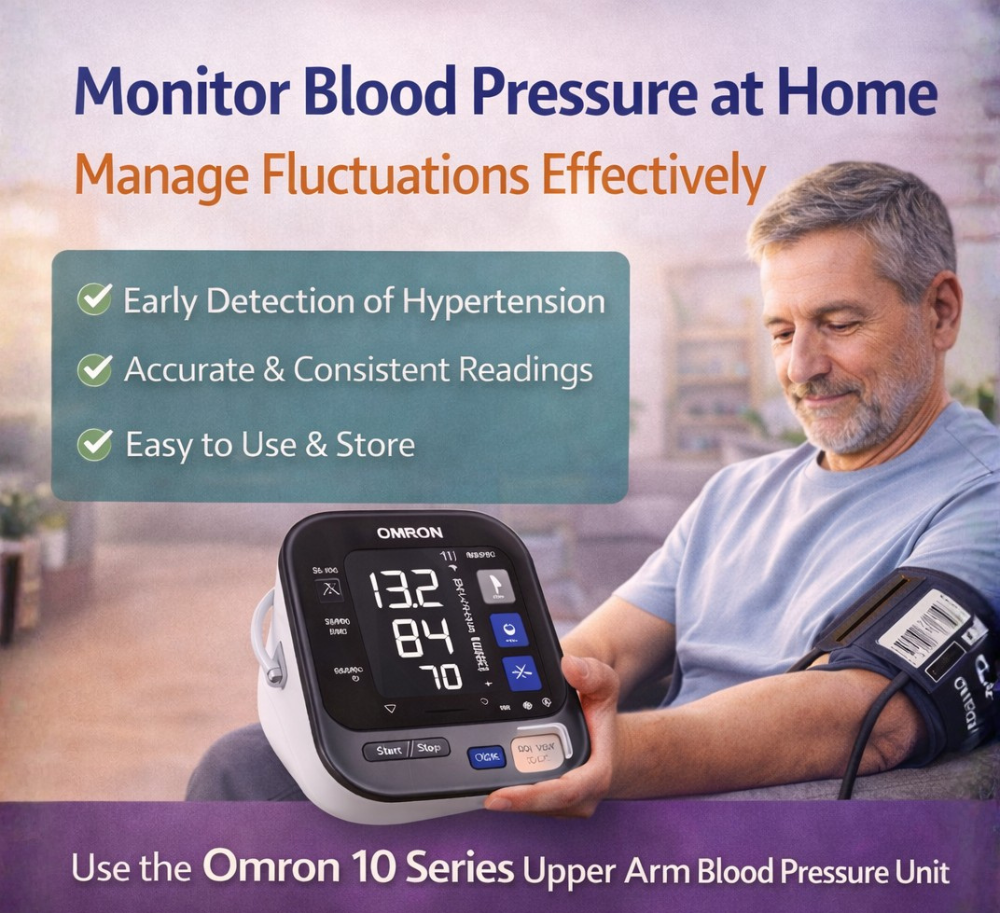
All of the above assumes the device itself is sound and the cuff fits. A cuff that is too small, worn out, or wrapped over clothing will produce variation that has nothing to do with your circulation. If you are unsure whether yours is still fit for purpose, our monitors, meters and tests range includes replacement cuffs as well as complete units, and the choice between wrist and upper-arm styles is covered in our wrist versus upper-arm cuff comparison.
When to contact your clinician
Get in touch if your weekly averages sit above the target you were given, if your readings have changed noticeably since starting a new medicine, if you feel faint or dizzy on standing, or if you are simply unsure what your log is telling you. Bringing a week of dated readings makes that conversation far more productive than describing them from memory.
This article is general information and is not medical advice. Confirm your personal blood pressure target, your measuring schedule, and any medication change with your own doctor, nurse or pharmacist.