The Step Frank Stopped Trusting
Frank is 64, and until last spring he would have told you his knees were fine. Then, coming down the back porch steps with a bag of mulch, his right knee did something it had never done before: it buckled. Not painfully, exactly — it just gave out for a fraction of a second, the way a chair does when one leg is shorter than the others. He caught the rail. Nothing tore. But something changed.
What changed was that Frank stopped trusting the step. Then he stopped trusting stairs generally. Then he started taking them one at a time, leading with the good leg, a hand on the wall. His doctor found mild osteoarthritis and a little laxity from an old college soccer injury — nothing that needed surgery, nothing dramatic. But the confidence was gone, and the confidence was the part that ran his day.
A knee brace gave a lot of that back. Not because it fused his joint or fixed his cartilage — it did neither — but because the right one gave his knee a boundary and his brain a signal: you are held. Within a couple of weeks he was walking the dog on the hill again. His arthritis was exactly the same. His willingness to move was not.
That is the honest promise of a knee brace, and it is worth saying plainly before we get into types and sizes: the brace is a tool, not a cure. It supports, stabilizes, offloads, or reminds — and choosing the right one depends entirely on which of those four jobs your knee actually needs done.
What a Knee Brace Actually Does
Knee braces do four different jobs, and most buying mistakes come from picking a brace built for the wrong one.
- Compression and warmth. A snug sleeve increases warmth and blood flow, calms mild swelling, and improves proprioception — your sense of where the joint is in space. For everyday arthritis ache and general stiffness, this is often all that is needed.
- Mechanical stability. Rigid or hinged braces physically limit side-to-side and front-to-back motion, protecting healing ligaments or a chronically loose knee from moving in ways that hurt or reinjure it.
- Offloading. Specialized unloader braces shift weight away from the worn side of an arthritic knee, reducing bone-on-bone contact in one compartment.
- Immobilization. A straight-leg immobilizer holds the knee still after surgery or an acute injury while tissue heals.
Notice that a brace does not strengthen the muscles around your knee. In fact, over-relying on a rigid brace can let those muscles weaken, which is why clinicians pair bracing with exercise. The brace buys you safe, confident movement; the movement is what actually rebuilds the knee.
The Five Types of Knee Braces
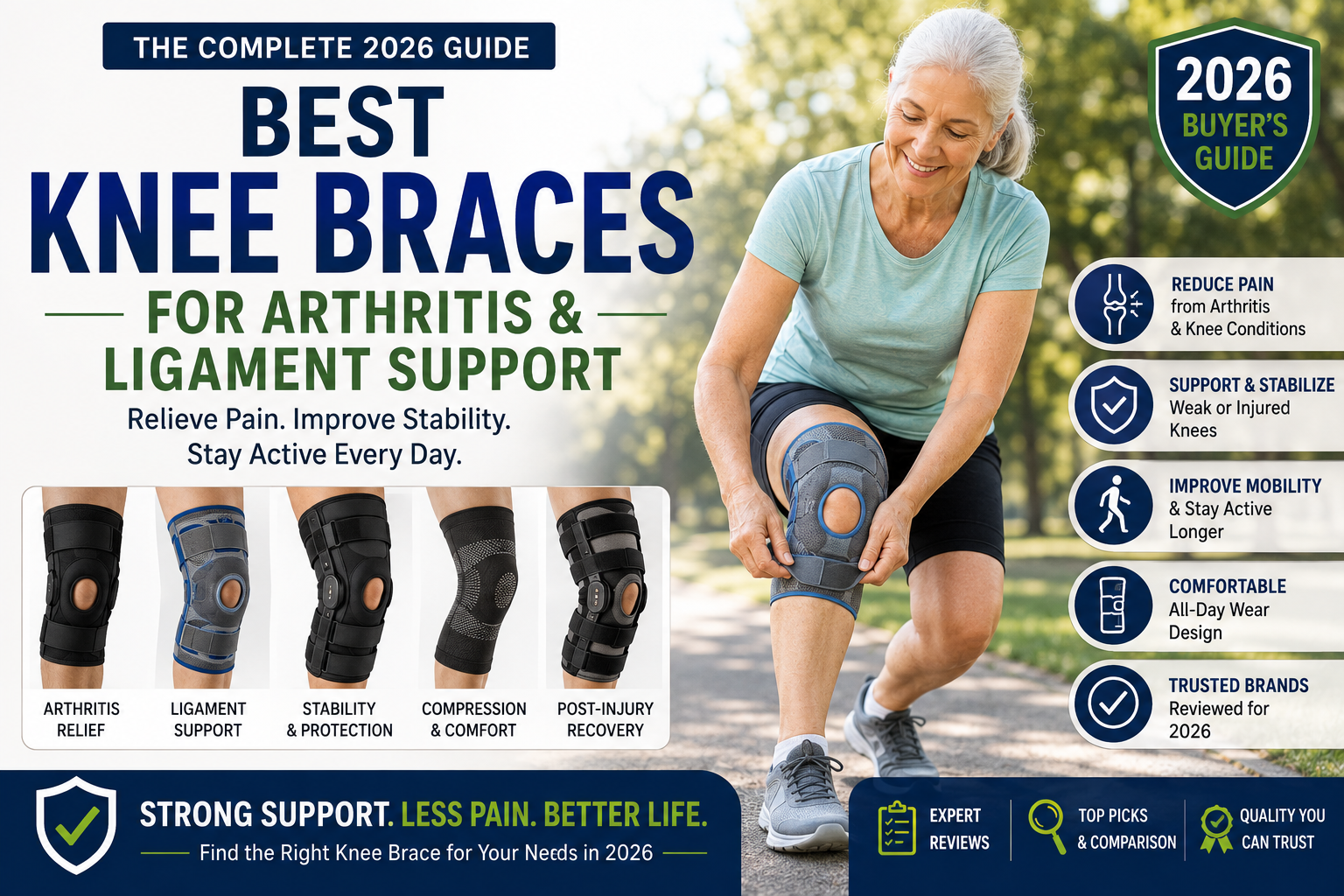
Nearly everything on the market falls into one of five categories. Match the category to your job first, then worry about brand and price.
1. Compression Sleeves
A simple elastic or neoprene tube you pull over the knee. It provides warmth, light compression, and a reassuring sense of support, but no rigid stabilization. Open-patella designs have a hole over the kneecap that reduces pressure and helps tracking; closed-patella designs give even compression across the whole joint.
Best for: mild arthritis, general aches, mild swelling, and confidence during walking or light activity. The Sportaid Neoprene Knee Sleeve with Open Patella (about $27.50) and the cushioned Gel Knee Support Sleeve (about $50.72) are representative. For an economical, widely fitted option with light stabilizers, the Blue Jay Slip-On Knee Support with Open Patella and Stabilizers starts around $25.74.
2. Adjustable Wraps and Straps
Wrap-around supports close with hook-and-loop straps rather than pulling over the foot — a real advantage for anyone with arthritic hands, swelling, or a knee that is painful to bend. Tension is adjustable, and a wrap can be applied while seated. A related sub-type, the patellar strap, is a thin band worn just below the kneecap to ease patellar-tendon pain (jumper's knee).
Best for: adjustable everyday support, fluctuating swelling, limited hand strength, and patellar-tendon pain. The Sportaid Neoprene Knee Wrap with adjustable Velcro straps (about $33.78) is a straightforward example.
3. Hinged Knee Braces
Hinges on one or both sides allow the knee to bend and straighten while blocking the side-to-side and twisting motions that stress ligaments. This is the workhorse category for instability and ligament support, ranging from soft wrap-around hinged braces to rigid framed models. The Gator Wrap Universal Hinged Knee Brace (a best seller at about $53.20) and the Cross-Fit Universal Hinged Knee Brace (about $76.01) offer wrap-on convenience with lateral hinge support, while the Wrap-Around Hinged Knee Brace (from about $52.16) extends the same idea through larger sizes. For kneecap tracking problems, the Min-Knee Hinged Knee Brace with a donut buttress (about $76.01) adds a padded ring that helps hold the patella in its groove.
Best for: ACL, MCL, LCL and PCL support, chronic instability, meniscus protection, and returning to activity after injury.
4. Unloader (Offloader) Braces
These are the specialists. An unloader brace applies a gentle three-point bending force that tilts the knee slightly, opening up the arthritic compartment and shifting load to the healthier side. For someone with osteoarthritis concentrated on one side of the knee (most often the inner, or medial, compartment), a well-fitted unloader can meaningfully reduce pain and delay or avoid surgery. The Cobra 2 Unloader Knee Brace (about $173.64, made in left and right versions) is an example of this category.
Best for: unicompartmental (one-sided) knee osteoarthritis with a clear painful side. Unloaders are most effective when fitted with clinician guidance, because the correction has to match your specific alignment.
5. Knee Immobilizers
A long, straight, padded sleeve with rigid stays that keeps the leg fully extended and prevents bending. It is not for walking rehabilitation — it is for holding the joint still after surgery, a patellar dislocation, or certain fractures and ligament tears. The Universal 3-Panel Knee Immobilizer (24 inch) (about $112.75) is a standard post-injury and post-operative choice.
Best for: short-term immobilization exactly as directed by a surgeon or physician — never as a substitute for a mobility-restoring brace once healing allows movement.
Comparison at a Glance
| Type | Support Level | Best For | Typical Price |
|---|---|---|---|
| Compression sleeve | Light | Mild arthritis, aches, warmth, proprioception | $20–$55 |
| Adjustable wrap / strap | Light to moderate | Adjustable support, swelling, weak hands, jumper's knee | $18–$55 |
| Hinged brace | Moderate to maximum | Ligament injuries, instability, meniscus, return to activity | $50–$150+ |
| Unloader brace | Specialized | One-sided (compartmental) osteoarthritis | $150–$500+ |
| Immobilizer | Maximum (no motion) | Post-surgery, acute injury, dislocation | $80–$150 |
Browse the full range in the braces, splints, and supports collection and the wider orthopedic care collection.
Match the Brace to the Problem
Here is the part most product pages skip. The single most useful thing you can know is which brace goes with which knee problem.
| Your Situation | Usual Brace Choice |
|---|---|
| Mild osteoarthritis, general stiffness | Compression sleeve, open or closed patella |
| One-sided (bone-on-bone) osteoarthritis | Unloader brace |
| ACL / MCL / PCL sprain or post-reconstruction | Hinged brace |
| Meniscus tear (non-surgical or recovery) | Hinged brace or supportive wrap |
| Kneecap pain / poor patellar tracking | Open-patella sleeve or J-buttress brace |
| Patellar-tendon pain (jumper's knee) | Patellar strap |
| The knee gives way / feels unstable | Hinged brace |
| Just had knee surgery or a dislocation | Immobilizer, then a hinged brace as directed |
If your knee is unstable or you are recovering from a ligament or meniscus injury, do not self-prescribe a soft sleeve because it is cheaper and more comfortable — comfort is not the same as protection. And if you are recovering from surgery and using a knee walker or scooter to stay off the leg, coordinate the brace with your surgeon's weight-bearing timeline.
Sizing: The Part That Makes or Breaks It
A knee brace that does not fit does not work — and can do harm. Too loose and it slides down, bunches behind the knee, and offers no real support. Too tight and it cuts circulation, pinches the back of the knee, and can worsen swelling. Most braces are sized by a single measurement, and getting it right takes thirty seconds.
How to Measure
Stand with your weight evenly on both feet, knee slightly bent. Using a flexible tape measure, measure the circumference of your leg around the center of the kneecap, snug but not compressing. Some brands instead ask for a measurement about six inches above the kneecap (mid-thigh) or below it (mid-calf) — always follow the specific brand's chart rather than assuming. If you fall between sizes, and the brace is a pull-on sleeve, size up slightly; if it is an adjustable wrap, either size works because the straps take up the slack.
Open Patella vs Closed Patella
An open-patella design has a cut-out over the kneecap. It relieves pressure on the kneecap, helps tracking, and vents heat — the better default for arthritis and kneecap pain. A closed-patella design covers the whole knee for even compression and warmth, which some people prefer for general aching. Neither is universally better; it depends on where your discomfort sits.
Fit Checklist
- Snug and secure without numbness, tingling, or throbbing.
- Stays put through a few knee bends and a short walk.
- No painful pinching behind the knee when you sit.
- The kneecap opening, if present, is centered over your kneecap.
- Hinges, if present, line up with the natural bend of your joint.
How to Wear It (and the Mistakes to Avoid)
- Skin first. Wear a brace over a thin layer or clean, dry skin. Neoprene over sweat can irritate. If you have sensitive skin, look for a moisture-wicking sleeve underneath.
- Do not wear it around the clock. Unless a clinician tells you otherwise, use a brace for activity and remove it for rest. Continuous compression can cause skin problems and swelling below the brace.
- Do not crank it as tight as it will go. Tighter is not stronger; it is just tighter. You want secure, not tourniquet.
- Keep using the leg. A brace should enable movement and strengthening, not replace it. Ask a physical therapist for quad and hip exercises — strong muscles protect the knee far more than fabric does.
- Watch for slipping. A brace that migrates down the leg is the wrong size or style; a wrap or a silicone-gripped model may fit better.
- Wash it. Hand-wash neoprene and elastic supports and air-dry them; a musty, stretched-out brace supports nothing.
Beyond the Brace: What Actually Helps a Knee
A brace works best as one piece of a larger plan. The things that move the needle most on knee pain are often the least glamorous.
- Heat and cold. Ice calms acute swelling and flare-ups; heat loosens stiff, arthritic joints before activity. A dual kit like the Hot and Cold Knee Therapy Comfort Kit (about $81.99) covers both, and there is a wider selection in the hot and cold therapy collection.
- TENS for pain. A TENS unit (about $117.53) uses gentle electrical stimulation to interrupt pain signals — a drug-free option many people use alongside a brace during flare-ups.
- Strength and weight. Building the quadriceps, hamstrings, and hip muscles offloads the knee, and even modest weight loss dramatically reduces the force through the joint with every step.
- Joint support supplements. Some people find relief with glucosamine, chondroitin, or similar; see the joint health collection and browse broader options for arthritis relief. Check with your pharmacist about interactions.
- Take the load off elsewhere. A cane in the opposite hand, a supportive seat cushion that keeps hips above knees, and good footwear all reduce daily knee strain. See the canes and crutches collection.
When to See a Doctor Instead of Buying a Brace
A brace is a reasonable first move for mild, familiar aches. It is the wrong first move — and a delay that can cost you — when the knee is telling you something more serious is happening. See a clinician promptly if you have any of the following:
- The knee cannot bear weight, or buckles repeatedly.
- It is locked and will not fully straighten or bend.
- Significant swelling that appears within hours of an injury.
- Obvious deformity, or the kneecap looks out of place.
- Redness, heat, and fever — which can signal infection.
- Numbness, severe pain, or a cold, pale foot below the knee.
- Pain that keeps worsening despite rest, ice, and a supportive brace.
A brace supports a knee. It does not diagnose one. Getting the diagnosis right first is what makes the brace the correct tool rather than a way to ignore a problem.
Why Shop Knee Braces and Orthopedic Support at AllCare Store
AllCare Store stocks the full range — compression sleeves, adjustable wraps, patellar straps, soft and rigid hinged braces, unloaders, and immobilizers — across sizes from petite to bariatric, alongside the hot and cold therapy, TENS units, cushions, and canes that round out a knee-care plan. Everything ships free within the U.S. with 30-day returns.
Knee bracing is one of those categories where a quick phone call beats a guess. The difference between a sleeve and a hinged brace is the difference between comfort and protection, and matching the brace to your specific diagnosis and measurements is exactly the kind of thing our team helps with every day. Start with the braces, splints, and supports collection or the orthopedic care collection, and compare related recovery guides like our ankle brace guide and recovery footwear guide.
Frequently Asked Questions
What is the best knee brace for arthritis?
For mild, general arthritis, a compression sleeve — open-patella if your kneecap is tender — usually gives the best balance of warmth, support, and comfort. For arthritis concentrated on one side of the knee (bone-on-bone in one compartment), an unloader brace that shifts weight off the worn side is more effective and is worth fitting with clinician guidance.
Do knee braces actually work?
Yes, for the right job. Braces reliably improve stability, reduce pain during activity, and boost confidence; unloaders can measurably reduce load in an arthritic compartment. What a brace cannot do is heal cartilage, strengthen muscle, or fix an underlying structural problem — so it works best paired with exercise and, where needed, medical treatment.
Can I wear a knee brace all day?
Usually you should not, unless a clinician directs it. Most people wear a brace for standing, walking, and activity, then remove it for rest. All-day compression can irritate skin and cause swelling below the brace, and constant support can let the surrounding muscles weaken.
What is the difference between a knee sleeve and a knee brace?
A sleeve is a soft compression tube that provides warmth and light support but no rigid stabilization. A brace — particularly a hinged one — adds structure that physically limits harmful motion. Sleeves suit mild aches; braces suit instability, ligament injuries, and recovery.
How do I know what size knee brace to buy?
Measure the circumference around the center of your kneecap with a flexible tape, standing with the knee slightly bent, then match it to the specific brand's size chart (some brands measure above or below the kneecap instead). Between sizes, size up for a pull-on sleeve; an adjustable wrap fits either way.
Should a knee brace be open or closed over the kneecap?
Open-patella braces relieve pressure on the kneecap, aid tracking, and vent heat — a good default for arthritis and kneecap pain. Closed-patella braces give even compression and warmth across the whole joint, which some prefer for general aching. Choose based on where your discomfort is.
What knee brace is best for a meniscus tear?
Many people recovering from a meniscus tear do well with a hinged brace or a firm supportive wrap that limits twisting while allowing controlled bending. The right choice depends on the tear and your treatment plan, so confirm with your clinician — especially if surgery is involved.
Will a knee brace help my knee from giving out?
A hinged brace is designed for exactly this. By resisting side-to-side and rotational motion it reduces episodes of the knee buckling and restores confidence. Persistent giving-way, though, is a reason to be evaluated — it often points to ligament laxity or a meniscus issue that has its own treatment.
Can I run or exercise with a knee brace?
Often yes, and many people return to activity sooner with appropriate support. Choose a low-profile hinged brace or a supportive sleeve rated for activity, make sure it does not slip, and increase intensity gradually. If a specific movement causes sharp pain even with the brace on, stop and get it checked.
Do I need a prescription for a knee brace?
Not for most sleeves, wraps, and off-the-shelf hinged braces — you can buy them directly. Custom unloader braces and post-surgical bracing are typically fitted through a clinician, and insurance or Medicare coverage for a brace generally requires a physician's order and documentation.
How long should I wear a knee brace after an injury?
It depends entirely on the injury and your clinician's plan — from a couple of weeks of activity support for a mild strain to several months of graded bracing after ligament reconstruction. Follow the timeline you are given, and taper off as strength and stability return rather than stopping abruptly.
How do I keep my knee brace from sliding down?
Slipping almost always means the size or style is wrong. Try a wrap-around model that straps in place, look for silicone grip bands, make sure the measurement matches the chart, and check that a pull-on sleeve is not stretched out from age. A brace that will not stay put is not supporting anything.
The Takeaway: Support the Knee, Then Rebuild It
A knee brace does not cure arthritis, repair a ligament, or rebuild the muscle a long layoff took away. It does one of four things — compresses, stabilizes, offloads, or immobilizes — and the whole art of choosing one is matching that job to what your knee actually needs. Get the diagnosis first. Measure carefully. Pick the lightest brace that does the job, wear it for activity rather than around the clock, and keep strengthening the leg underneath it.
Done right, a knee brace is not a sign you are giving up on your knee. It is the thing that lets you keep using it — the reason Frank trusts the back steps again.
Not Sure Which Knee Brace You Need? Let's Talk It Through.
AllCare Store carries compression sleeves, adjustable wraps, patellar straps, hinged braces, unloaders, and immobilizers in sizes from petite to bariatric — plus the hot and cold therapy, TENS units, cushions, and canes that complete a knee-care plan. Browse the braces, splints, and supports collection and the orthopedic care collection to compare options.
Call 1-888-889-6260 to talk with a specialist about brace type, sizing, and insurance documentation, or visit AllCareStore.com to browse the full selection. Free U.S. shipping and 30-day returns on every order.
This guide was written and reviewed by the AllCare Store editorial team. It is educational and not a substitute for individualized medical advice. Product availability and pricing change — verify current details on each product page, and consult your physician or physical therapist about the right brace for your knee.
MEDICAL DISCLAIMER: This article is for general information only and is not a substitute for a diagnosis or treatment plan from a physician, orthopedic specialist, or physical therapist. A knee brace supports a joint; it does not identify what is wrong with it. Knee pain, swelling, locking, giving way, or instability can have many different causes, and the right brace for one is the wrong brace for another. Get an accurate diagnosis first, follow the guidance of your clinician on which brace to wear and for how long, and seek prompt medical care for a knee that is grossly swollen, cannot bear weight, is locked, looks deformed, or follows a significant injury. Prices mentioned were current at the time of writing and may change.